E3 Lithium provides progress update for the demonstration facility
E3 LITHIUM LTD., a leader in Canadian lithium, is pleased to provide a progress update on its Demonstration Facility (“Demo Facility”). The Demo Facility is planned to be brought on stream in three phases through the second half of 2025 and into 2026. The lithium extraction equipment comprising of the 30-column Direct Lithium Extraction (DLE) system (the “30-Column System”), as well as the purification and concentration equipment is now fully fabricated and undergoing final checks. The heart of the lithium production equipment is comprised of five separate skids, each containing a specific operation: Skids one and two host the 30-columns and the value control for the DLE system, skids 3 and 4 host the filtration and purification equipment and skid 5 houses the control center. The skids are expected to arrive and be assembled on site in the Clearwater Project area over the next six to eight weeks. E3 Lithium has also received the sorbent for the DLE columns and completed the majority of the payments for this equipment. Following arrival on site, the equipment will be assembled and undergo operational and safety checks, followed by final leak checks. Phase 1 will use brine hosted on site for the commissioning and operation of the 30-column system equipment to produce battery-grade lithium carbonate. It is expected that shortly after the drilling of the wells in Phase 2, the production well will be tied directly into the 30-column equipment and operate using a “live” brine feed. Operation of a fully integrated system will enable E3 Lithium to optimize the process for factors such as recovery and flow rates and will provide important data for use in the design and costing of the commercial facility. The lithium carbonate produced will be used for customer interrogation and to potentially begin pre-qualification. Each phase of the Demo Facility is an important step towards validating the process technology and E3 Lithium’s ability to produce battery-grade lithium carbonate from Leduc Brines at scale. The key objective of the Demo Facility is to de-risk the project design for E3 Lithium’s full commercial scale Clearwater Project as the Company progresses towards completion of the Feasibility Study and securing of project financing. “The team is very excited to see the equipment arrive on site,” commented E3 Lithium’s CEO, Chris Doornbos. “The Demo Facility will be one of the few systems of this kind globally to operate at this scale. It is a significant achievement for E3 Lithium to turn this design into a reality, and a major step forward to see it operate in the very near future.” Preparation for Phase 3 will increase as the first phase begins field operations and is expected to be installed in early 2026. businesswire.com
Spain launches €700 million support scheme for energy storage

It is open to standalone battery energy storage system (BESS) projects, thermal energy storage projects and pumped hydro energy storage (PHES) projects as well as those that are hybridised with renewable generation facilities. Eligible costs include civil works, storage systems, auxiliary equipment and systems and related expenses. The Ministry of Environment – full name the Ministry for Ecological Transition and the Demographic Challenge (MITECO) – has given applicants until 15 July, 2025, to apply. The Institute for Energy Diversification and Saving (IDAE), part of MITECO, will manage the subsidy scheme, and is running a webinar on 5 June to go through the details. MITECO will distribute the funding across the 17 regions (and the two autonomous cities of Ceuta and Melilla). Nearly half of the financial support will be allocated to the southern region of Andalusia, with €311 million, followed by the northwestern region of Galicia with €86 million and the central region of Castilla-La Mancha with €80 million. The projects will make the energy system in Spain more flexible, robust, and resilient, MITECO said. Spain and Portugal recently suffered a huge blackout. Industry commentators have speculated that more energy storage, particularly grid-forming energy storage would have helped, although it is too early to be certain. A maximum subsidy amount has been set based on different technologies: €250 per kWh for BESS €300 per kWh for grid-forming BESS €300 per kWh for thermal energy storage €1,500 per kW (kilowatt) for new PHES projects €1,000 per kW for existing PHES projects Projects will need to be built within 36 months of being granted the aid, with a final commercial operation date no later than 31 December, 2029. Spain is targeting around 22.5GW of energy storage by 2030 as part of its National Energy and Climate Plan (NECP). But, it has been relatively slower to deploy grid-scale energy storage than other major EU economies including Italy, France, Germany, Belgium, Netherlands and the Nordics. However, some 1GWh is under construction according to a Sungrow executive, who discussed Spain with us in a recent interview (Premium).
Ford Recalls 30,000 F-150 Lightning EVs Over Suspension Nut That Could Go Missing
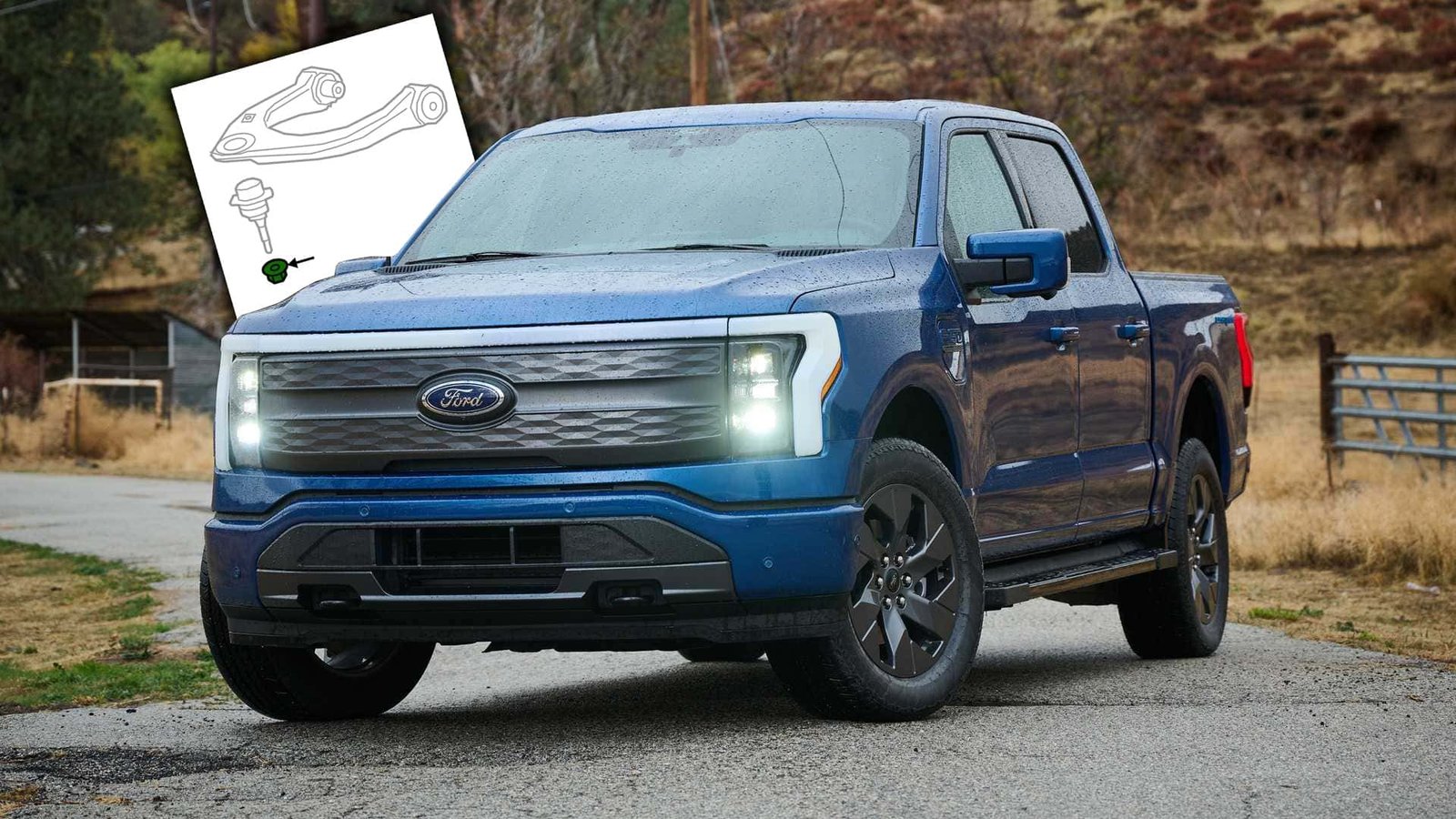
Nearly 30,000 Ford F-150 Lightning EVs are being recalled. The nut on the ball joint that secures the upper control arm to the knuckle might not have been torqued correctly. If the nut has fallen off, the knuckle could separate from the upper control arm. Ford is recalling nearly 30,000 F-150 Lightning electric pickup trucks sold in the United States because a suspension nut might be loose or missing. In total, 29,501 units built between February 15, 2024, and April 14, 2025, are affected by this recall. According to Ford, certain vehicles from this period may have an improperly torqued nut on the ball joint that secures the front upper control arm to the knuckle assembly. The majority of potentially affected trucks, 20,528, are 2024 model year cars, while the remaining 8,973 are 2025 model year vehicles. The green nut might not have been torqued properly, increasing the risk of separation. Photo by: Ford If the ball joint nut is loose or missing, the driver might hear clunks or rattles over bumps, and the vehicle might also vibrate while driving. Ford says the nut might not have been torqued properly during the assembly process “due to variation in the alignment or orientation between the fastening tool and the fastener that may have induced lateral forces on the tool, preventing it from properly seating on the fastener.” Ford is aware of a single field report related to this issue, dated March 6, 2025. An owner of a 2024 F-150 Lightning, who had driven the truck just 634 miles after taking delivery, reported experiencing a right front wheel failure. The EV was towed to a dealership, where a service technician saw that the control arm had detached from the knuckle because the ball joint nut was missing. The automaker improved the design of the factory tooling on April 14, so trucks built after this date are not part of this recall. To fix the issue for existing cars, Ford and Lincoln dealers will inspect the torque of the left and right upper control arm ball joint nut. If the inspection passes, technicians will replace the nut. If the inspection fails, the knuckle and nut will be replaced. The Ford F-150 Lightning is currently the best-selling electric pickup in the United States. In the first quarter of this year, Ford sold 7,187 F-150 Lightnings in the U.S., narrowly beating the Tesla Cybertruck, which was America’s best-selling battery-powered truck last year. 5 Source: Ford
बोली में ऊर्जा भंडारण की लागत 10.18 रुपये प्रति किलोवाट घंटा हुई- विद्युत मंत्रालय
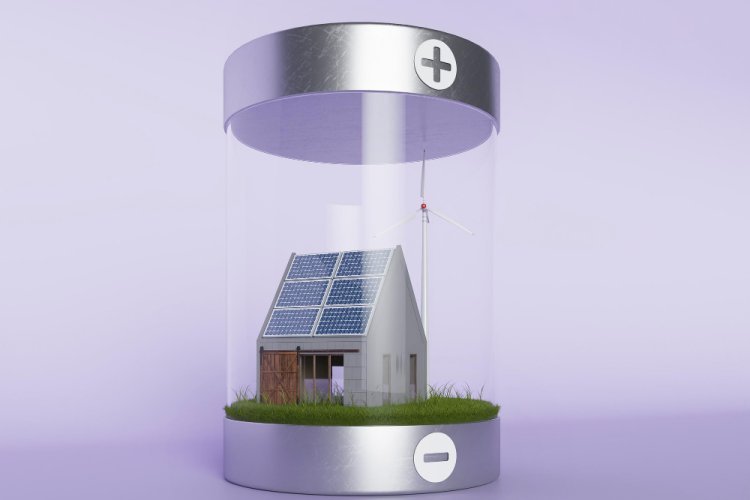
बैटरी ऊर्जा भंडारण के लिए वीजीएफ और पीएलआई से भंडारण की लागत कम होने की उम्मीद: केंद्रीय ऊर्जा और नवीन एवं अक्षय ऊर्जा मंत्री केंद्रीय ऊर्जा और नवीन एवं अक्षय ऊर्जा मंत्री ने सूचित किया है कि भारतीय सौर ऊर्जा निगम (एसईसीआई) द्वारा 500 एमडब्ल्यू/1000 एमडब्ल्यूएच बैटरी ऊर्जा भंडारण प्रणाली (बीईएसएस) की स्थापना के लिए टैरिफ-आधारित प्रतिस्पर्धी बोली में क्षमता शुल्क 10.83 लाख रुपये/मेगावाट/महीना यानी लगभग 10.18 रुपये/केडब्ल्यूएच तय हुई है। बैटरी भंडारण को किफायती बनाने के लिए सरकार ने 4,000 एमडब्ल्यूएच क्षमता वाली बीईएसएस की स्थापना के लिए एक व्यवहार्यता अंतर वित्तपोषण योजना को मंजूरी दी है। इस योजना में बीईएसएस के लिए पूंजीगत लागत के 40% तक वीजीएफ का प्रावधान है, जिससे बिजली की लागत कम हो जाएगी। इसके अलावा, भारी उद्योग मंत्रालय (एमएचआई) ने जून, 2021 में 50 जीडब्ल्यूएच क्षमता की एडवांस्ड केमिस्ट्री सेल (एसीसी) बैटरी भंडारण के निर्माण के लिए प्रोडक्शन-लिंक्ड इंसेंटिव (पीएलआई) योजना शुरू की है। इसमें 10 जीडब्ल्यूएच से अधिक ग्रिड-स्केल बैटरी भंडारण शामिल हैं। 50 जीडब्ल्यूएच क्षमता में से 30 जीडब्ल्यूएच क्षमता प्रतिस्पर्धी बोली प्रक्रिया के माध्यम से पहले ही आवंटित की जा चुकी है। पीएलआई-एसीसी योजना का परिव्यय 18,100 करोड़ रुपये है। पीएलआई योजना ग्रिड-स्केल अनुप्रयोगों के लिए सेल के घरेलू विनिर्माण में निवेश को प्रोत्साहित करेगी, यह आयात पर निर्भरता कम करेगी और नतीजतन भविष्य में बीईएसएस की लागत में कमी आएगी। यह जानकारी केंद्रीय ऊर्जा और नवीन एवं अक्षय ऊर्जा मंत्री श्री आर. के. सिंह ने आज 12 दिसंबर, 2023 को राज्यसभा में एक प्रश्न के लिखित उत्तर में दी है। 12 DEC 2023 6:26PM by PIB Delhi
BYD begins pre-sales of new electric sedan Seal 06 EV, launch set for later this month
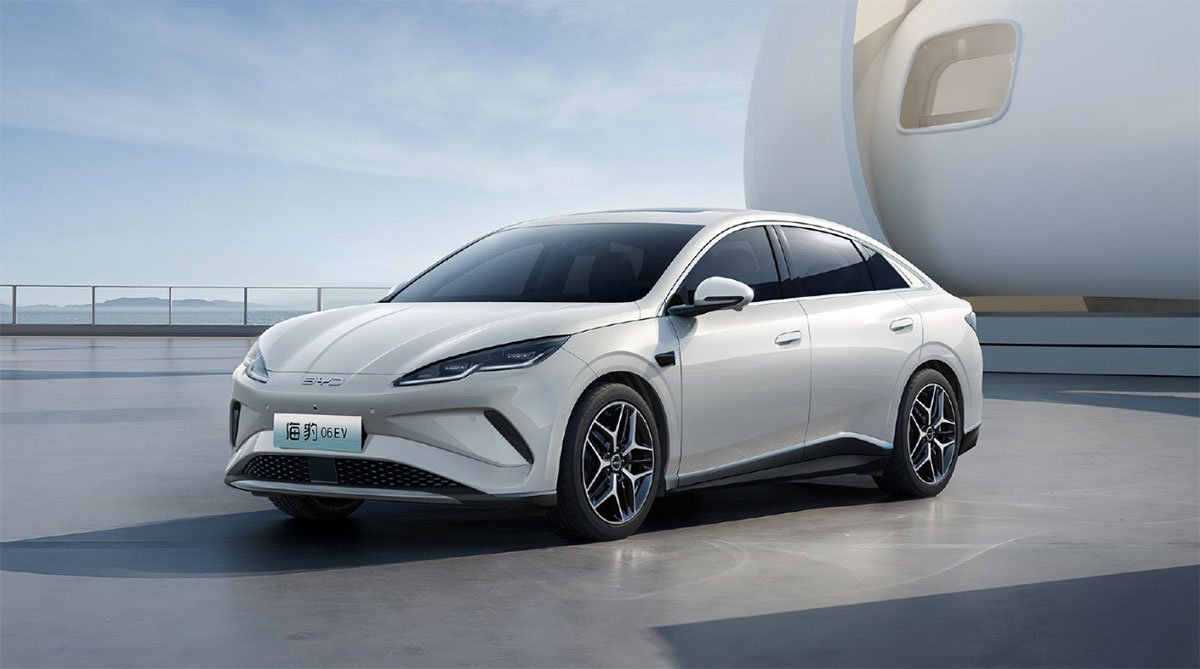
The pre-sales price range for the BYD Seal 06 EV is RMB 120,000 ($16,670) to RMB 150,000. The Seal family sold 26,051 units in April, up 82.57 percent year-on-year but down 41.54 percent from March. (BYD Seal 06 EV. Image credit: BYD) BYD (HKG: 1211, OTCMKTS: BYDDY) has launched the pre-sales of its new all-electric sedan model, the Seal 06 EV, as the Seal family is set to welcome a new member. The company announced the start of pre-sales for the Seal 06 EV on the first day of the Guangdong-Hong Kong-Macao Greater Bay Area International Auto Show, or the 2025 Shenzhen auto show, yesterday. The electric sedan's pre-sales price range is RMB 120,000 ($16,670) to RMB 150,000, with an expected official launch in the second quarter, or later this month. The Seal 06 EV made its debut at the 2025 Shanghai auto show in April, continuing BYD's Seal family design language. It is a pure electric mid-size sedan with dimensions of 4,720 mm in length, 1,880 mm in width, and 1,495 mm in height, with a wheelbase of 2,820 mm, according to a regulatory filing in February. All Seal 06 EV models filed by BYD are single-motor variants, with maximum motor power of 110 kW and 160 kW, supporting top speeds of 160 km/h and 180 km/h, respectively. The Seal originally began as an electric sedan but has since expanded into a family of multiple sedan models. The Seal family currently includes the hybrid Seal 05 DM-i, hybrid Seal 06 DM-i, hybrid Seal 07 DM-i, all-electric Seal 06 GT, and all-electric Seal sedan, with starting price ranges from RMB 79,800 to RMB 239,800. BYD sold 380,089 new energy vehicles (NEVs) in April, a year-on-year increase of 21.34 percent and a month-on-month increase of 0.71 percent. The Seal family sold 26,051 units in April, marking a year-on-year increase of 82.57 percent, but a month-on-month decrease of 41.54 percent. BYD is expected to announce its May NEV sales figures later today. ($1 = RMB 7.1998) "In China, we see intense competition and Tesla is no longer seen as the technology leader."
China’s Rept Battero, Korea’s Hyosung Heavy Industries sign 2.5GWh energy storage supply agreement
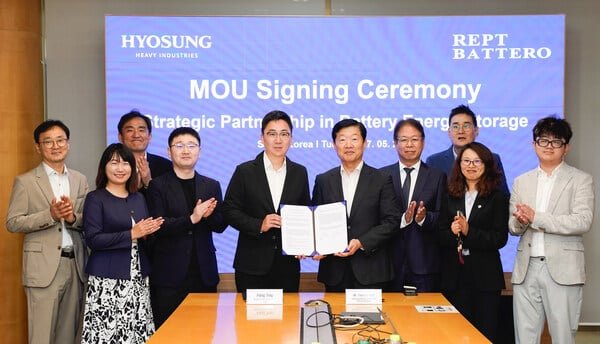
China’s Rept Battero, Korea’s Hyosung Heavy Industries sign 2.5GWh energy storage supply agreement - Energy-Storage.News Skip to content
Toyota Plots Massive EV Push With 7 New Models For The U.S.: ‘Won’t Give Up’
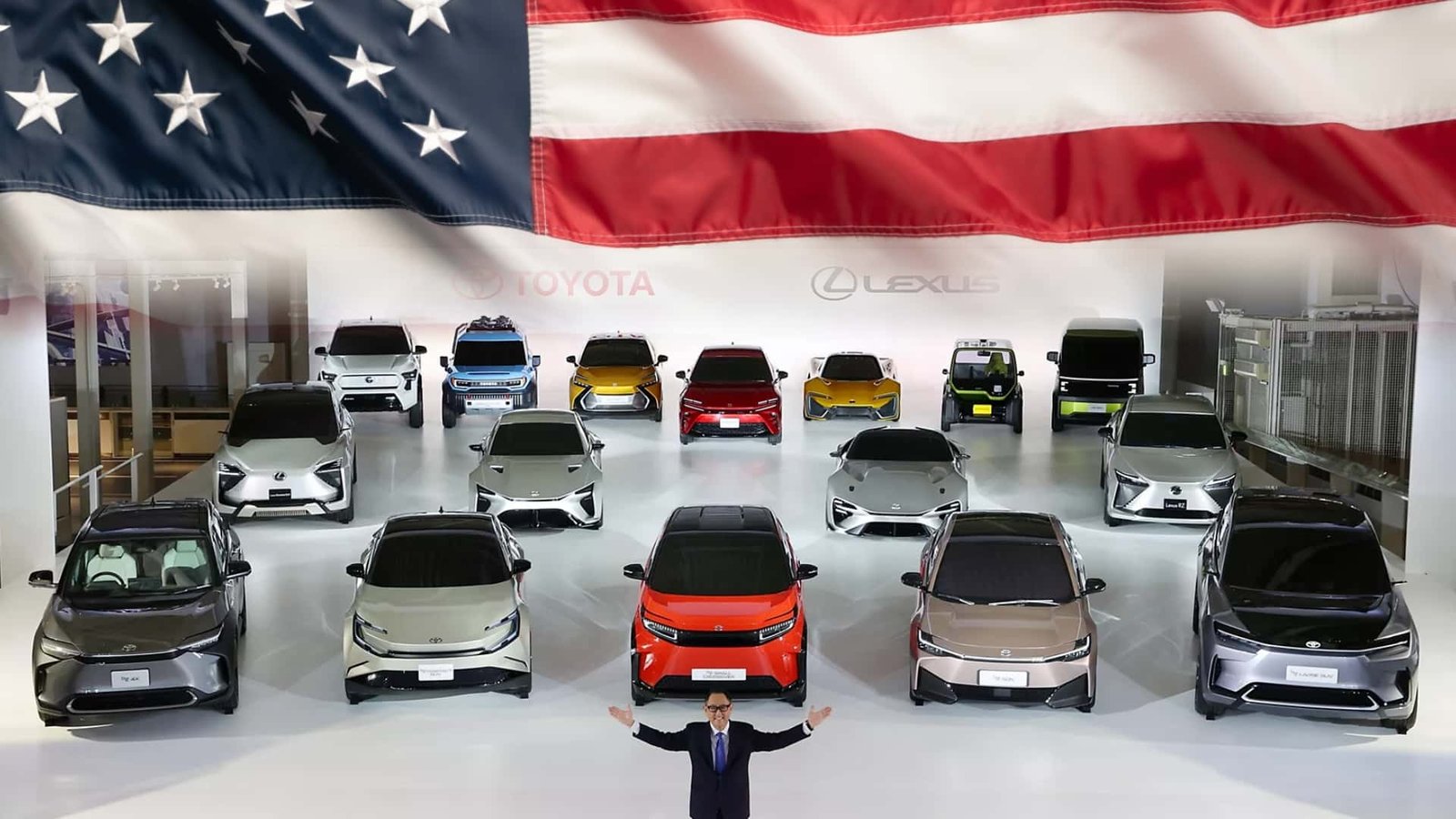
Toyota and Lexus revealed five new electric cars for the U.S. last week, some of which will go on sale in the fall and the others by early next year. Two additional EVs are in the pipeline for the American market. They will be U.S.-made and use locally sourced batteries. The automaker said it doesn't want to "give up" to competition and sees EV sales growth on the horizon. Toyota’s two bestsellers, the Camry and the RAV4, are going hybrid-only. Every trim of both models will now include an electric motor and a lithium-ion battery, easing the load on the gas engine and cutting emissions, without changing how owners road-trip or refuel. But that’s just the start of a broader electrification push as it prepares to launch multiple fully electric models over the next couple of years. Toyota is gearing up to launch seven new fully electric vehicles in the U.S. by 2027, Bloomberg reported Thursday. I saw five of them last week at the company’s North American HQ in Plano, Texas. The lineup includes the refreshed bZ (already reviewed on InsideEVs), the new C-HR, the larger all-terrain bZ Woodland, and two Lexus models: the updated RZ and the all-new ES sedan. The sixth and seventh models are under wraps for now. But at least one of them is rumored to be a long-awaited three-row electric SUV, which could also be the production version of the 2021 “bZ Large SUV” concept. But the five models I saw show real promise. The updated bZ now gets over 300 miles of range, stronger performance and more features which could help Toyota drive more volumes. It can even play the same role as the Equinox does for Chevy—assuming it’s priced competitively. And on the luxury side, the refreshed Lexus RZ could serve a similar role to Cadillac’s Lyriq—a stylish, premium EV getting more upmarket buyers into EVs. Notably, two of the seven EVs will be built in the U.S., likely with locally produced batteries from Toyota’s North Carolina plant. The first is expected to be that three-row SUV; the second is a mystery, for now. But by 2027, when you walk into a Toyota or Lexus dealership, you’ll find a fully electric option in every major segment. That’s part of Toyota’s so-called “multi-pathway approach”: offering gas, hybrid, plug-in hybrid and EV options so customers can pick the powertrain that they think works best for them. Building two mass-market EVs in the U.S. is a bold bet, especially in today’s political and regulatory climate. The Trump camp wants to roll back EV tax credits and weaken emissions targets, casting a shadow over the already tough economics of EV manufacturing. Outside of Tesla, no automaker has turned a profit on EVs in the U.S., and this remains one of the most capital-intensive bets in the industry. Still, Toyota is pushing ahead. That likely means the company sees real growth on the horizon. Toyota typically doesn’t commit a new model to production unless it expects to sell 100,000 to 150,000 units a year. But in this case, if its EV sales fall short, it’ll export the vehicles to markets where demand is strong. “In the future, we think it’s a really important segment that we don’t want to give up to the competition,” Cooper Ericksen, Toyota’s senior vice president of planning and strategy, told Bloomberg. Competition is indeed growing and Toyota doesn’t want to be left behind. Tesla still commands nearly half the U.S. EV market and has cheaper models coming soon. General Motors, Hyundai, and Kia are all expanding their EV lineups, especially in the crossover and large family SUV segments Americans love. Toyota doesn’t seem keen to let them run away with it. Have a tip? Contact the author: suvrat.kothari@insideevs.com
Battery swapping won't work in India: Ather CEO

The electric two-wheeler startup stumbled upon operational challenges while testing out some prototypes. According to Tarun Mehta, founder and CEO of Ather Energy, battery conversion, as opposed to EV charging, is unlikely to succeed in India with the added cost of infrastructure, labor and other batteries. The two-wheel electric starter ran into operational issues while testing some of its models. While building the model, we encountered many challenges that were not present during the conceptual phase. The first problem we encountered was the weight of the battery. Lifting the 10 kg battery is manual. Change is not easy for adults. Be sure to push gently without falling. Mehta told Fortune India: Battery switching, the transfer of a discharged battery to a charged battery, is used in two- and three-wheeled electric vehicles. Traditionally, Indians expect more support and assistance and may not be willing to deal with dangerous batteries, Mehta said. If a company sends volunteers to replace batteries, it will only be economically viable if they put 200 batteries in the replacement station. And it takes up more space, half the size of a gas pump. Then the cost of the infrastructure suddenly increased. Mehta explains. Also, he estimates the cost of attendants and security to maintain the expensive lithium-ion batteries that support replacement at ₹500-600 per customer per month. For every 100 scooters, 30 more batteries are needed. Such costs must be recovered from the buyer. he said Adding the cost of infrastructure, people, security, and other batteries, the average cost for a customer traveling more than 1,500 km per month is about ₹ 2.8 per km, which is more than the cost of replacing petrol ( ₹2.5 per km). CEO Ather said: In addition to cost and management issues, there are other considerations. Consumers who just bought a new scooter may not want to replace their new three-year-old battery at a replacement station, Mehta said, along with Ather co-founder Swapnil Jain, who filed India's first battery-switching patent. And I am a strong supporter of transfers, even of party members who may not agree with the idea of transfers. While I've always been a fan of battery replacement, I took a different turn when this EV was built. Mehta agrees. Recently, several battery transfer stations targeting B2B chargers have arrived in India. Considering the battery replacement and widespread adoption of electric vehicles in the country, NITI Aayog, a government and public policy think tank, is holding discussions with stakeholders. However, the ecosystem remains complex because it includes many technologies that are still evolving. NITI Aayog, Bureau of Indian Standards, Ministry of Science and Technology and other agencies are conducting further deliberations on the draft policy to come up with a battery replacement policy that encourages electric vehicles and does not affect the technology of the i hate When it comes to comparing batteries, Mehta believes the industry needs to find its own way. If the switch is coming, you need to calibrate the batteries. But before you start deciding on batteries, there may be a new chemistry or style that is cheaper and has a better life. Mehta says: If you know for sure that the innovation will be very slow, you can benchmark it.
Nissan sees initial success in China's EV market, as N7 sedan secures 17,215 orders in 1 month
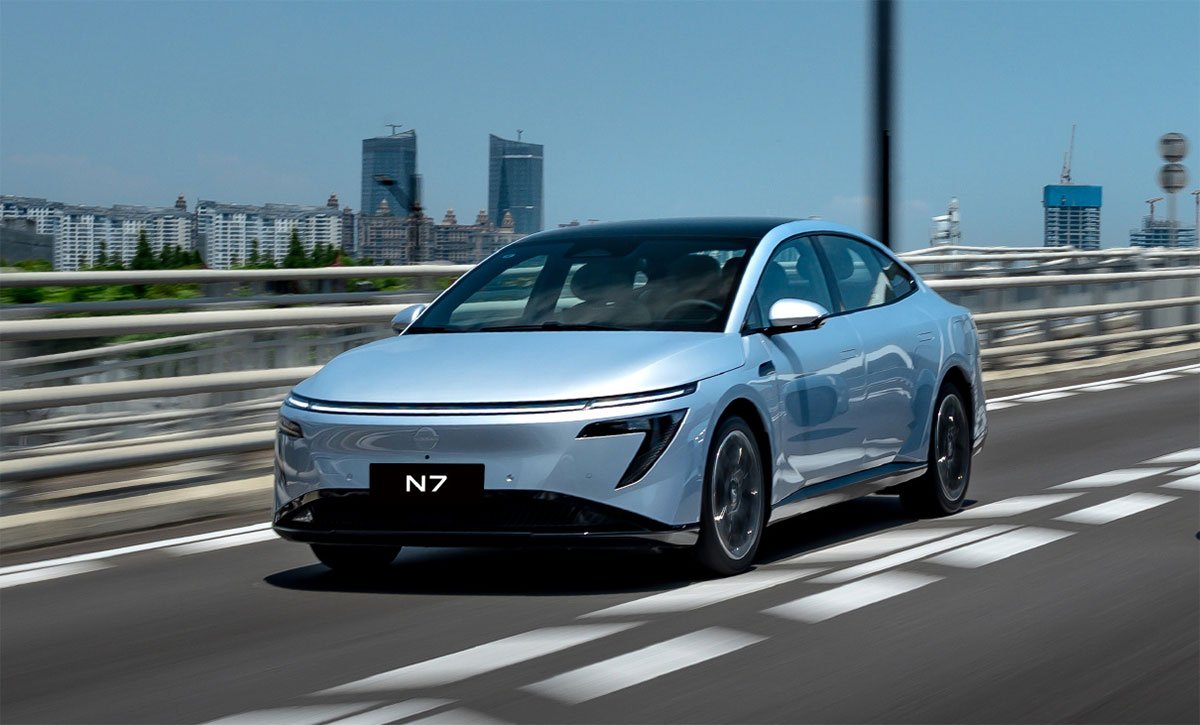
Dongfeng Nissan's N7 has received 17,215 firm orders, 35 days after the model's launch. The N7's starting price is just RMB 119,900 ($16,650), marking one of the major comebacks by joint-venture automakers in China. (Image credit: Dongfeng Nissan) Nissan's joint venture in China, Dongfeng Nissan, has become one of the few major joint-venture automakers in China to see success with a new model, as the N7 pure electric sedan has gained popularity. As of May 31, the Dongfeng Nissan N7 had accumulated 17,215 firm orders, 35 days after the model's launch, the company announced today on Weibo. In China, firm orders typically refer to orders that have paid a non-refundable deposit, although some automakers offer a few days' grace period allowing consumers to refund. Among these orders, 13,746 units, or 96.64 percent, have locked in vehicle configurations, according to backend order data shown by a Dongfeng Nissan executive in a video circulating on Chinese social media platforms. Dongfeng Nissan launched the N7 on April 27, offering five variants -- 510 Air, 510 Pro, 625 Pro, 510 Max, and 625 Max-- with starting prices of RMB 119,900 ($16,650), RMB 129,900, RMB 139,900, RMB 139,900, and RMB 149,900, respectively. This unexpectedly low price is seen as one of the major comebacks by joint-venture automakers in China in recent years. The N7 is built on Dongfeng Nissan's Tianyan architecture, with dimensions of 4,930 mm in length, 1,895 mm in width, and 1,484 mm in height, and a wheelbase of 2,915 mm. The N7's 510-km range variants are equipped with a 58 kWh lithium iron phosphate (LFP) battery pack, while the two 625-km range variants feature a 73 kWh LFP battery pack. All five variants support 3C fast charging, enabling a charge from 10 percent to 80 percent in 19 minutes. They also support external power output, with a maximum power of 6.6 kW. All variants of the N7 are single-motor front-wheel-drive models, unlike the currently mainstream single-motor EVs that are rear-wheel-drive models. The N7 is the first model designed and developed by a Chinese team and is also a globally oriented model. Its exterior design aligns with the preferences of China's mainstream consumers, which is one of the most important factors for the success of a new model in China. Over the past few years, as China's electrification process has accelerated, domestic brands have risen, while joint-venture brands have fallen behind. The launch of the N7 represents a major comeback by Japanese automotive brands as they face marginalization in China's EV market. ($1 = RMB 7.1998) China's smart NEV market has been dominated by local brands, but global auto brands have caught up, said Deutsche Bank.
3.4GWh of BESS submitted to Australia’s EPBC Act
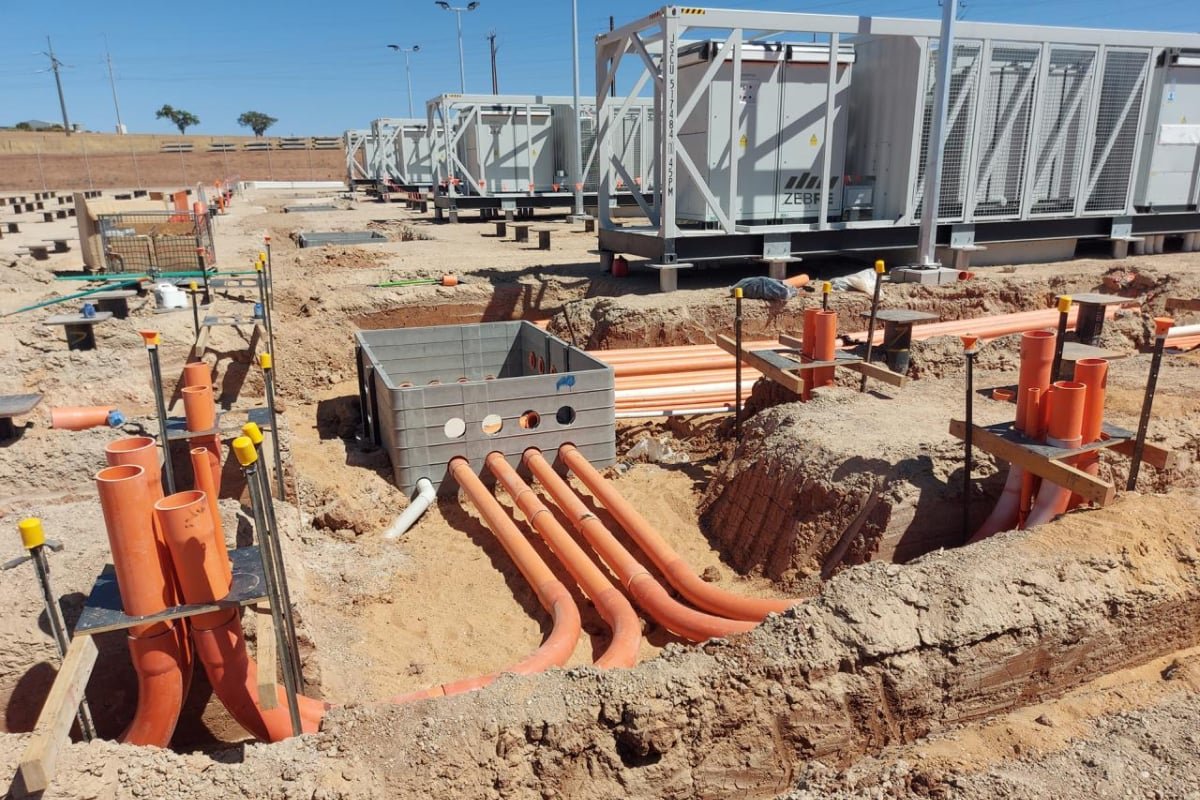
3.4GWh of BESS submitted to Australia’s EPBC Act - Energy-Storage.News Skip to content
Tesla's Robotaxis Are Finally Testing Without A Safety Driver: Musk
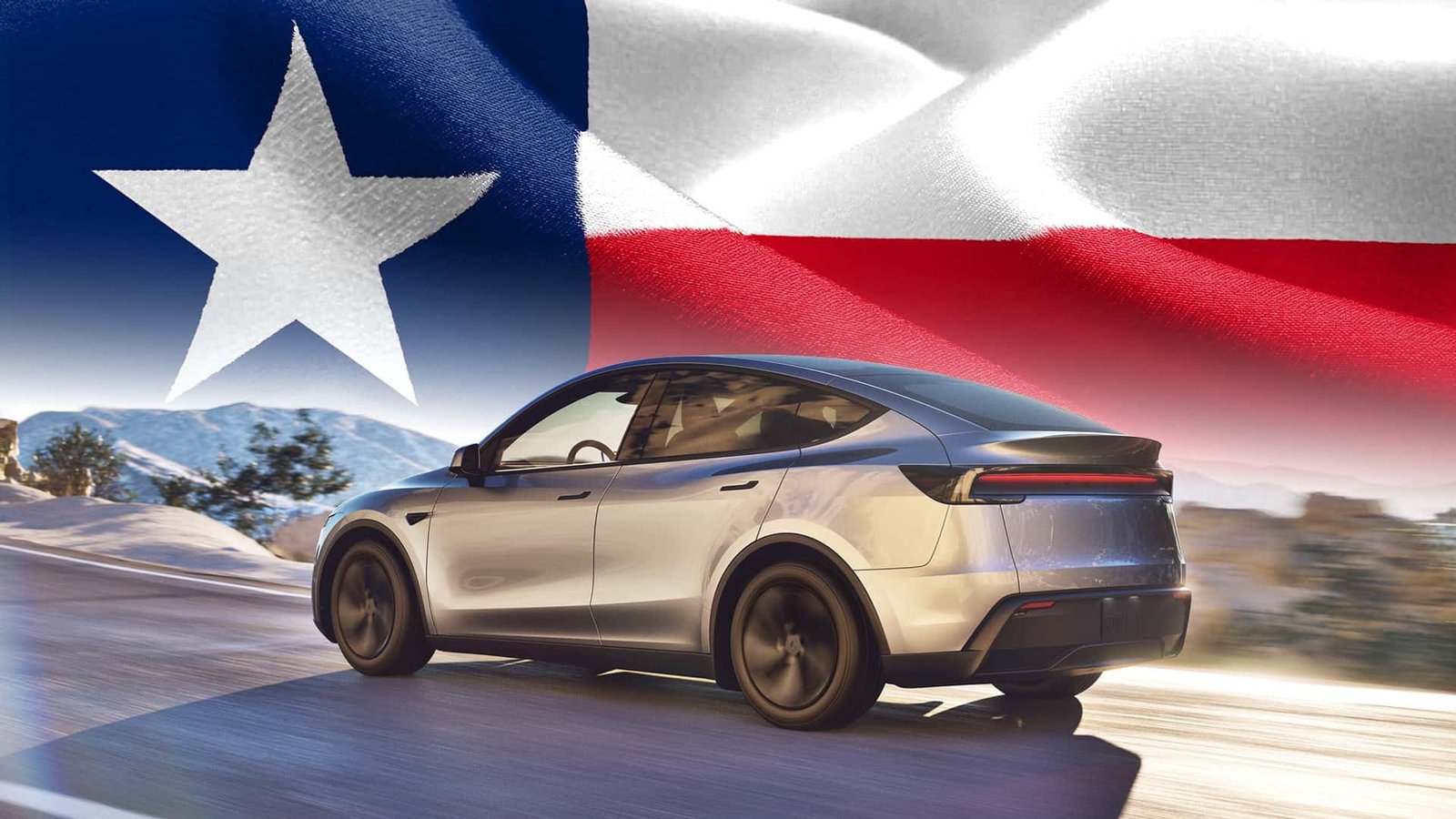
Tesla is planning to launch its robotaxi service in June. The automaker has been testing a small fleet of driverless Model Ys ahead of the launch. CEO Elon Musk says that the company has had no incidents during its testing so far. If you've driven through Austin, Texas in the past two years, you've probably seen those driverless Waymos roaming the streets. They'll soon have some new competition in town. Tesla has promised to unleash a fleet of driverless Cybercabs very soon, and testing may already be underway. According to the CEO, the automaker has been testing its Model Y robotaxis—with no safety drivers—for "several days. Tesla promised to launch its robotaxi service in June earlier this year, so it should come as no surprise that the automaker is working on the last steps needed to ready its fleet for the roads. Musk says that this particular round of testing began about "a month ahead of schedule," which backs up rumors that the pilot service is planned for a mid-June launch (recent reports suggest June 12th is the magic day). Keep in mind that ahead of schedule is still behind the original promise of a million robotaxis on the road by the end of 2020, and several other related unfulfilled promises since. The company plans to do a slow roll out. Tesla says that it plans to geofence the cars to the "safest" parts of Austin, with only approved riders, which represents a major shift for the automaker's typical silicon valley approach of move fast and break things. I guess when more liability is involved and there's nobody behind the wheel to take the blame when something goes wrong, safety becomes a bigger priority. Tesla is expected to gradually roll out its service with a small number of Model Ys owned by Tesla—likely somewhere between 10 and 12 vehicles. Musk has previously said that he believes the program "will probably be at 1,000 [cars] within a few months." Meanwhile, the company is working to hire a small army of human teleoperators responsible for monitoring the fleet should something go awry or the car become confused. Federal regulators are seemingly in the dark to all of this. Earlier this month, the National Highway Traffic Safety Administration sent Tesla a lengthy list of questions to answer about the services it plans to offer in Austin and beyond. Critics are already to jump at Tesla's first mistake. After all, the automaker has been promising a fully autonomous cross-country drive for the better part of a decade and has yet to deliver, all while its CEO called lidar—the headwind behind the success of Waymo's tech stack—a crutch. Hopefully Tesla's trial comes out of its testing with no major issues, but if Cruise taught the world anything, it's that an automaker can spend $10 billion on a self-driving arm only to shutter it over difficulties instead of scaling it up. But with the company's future riding on it, that may not be an option for Tesla.
Govt. approves VGF for development of BESS with capacity of 4,000 MWh
At least 85% of power from VGF-funded BESS projects to be first offered to Discoms The Union Minister for Power and New & Renewable Energy R K Singh has informed that the Government has approved the scheme for Viability Gap Funding (VGF) for the development of Battery Energy Storage Systems (BESS) with a capacity of 4,000 megawatts hours (MWh).Under the scheme, VGF to the extent of up to 40% of capital cost for BESS shall be provided by the Central Government. Public and private sector entities shall be selected through the bidding process to be conducted by the Implementing Agency(ies) as per the provisions of the Scheme and Bidding Guidelines for the development of BESS.The projects under the scheme will be approved during a period of 3 years (2023-24 to 2025-26) and for passing on the scheme to consumers of the Discoms, at least 85% of the power from VGF-funded BESS projects shall be first offered to Discoms before making it available for others.The selection of developers under the VGF scheme has not commenced yet.
Nio delivers 23,231 cars in May, up 13% year-on-year
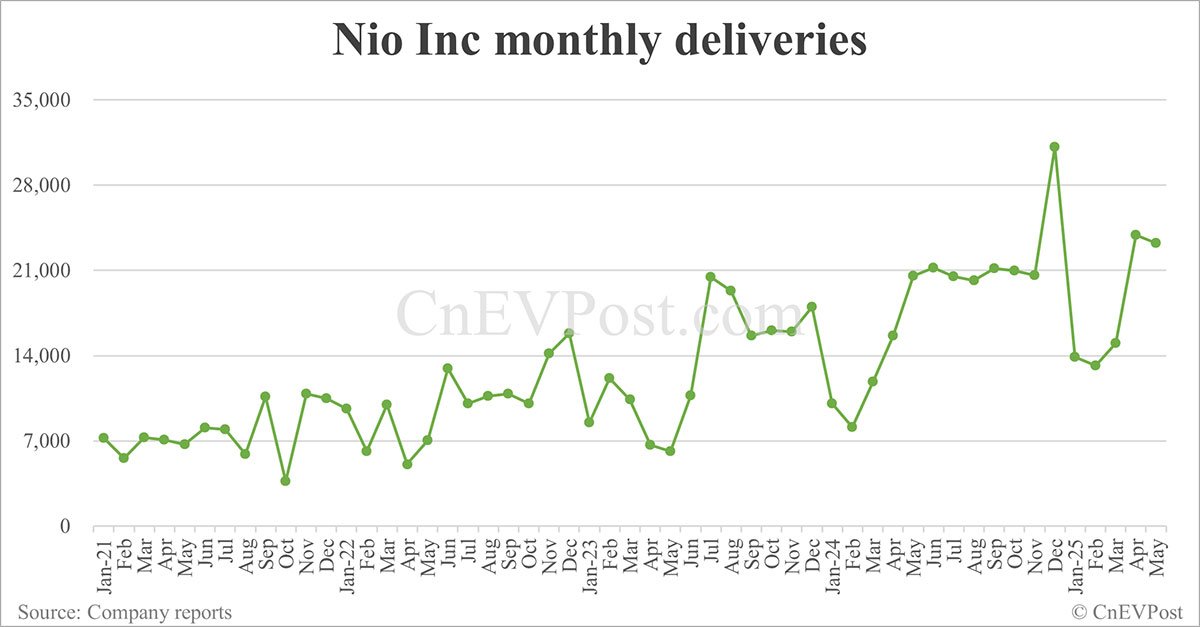
The Nio main brand delivered 13,270 cars in May, Onvo 6,281, and Firefly 3,680. From January to May, Nio Inc delivered 89,225 vehicles, a year-on-year increase of 34.75 percent. Nio Inc (NYSE: NIO) saw a year-on-year increase in deliveries last month, primarily driven by its sub-brands Onvo and Firefly. The Chinese electric vehicle (EV) maker delivered 23,231 vehicles in May, up 13.08 percent from 20,544 in the same month last year, but down 2.80 percent from 23,900 in April, according to data released today. The Nio main brand delivered 13,270 vehicles in May, down 35.41 percent year-on-year and down 31.13 percent month-on-month. Onvo delivered 6,281 vehicles in May, up 42.75 percent from April. Firefly delivered 3,680 vehicles in May. This was the first full month of deliveries for the Nio sub-brand. In the first five months of the year, Nio Inc delivered 89,225 vehicles, up 34.75 percent year-on-year. The Nio main brand delivered 59,852 vehicles from January to May, a year-on-year decrease of 9.61 percent. Onvo delivered 25,462 vehicles from January to May. Firefly has cumulatively delivered 3,911 vehicles since it began deliveries at the end of April. As of the end of May, Nio Inc's cumulative deliveries totaled 760,789 vehicles, including 710,655 from the Nio main brand, 46,223 from Onvo, and 3,911 from Firefly. The Nio brand completed updates of its main models in May, which may have had some negative impact on delivery volumes. On May 16, it launched the updated ES6 SUV (sport utility vehicle) and EC6 coupe SUV, with prices remaining unchanged but featuring significant feature upgrades. Deliveries for these two models began on May 20. On May 25, Nio launched the updated ET5 sedan and ET5T wagon, also with unchanged starting prices but with feature upgrades. Deliveries for these two models began on May 27. These four models are Nio's best-selling, with a combined total of 180,038 units delivered in 2024, contributing 81.11 percent of Nio Inc's 221,970 units delivered last year and 89.48 percent of Nio brand's 201,209 units delivered. Among these, the ES6 is the single most important model, with 75,433 units delivered in 2024, accounting for 33.98 percent of Nio Inc's total deliveries and 37.49 percent of the Nio brand's total deliveries. Nio did not disclose the breakdown of sales for its different models today, and this information is expected to be available later this month in data released by the China Passenger Car Association (CPCA). For reference, the ES6 delivered 6,866 units in April, contributing 28.73 percent of Nio Inc's monthly deliveries, continuing to be the Nio brand model with the highest delivery volume. The Nio brand currently offers nine models: ET9, ES8, ES7, ES6, EC7, EC6, ET7, ET5, and ET5T. It will launch a new flagship SUV, the ES9, in the first half of 2026, Qin Lihong, the company's co-founder and president, said on May 30. The updated version of the current Nio brand flagship SUV, the ES8, would be launched between August and September, according to Qin. Onvo currently only has the L60 for sale, which was launched on September 19, 2024, with deliveries beginning on September 28. Onvo's second model, the L90 large SUV, is expected to be launched in the third quarter, while another SUV, the L80, is expected to be launched in the fourth quarter, according to information previously mentioned by Nio management. Firefly's sole model was launched on April 19 and began deliveries on April 29. On April 22, Qin said during a media roundtable that Firefly would select an appropriate time between June and August to launch its first model in Europe, with the right-hand drive version expected to be ready by October at the latest. Nio said NWM -- first available to 400,000 NT 2.0 vehicles -- brings a "comprehensive upgrade" to smart driving capabilities.
EV Batteries Got 20% Cheaper Last Year
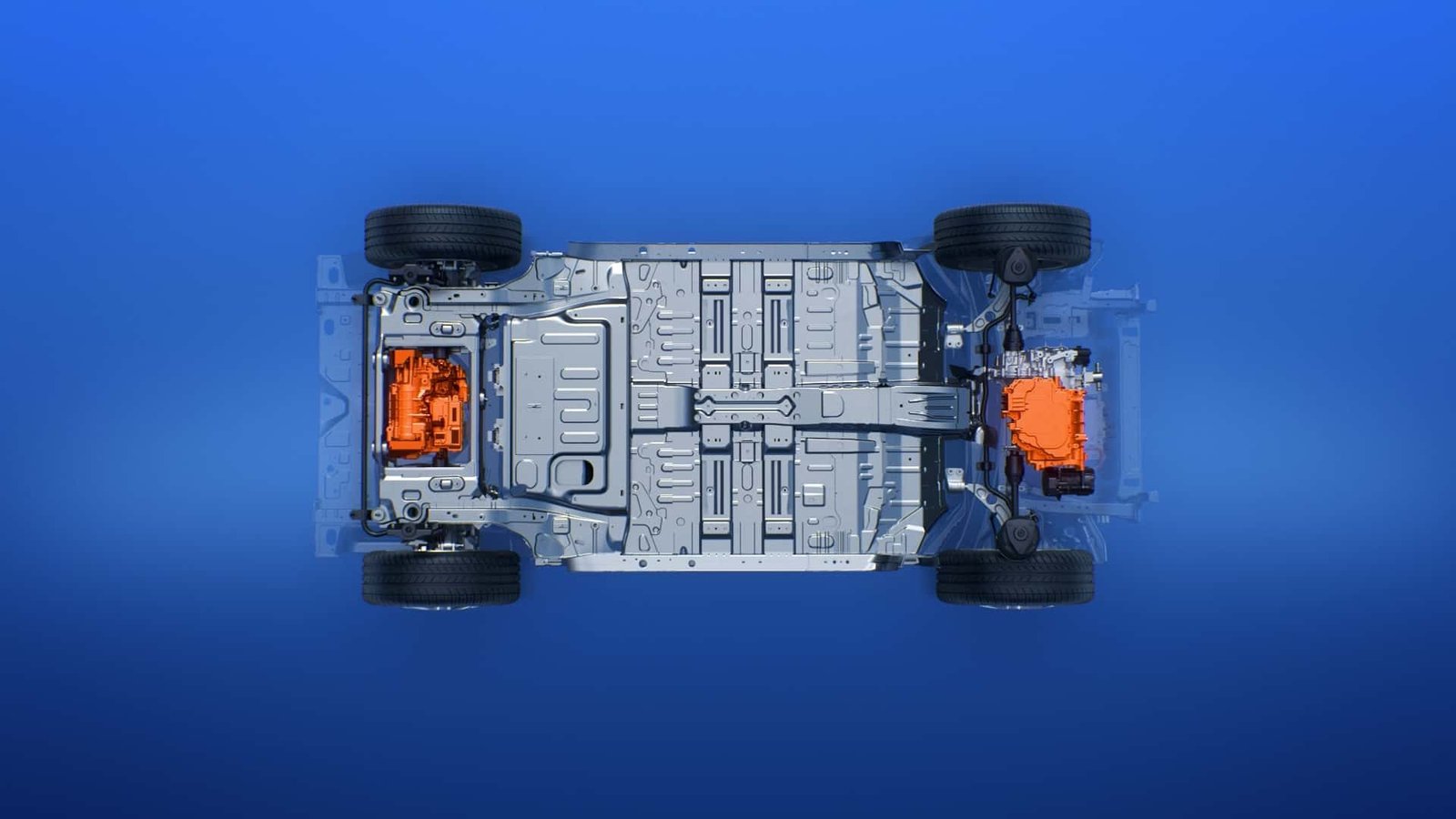
Prices for lithium-ion battery packs fell 20% in 2024, the largest drop since 2017, according to a study from the International Energy Agency (IEA). Cheaper batteries mean cheaper EVs, and electric cars and trucks remain the main driver of battery demand. China’s price advantage is widening over the rest of the world. The war for a zero-emission future of transportation is really a war for batteries. If battery prices—the biggest single cost of any electric vehicle—remain high, then EVs will stay expensive. But if batteries can be made or secured cheaply and locally, prices will decline. Tesla figured this out early on with its Gigafactory in Nevada. It's also why automakers like General Motors, Toyota and Ford are planning battery plants of their own—to varying degrees of success thus far. But as every automaker, battery supplier and energy provider races toward that future, here's some good news: global prices for lithium-ion battery packs fell 20% in 2024, according to a new study from the International Energy Agency (IEA). That's the biggest single price drop since 2017. You can thank increased competition, more production and growing demand for this situation. "Lithium prices, in particular, dropped nearly 20% in 2024, reaching similar prices to those at the end of 2015, despite lithium demand in 2024 being about six times bigger than in 2015," the report said. The low prices of critical minerals are due to current surpluses, which is good news for EV costs in the near-term but could lead to under-investment in the future. Battery Prices (IEA) Photo by: InsideEVs Battery pack prices fell in all markets, the report said. But the biggest drops were in—and probably not surprisingly—China. That country has a significant lead in the battery race, both in terms of securing the supply chain and overall technological development. "China was responsible for 80% of global battery cell production in 2024, while the remainder was produced in the United States, the European Union, Korea and Japan," the study said. "The faster pace of battery cost reduction and innovation in China has been enabled by fierce competition that has driven down profit margins for most producers (though not all), at the same time as driving up manufacturing efficiency and yields, as well as access to a large, skilled workforce." Interestingly, that study also notes that contrary to what you may think, hybrid batteries are more expensive than EV batteries, despite being significantly smaller. The price of such components is spread across fewer battery cells, increasing the price per kilowatt-hour," the study said. "In 2024, the average price of a 20 kWh PHEV battery pack—roughly the global sales-weighted average for standard plug-in hybrids—was about the same as a 65 kWh BEV battery pack." China's near-total lead on lithium iron phosphate (LFP) batteries is having a big impact on the market as well. While LFP batteries have long been considered a lower-cost option for EVs, their performance has improved significantly through continued development, making them far more suited for mainstream mass-market car duty than ever. LFP batteries made up nearly half of the global EV battery market, the study said, also attributable to China. Their use grew by about 90% in 2024 in the European Union, but remained at only 10% in the United States, due to anti-China tariffs. Meanwhile, LFP batteries are sort of taking over the rest of the world. "Market penetration of LFP batteries is moving even faster in other markets," the study said. "In Southeast Asia, Brazil and India, the share of electric car batteries using LFP reached more than 50% in 2024. In Southeast Asia and Brazil, LFP uptake is led by imports from China, mostly by BYD, whereas in India it is driven by cars produced domestically, led by Tata Motors." Meanwhile, LFP battery development is moving more quickly in South Korea and Japan as well. LFP vs NMC battery adoption Photo by: InsideEVs Onto more good news and bad news. On the first front, the U.S. is slowly beginning to catch up. "Manufacturing capacity in the United States grew by almost 50%, led by Korean companies attracted by tax credits, which accounted for nearly 70% of the growth in 2024," the study said. "This led installed capacity in the United States to surpass that in the European Union, which nonetheless increased by 10% in 2024 despite the Northvolt plant in Sweden being halted following its bankruptcy." However, those tax credits could very likely go away soon if President Donald Trump's budget bill is signed into law. The so-called Big, Beautiful Bill is poised to eliminate both EV tax credits and tax incentives for domestic battery manufacturing. A current version passed by the U.S. House of Representatives cuts both; it is now working its way through the Senate. Ultimately, the global battery boom isn't going anywhere. But whether America wants to have a place in it remains to be seen. Check out the full study here. Contact the author: patrick.george@insideevs.com
The future of lead-acid batteries looks bright
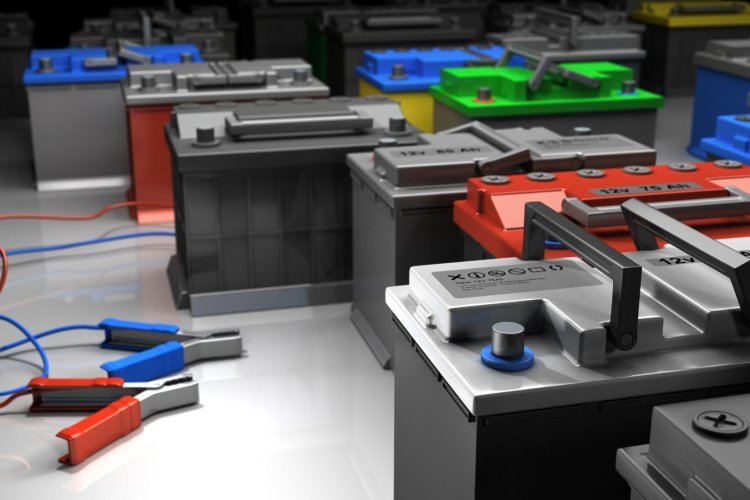
Safe, affordable and fully recyclable, lead-acid batteries will find even more use in the age of renewable and clean energy. Over the years, the lead-acid battery has undergone a number of technological changes, leading to improved performance, lower weight, durability, use of newer materials, high recyclability, etc. Lead-acid batteries were originally used in the lamps on miners’ caps, and later in automobiles, defence, communications, power and railways. With the dawn of the computer era, lead battery-powered UPS became a common application. During power cuts and outages, inverters backed by lead batteries are are widely used in homes, offices, banks, shops, schools, etc. In the renewable energy sector — solar and wind — lead batteries are used for energy storage. To bring down urban transport pollution as well as improve air quality levels, electric vehicles are being promoted in many parts of the world. In India, e-mobility is being subsidised. For charging the batteries in EVs, the ideal option would be to gradually use more renewable energy. For public transport and last-mile connectivity, the country is likely to see more e-rickshaws, e-scooters and e-buses. Electric cars have also started plying in metros and other cities, though not in large numbers. Unfortunately, for batteries in such applications, India will need critical metals like nickel, cobalt, lithium, etc., which are not available locally. These metals, or finished batteries, need to be imported. Lead depositsHowever, in the case of lead batteries, India is blessed with sufficient lead deposits — primary as well as secondary/recycled. India produces 0.8-1 million tonnes of lead out of used batteries. Primary lead production is around 0.25 million tonnes. India has the expertise in manufacturing lead batteries using locally available materials and inputs. India also exports lead batteries to many parts of the world. Out of the total lead consumed domestically, 75-80 per cent goes for the manufacture of batteries. Lead battery is the best example for atmanirbhar. As a result, lead-acid battery is cheaper and affordable even for farmers to use in tractors, and in e-rickshaws in cities. Recovery of lead from used batteries is an easy, low temperature operation. In the true spirit of “Recycle and Reuse”, lead batteries can be recycled a number of times without any loss in properties. Among all the materials globally, lead is the most recycled (about 99 per cent), thus helping the cause of sustainable development. Also, lead batteries are to be used in a number of applications and are absolutely safe. Lead battery technology continues to evolve based on consumer needs and industrial demand. There are enough indications that lead batteries are not only here to stay but also grow in the coming years. The writer is Past President, The Indian Institute of Metals Source
Xiaomi, Huawei clash extends from smartphones to EVs
Huawei's Richard Yu hinted that Xiaomi's EVs are not as good as the cars from brands backed by Huawei, but they're getting high sales. Xiaomi executives responded, suggesting this was Huawei's jealousy. (Image credit: CnEVPost) The clash between Xiaomi (HKG: 1810, OTCMKTS: XIACY) and Huawei has extended from smartphones to the electric vehicle (EV) industry, as both Chinese tech giants seek to gain more supporters in a rapidly growing but highly competitive industry. Huawei's executive director and chairman of the consumer business group, Richard Yu, hinted during a speech on the first day of the 2025 Shenzhen auto show that Xiaomi's EVs are of lower quality than those of brands backed by Huawei and do not deserve such high sales figures. Xiaomi executives subsequently responded, turning the dispute into a trending topic on social media from yesterday to today. "As you can see, a company from another industry, making just one car, has achieved massive sales," Yu said in his speech yesterday, according to widely circulated video clips on Chinese social media platforms. "Although its products may not be that good, they've already sold like hotcakes," Yu said. Yu did not directly mention Xiaomi by name, but it was clear he was referring to the company, implying that Xiaomi's EVs are weak in terms of quality and autonomous driving capabilities but have achieved success through marketing. "It has strong marketing capabilities, strong brand capabilities. So one product from it can become a hot seller," Yu said. "Our products are better than theirs in every aspect -- better quality, better experience, better performance, but we can't sell as much as they do, not even a fraction of their sales," Yu complained. "That's just how it is in today's world," he said. Xiaomi partner and president Lu Weibing responded on Weibo last night, suggesting that Yu was defaming the company. "Whether it's the popularity of the SU7 or the higher attention and expectations for the YU7 compared to the SU7, it's all based on strong product competitiveness," Lu wrote on Weibo. "The success of Xiaomi EV is the success of Xiaomi's values, Xiaomi's business model, and Xiaomi's methodology!" Lu said. Lu also quoted Mo Yan, a renowned Chinese literary figure and the 2012 Nobel Prize in Literature laureate, saying, "Slandering is, in itself, a form of admiration." Xiaomi founder, chairman, and CEO Lei Jun cited the same quote when sharing Xiaomi EV's May delivery figures today, though he later edited and removed the quote. Huawei and Xiaomi are among the most closely watched companies in China's automotive industry, despite their differing approaches to the sector. Huawei does not directly manufacture vehicles but has partnered with multiple domestic automotive giants under its HIMA (Harmony Intelligent Mobility Alliance) business to create new automotive brands. Under the HIMA business, there are currently five brands: Aito from Seres Group, Luxeed from Chery, Stelato from BAIC Group, Maextro from Anhui Jianghuai Automobile Group (JAC), and Shangjie from SAIC Motor (SHA: 600104). The new models from these five brands are typically launched directly by Huawei, primarily by Yu. Huawei does not own these brands but plays a key role in product definition, design, and sales. Xiaomi officially announced its entry into the automotive industry in March 2021 and officially launched its first model, the SU7 electric sedan, in March 2024. The SU7 achieved rapid success and is one of the rare models in China's EV sector that remains popular a year after its launch. Xiaomi EV delivered over 28,000 units in May, marking the eighth consecutive month with monthly deliveries exceeding 20,000 units, according to data released earlier today. Xiaomi EV currently offers only the SU7 series, including the standard SU7 model and an electric sports car based on the SU7 with a maximum power output of 1,548 Ps. Xiaomi unveiled the YU7 electric SUV on May 22, with an official launch scheduled for July. Huawei started as a manufacturer and seller of telecommunications equipment and entered the smartphone market during the early days of the Android system. Xiaomi began by developing a custom Android skin and quickly became one of the world's largest smartphone manufacturers. During the smartphone era, the two companies frequently clashed, with the most notable incident occurring in 2019. On January 10, 2019, Xiaomi announced the independence of its new brand Redmi, targeting the lower-price market, and repeatedly compared it to Honor, which was then a Huawei sub-brand, during the launch event. "Take life and death in stride; if you're not convinced, let's fight,” Lei wrote in Chinese on a slide, which was seen as a direct challenge to Huawei. Huawei and Honor executives later responded, making the topic a focal point of discussion for a long time. (A screenshot of a Weibo post by Xiaomi president Lu Weibing.) (A screenshot of the edit history of a Weibo post by Lei Jun, founder, chairman, and CEO of Xiaomi.) "In China, we see intense competition and Tesla is no longer seen as the technology leader."
General Motors Is Now Canada’s Best-Selling EV Maker As Tesla Sales Crater
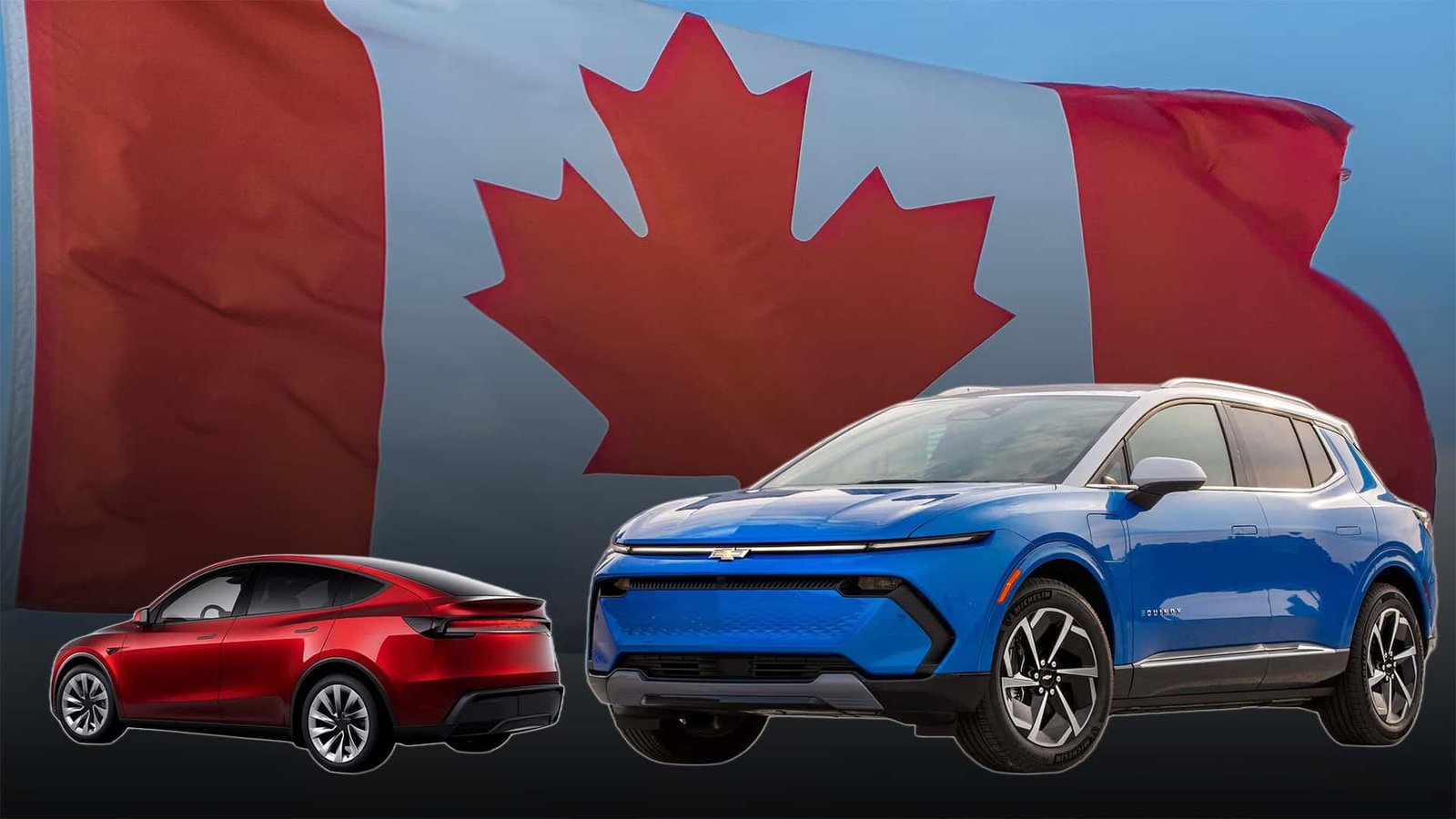
General Motors claims to be Canada's best-selling EV maker. The auto giant overtook Tesla, which has ruled Canada's EV sales charts for years. During Q4 2024 and Q1 2025, GM sold more electric cars than Tesla in Canada. Tesla has lost its spot as the best-selling electric car brand in Canada, making way for General Motors to come in and take the crown. The information went relatively under the radar and was spotted by GM Authority in an Instagram post from GM Canada, which claimed the company is now the country’s best-selling EV maker. A GM spokesperson said that the claim is “based on Canadian vehicle registrations for the third quarter of 2024 and the first quarter of 2025,” and that “the data shows GM as the number one EV seller in Canada over that period.” In the last quarter of 2024, GM sold roughly 15,000 EVs in Canada, while the first quarter of this year saw sales of about 6,000 EVs, according to the company’s records. In Tesla’s case, the automaker doesn’t release sales numbers for individual countries every month. That said, data from Quebec’s vehicle registration service (SAAQ), quoted by Global News, shows a severe drop in registrations for Tesla. In Canada’s largest market for EVs, Tesla went from 5,097 cars registered in Q4 2024 to just 524 in Q1 2025, a 90% decrease. Data for the whole country is not yet available. Both companies saw their registration numbers go down at the beginning of this year because the Canadian government stopped its iZEV rebate program for battery-powered cars in February. At the same time, Quebec halted its regional incentive program during February and March. It’s also worth noting that General Motors managed to overtake Tesla in Canada thanks to its extensive brand portfolio. The American automaker has three brands selling EVs in Canada, while Tesla is a single entity with just four models on offer, and only two of them are high-volume vehicles. However, this hasn’t stopped it from being the favorite choice among EV buyers in Canada in the past. Now, though, Canadians aren’t particularly keen on getting behind the wheel of a new Tesla. That has a lot to do with Elon Musk, the company’s CEO, who said that “Canada is not a real country.” Combined with the U.S. and Canada's ongoing tariff war, Canadians aren't too enthusiastic about a company controlled by the President's right-hand man. That's bad news for Tesla and, apparently, good news for GM.
Tesla Power India Launches Refurbished battery brand Restore
Tesla Power India today announced the launch of ReStore, Which it said is India’s first and foremost refurbished battery brand. The company is planning to launch 5000 “ReStore Battery Refurbishing Centers” in India by 2025 (500 of which are already operational). Significantly extends the lifespan of all types of Lead acid batteries, including tall tubular inverter batteries and UPS VRLA batteries, offering a cost-effective solution that can extend the battery's life by 1 to 2 years by refurbishing them. The refurbished batteries under the brand name of “ReStore” will be sold to the customer at almost half of the cost of a new inverter battery along with warranty, the company sais. "The launch of this brand “ReStore” is in compliance with the “Battery Waste Management Rules 2022” wherein the CPCB has recognized Battery Refurbishing as an approved business activity. This change in the policy and rules will open up a new service industry and approximately 30,000 battery refurbishment centers are expected to open up in India giving employment opportunities to more than 1 Lac people," Tesla Power India said in a release. Tesla Power India said approximately 10 crore lead acid batteries are scrapped and replaced every year in India, costing Rs.40,000 crore to the Indian economy. Hence, the company added, its refurbished battery business will "addresses both economic strain from battery replacements and environmental hazards linked to improper disposal, and complying to the Indian government's commitment to promote circular economy and sustainability through innovative battery waste management policy. Speaking on the launch of ReStore, Kavinder Khurana, Managing Director of Tesla Power India, said, “ReStore is not just a refurbished battery brand; it's also a solution for employment generation in a new battery service industry, which will contribute to a sustainable environment. By offering affordable refurbished batteries with performance warranty, we aim to not only redefine the market but also to train the micro and small entrepreneurs on our Electro-chemical battery enhancement process (EBEP technology) which has been proven as a game-changer, as we have already refurbished more than 3 Lac batteries using our proprietary technology”, said Mr. Khurana. Source ET news