Press Information Bureau Government of India Ministry of New and Renewable Energ
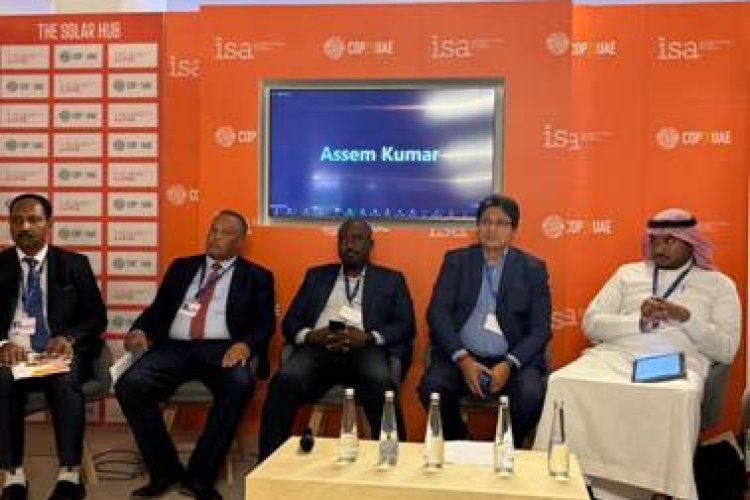
Dual financing approach is being adopted to enhance the contribution of Micro, Small and Medium Enterprises in the transition to renewable energy use: Pradeep Kumar Das, CMD, IREDA at COP 28 Shri Pradeep Kumar Das, Chairman and Chief Managing Director, Indian Renewable Energy Development Agency Limited (IREDA) has highlighted the importance of providing credit to Micro, Small and Medium Enterprises (MSMEs) emphasizing both their economic and environmental contribution in the renewable energy sector. During a session on "Leading Sustainability in Micro, Small and Medium Enterprises: Envisioning Global Growth and Local Impact" organized by the International Solar Alliance and CII as part of COP10 today, December 2023, 28 in Dubai, he reiterated the commitment of the Indian Renewable Energy Development Agency Limited (IREDA) to promote environmental sustainability. Shri Das informed that this commitment includes increasing the participation of Micro, Small and Medium Enterprises (MSMEs) in the renewable sector through accessible credit facilities, strengthening the dedication of the organization for a sustainable future. The CMD stressed on the important role to be played by Micro, Small and Medium Enterprises (MSMEs) in environmental sustainability and informed that Micro, Small and Medium Enterprises currently account for about 22 percent of the total loan assets of the company in FY2. Indian Renewable Energy Development Agency Limited (IREDA) is dedicated to continuously addressing the challenges faced by Micro, Small and Medium Enterprises (MSMEs) and is actively working towards increasing their participation in the renewable energy sector. He also underlined that the agriculture sector and Micro, Small and Medium Enterprises (MSMEs) are the biggest contributors to GDP growth. Shri Pradip Kumar Das, Chairman and Chief Managing Director, Indian Renewable Energy Development Agency Limited (IREDA) acknowledged that a significant constraint for Micro, Small and Medium Enterprises (MSME) entrepreneurs is securing loans at reasonable interest rates. However, the Indian Renewable Energy Development Agency Limited (IREDA) has made substantial progress in improving "Ease of Doing Business". This includes the implementation of faceless loan approvals and disbursements, reduction in documentation involved in the loan sanction and disbursement cycle, as well as expanding geographical reach across the country. Highlighting a successful case study related to lending to e-rickshaws through Mufin Green Finance, Shri Das informed that Indian Renewable Energy Development Agency Limited (IREDA) intervened to reduce the interest rates from the current 30 per cent to a much lower 36 per cent to 18 per cent. Leveraging its track record of making previously unbankable sectors bankable, he expressed confidence that the company's initiatives will result in increased participation of Micro, Small and Medium Enterprises (MSMEs) in the green energy sector. Shri Pradip Kumar Das, Chairman and Chief Managing Director, Indian Renewable Energy Development Agency Limited (IREDA) also underlined the Indian Renewable Energy Development Agency Limited's (IREDA) unwavering commitment to incentivize farmers across the country to reduce their carbon emissions through funding under the PM-KUSUM scheme. In a proactive move to promote Micro, Small and Medium Enterprises (MSMEs) and contribute to the success of the PM-KUSUM scheme, Indian Renewable Energy Development Agency Limited (IREDA) has recently launched its retail division. Soon after its inception, the retail division sanctioned its first loan, under Kusum-B amounting to Rs 58 crore. 10 DEC 2023 7:48PM by PIB Delhi
Xiaomi's EV business expected to turn profitable in H2 2025, founder says
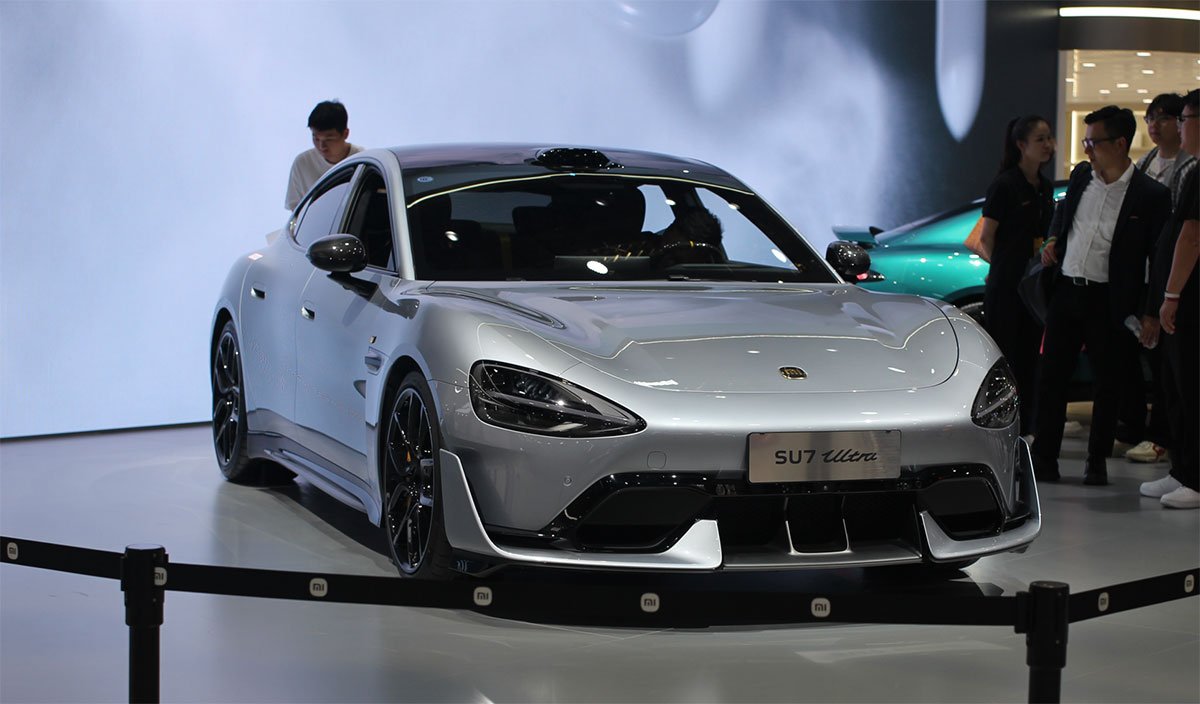
Xiaomi EV is poised to become the fastest to achieve profitability among China's new automotive brands. In the first quarter, Xiaomi's innovative businesses, including EV and AI, reported an operating loss of RMB 500 million. (A Xiaomi SU7 Ultra displayed at the Shanghai auto show in April 2025. Image credit: CnEVPost) Xiaomi (HKG: 1810, OTCMKTS: XIACY)'s electric vehicle (EV) business is expected to turn profitable in the second half of 2025, the smartphone giant's founder, chairman, and CEO Lei Jun said today. Lei mentioned this timeline during today's Xiaomi Investor Day event. If the target is achieved, it will make Xiaomi EV the fastest to achieve profitability among China's new automotive brands. Nio (NYSE: NIO) and Xpeng (NYSE: XPEV), both founded about 10 years ago, aim to achieve quarterly profitability this year. Li Auto (NASDAQ: LI) has remained profitable since the fourth quarter of 2022. Leapmotor (HKG: 9863) saw its first quarterly profit in the fourth quarter of 2024. Xiaomi officially announced its entry into the automotive industry in March 2021 and officially launched its first model, the SU7 electric sedan, in March 2024. In the first quarter of 2025, Xiaomi's EV business generated RMB 18.1 billion ($2.5 billion) in revenue, according to the unaudited financial report published on May 27. This represents an 11.04 percent increase from the RMB 16.3 billion reported for the fourth quarter of last year, according to calculations by CnEVPost. In the first quarter, Xiaomi's innovative businesses, including EV and AI, generated RMB 18.6 billion in revenue, with RMB 500 million from other businesses. The gross margin for innovative businesses, including EV and AI, was 23.2 percent in the first quarter, up from 20.4 percent in the fourth quarter of last year. The operating loss for these innovative businesses -- gross profit minus operating expenses --was RMB 500 million in the first quarter, down from RMB 700 million in the fourth quarter of 2024. ($1 = RMB 7.1912) Xiaomi's innovative businesses, which include EV and AI, posted a gross margin of 23.2 percent in the first quarter, up from 20.4 percent in the fourth quarter last year.
RedEarth claims world’s first ‘Microgrid-in-a-Box’ solution
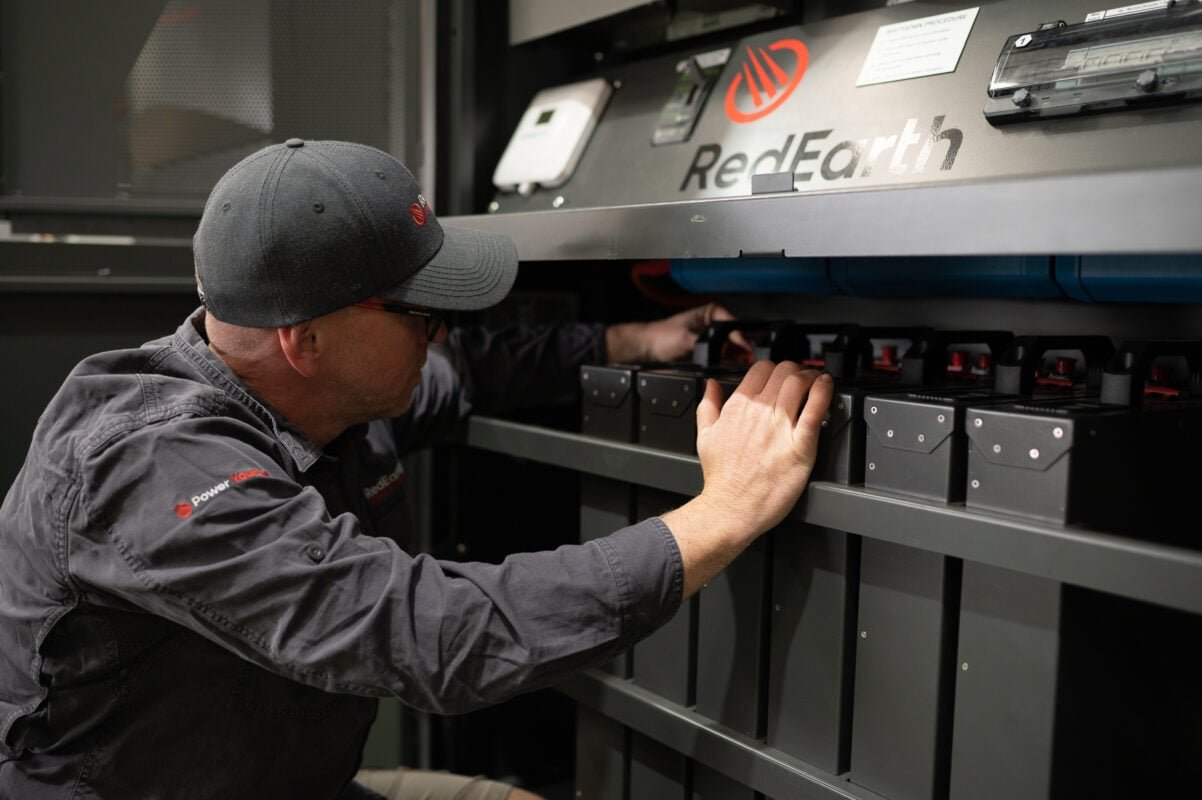
RedEarth claims world’s first ‘Microgrid-in-a-Box’ solution - Energy-Storage.News Skip to content
BESS as virtual transmission in Australia: Unlocking the grid
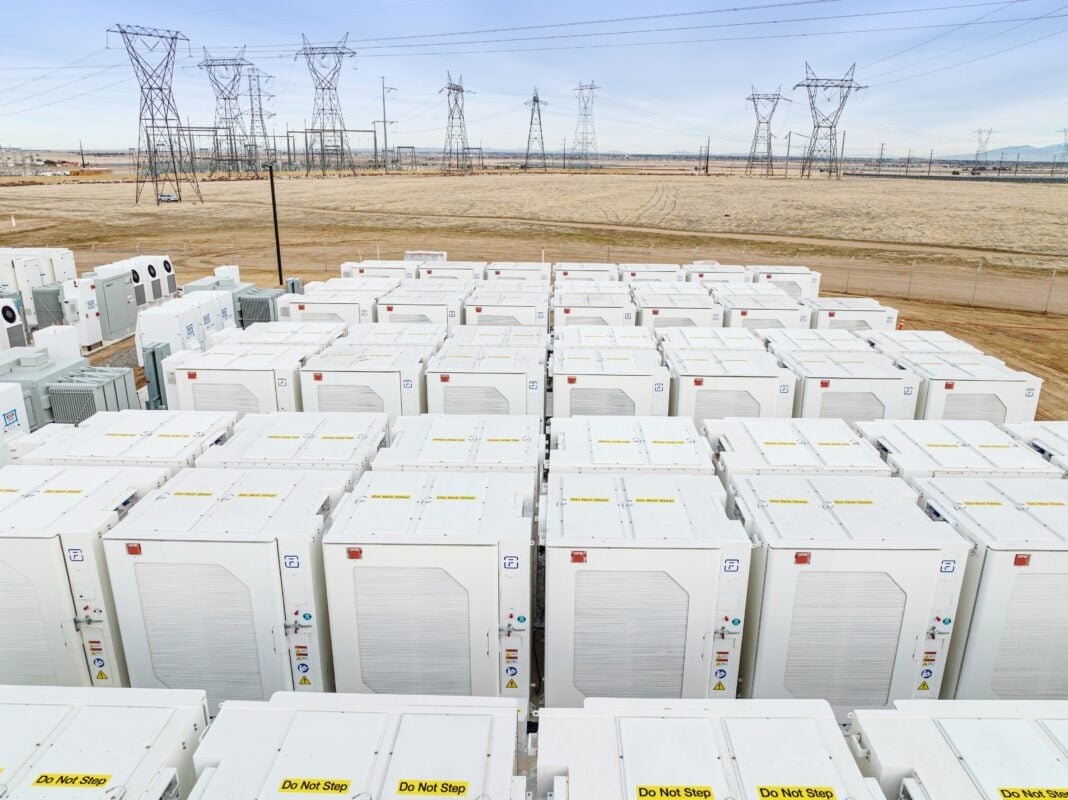
One of the most promising developments is the use of battery energy storage systems (BESS) as virtual transmission—a concept increasingly referred to as storage-as-transmission assets (SATA). This approach is already being actively deployed in Germany and elsewhere. In Australia, the opportunity is clear: by deploying BESS strategically along transmission corridors, we can ease congestion, increase asset utilisation, reduce reliance on new lines, and stabilise the grid – all while enabling deeper renewable energy integration. What is virtual transmission? Traditional transmission upgrades are costly and time-intensive, often taking years to plan and execute. Virtual transmission is a much faster solution, leveraging energy storage to relieve stress on the grid. Strategically placed BESS are fast to deploy and can reduce the need, or allow more time, for additional network investments. Energy storage also has the benefit of a smaller footprint and less impact to communities than traditional network investment. Depending on the nature of the arrangement, BESS can be used to store energy during low-demand periods and release it when the grid is constrained, effectively shifting power across space and time. Alternatively, BESS can react to transmission system faults in a way that avoids the need for the additional line capacity that is typically reserved for contingency events. By doing so, storage can increase a powerline’s overall load carrying capacity. Rendering of TenneT and Fluence’s Audorf “grid-booster” project in Germany. Image: Fluence. In Germany, transmission system operators (TSOs) including TenneT and TransnetBW are deploying three large-scale BESS to act as grid boosters. A 250MW/250MWh project by TransnetBW will be used to ease grid congestion driven by coincident wind energy output by taking over the n-1 requirement. In doing this, energy storage supports higher utilisation of the existing transmission infrastructure—an economic and environmental win. The German regulator has approved two additional projects, 250MW/250MWh each, which will be tendered in 2025/26. These projects will bring the total energy storage used as a transmission asset in Germany to a total of 950MW/950MWh. Similarly, the EPSO-G Energy Cells project in Lithuania is playing a critical role in decoupling the Baltic states from the Russian grid. The project is expected to enhance resilience and support synchronisation with the continental European grid, delivering energy security to the Baltic states. The Australian landscape: room for innovation Australia is well-positioned to use SATA to delay or reduce investments in traditional network infrastructure. However, the regulatory arrangements are often difficult to navigate. Recent reforms are improving the possibility of deploying SATA, such as: The Australian Energy Market Commission (AEMC)’s recent rule change to improve cost recovery arrangements for transmission non-network options in the Regulatory Investment Test for Transmission (RIT-T). The Special Integrity Protection Scheme (SIPS) which, similar to Germany, uses a procurement framework to strategically deploy storage and renewables to support the network at critical times. Network support agreements (NSAs) which can be used, especially at fringe-of-grid, to reduce the need for network upgrades. Making the stars align: From potential to practice There are some schemes currently available in the NEM to support SATA, including the System Integrity Protection Scheme (SIPS) and the inclusion of non-network options in the Regulatory Investment Test for Transmission (RIT-T) framework. However, BESS is also well-placed to be able to provide multiple services across both transmission, wholesale market, and other system services. Historically, investment in the power system has focused on transmission or wholesale market operations, rather than on investments that can support both. BESS is well-placed to value stack multiple sources of revenue and drive lower cost and more reliable outcomes for consumers. A complex matrix of stakeholders – market bodies, regulators, developers, and original equipment manufacturer’s (OEMs) – must work together to turn this value stacking into a reality. Decarbonising the grid towards inverter-based technologies will be enhanced when Australia develops: New markets to explicitly value system services that can be addressed in-market such as inertia. Consistent procurement approaches and technical standards to facilitate the timely development of innovative energy storage products that are resilient to future system needs. Such reforms are critical to make sure that governments and market bodies see the investment needed to decarbonise Australia’s grid: Product developers can prioritise development of technology to deliver the best possible assets to meet our system needs. Project developers and independent power producers can value the full range of system services to make the best investments that can support grid stability and deliver returns over asset lifetimes. SATA is not just about easing congestion. BESS can deliver a suite of advanced grid services critical for system strength and stability: Synthetic Inertia and Virtual Synchronous Machine (VSM): Mimics synchronous generator behavior to stabilise frequency. Power Oscillation Damping: Controls inter-area oscillations that threaten grid stability. Black start: Re-energises the grid post-blackout, without reliance on thermal assets with spinning machines. Dynamic Voltage Control: Stabilises voltage amid rising renewable energy volatility. Lessons from Iberia’s recent blackout The importance of system resilience was underscored by the recent blackout in Iberia, where a sudden system event led to widespread disruption. While Fluence had no active projects in Iberia at the time, its systems elsewhere in the continental European grid performed as expected. The role of reduced inertia on the grid, due to the high penetration of inverter-fed renewables, may have played a role in the events that led to the blackout. The cause of the event remains under investigation, and a detailed ENTSO-E report is forthcoming. This incident reinforces the relevance of battery systems equipped with fast-responding, grid-forming capabilities. As we move away from thermal asset inertia sources, these technologies are no longer nice to have—they are essential for grid resilience. BESS as virtual transmission offer a pragmatic solution to many of Australia’s most pressing grid challenges. They are fast to deploy, highly flexible, and capable of addressing network utilisation and system stability issues. They complement and provide more time for additional investment in transmission assets. Australia already has the technical expertise, project momentum, and stakeholder alignment to lead globally in this domain—now it needs the technical standards and transparent markets
Australia: Victoria sets new BESS charge and discharge records
Australia: Victoria sets new BESS charge and discharge records - Energy-Storage.News Skip to content
BYD's Five-Minute 'Megawatt' Chargers Are A Big Deal. 15,000 More Are Coming
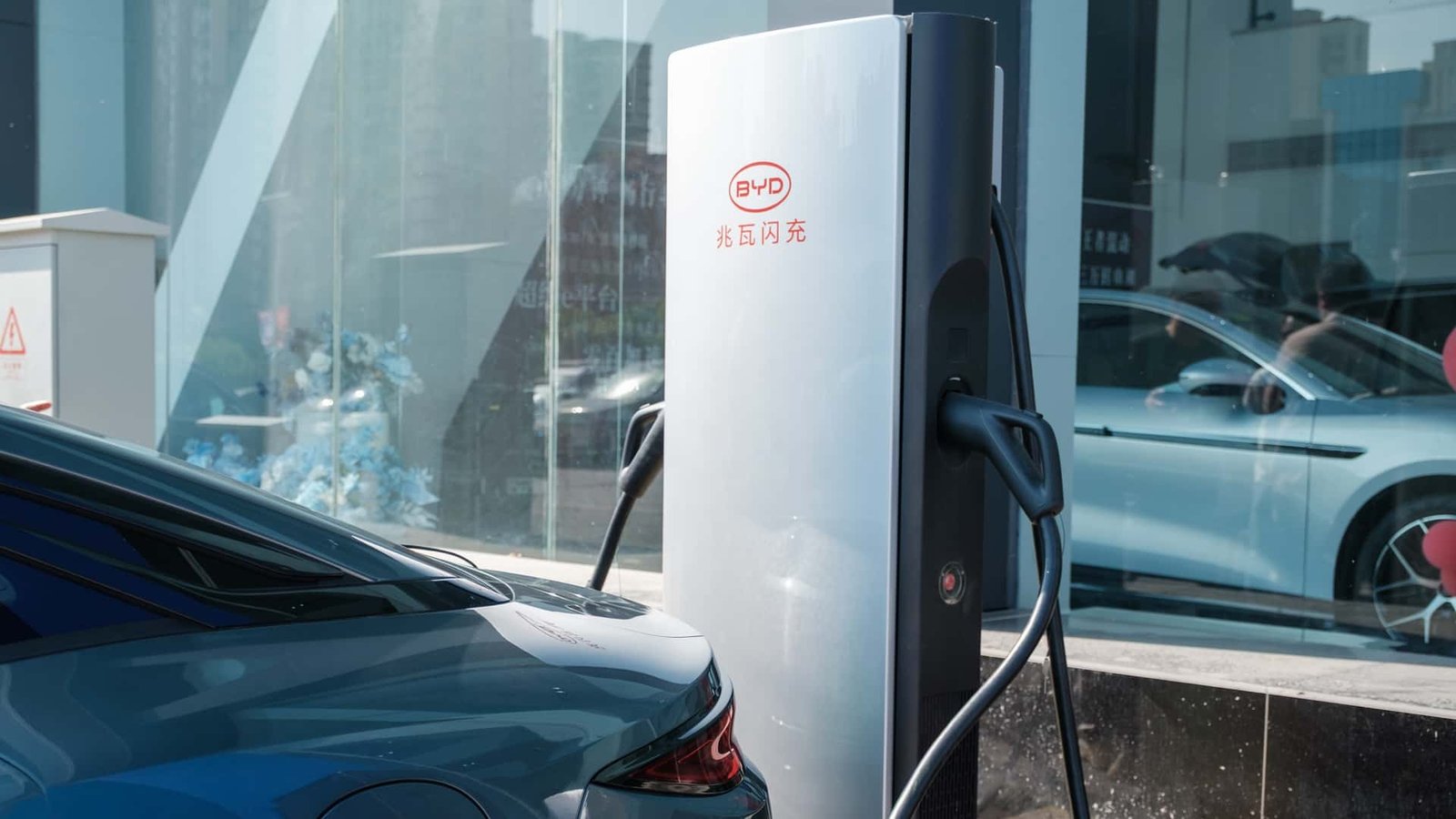
BYD teams up with two Chinese charging powerhouses to deploy 15,000 1,000-kilowatt (1-MW) EV chargers in China. It already has two models capable of charging at that rate, with plans to launch more soon. BYD is China's leading EV charging company, but competitors have announced they are working on 1.2- and 1.5-MW charging solutions. When BYD revealed its one-megawatt (1,000 kW) five-minute chargers in mid-March, it broke the internet. Everybody was covering it, arguing whether such high charging speeds were really needed and whether having a large network of such chargers was even feasible. But BYD didn’t do it for the publicity and is pushing ahead with bold plans to have thousands of these chargers up and running in China. It already has more than 500 1-MW chargers operational today, which cover the most important urban centers in the country, but it’s partnering up with third parties to vastly expand the network. It recently announced it was joining forces with companies Xiaoju Charging and LongShine. The former has pledged to build or upgrade 10,000 charging points to 1 MW, while the latter has committed to an additional 5,000, although a clear time frame for when they would be ready was not provided. Both partner companies are big players on the Chinese EV charging scene with their own large networks, and while they will build the chargers, BYD will supply energy storage to enable 1 MW charging even in areas where the electricity grid wouldn’t support it. Only cars built on BYD’s new Super e-Platform 2.0 support 1 MW charging, and only two such models are currently available: the Han L sedan and Tang L SUV, both launched in April. Both models sold over 10,000 units in their first full month on sale, indicating that ultra-fast charging is a feature that buyers in China are seeking. We saw the former charging from such a station in China and were blown away by how quickly its range was being replenished. It really is about as quick as putting fuel in a combustion car, eliminating one of the biggest downsides that drivers say was keeping them from going electric. BYD isn’t the only Chinese automaker with big ultra-fast charging plans. Xpeng has already deployed 480-kW rapid chargers in China, with its goal to reach 800 kW with its next generation of chargers. GAC Aion is not among the big Chinese automakers mentioned by the Western press, but it is a charging powerhouse with its 6C chargers, meaning they charge six times quicker than the battery pack’s capacity, so a 100 kWh EV would charge at 600 kW. Zeekr, the Geely-backed automaker looking to establish itself as a household premium name in Europe, is working on a 1.2 MW charger, while tech powerhouse Huawei wants to take it to 1.5 MW. But while competitors are just talking about these ridiculously high charging speeds, the fact of the matter is BYD has a considerable lead with the hundreds it already has in operation and the thousands more it has coming (as well as EVs that can actually use all that charging power).
Union Power and New & Renewable Energy Minister
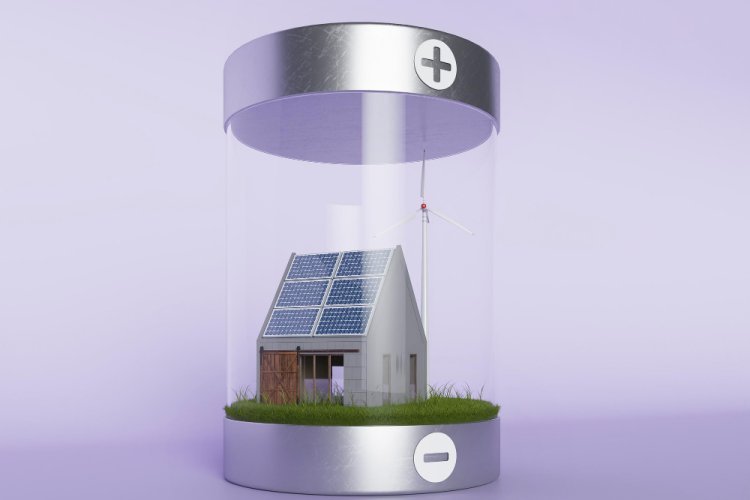
Cost of energy storage in bid increased to Rs 10.18 per kWh, VGF and PLI for battery energy storage expected to reduce storage cost The Union Minister of Power and New & Renewable Energy has informed that the capacity tariff for installation of 500MW/1000MWh Battery Energy Storage System (BESS) has been fixed by Solar Energy Corporation of India (SECI) at Rs. 10.83 lakh/MW/month i.e. approximately Rs. 10.18/kWh in a tariff-based competitive bidding. To make battery storage affordable, the government has approved a Viability Gap Funding Scheme for setting up of 4,000 MWh capacity BESS. The scheme has a provision of VGF up to 40% of the capital cost for BESS, which will reduce the cost of power. Further, the Ministry of Heavy Industries (MHI) has launched the Production-Linked Incentive (PLI) scheme for construction of Advanced Chemistry Cell (ACC) battery storage of 2021 GWh capacity in June, 50. It includes more than 10 GWh of grid-scale battery storage. Out of 50 GWh capacity, 30 GWh capacity has already been allocated through competitive bidding process. The PLI-ACC scheme has an outlay of Rs 18,100 crore. The PLI scheme will encourage investment in SAIL's domestic manufacturing for grid-scale applications, it will reduce dependence on imports and consequently reduce the cost of BESSs in future. This information has been given by the Union Minister of Power and New & Renewable Energy, Shri R.K. Singh in a written reply to a question in the Rajya Sabha today, December 12, 2023. 12 DEC 2023 6:26PM by PIB Delhi
Li Auto delivers 40,856 cars in May, up 16.66% year-on-year
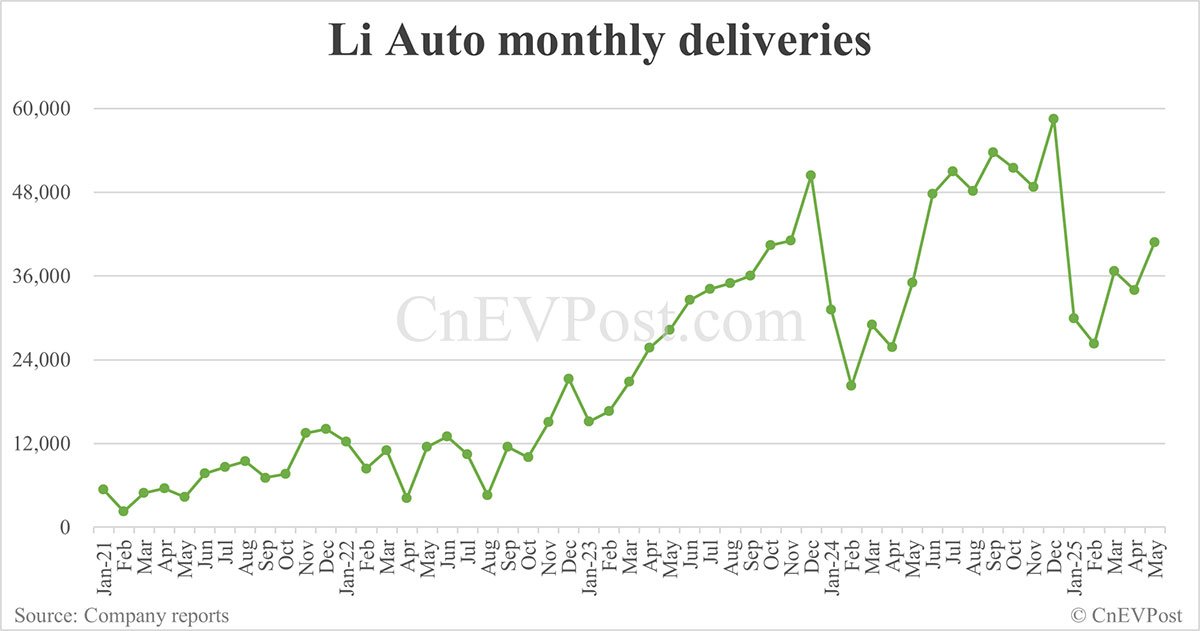
In the first five months of the year, Li Auto delivered 167,659 vehicles, a year-on-year increase of 18.73 percent. Li Mega Home orders have far exceeded expectations, Li Auto said. Li Auto (NASDAQ: LI) saw a sequential rebound in deliveries last month after a decline in April. The company delivered 40,856 vehicles in May, up 16.66 percent from 35,020 in the same period last year and up 20.38 percent from 33,939 in April, according to data released today. From January to May, Li Auto delivered 167,659 vehicles, up 18.73 percent year-on-year, according to data compiled by CnEVPost. As of the end of May, Li Auto had accumulated total deliveries of 1,301,531 vehicles since its inception. Last month, a local media report said that Li Auto had lowered its 2025 sales target from the previous 700,000 units to 640,000 units. Li Auto currently offers the extended-range electric vehicle (EREV) models Li L9, Li L8, Li L7, Li L6, and the all-electric Li Mega MPV (multi-purpose vehicle). The company launched the updated Li Mega MPV on April 23, introducing a higher-priced Home variant. On May 8, it rolled out the updated L-series EREVs. Li Mega Home began deliveries in late May, and its production ramp up is accelerating as orders significantly exceeded expectations, Li Auto said today. The company will officially launch its first pure electric SUV (sport utility vehicle) model, the Li i8, in July, and will roll out another electric SUV, the Li i6, in September, Li Auto management said during an earnings call on May 29. The Li i8 is a six-seat large SUV, while the Li i6 is a five-seat SUV. Li Auto's current lineup includes SUVs and MPVs but no sedans. During the May 29 conference call, its management mentioned plans for sedans but hinted that this is not a high priority at present. Li Auto would only launch sedan products based on market demand once its annual revenue reaches RMB 300 billion ($41.7 billion) and its product portfolio reaches a certain scale, Li Auto founder, chairman, and CEO Li Xiang said during the call. The company's revenue for 2024 was RMB 144.5 billion. In China, SUV models are the most popular, followed by sedans, while MPVs are a niche market. In 2024, SUVs accounted for 49 percent of China's passenger vehicle retail sales, sedans for 46 percent, and MPVs for 5 percent, according to data compiled by CnEVPost. As of May 31, Li Auto operates 506 retail stores across 152 cities, 502 service centers across 222 cities, and Li Auto-authorized body and paint shops. The company also operates 2,414 supercharging stations in China, equipped with 13,195 charging stalls. Its goal is to complete the deployment of the 2,500th supercharging station by June, setting the stage for the Li i8, which is scheduled to launch in July. ($1 = RMB 7.1998) Li Auto will launch its first all-electric SUV model, the Li i8, in July, and will roll out another electric SUV, the Li i6, in September.
Tesla dominates in Norway with 213% sales jump from '24
Tesla shares are up nearly 20 percent in the past month, but that is not stopping the only trillion-dollar automaker from attracting all types of new potential sectors to disrupt, at least from an investor and analyst perspective. Morgan Stanley’s Adam Jonas is not one to shy away from some ideas that many investors would consider far-fetched. In a recent note, Jonas brought up some interesting discussion regarding Tesla’s potential in the eVTOL industry, and how he believes CEO Elon Musk’s answer was not convincing enough to put it off altogether. Tesla’s Elon Musk says electric planes would be ‘fun problem to work on’ Musk said that Tesla was “stretched pretty thin” when a question regarding a plane being developed came up. Jonas said: “In our opinion, that’s a decidedly different type of answer. Is Tesla an aviation/defense-tech company in auto/consumer clothing?” Musk has been pretty clear about things that Tesla won’t do. Although he has not unequivocally denied aviation equipment, including planes and drones, as he has with things like motorcycles, it does not seem like something that is on Musk’s mind. Instead, he has focused the vast majority of his time at Tesla on vehicle autonomy, AI, and robotics, things he sees as the future. Tesla and China, Robotics, Pricing Morgan Stanley’s note also discussed Tesla’s prowess in its various areas of expertise, how it will keep up with Chinese competitors, as there are several, and the race for affordable EVs in the country. Tesla is the U.S.’s key to keeping up with China “In our view, Tesla’s expertise in manufacturing, data collection, robotics/ physical AI, energy, supply chain, and infrastructure are more critical than ever before to put the US on an even footing with China in embodied AI,” Jonas writes. It is no secret that Tesla is the leader in revolutionizing things. To generalize, the company has truly dipped its finger in all the various pies, but it is also looked at as a leader in tech, which is where Chinese companies truly have an advantage. Robotics and the ‘Humanoid Olympics’ Jonas mentioned China’s recent showcasing of robots running half marathons and competing in combat sports as “gamification of robotic innovation.” Tesla could be at the forefront of the effort to launch something similar, as the analyst predicts the U.S. version could be called “Humanoid Ninja Warrior.” Pricing Tesla is set to launch affordable models before the end of Q2, leaving this month for the company to release some details. While the pricing of those models remains in limbo with the $7,500 tax credit likely disappearing at the end of 2024, companies in China have been able to tap incredibly aggressive pricing models. Jonas, for example, brings up the BYD Seagull, which is priced at just about $8,000. Tesla can tap into an incredibly broader market if it can manage to bring pricing to even below $30,000, which is where many hope the affordable models end up. During the Q3 2024 Earnings Call, Musk said that $30,000 is where it would be with the tax credit: “Yeah. It will be like with incentive. So, 30K, which is kind of a key threshold.”
Leap and ChargeScape aim to build the nation’s largest EV virtual power plant
Leap, the leading platform for building and scaling virtual power plants (VPPs), and ChargeScape, the only automotive joint venture delivering vehicle-grid integration, today announced a new partnership to accelerate electric vehicle (EV) participation in grid services programs across the United States.Together, the companies aim to build the nation’s largest EV virtual power plant capable of providing urgently-needed capacity for electric grids while putting cash back in the wallets of EV drivers across the country. ChargeScape provides a secure, unified EV charging platform that connects power grids with some of the largest automotive brands, including BMW, Ford, Honda, Nissan and Tesla. Leap’s software-only solution offers fast, automated access to energy markets, making it easy for EVs and other distributed energy resources (DERs) to participate in a wide range of demand response and other grid services programs through a universal interface. Leveraging these complementary technologies, automakers can more easily unlock the full value of EVs as revenue-generating grid assets – and do so at scale. “Joining forces with Leap will allow ChargeScape to offer new revenue streams to the automakers using our platform,” said Joseph Vellone, CEO of ChargeScape. “More than that, we’re delighted to be able to put money back in the pockets of EV drivers across America and do our part to make EV ownership more affordable and accessible for everyone.” The partnership unlocks new revenue opportunities for EVs both through smart charging (V1G) – reducing demand during periods of high grid demand – and through bi-directional power export, including vehicle-to-grid (V2G). Through streamlined access to the California wholesale market, automakers on the ChargeScape platform can earn new revenue in Resource Adequacy and the Emergency Load Reduction Program (ELRP), in addition to the statewide Demand Side Grid Support (DSGS) program. “Partnering with ChargeScape expands Leap’s network of automakers and enhances our ability to tap into previously inaccessible EV assets,” said Jason Michaels, CEO of Leap. “By combining Leap’s market automation platform with ChargeScape’s direct automaker integration capabilities, we’re accelerating EV participation in VPPs at a time when the grid needs it most.” After launching in California, the companies plan to extend coverage to other geographies across the U.S. Together, Leap and ChargeScape expect to expand the availability of grid services revenue opportunities, strengthen U.S. grid resiliency, and pave the way for broader EV participation in virtual power plants across the country. leap.energy
Morgan Stanley says this is Elon Musk's next challenge
Tesla shares are up nearly 20 percent in the past month, but that is not stopping the only trillion-dollar automaker from attracting all types of new potential sectors to disrupt, at least from an investor and analyst perspective. Morgan Stanley’s Adam Jonas is not one to shy away from some ideas that many investors would consider far-fetched. In a recent note, Jonas brought up some interesting discussion regarding Tesla’s potential in the eVTOL industry, and how he believes CEO Elon Musk’s answer was not convincing enough to put it off altogether. Tesla’s Elon Musk says electric planes would be ‘fun problem to work on’ Musk said that Tesla was “stretched pretty thin” when a question regarding a plane being developed came up. Jonas said: “In our opinion, that’s a decidedly different type of answer. Is Tesla an aviation/defense-tech company in auto/consumer clothing?” Musk has been pretty clear about things that Tesla won’t do. Although he has not unequivocally denied aviation equipment, including planes and drones, as he has with things like motorcycles, it does not seem like something that is on Musk’s mind. Instead, he has focused the vast majority of his time at Tesla on vehicle autonomy, AI, and robotics, things he sees as the future. Tesla and China, Robotics, Pricing Morgan Stanley’s note also discussed Tesla’s prowess in its various areas of expertise, how it will keep up with Chinese competitors, as there are several, and the race for affordable EVs in the country. Tesla is the U.S.’s key to keeping up with China “In our view, Tesla’s expertise in manufacturing, data collection, robotics/ physical AI, energy, supply chain, and infrastructure are more critical than ever before to put the US on an even footing with China in embodied AI,” Jonas writes. It is no secret that Tesla is the leader in revolutionizing things. To generalize, the company has truly dipped its finger in all the various pies, but it is also looked at as a leader in tech, which is where Chinese companies truly have an advantage. Robotics and the ‘Humanoid Olympics’ Jonas mentioned China’s recent showcasing of robots running half marathons and competing in combat sports as “gamification of robotic innovation.” Tesla could be at the forefront of the effort to launch something similar, as the analyst predicts the U.S. version could be called “Humanoid Ninja Warrior.” Pricing Tesla is set to launch affordable models before the end of Q2, leaving this month for the company to release some details. While the pricing of those models remains in limbo with the $7,500 tax credit likely disappearing at the end of 2024, companies in China have been able to tap incredibly aggressive pricing models. Jonas, for example, brings up the BYD Seagull, which is priced at just about $8,000. Tesla can tap into an incredibly broader market if it can manage to bring pricing to even below $30,000, which is where many hope the affordable models end up. During the Q3 2024 Earnings Call, Musk said that $30,000 is where it would be with the tax credit: “Yeah. It will be like with incentive. So, 30K, which is kind of a key threshold.”
China's BYD and Great Wall Motor clash over China's auto price war
Tensions between two of China’s largest automakers erupted into the open on Friday when a BYD executive slammed as alarmist comments by the chief of Great Wall Motor that called the industry “unhealthy”. Shares in Chinese automakers such as BYD, Nio and XPeng tumbled this week after the chairman of Great Wall Motor, Wei Jianjun, worried openly about China’s deepening price war, with pricing pressure hammering the bottom lines of car companies and suppliers. In his remarks last Friday Wei even drew a parallel to Evergrande, saying that the industry had its own version of the Chinese property developer that was liquidated last year after a major debt crisis, but did not name any names.Li Yunfei, BYD’s general manager of branding and public relations, said on Friday that there was no crisis such as Evergrande’s among leading automakers, and said he was baffled by online speculation that Wei was referring to BYD.In a lengthy post on Weibo, Li defended BYD’s 70% debt-to-asset ratio and over 580 billion yuan debt by making comparisons against the likes of Ford, Boeing and Toyota <7203.T>. He said this was the result of BYD growing rapidly even as some rivals had stagnated. He did not specify names.Li added that BYD plans to hold online users who had spread such speculation legally responsible and had handed “evidence” to Chinese authorities.Great Wall Motor did not immediately respond to a request for comment.China’s auto price war is showing little signs of abating despite expressions of concern from both Chinese automakers and industry players. Several automakers followed BYD in offering fresh incentives on cars this week.At least one other Chinese automaker has spoken out in support of Great Wall Motor’s Wei.Zhu Huarong, the chairman of state-owned automaker Changan, told an annual shareholder meeting on Tuesday that his comments were a reminder to the industry that they needed to pay more attention to risks, local media reported.Great Wall Motor and BYD have clashed publicly before. In 2023, Great Wall Motor announced it had filed a report with China’s regulators against BYD, saying BYD’s two top-selling hybrid models did not meet emissions standards.Later that year, BYD made a call for China’s auto industry to band together and “demolish the old legends” of the global market, drawing a rebuke from Great Wall Motor. Previous articleLeap and ChargeScape aim to build the nation’s largest EV virtual power plant Next articleLG Energy Solution begins large-scale ESS battery production in North America
Don’t Get Left In The Dark: EcoFlow's Home Backup Power Systems Are Up To 55% Off
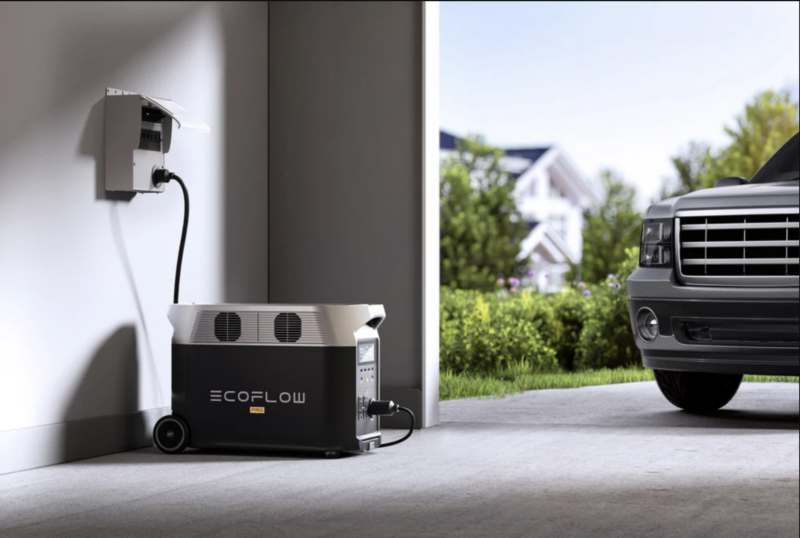
With summer storms and grid stress becoming more common, having a reliable home backup power system isn’t just a luxury, it’s essential. That’s where EcoFlow’s Home Backup Sale can help, as it features prices up to 55% off on EcoFlow’s top-tier home backup bundles, portable power stations, and solar kits from May 29 to June 8, 2025. Whether you’re already familiar with backup systems, or just now considering the idea for your home, this sale is an excellent chance to upgrade or expand your setup — or to get started on your first system — at a significant discount. Whole-Home Backup, Redefined EcoFlow DELTA Pro Ultra Whole-Home Backup Power At the heart of the sale are EcoFlow’s DELTA Pro Ultra systems, which are modular, scalable, and powerful enough to run entire homes for days on end. DELTA Pro Ultra + Smart Home Panel 2 + Two 400W Rigid Solar Panels: Perfect for long outages, this bundle offers solar-powered security for up to a month of essential usage. It’s on sale for $6,999 (normally $8,996), and EcoFlow members get double EcoCredits with purchase. DELTA Pro Ultra + Extra Battery (1 Inverter + 2 Batteries): With 12kWh of capacity, this setup can keep your whole house running for 3–5 days. Now available for $7,299, down from $9,397. DELTA Pro Ultra (1 Inverter + 1 Battery): With 6kWh of energy storage, it’s ideal for 1–3 days of backup support. On sale for $4,999, regularly $6,098. These systems are built for flexibility, allowing homeowners to expand as their needs grow by adding batteries, solar panels, or integrating into a home circuit via EcoFlow’s Smart Home Panel 2. Portable Power, Serious Output EcoFlow DELTA Pro 3 If you need something more mobile, or just want a powerful unit that’s easy to deploy in an outage, EcoFlow’s DELTA Pro 3 is the latest in their portable powerhouse lineup. DELTA Pro 3 + Extra Battery (8192Wh capacity, 4000W output): Serious power in a flexible package — now $4,299, down from $6,298. DELTA Pro 3 + 400W Portable Solar Panel: A perfect off-grid bundle for extended use or camping setups. Sale price: $3,399 (regularly $4,898). DELTA Pro 3 + Smart Generator 4000 (Dual Fuel): Combines clean battery backup with the flexibility of gas/propane, which is great for extended blackouts. Discounted to $4,299 from $5,498. These portable setups are ideal for homes that don’t need a full install but still want peace of mind, or for those who value power on the go. Solar Kits That Work For You EcoFlow DELTA 2 portable power station + 220W solar panel. EcoFlow’s solar bundles make it easy to reduce fossil fuel consumption while staying powered both on- and off-grid. DELTA 2 Max + 500W Solar Kit: Includes four 125W modular bifacial panels, a 2048Wh battery, and 2400W output. Sale price: $1,499 (normally $2,699). DELTA 2 Max + 220W Portable Solar Panel: Compact and convenient, now just $1,299, down from $2,548. DELTA 2 Max + 800W Alternator Charger: Designed for fast recharging from your vehicle’s alternator. Discounted to $1,299, regularly $2,498. Whether you’re prepping for emergencies or powering an RV adventure, these solar kits provide flexible, renewable energy where and when you need it. Member Perks Sweeten The Deal EcoFlow customers who join the free membership program unlock even more value during this sale by getting double EcoCredits on eligible purchases, which can be used toward future discounts, and also by getting exclusive members-only prices on select bundles. If you’re already investing in backup power, it’s worth signing up for these added savings. Why Now? EcoFlow’s Home Backup Sale is being billed as “All-Day Power for Summer Safety,” and for good reason, because with summer at hand and extreme weather in action — from heatwaves to hurricanes — power outages are more than a possibility. Depending on where you live, they’re either likely to happen, or pretty much a certainty. These discounted packages from EcoFlow can help you be prepared for grid failure and extreme weather, while also reducing your reliance on fossil fuels, so shopping this sale could be a great place to start building energy resilience. But don’t wait too long, as the sale ends June 8, 2025. Sign up for CleanTechnica's Weekly Substack for Zach and Scott's in-depth analyses and high level summaries, sign up for our daily newsletter, and follow us on Google News! Whether you have solar power or not, please complete our latest solar power survey. Have a tip for CleanTechnica? Want to advertise? Want to suggest a guest for our CleanTech Talk podcast? Contact us here. Sign up for our daily newsletter for 15 new cleantech stories a day. Or sign up for our weekly one on top stories of the week if daily is too frequent. Advertisement CleanTechnica uses affiliate links. See our policy here. CleanTechnica's Comment Policy
Powin could cease operations by end of July
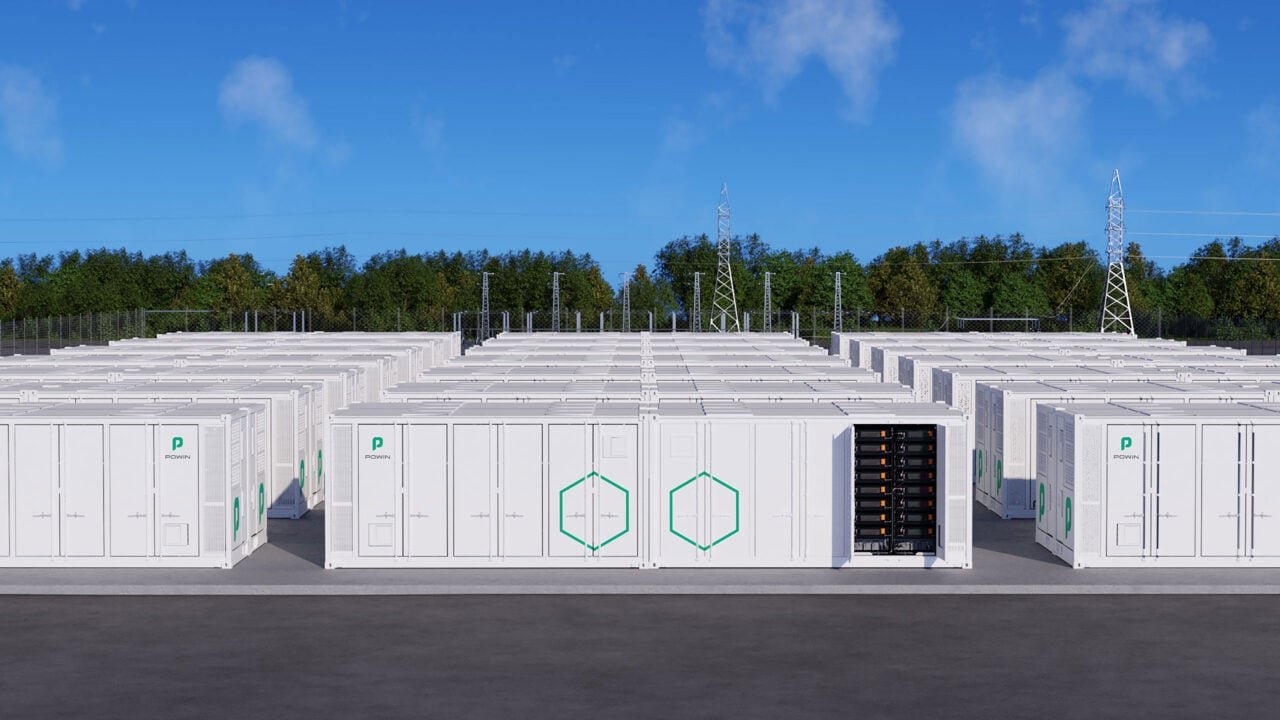
In a letter addressed to Michael Welter, rapid response coordinator at Oregon’s Higher Education Coordinating Commission (HECC), and the mayors of Portland and Tualatin, where its operations are based, Powin said it faces the possibility of having to close and lay off 250 staff. “If Powin LLC’s present business circumstances do not improve, it is currently anticipated that a layoff will occur on or before 28 July 2025,” the letter, signed by Powin’s VP for human resources, Scott Getman, read. In accordance with Oregon’s Worker Adjustment and Retraining Notification (WARN) act, companies with 100 or more workers must give 60 days’ notice to affected workers of closures and layoffs. Powin’s notification to the state listed the roles of all staff affected, including its chief executives. According to the letter, if cessation of business operations occurs, “it is presently contemplated that the affected employees will be permanently terminated.” Powin announcement comes amid atmosphere of uncertainty for US BESS industry The system integrator provides BESS hardware based on its modular Powin Pod liquid-cooled 5MWh lithium-ion (Li-ion) solution in a standard 20-foot container, driven by its StackOS energy management system (EMS) platform. Powin has supplied more than 11GWh of operational projects worldwide and is currently working on more than 6GWh of projects in construction, according to its website. The company works with a variety of battery vendors and was among the first integrators outside China to launch a BESS solution with 5MWh capacity within the 20-foot container form factor. This, company executive VP Danny Lu told ESN Premium, was to enable Powin to compete with Chinese integrators on energy density and high power output. As Chinese integrators upped their system energy densities, so too did Powin, with its 6.26MWh Pod Max product, launched just a few weeks ago. Although the company raised US$200 million financing through a credit facility with influential US investment firm Kohlberg Kravis Roberts & Co (KKR) as recently as Q3 of last year, Powin cited “unforeseen business circumstances” impacting its performance in its notice letter last week. Late last year, one of Powin’s battery suppliers, CATL, filed a complaint in a US court for alleged non-payment for battery cells supplied during 2023. The Chinese battery manufacturer claimed the US integrator had not paid for two shipments of cells, worth CNY310 million (US$44 million). Though the company has pushed into international markets including Australia, Europe and Latin America, Powin’s announcement comes amid a backdrop of uncertainty for the US battery storage industry, driven by US federal policy announcements including tariffs and the possible repeal of tax credit incentives for clean energy manufacturing and deployment via the budget reconciliation bill.
Elon Musk responds to Tesla Supercharger shutdown on NJ Turnpike
Pension fund leaders with Tesla investments are urging the company’s board to mandate Elon Musk dedicate at least 40 hours per week to the electric vehicle maker, citing a looming crisis. The group holds a combined 7.9 million TSLA shares and expressed alarm over Tesla’s challenges in a Wednesday letter to board chair Robyn Denholm. “Tesla’s stock price volatility, declining sales, as well as disconcerting reports regarding the company’s human rights practices, and a plummeting global reputation are cause for serious concern,” the investors wrote. https://www.teslarati.com/tesla-elon-musk-explains-25-percent-voting-share-tsla/ They attributed many issues to Musk’s external activities, including his role in the U.S. Department of Government Efficiency (DOGE). The pension fund leaders criticized the board for failing to ensure Musk’s “full-time attention” on Tesla. The group includes the SOC Investment Group, the American Federation of Teachers, New York City Comptroller Brad Lander, and Oregon State Treasurer Elizabeth Steiner. The investors’ letter comes as the Tesla board plans for Elon Musk’s next compensation plan, following the Delaware Court of Chancery’s 2023 ruling to rescind his $56 billion 2018 package. Besides a 40-hour workweek requirement, they also called for a clear succession plan and limits on directors’ external board commitments to strengthen governance. The letter highlighted concerns about board independence. Tesla recently added former Chipotle CFO Jack Hartung, who previously worked with Musk’s brother, Kimbal Musk, as a Tesla board member. The group’s letter reveals where the position of some investors as Elon Musk forges ahead with Tesla’s future plans. Musk’s broader ambitions for Tesla were evident during the Q4 and FY 2023 earnings call, where he envisioned the company as an AI and robotics powerhouse with “truly immense capability and power.” He emphasized his desire for 25% voting control to maintain influence without complete control. “You know, we’ve had a lot of challenges with Institutional Shareholder Services, ISS — I call them ISIS — and Glass Lewis, you know, which there’s a lot of activists that basically infiltrate those organizations and have strange ideas about what should be done,” Musk said. As Musk plans to focus more on Tesla, alongside xAI and SpaceX, the investors’ demands underscore tensions between his expansive vision and shareholder expectations. With Tesla navigating stock volatility and reputational challenges, the board faces pressure to align Musk’s leadership with the company’s long-term stability.
LG Energy Solution begins large-scale ESS battery production in North America
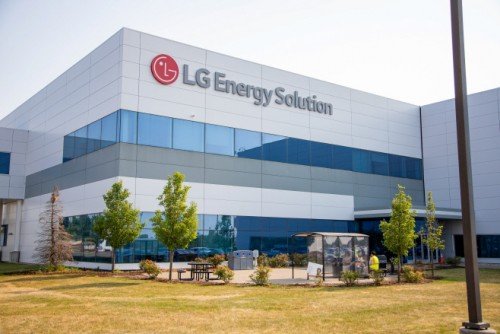
LG Energy Solution has begun large-scale production of lithium iron phosphate (LFP) batteries for energy storage systems (ESS) in North America. The company is currently the only global battery manufacturer with an established large-scale ESS production system in the region—an advantage that industry experts say is timely given surging demand from sectors like AI data centers and renewable energy. On June 1, LG Energy Solution announced it had started mass production of ESS-dedicated LFP batteries at its Holland plant in Michigan. The batteries, based on long-cell pouch-type designs, offer superior energy efficiency, safety, and cost competitiveness. Supply agreements have already been secured with major clients, including Terra-Gen and Delta. Originally, the company had planned to launch ESS battery production at a new plant in Arizona starting in 2026. However, by repurposing and optimizing space at its existing Michigan plant—previously dedicated to EV batteries—LG Energy Solution accelerated its timeline and began production ahead of schedule. Additionally, these U.S.-made batteries are exempt from tariffs, giving the company a price edge over competitors. The move to speed up the transition came amid a plateau in global electric vehicle demand. In response, LG Energy Solution is diversifying its business model—investing in next-generation technologies such as solid-state and lithium-sulfur batteries—while expanding its ESS portfolio. According to market research firm SNE Research, the global lithium-ion battery ESS market is projected to grow more than sixfold from about 185 GWh in 2023 to 1,232 GWh in 2035. In North America, the market is expected to nearly double, from about 97 GWh this year to 178 GWh by 2030. The company recently signed an agreement to supply batteries for OCI Holdings’ North American ESS project and is also expanding its presence in Europe’s fast-growing residential and commercial ESS markets. At the “Path of Oil, Chemicals, and batteries” forum held in Seoul on May 21, Kang Yong-mook, a professor of materials science and engineering at Korea University, commented, “LFP batteries offer high safety and are well-suited for national grid applications. Their use is expected to grow rapidly.” He added, “LG Energy Solution is currently in the strongest position, with multiple U.S. plants already supplying large-scale state projects—successfully overcoming market challenges.”
California's US$280 million home energy storage, solar programme
California's US$280 million home energy storage, solar programme - Energy-Storage.News Skip to content
Tesla bails on crucial piece of India production, aims to rely on imports
Tesla is going to lose 64 Superchargers on the New Jersey Turnpike after a decision by the Turnpike’s governing body was made not to renew its contract with the automaker. On Friday, Tesla revealed that the New Jersey Turnpike Authority (NJTA) had officially decided to choose a sole third-party provider for its electric vehicle infrastructure. This resulted in the NJTA not renewing its contract to keep Tesla Superchargers on the toll road. The NJTA also requested, with its decision not to renew with Tesla, that the company decommission all 64 Supercharger stalls, an unprecedented decision that will remove these plugs from the turnpike, making charging more scarce on the busy roadway. The New Jersey Turnpike Authority (“NJTA”) has chosen a sole third-party charging provider to serve the New Jersey Turnpike and is not allowing us to co-locate. As a result, NJTA requested 64 existing Supercharger stalls on the New Jersey Turnpike to not be renewed and be… pic.twitter.com/sosNIwMfYu — Tesla Charging (@TeslaCharging) May 30, 2025 Tesla detailed the situation on Friday: “The New Jersey Turnpike Authority (“NJTA”) has chosen a sole third-party charging provider to serve the New Jersey Turnpike and is not allowing us to co-locate. As a result, NJTA requested 64 existing Supercharger stalls on the New Jersey Turnpike to not be renewed and be decommissioned.” Tesla said it has been preparing for the potential that the Turnpike Authority would make this decision for three years by building 116 Superchargers nearby to still supply drivers with reliable charging infrastructure. The company also noted that its Trip Planner would adjust automatically. There were also efforts to maintain a relationship that would benefit both the Turnpike and EV drivers who use it. Tesla said it offered the NJTA various “above-market commercial items,” like an offer to build Superchargers at all New Jersey Service Plazas with equipment upgrades like screens and adapters for those companies who have gained access to its charging piles but need to utilize the NACS and CCS1 plugs. The decision is one that seemed to baffle the company, especially as infrastructure is one of the biggest concerns among EV skeptics: “Tesla always advocates for more infrastructure and co-location with additional third-party charging providers. This drives down costs through optionality, and accelerates EV adoption by having sufficient capacity to shoulder peaks. We expect that ~30 times more fast-charging capacity is needed to get to full EV adoption. NJTA’s decision to remove, rather than add, critical charging infrastructure is a setback for New Jersey’s EV adoption goals of 100% Zero-Emission New Car Sales by 2035. It removes Turnpike access to the most reliable (99.9% uptime), least congested (<1% waiters) and cost-effective (~30% lower $/kWh) charging. “ The company said it was more than willing to invest in Turnpike sites if the Authority or New Jersey Governor Phil Murphy wanted to reverse the decision.