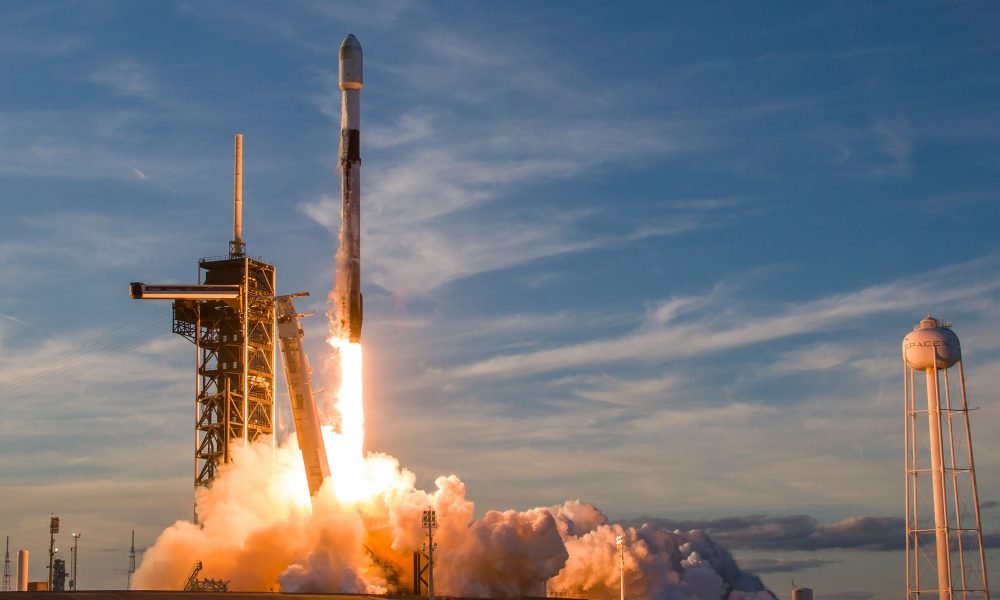
SpaceX marks 500th Falcon launch with Starlink 11-22 Mission
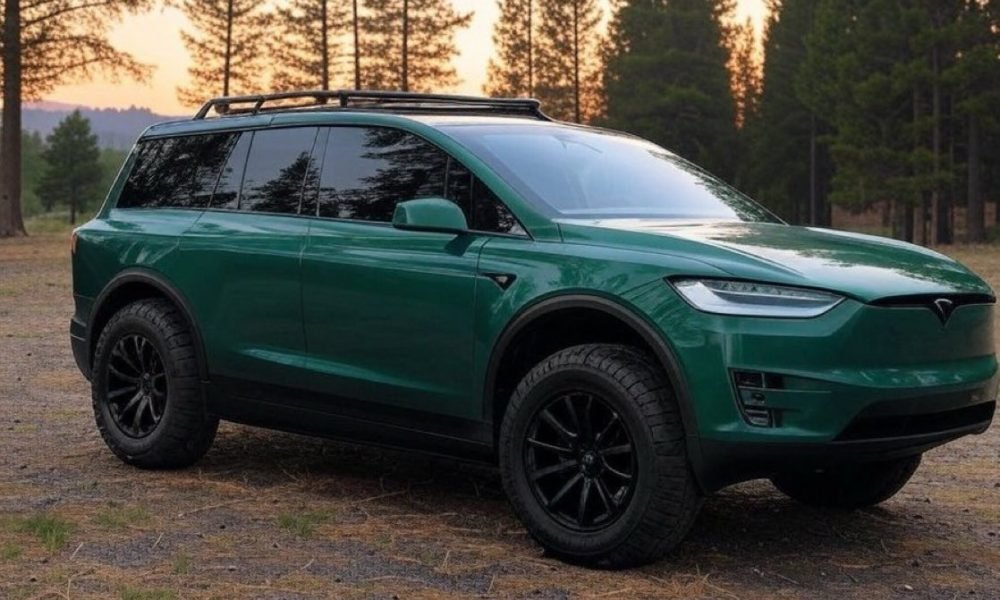
Tesla’s lineup of vehicles has expanded considerably over the last few years. At first, the company offered the Model S luxury sedan, then the Model X luxury SUV, which has the seats but not the space or the affordability that everyone is looking for. The Model 3 and Model Y are sedan and crossover vehicles that have launched the company into the mass-market category. The Cybertruck brought out the company’s first-ever pickup design, and while it is unorthodox, it is certainly functional. Tesla Cybertrucks join Jalisco’s police fleet ahead of FIFA World Cup But there is one thing Tesla is missing in its lineup, and it is a vehicle type that many have waited for and want. The company currently has not announced any plans to produce it, but its fans are loud and persistent, and we’ve even nudged Tesla to consider making it. It’s a full-size SUV. This particular segment is dominated by combustion engines currently: Chevrolet Tahoe and GMC Yukon topped sales with 105,756 and 82,304 units sold, respectively. The Ford Expedition is just behind with 62,007 units sold last year. There are a few formidable competitors on the EV side of things, with the Rivian R1S, the GMC Hummer SUV EV, and even the Kia EV9. However, Tesla has yet to dip its toe into this market, and it seems many of its fans are willing to admit that the company is missing a true “people mover” with enough space to handle a cross-country road trip with a handful of kids. A legitimate, comfortably sized 3-row family SUV. Not an undersized egg-shaped one with a 3rd row that can only fit contortionists, and design-limiting gimmicks like falcon wing doors that just add cost/complexity for a customer set that doesn’t want them. — Weather Nole (@WxGuesserNole) June 4, 2025 No question… we need a full size SUV built on the cybertruck’s platform. — HARLAN Z. HILL 🇺🇸 (@Harlan) June 4, 2025 This, they should build this. Cybertruck AWD drivetrain, but this as rough form. pic.twitter.com/SH4DvkvoIe — Timothyz (@Timothyz) June 4, 2025 Why Not the Model X? The Model X is likely Tesla’s lowest-selling vehicle. It contributes very little to the overall mission of the company, and even CEO Elon Musk once said that it, along with the Model S, is only produced due to “sentimental reasons.” When it comes to the X, it’s simply not quite what people are looking for in terms of a “full-size SUV.” Instead, it is more of a van/crossover SUV hybrid. It does not have tons of cargo and interior space. It does have a lot of great tech, a flashy look, and adequate range for that trip with the kids. It’s a great car, and one that Tesla is planning to refine with an upcoming refresh, its second this decade. However, it falls short of what would qualify as a full-size SUV, especially considering its third row is a little tight, even for younger children. But it’s not quite what many would consider as what Tesla needs to fill this void in its lineup. What Could Be Coming? Many fans say they would like to see a CyberSUV — something built on the Cybertruck platform but in the form of a full-size SUV. This is not totally out of the question, especially considering Tesla has already made it clear the Cybercab would adopt the same sort of aesthetic as the Cybertruck. However, we can all agree it’s a far cry from what the Cybertruck truly is, and Tesla likely will not build something that’s even close to the pickup. It already admitted it would not adopt the stainless steel exoskeleton for future vehicles in the Q4 2024 Shareholder Deck. So, if Tesla were to decide to build something that would be in the full-size SUV segment, it wouldn’t look like the Cybertruck.
Australia’s home BESS subsidy to make it a ‘red-hot market’
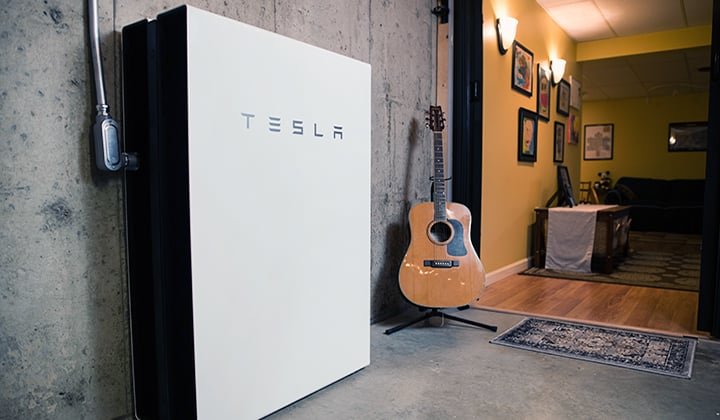
“It [the government’s programme] is likely to make Australia a red-hot market for new battery energy storage systems, and so it’ll build out the local supply chains,” Buckley explains. Indeed, when introduced from 1 July 2025, the programme will help cut the upfront cost of home BESS by 30%. Although it focuses on home installations, this could support the the broader energy storage market by helping develop domestic manufacturing capabilities and supply chains, which could benefit utility-scale projects. “It’s going to bring to Australia the best technology, the best innovation, and hopefully a lot of domestic labour so that we can go and deploy,” Buckley adds. The Cheaper Home Batteries Program was first announced in early April in the build-up to the 2025 federal election, which took place on 3 May and saw Anthony Albanese’s Australian Labour Party win a second term in government. Buckley emphasises the Cheaper Home Batteries scheme’s importance and its potential impact on driving down the cost of home BESS when combined with state government schemes. “I think this is a really important policy expansion by the Albanese government. I like that this is a 30% subsidy to the capital cost. It’s additional or stackable with any state scheme. So, the New South Wales battery subsidy programme, which grants up to AU$2,400, can be stacked with the federal one,” Buckley says. “In Western Australia, they are proposing an AU$5,000 per household subsidy for a home battery. It’s stackable and will make it virtually free to get a battery.” Details on Western Australia’s Household Battery Rebate Scheme were released earlier this week. Synergy customers will be eligible to receive up to AU$5,000 and Horizon Power customers up to AU$7,500 towards a home BESS. This scheme will have a budget of AU$337 million. According to Buckley, despite sounding like “massive overkill” in terms of subsidy, these schemes will stimulate activity and support the uptake of home batteries, creating his aforementioned ‘red-hot’ market conditions. Bringing real benefits to customers Another key component of this home BESS scheme that Buckley raises is its ability to provide tangible benefits to customers from the get-go. This provides customers with cost advantages and money off their electricity bills, while developers focus on utility-scale renewable energy and energy storage projects and the necessary grid transmission rollout to decrease the grid’s carbon intensity. “The scheme allows us to deploy a huge amount of solar across Australia using the existing grid. My biggest fear is that we spend AU$40 billion on massive new grid transmission upgrades, and we, the consumer, all have to bear that,” Buckley begins. “Whereas these batteries, these rooftop solar systems, all these electric vehicles (EVs), will use the existing grid, which means we don’t have to wait five or 10 years for grid transmission system build-outs.” This could be pivotal in maintaining public support for the energy transition. Peter Dutton, the former leader of the opposition, said his party would exploit oil, gas, and coal to drive down energy bills, attempting to appeal to a wider audience. Providing cost benefits and evidence of decreasing energy bills for customers, mainly through the uptake of solar PV systems and a home BESS, could help appeal to a broader range of people and prove the cost benefits of quick-to-deploy renewables and energy storage. Buckley agrees with this perspective, saying that one of the core components of the recent federal election was the cost-of-living crisis. ‘Hybrid projects are eminently bankable’ In Australia’s utility-scale energy storage sector, there has been a growing number of co-location and hybridisation of energy assets, including both renewable energy generation and an energy storage asset, often a BESS. Buckley claims that bankability and negative power prices are the biggest drivers of co-location. He states that when a solar PV power plant generates energy, all the other utility-scale assets do the same, leading to negative power prices. Including a co-located BESS can help solve this by storing and shifting energy exports to the evening peak. “If you throw a big energy storage system alongside a solar PV plant, it becomes eminently bankable, because you’re then using that behind-the-meter solar generation to charge the BESS, and then you are shifting it into the evening peak,” Buckley says. “You’re effectively underwriting a power purchase agreement delivering electricity across the 24-hour period. It makes solar at the utility-scale eminently bankable, which has been unbankable for the last five years, because rooftop solar is so effective in Australia.” More information on the Australian government’s Cheaper Home Batteries Program can be found on the official website.
Tesla Jailbreak Exposes Trick To Get Inside Locked Glovebox
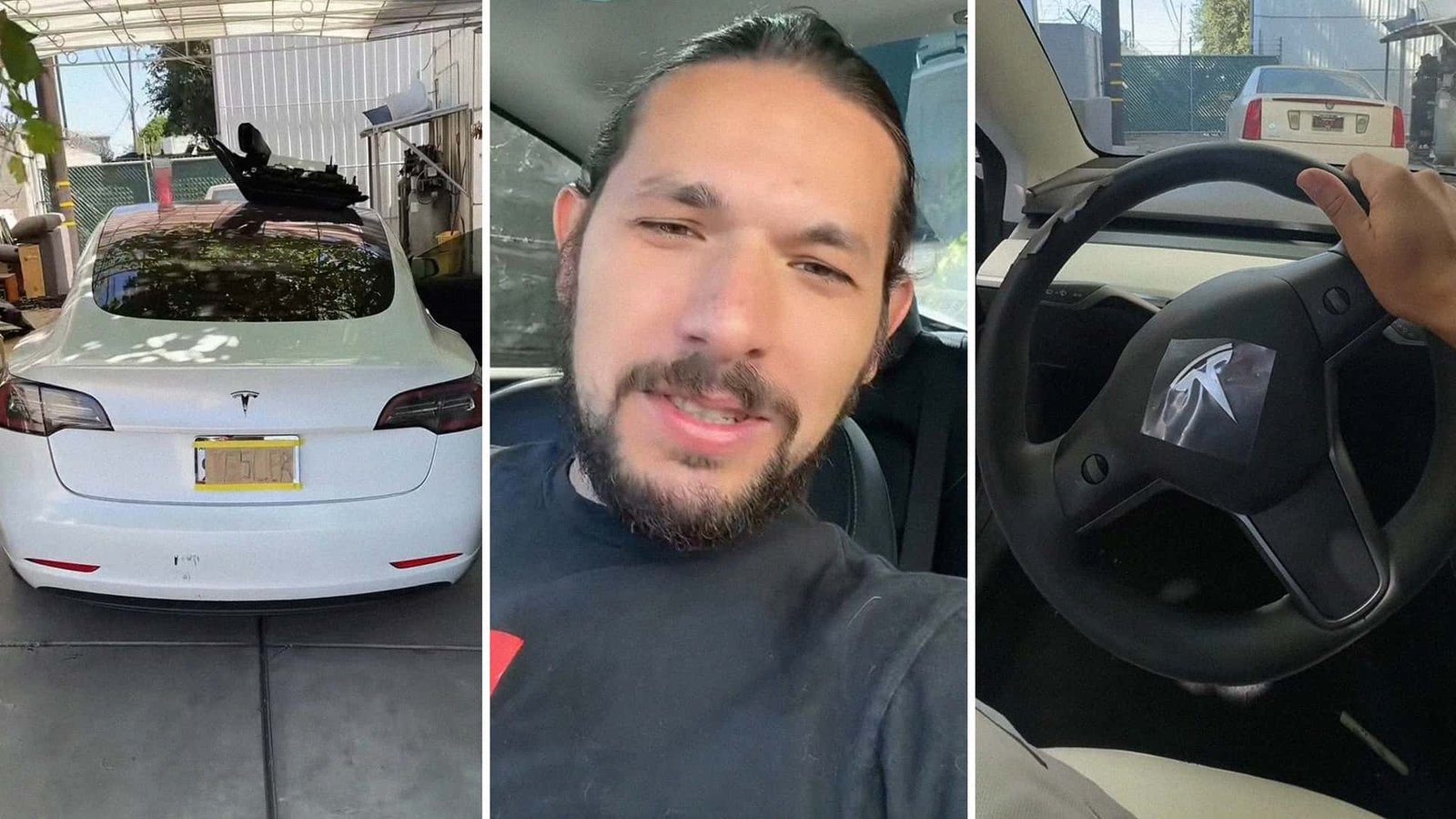
In the age of smart everything, sometimes dumb tools still win. In a recent TikTok clip that’s been viewed more than 410,000 times, creator Original Dr. Auto (@itsmedrauto) showed the world how to physically "jailbreak" the high-tech electric vehicle. Dr. A has created several videos where he's modified Teslas—often for hire, he claims—in ways that involve altering circuit boards and electronic parts. The video opens with Dr. A inside a Tesla he’s been hired to jailbreak, explaining he needs the owner’s glove box PIN to complete the job. Without that info, he shows us another way. After casually popping off the trim panel on the side of the dashboard, just next to where the glove box sits, he probes behind the plastic interior with a simple screwdriver-like tool and flips a hidden release. The glove box drops open like it’s just been told a secret. No digital system is engaged at all. Tesla’s glove box PIN is meant to be a privacy and security feature, basically a four-digit code that locks access to the glove compartment. Drivers can enable it in the settings menu to keep valuables safe, especially when handing over the car to a valet, loaning it out, or using remote services. (InsideEVs contacted Dr. A via direct message and Tesla via email for comment.) Dr. A’s workaround skips the software entirely—the physical equivalent of climbing through the window after locking the front door. In the world of Teslas and other electronic devices, "jailbreaking" usually means hacking into the vehicle’s software to unlock features Tesla would prefer you pay for. Think heated rear seats, performance boosts, or access to hidden diagnostics screens. Those are features that are often already built into the car, just waiting for a software update or a few hundred bucks to come alive. Jailbreaking skips the checkout process and flips the switches manually. This usually involves rooting the car’s operating system, gaining administrator access, and installing custom code to override restrictions. It’s the kind of thing that makes Tesla’s engineers sweat and Reddit users cheer. (For legal reasons, InsideEVs does not recommend doing anything that might void your car's warranty or is forbidden by the owner's manual or terms of service.) This is a manual override that bypasses Tesla’s digital defenses entirely. It’s more pick-the-lock than hack-the-mainframe, and in some ways, that makes it even more interesting. While Tesla focuses on digital security, this is apparently a vulnerability you can reach with your fingers. The glove box trick taps into the growing tension between car owners, curious tinkerers, and the companies that want to lock down their machines like Fort Knox. Many software-defined vehicles and EVs, including those from Tesla, can be more difficult to repair yourself than old-school gas cars ever were. (Then again, playing shadetree mechanic to a modern gas engine with forced induction, direct injection and lots of sensors is no picnic, either.) That’s why these little DIY wins feel so satisfying to the online Tesla crowd. They raise the question: What else is hidden just behind the paneling? If the glove box PIN can be bypassed with a twist of the wrist, how many other features are one plastic tab away from freedom? At the heart of it is a deeper debate: When you buy an EV—often more like a smartphone on wheels than a traditional car—do you actually own it, or just rent access to the software that makes it run? The rise of "right to repair" advocates has only amplified that question, with Tesla often cast as the villain in a broader fight over user autonomy in the age of smart everything. Tesla's ongoing legal battles over repair restrictions have intensified the national conversation around the "right to repair" movement. Owners and independent repair shops are challenging Tesla's tight control over vehicle maintenance and parts, arguing that such practices limit consumer choice and inflate repair costs. In March 2023, a class-action antitrust lawsuit was filed against Tesla by Virginia M. Lambrix in San Francisco, alleging that the company unlawfully monopolized the market for maintenance and repair of its vehicles. The lawsuit claims that Tesla's design requires diagnostic and software updates that only the company can provide, effectively forcing owners to use Tesla's services and parts. While six of the eight alleged antitrust violations were dismissed, in June 2024, U.S. District Judge Trina Thompson allowed two claims to proceed, including alleged violations of California’s Cartwright Act and Unfair Competition Law, citing evidence of a repairs monopoly and parts monopoly by Tesla. Further complicating matters, Tesla faces another class-action lawsuit alleging that it manipulates odometer readings to accelerate warranty expiration and avoid repair costs. Plaintiff Nyree Hinton claims the odometer on his 2020 Model Y overestimated mileage by at least 15%, causing his 50,000-mile warranty to expire prematurely. Tesla has moved the case to federal court and denied all material allegations. These legal challenges coincide with a broader legislative push for right-to-repair laws across the United States. In October 2023, California enacted Senate Bill No. 244, requiring electronics manufacturers to provide tools, parts, software, and documentation for specific durations after production. This law, effective last July, aims to empower consumers and independent repair shops by ensuring access to necessary repair resources. Viewers of Dr. A’s clip showed a mix of praise and worry over the vulnerabilities for Tesla vehicles. “Locks are only a deterrent. I fear everyone knows this,” one observed. And another cautioned against the company’s possible punishment for the tinkering: “lol good luck with warranty and stuff or if you need stuff replaced bc now it’s going to cost you more.” In other words: proceed at your own risk.
Empowering Our World: Unveiling the Advantages of the Battery Industry
The battery sector has grown to be a vital component in our contemporary society, energizing a diverse range of devices and systems. Beyond merely enhancing the convenience of portable electronics, this industry holds profound consequences that reach into domains such as renewable energy, transportation, and environmental preservation. In this article, we will explore the numerous advantages that the battery industry bestows upon society, the environment, and the economy. Energy Storage Revolution At the heart of the battery industry's contribution lies the energy storage revolution. Batteries efficiently capture and store energy, transforming the energy landscape. This innovation supports the storage of surplus energy from renewable sources such as solar and wind, ensuring reliable power supply even during fluctuations. Electrification of Transportation The battery industry's influence extends to transportation, as electric vehicles (EVs) take the roads by storm. By powering cars, buses, and even bicycles, batteries significantly reduce greenhouse gas emissions and dependence on fossil fuels. They offer consumers long-term cost savings and contribute to cleaner air in cities worldwide. Grid Stability Large-scale energy storage systems, predominantly leveraging advanced battery technology, stabilize electrical grids. They provide essential backup power during outages, manage peak demand efficiently, and enhance the overall resilience of energy infrastructure. Integration of Renewable Energy Batteries play a pivotal role in the integration of intermittent renewable energy sources into the grid. They smooth out supply fluctuations, ensuring a consistent power supply regardless of weather conditions. Environmental Benefits The battery industry is a linchpin in the quest for environmental sustainability. Battery-powered systems significantly reduce greenhouse gas emissions, contributing to mitigating climate change and improving air quality. Energy Independence By reducing reliance on fossil fuels, the battery industry enhances energy independence. This minimizes exposure to energy price volatility and strengthens national energy security. Consumer Savings Electric vehicles, benefiting from lower operating and maintenance costs, offer consumers long-term economic advantages. Reduced fuel expenses and less frequent maintenance make EVs an attractive financial choice. Job Creation The growth of the battery industry stimulates job creation across manufacturing, research and development, installation, and maintenance. As the demand for batteries grows, it fosters economic growth and fosters innovation. Technological Advancements and Innovation The battery industry is a catalyst for innovation, driving advances in energy storage technologies. These innovations have applications not only in energy but also in consumer electronics, medical devices, and aerospace. Sustainable Energy Transition The battery industry is integral to the transition toward cleaner, sustainable energy. It reduces the environmental impact of energy production and consumption, aligning with global efforts to combat climate change. Improved Energy Access In remote or off-grid regions, batteries provide a reliable power source for lighting, communication, and basic electrical needs. This fosters a better quality of life for communities with limited access to electricity. Reduced Noise Pollution Electric vehicles and battery-powered equipment are quieter than their fossil fuel counterparts. This reduction in noise pollution benefits urban environments and enhances overall quality of life. Conclusion The battery industry has emerged as a driving force of change, offering a wealth of benefits that extend beyond energy storage and electrified transportation. As the industry continues to evolve and address challenges, such as resource constraints and environmental concerns, it will play an increasingly significant role in fostering a cleaner, more sustainable, and energy-efficient future for all.
Tesla China sells 61,662 cars in May, down 15% year-on-year
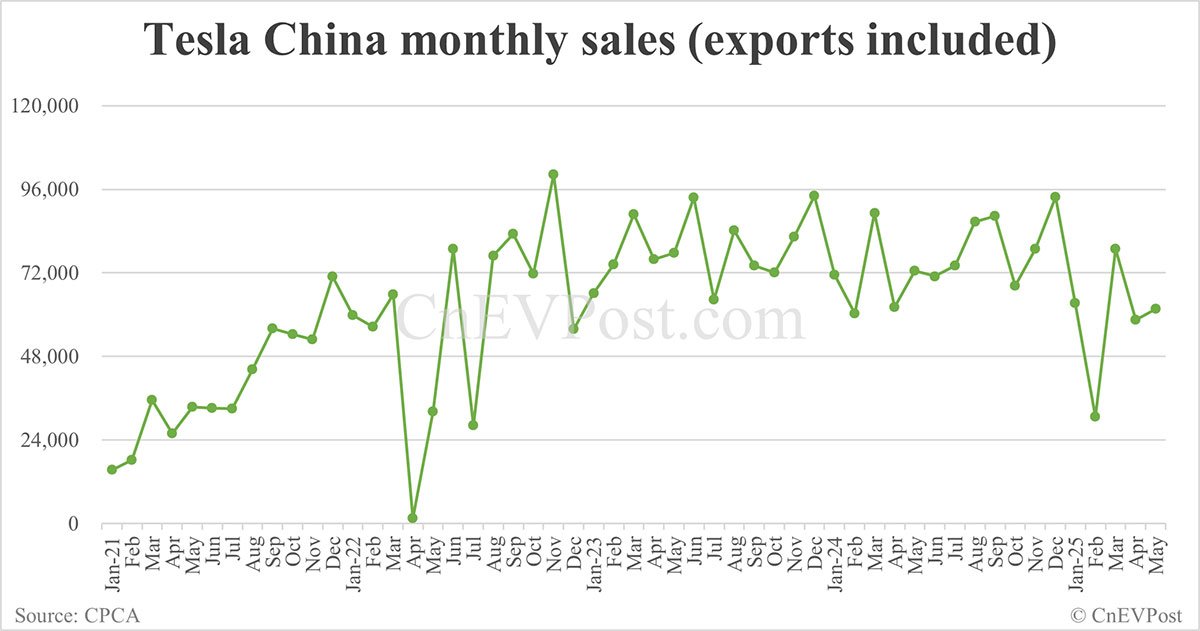
This marks Tesla China's eighth consecutive month of year-on-year sales decline. In the first five months of the year, Tesla China sold 292,875 vehicles, down 17.64 percent year-on-year. Tesla (NASDAQ: TSLA) sales of China-made vehicles continued to falter, extending the decline to the eighth month. Tesla China sold 61,662 vehicles in May, including those sold in China and exported from China to overseas markets, according to data released today by the China Passenger Car Association (CPCA). This represents a 15.03 percent decrease from the 72,573 vehicles sold in the same period last year, despite a 5.48 percent increase from the 58,459 vehicles sold in April. This marks the eighth consecutive month of year-on-year declines in Tesla China's sales since October 2024, according to data compiled by CnEVPost. In the first five months of the year, Tesla China sold 292,875 vehicles, including exports. This represents a 17.64 percent decrease from the 355,616 units sold in the same period last year. Tesla operates a factory in Shanghai that produces the Model 3 sedan and Model Y crossover, delivering vehicles to domestic customers and serving as an export hub. Tesla's May delivery figures in China and export numbers from its Shanghai factory are currently unavailable. Notably, with Xiaomi (HKG: 1810, OTCMKTS: XIACY) set to launch its YU7 electric SUV next month, Tesla's hot-selling Model Y could face increased competition, adding pressure to its market position in China. The YU7 made its debut on May 22, with Xiaomi stating that the SUV's official launch will take place in July. Xiaomi's first model, the SU7 electric sedan, is a competitor to Tesla's Model 3 and has achieved significant success. The SU7 series delivered over 28,000 units in May, marking the eighth consecutive month with monthly deliveries exceeding 20,000 units, according to Xiaomi's EV unit, Xiaomi EV, earlier this month. In addition to Xiaomi EV, other major Chinese EV makers mostly saw year-on-year growth in deliveries in May. Nio Inc (NYSE: NIO) delivered 23,231 vehicles in May, up 13.08 percent from 20,544 in the same period last year, though down 2.80 percent from 23,900 in April. Xpeng (NYSE: XPEV) delivered 33,525 vehicles in May, marking the seventh consecutive month with deliveries exceeding 30,000 units. This represents a 230.43 percent increase from the 10,146 vehicles delivered in the same period last year, though it is a 4.34 percent decrease from the 35,045 vehicles delivered in April. Li Auto (NASDAQ: LI) delivered 40,856 vehicles in May, a 16.66 percent increase from the 35,020 vehicles delivered in the same period last year, and a 20.38 percent increase from the 33,939 vehicles delivered in April. BYD (HKG: 1211, OTCMKTS: BYDDY) reported wholesale sales of 382,476 new energy vehicles (NEVs) in May, up 15.27 percent year-on-year and up 0.63 percent from April. Its passenger NEVs sold 376,930 units in May, up 14.05 percent year-on-year and up 1.16 percent from April. "In China, we see intense competition and Tesla is no longer seen as the technology leader."
Tesla is missing one type of vehicle in its lineup and fans want it fast
Tesla’s lineup of vehicles has expanded considerably over the last few years. At first, the company offered the Model S luxury sedan, then the Model X luxury SUV, which has the seats but not the space or the affordability that everyone is looking for. The Model 3 and Model Y are sedan and crossover vehicles that have launched the company into the mass-market category. The Cybertruck brought out the company’s first-ever pickup design, and while it is unorthodox, it is certainly functional. Tesla Cybertrucks join Jalisco’s police fleet ahead of FIFA World Cup But there is one thing Tesla is missing in its lineup, and it is a vehicle type that many have waited for and want. The company currently has not announced any plans to produce it, but its fans are loud and persistent, and we’ve even nudged Tesla to consider making it. It’s a full-size SUV. This particular segment is dominated by combustion engines currently: Chevrolet Tahoe and GMC Yukon topped sales with 105,756 and 82,304 units sold, respectively. The Ford Expedition is just behind with 62,007 units sold last year. There are a few formidable competitors on the EV side of things, with the Rivian R1S, the GMC Hummer SUV EV, and even the Kia EV9. However, Tesla has yet to dip its toe into this market, and it seems many of its fans are willing to admit that the company is missing a true “people mover” with enough space to handle a cross-country road trip with a handful of kids. A legitimate, comfortably sized 3-row family SUV. Not an undersized egg-shaped one with a 3rd row that can only fit contortionists, and design-limiting gimmicks like falcon wing doors that just add cost/complexity for a customer set that doesn’t want them. — Weather Nole (@WxGuesserNole) June 4, 2025 No question… we need a full size SUV built on the cybertruck’s platform. — HARLAN Z. HILL 🇺🇸 (@Harlan) June 4, 2025 This, they should build this. Cybertruck AWD drivetrain, but this as rough form. pic.twitter.com/SH4DvkvoIe — Timothyz (@Timothyz) June 4, 2025 Why Not the Model X? The Model X is likely Tesla’s lowest-selling vehicle. It contributes very little to the overall mission of the company, and even CEO Elon Musk once said that it, along with the Model S, is only produced due to “sentimental reasons.” When it comes to the X, it’s simply not quite what people are looking for in terms of a “full-size SUV.” Instead, it is more of a van/crossover SUV hybrid. It does not have tons of cargo and interior space. It does have a lot of great tech, a flashy look, and adequate range for that trip with the kids. It’s a great car, and one that Tesla is planning to refine with an upcoming refresh, its second this decade. However, it falls short of what would qualify as a full-size SUV, especially considering its third row is a little tight, even for younger children. But it’s not quite what many would consider as what Tesla needs to fill this void in its lineup. What Could Be Coming? Many fans say they would like to see a CyberSUV — something built on the Cybertruck platform but in the form of a full-size SUV. This is not totally out of the question, especially considering Tesla has already made it clear the Cybercab would adopt the same sort of aesthetic as the Cybertruck. However, we can all agree it’s a far cry from what the Cybertruck truly is, and Tesla likely will not build something that’s even close to the pickup. It already admitted it would not adopt the stainless steel exoskeleton for future vehicles in the Q4 2024 Shareholder Deck. So, if Tesla were to decide to build something that would be in the full-size SUV segment, it wouldn’t look like the Cybertruck.
How Ford And GM Are Plotting A Battery Breakup With China
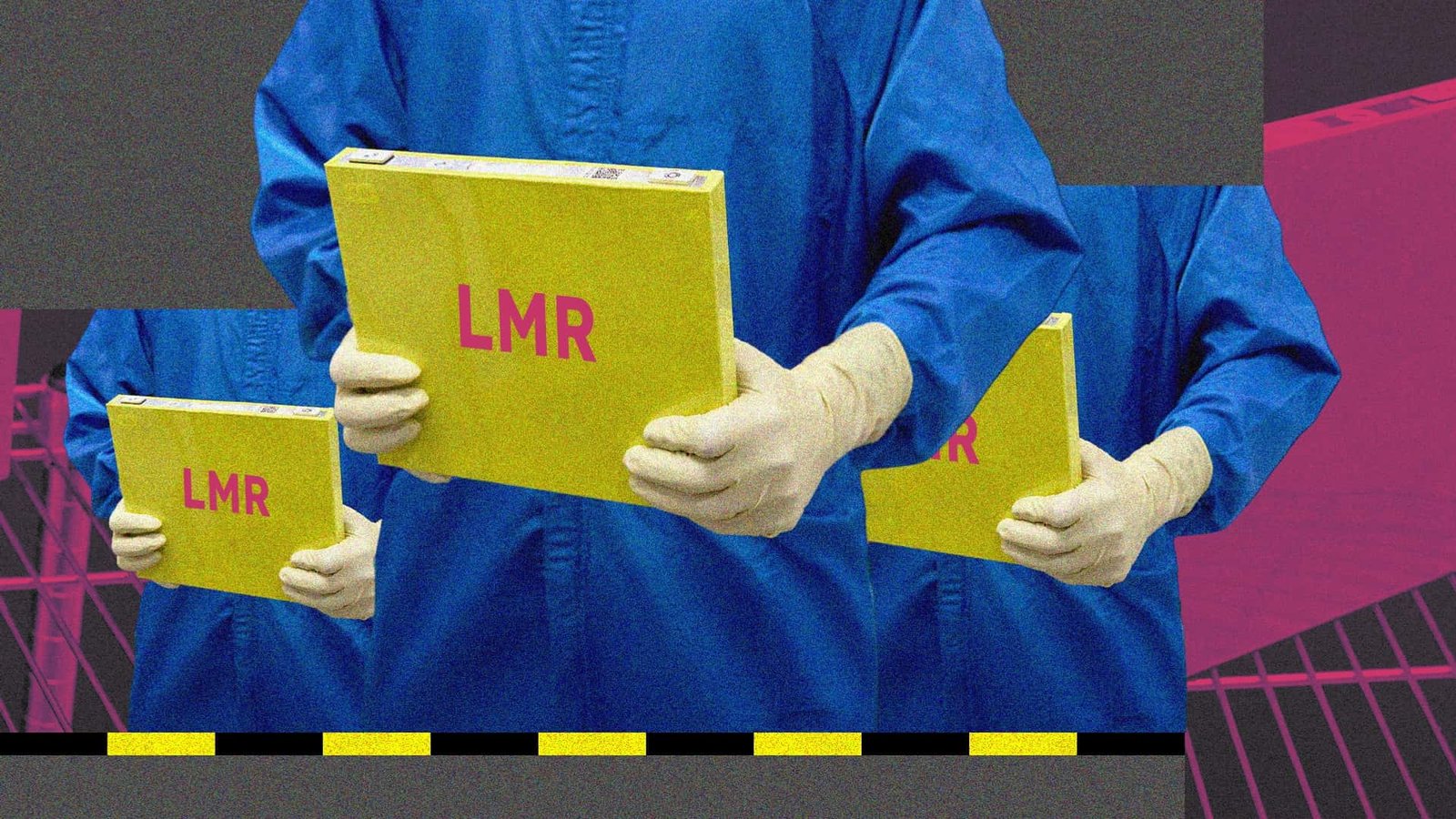
The research labs inside General Motors' Global Technical Center aren't what spring to mind when you think of a traditional car company. The labs in Warren, Michigan, just north of Detroit, are top-secret facilities. They have long, empty corridors illuminated with bright white lights. Each corridor is spotless, feeling clinical and eerie. Few windows offer a glimpse at the scientists working in full safety suits. It’s a strikingly futuristic setup for a company that has a long history of making combustion engines. But what those scientists are working on is, in many ways, even more important: the next-generation lithium manganese-rich (LMR) batteries that will power GM’s future electric vehicles. About 30 miles from this facility, Ford is also developing its own LMR batteries at its Ion Park research hub in Romulus, southwest of Detroit. The Dearborn automaker has been working on these batteries for four years and recently reached a breakthrough, announcing the start of pilot production in Michigan. This is when automakers make small-scale versions to test and refine them before full-blown manufacturing begins. If either American automaker can pull this off—or, ideally, both—then the United States may have a chance to outmaneuver China in the EV and battery race. Photo by: InsideEVs As China has run away with a massive technology lead, America’s auto giants are grappling with unpredictable regulations, tariffs and the end of emissions rules that promised to accelerate EV adoption. Even before the Trump administration threw the Biden-era EV initiatives into chaos, automakers struggled with profitability and high costs—often because of the batteries themselves and also due to China’s stranglehold on supply chains. U.S. automakers are now looking to carve out an electric future of their own. GM and Ford say LMR can help them achieve that goal. This new chemistry should reduce the cost of EVs, making them more accessible without sacrificing range and performance. InsideEVs interviewed engineers from both companies to understand what exactly these novel LMR batteries are and how they’re overcoming engineering challenges. Welcome To General Motors’ Battery Kitchen Photo by: Suvrat Kothari Making EV batteries is, in many ways, harder than building internal combustion engines. They are chemically complex with far more variables on the molecular level. Even for R&D and small-scale testing, they require large halls full of equipment, millions of dollars in investments and deep technical skills—an area where China, Japan and Korea have huge advantages. Inside GM’s Kettering R&D lab—named after legendary American inventor Charles Kettering—material scientists showed the machines they work on all day. Waist-high metal boxes line the rooms. Each one is a testbed for the powders and slurries that make up a battery cell. Large tubes flow from the ceiling for ventilation, air filtration and to supply specific gases or compressed air for the chemistry experiments. One engineer showed me a machine used for “cathode material synthesis,” the scientific process of making the powder-like mix that makes up the cathode. Another explained “electrolyte development and characterization,” which involves developing the material that sits between the anode and cathode. A third engineer described the process like chefs in a restaurant. The electrode slurry, a thick black material, turns into a “cake batter” in what she jokingly called a KitchenAid mixer. Once it reaches a “honey-like texture” in the mixer, it's smeared onto thin sheets of metal and baked in an oven, “just like cookies.” The wet slurry or "cake batter" that's made of cathode active materials, a binder and solvent which goes on to form the energy storing part of the battery cell. Photo by: General Motors When the cells developed here meet certain criteria, they go to the Wallace Battery Innovation Center—named after Bill Wallace, who spearheaded battery development for the Chevy Volt, Bolt EV and Malibu Hybrid—within the same campus for advanced testing. Getting Ahead Of China For the past five years, GM engineers have been using their research labs to develop the LMR cells, starting at the small coin cell level—smaller than a penny—to building their first automotive-grade cells this year. These cells aren’t radically different from the nickel manganese cobalt (NMC) cells currently dominant in GM EVs. But they should solve the cost issues that plague many current batteries, GM claims. China holds a commanding grip on the raw materials that power most electric vehicles sold in the U.S. and around the world. Today’s EV batteries rely heavily on nickel and cobalt—China dominates the supply chain at every step. Roughly 85% of global battery cell production happens there, along with 65% of the world’s nickel refining and an overwhelming 75% of cobalt refining, according to a recent report from the International Energy Agency. LFP vs NMC battery adoption Photo by: InsideEVs The cheaper lithium-iron phosphate (LFP) batteries are a promising alternative to nickel-based ones, but China’s lead in LFP battery production is even bigger, with nearly all EVs with LFP batteries sold in the U.S. and Europe in 2024 using packs made in China. It’s a strategic advantage that no other country can replicate. What adds to the challenge is that both nickel and cobalt are not only in high demand but also more difficult and costly to mine and refine. GM engineers said manganese, by contrast, is more abundant, easier to process and far less expensive, making it an increasingly attractive alternative to counter China’s chokehold on battery materials. At GM's Wallace Battery Cell Innovation Center, the automaker conducts advanced cell testing. Photo by: Suvrat Kothari Over the years, automakers have moved from using traditional NMC batteries, which use equal portions of nickel, manganese and cobalt, to high-nickel batteries, which use less cobalt and manganese, but higher nickel content. The next logical step towards cost reduction, GM says, is to reduce the nickel content and increase the portion of manganese, giving birth to what’s called the lithium manganese-rich (LMR) battery. There’s not a lot of manganese production in North America, but it’s an opportunity to finally start producing it here to move away from China’s dominant
नवीन एवं नवीकरणीय ऊर्जा मंत्रालय
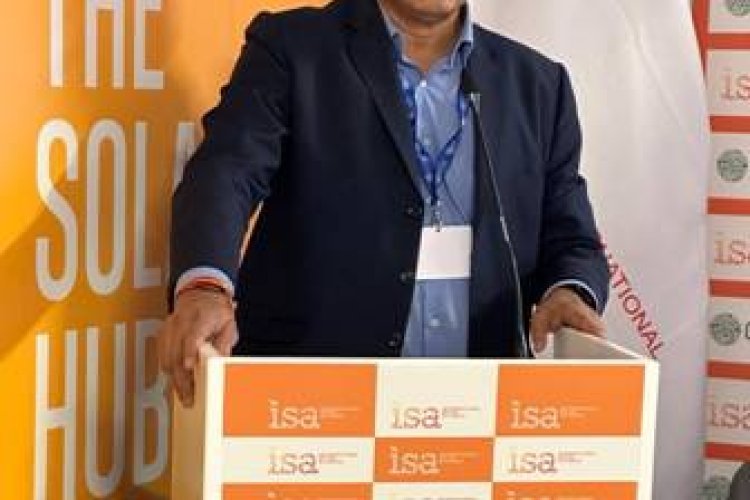
नवीकरणीय ऊर्जा उपयोग के परिवर्तन में सूक्ष्म, लघु एवं माध्यम उद्यमों के योगदान को बढ़ाने के लिए दोहरे वित्तपोषण दृष्टिकोण को अपनाया जा रहा है: सीओपी 28 में आईआरईडीए के मुख्य प्रबंध निदेशक प्रदीप कुमार दास भारतीय नवीकरणीय ऊर्जा विकास एजेंसी लिमिटेड (आईआरईडीए) के अध्यक्ष और मुख्य प्रबंध निदेशक श्री प्रदीप कुमार दास ने नवीकरणीय ऊर्जा क्षेत्र में सूक्ष्म, लघु और मध्यम उद्यमों (एमएसएमई) के आर्थिक और पर्यावरणीय योगदान दोनों पर बल देते हुए उन्हें ऋण प्रदान करने के महत्व पर प्रकाश डाला है। दुबई में आज, 10 दिसंबर, 2023 को सीओपी 28 के हिस्से के रूप में अंतर्राष्ट्रीय सौर गठबंधन और सीआईआई द्वारा आयोजित “सूक्ष्म, लघु और मध्यम उद्यमों में अग्रणी स्थिरता: वैश्विक विकास और स्थानीय प्रभाव की कल्पना” पर एक सत्र के दौरान, उन्होंने पर्यावरणीय स्थिरता को बढ़ावा देने के लिए भारतीय नवीकरणीय ऊर्जा विकास एजेंसी लिमिटेड (आईआरईडीए) की प्रतिबद्धता दोहराई। श्री दास ने बताया कि इस प्रतिबद्धता में सुलभ ऋण सुविधाओं के माध्यम से नवीकरणीय क्षेत्र में सूक्ष्म, लघु और मध्यम उद्यमों (एमएसएमई) की भागीदारी बढ़ाना, एक स्थायी भविष्य के लिए संगठन के समर्पण को मजबूत करना शामिल है। मुख्य प्रबंध निदेशक महोदय ने पर्यावरणीय स्थिरता में सूक्ष्म, लघु और माध्यम उद्यमों (एमएसएमई) द्वारा निभाई जाने वाली महत्वपूर्ण भूमिका पर बल दिया और बताया कि सूक्ष्म, लघु और माध्यम उद्यम वर्तमान में वित्त वर्ष 22 में कंपनी की कुल ऋण परिसंपत्तियों का लगभग 2 प्रतिशत हिस्सा है। भारतीय नवीकरणीय ऊर्जा विकास एजेंसी लिमिटेड (आईआरईडीए) सूक्ष्म, लघु और माध्यम उद्यमों (एमएसएमई) के सामने आने वाली चुनौतियों का लगातार समाधान करने के लिए समर्पित है और नवीकरणीय ऊर्जा क्षेत्र में सक्रिय रूप से उनकी भागीदारी बढ़ाने की दिशा में काम कर रहा है। उन्होंने यह भी रेखांकित किया कि सकल घरेलू उत्पाद की वृद्धि में कृषि क्षेत्र और सूक्ष्म, लघु और माध्यम उद्यमों (एमएसएमई) का सबसे बड़ा योगदान है। भारतीय नवीकरणीय ऊर्जा विकास एजेंसी लिमिटेड (आईआरईडीए) के अध्यक्ष और मुख्य प्रबंध निदेशक श्री प्रदीप कुमार दास ने स्वीकार किया कि सूक्ष्म, लघु और माध्यम उद्यमों (एमएसएमई) के उद्यमियों के लिए एक महत्वपूर्ण बाधा उचित ब्याज दरों पर ऋण हासिल करना है। हालाँकि, भारतीय नवीकरणीय ऊर्जा विकास एजेंसी लिमिटेड (आईआरईडीए) ने "व्यवसाय करने में सुगमता" में सुधार लाने में पर्याप्त प्रगति की है। इसमें फेसलेस ऋण स्वीकृतियों और संवितरण का कार्यान्वयन, ऋण स्वीकृति और संवितरण चक्र में शामिल दस्तावेज़ीकरण में कमी, साथ ही पूरे देश में भौगोलिक पहुंच का विस्तार करना शामिल है। श्री दास ने मुफिन ग्रीन फाइनेंस के माध्यम से ई-रिक्शा को ऋण देने से संबंधित एक सफल केस स्टडी पर प्रकाश डालते हुए जानकारी दी कि भारतीय नवीकरणीय ऊर्जा विकास एजेंसी लिमिटेड (आईआरईडीए) ने मौजूदा ब्याज दरों को 30 प्रतिशत से 36 प्रतिशत से काफी कम 18 प्रतिशत तक कम करने के लिए हस्तक्षेप किया। पहले बिना बैंक योग्य वाले क्षेत्रों को बैंक योग्य बनाने के अपने ट्रैक रिकॉर्ड का लाभ उठाते हुए, उन्होंने विश्वास व्यक्त किया कि कंपनी की पहल के परिणामस्वरूप हरित ऊर्जा क्षेत्र में सूक्ष्म, लघु और माध्यम उद्यमों (एमएसएमई) की भागीदारी बढ़ेगी। भारतीय नवीकरणीय ऊर्जा विकास एजेंसी लिमिटेड (आईआरईडीए) के अध्यक्ष और मुख्य प्रबंध निदेशक श्री प्रदीप कुमार दास ने पीएम-कुसुम योजना के अंतर्गत वित्तपोषण के माध्यम से देश भर में किसानों को अपने कार्बन उत्सर्जन को कम करने के लिए प्रोत्साहित करने की भारतीय नवीकरणीय ऊर्जा विकास एजेंसी लिमिटेड (आईआरईडीए) की अटूट प्रतिबद्धता को भी रेखांकित किया। सूक्ष्म, लघु और माध्यम उद्यम (एमएसएमई) को बढ़ावा देने और पीएम-कुसुम योजना की सफलता में योगदान देने के लिए एक सक्रिय कदम में, भारतीय नवीकरणीय ऊर्जा विकास एजेंसी लिमिटेड (आईआरईडीए) ने हाल ही में अपना रिटेल डिवीजन शुरू किया है। अपनी स्थापना के तुरंत बाद, रिटेल डिवीजन ने अपना पहला ऋण स्वीकृत किया, कुसुम-बी के अंतर्गत जिसकी राशि 58 करोड़ रुपये थी। 10 DEC 2023 7:48 PM by PIB Delhi
CPCA estimates China's May NEV wholesale to grow 38% year-on-year to 1.24 million
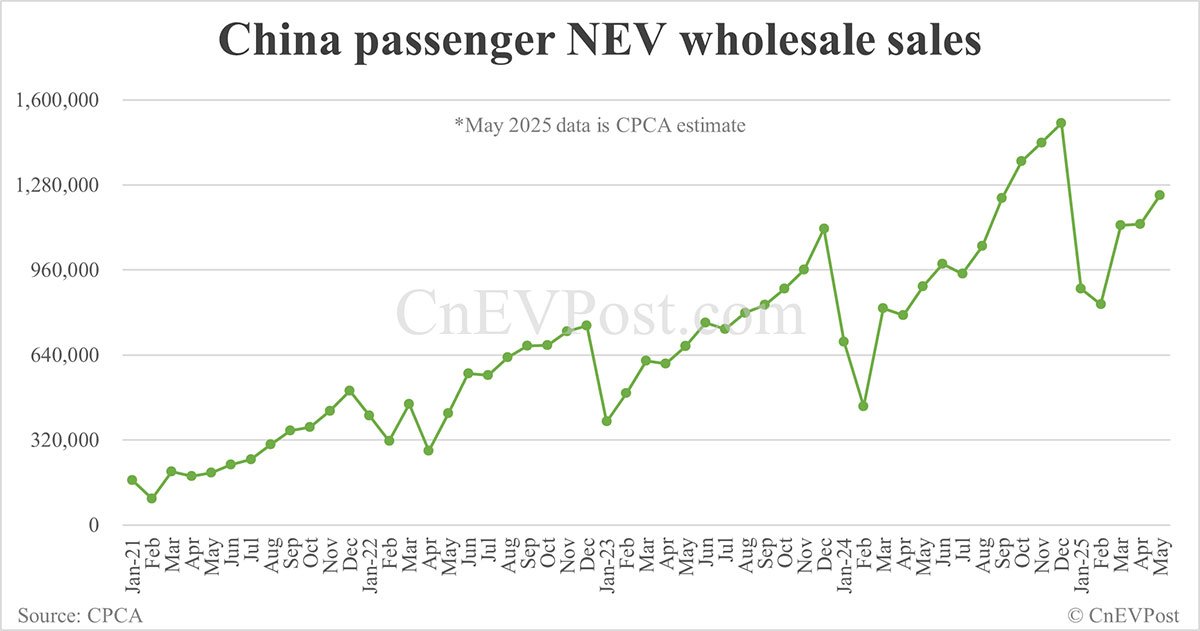
In May, China's passenger NEV wholesale sales are estimated to have reached 1.24 million units, up 38 percent year-on-year and 9 percent month-on-month. In the first five months of the year, China's NEV wholesale sales are estimated to have reached 5.22 million units, up 41 percent year-on-year. China's overall new energy vehicle (NEV) sales continued to grow last month. In May, China's passenger NEV wholesale sales are expected to reach 1.24 million units, up 38 percent year-on-year and 9 percent month-on-month, according to a report released today by the China Passenger Car Association (CPCA). In April, manufacturers with passenger NEV wholesale sales exceeding 10,000 units accounted for 90 percent of the month's total NEV wholesale sales, CPCA said. Preliminary figures for these manufacturers' passenger NEV sales in May totaled 1.13 million units. Based on last month's sales structure, China's passenger NEV wholesale sales in May are expected to reach 1.24 million units, the CPCA said. In China, NEVs include battery electric vehicles (BEVs), plug-in hybrid electric vehicles (PHEVs), and fuel cell vehicles. Their specific figures are expected to be released later this month. China's local governments have introduced policies to promote car purchases, and offline events such as auto shows have also contributed to the positive trend in the car market in May, according to the CPCA. In the first five months of the year, China's NEV wholesale sales are estimated to have reached 5.22 million units, up 41 percent year-on-year, according to the CPCA. Among major automakers, BYD (HKG: 1211, OTCMKTS: BYDDY) had 376,930 NEV wholesale sales, Geely 138,021, Changan 88,264, SAIC-GM-Wuling 65,390, and Tesla (NASDAQ: TSLA) 61,662. Data released earlier this month by BYD showed that it sold 382,476 NEVs in May, up 15.27 percent year-on-year and 0.63 percent month-on-month. Its passenger NEVs sold 376,930 units in May, up 14.05 percent year-on-year and up 1.16 percent month-on-month. In May, China's passenger NEV retail sales are expected to be 980,000 units, with penetration at around 52.9 percent.
Tesla customers are still being targeted by automaker with Musk rivalry
Tesla shares are up nearly 20 percent in the past month, but that is not stopping the only trillion-dollar automaker from attracting all types of new potential sectors to disrupt, at least from an investor and analyst perspective. Morgan Stanley’s Adam Jonas is not one to shy away from some ideas that many investors would consider far-fetched. In a recent note, Jonas brought up some interesting discussion regarding Tesla’s potential in the eVTOL industry, and how he believes CEO Elon Musk’s answer was not convincing enough to put it off altogether. Tesla’s Elon Musk says electric planes would be ‘fun problem to work on’ Musk said that Tesla was “stretched pretty thin” when a question regarding a plane being developed came up. Jonas said: “In our opinion, that’s a decidedly different type of answer. Is Tesla an aviation/defense-tech company in auto/consumer clothing?” Musk has been pretty clear about things that Tesla won’t do. Although he has not unequivocally denied aviation equipment, including planes and drones, as he has with things like motorcycles, it does not seem like something that is on Musk’s mind. Instead, he has focused the vast majority of his time at Tesla on vehicle autonomy, AI, and robotics, things he sees as the future. Tesla and China, Robotics, Pricing Morgan Stanley’s note also discussed Tesla’s prowess in its various areas of expertise, how it will keep up with Chinese competitors, as there are several, and the race for affordable EVs in the country. Tesla is the U.S.’s key to keeping up with China “In our view, Tesla’s expertise in manufacturing, data collection, robotics/ physical AI, energy, supply chain, and infrastructure are more critical than ever before to put the US on an even footing with China in embodied AI,” Jonas writes. It is no secret that Tesla is the leader in revolutionizing things. To generalize, the company has truly dipped its finger in all the various pies, but it is also looked at as a leader in tech, which is where Chinese companies truly have an advantage. Robotics and the ‘Humanoid Olympics’ Jonas mentioned China’s recent showcasing of robots running half marathons and competing in combat sports as “gamification of robotic innovation.” Tesla could be at the forefront of the effort to launch something similar, as the analyst predicts the U.S. version could be called “Humanoid Ninja Warrior.” Pricing Tesla is set to launch affordable models before the end of Q2, leaving this month for the company to release some details. While the pricing of those models remains in limbo with the $7,500 tax credit likely disappearing at the end of 2024, companies in China have been able to tap incredibly aggressive pricing models. Jonas, for example, brings up the BYD Seagull, which is priced at just about $8,000. Tesla can tap into an incredibly broader market if it can manage to bring pricing to even below $30,000, which is where many hope the affordable models end up. During the Q3 2024 Earnings Call, Musk said that $30,000 is where it would be with the tax credit: “Yeah. It will be like with incentive. So, 30K, which is kind of a key threshold.”
Dürr and Grob present battery concept factory
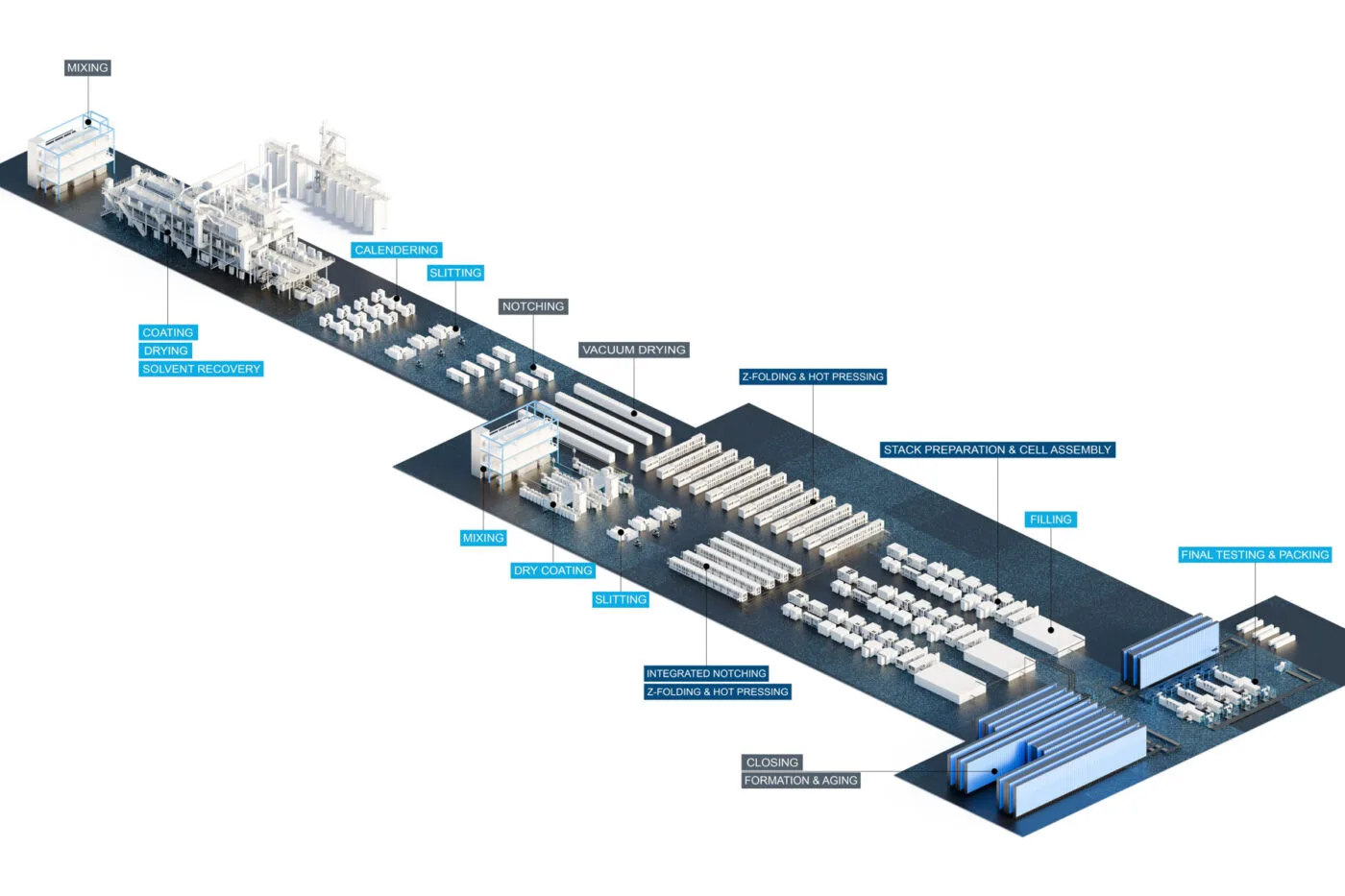
At the Battery Show Europe, the two partners Dürr and Grob are presenting their new concept factory for lithium-ion battery cells. The optimised production is intended to offer ‘more performance and the highest battery cell quality’ – with lower energy and space requirements. Dürr and Grob want to demonstrate several technical innovations with the concept factory. Key technologies include dry coating of the electrodes, which does not require a drying process, and high-performance Z-folding technology for cell assembly with integrated notching, according to the two companies. Dürr and Grob have been cooperating since 2022 to establish themselves as a system provider of battery production systems in Europe and North America. The mechanical engineering company Manz was previously also part of this German battery production alliance, but with Manz’s insolvency, Dürr and Grob have decided to continue their projects as a duo. In addition to the conventional wet coating of battery electrodes, the two partners can now also offer production systems with dry coating. “Our concept factory and dry coating in particular represent the next generation of battery cell production,” says Jochen Weyrauch, CEO of Dürr AG. “Thanks to powerful and innovative technologies, production requires 50 percent less space and energy. This means significantly higher space efficiency and lower operating costs for our customers.” German Wankmiller, CEO of the Grob Group, adds: “With our expanded portfolio of high-availability machines and systems, together we cover almost the entire value chain for battery cell production with our own technologies. By dry coating the electrodes, the large and energy-intensive drying ovens in the battery factory can be dispensed with, for example, and the systems for recovering and processing solvents become superfluous. Instead of the conventional slurry, a dry-mixed active material is used in the “Activated Dry Electrode” process. This powder mixture is pressed into a free-standing film using calendering machines, which is then laminated onto both sides of the collector foil. “The free-standing film also has advantages in terms of material efficiency, as excess film material can be completely returned to the production process before being laminated onto the collector foil. After calendering, the basis weight can be measured directly, allowing better control of the coating thickness. Less force is required for the subsequent lamination onto the collector foil than for calendering in the wet coating process, so there is no deformation of the foil, which improves processability for downstream notching and stacking,” the partners explain in the press release. Another innovation for Dürr and Grob production systems is the so-called Z-folding, which boasts an integrated notching process. This makes the space requirement of the system smaller. “For a particularly stable and reliable system technology, the separator is guided over a few deflection rollers with a very uniform and low web tension. Thanks to high-quality electrode magazine technology, the system achieves an availability of 95 per cent,” say the companies. The filling of the almost finished battery cells with an electrolyte has also been improved, with the systems operating at a significantly higher pressure than before, reaching up to 30 bar. This should not only shorten the filling process, but also enable precise dosing. Wet coating processes have been further optimised in terms of performance and energy efficiency, in case customers prefer this technology. At the Battery Show Europe in Stuttgart (until June 5), Dürr and Grob will be presenting their concept factory as a physical 3D model. Other technologies will also be demonstrated at the joint stand, such as the end-to-end digitalisation of production. This begins in the planning phase with a digital twin and extends to traceability and quality analysis in ongoing production durr.com
Snapshot of China's critical mineral export controls
Global automakers are sounding the alarm on an impending shortage of rare earth magnets as China’s restrictions on the material vital for the automotive, defence and clean energy industries threaten production delays around the world. German automakers became the latest to warn that China’s export restrictions threaten to shut down production and rattle their local economies, following a similar complaint from an Indian EV maker last week. U.S., Japanese and South Korean automakers warned President Donald Trump on May 9 car factories could close. The restricted rare earths joined an export control list with over a dozen minerals and related materials already listed, in each case forcing exporters to apply to Beijing for licenses before selling overseas. China has also separately banned exports of gallium, germanium and antimony to the United States. Below is a summary of all Beijing’s mineral export restrictions since 2023: RARE EARTHS China placed some rare earth magnets and seven rare earth elements – samarium, gadolinium, terbium, dysprosium, lutetium, scandium and yttrium – along with related items on an export control list in April. While the announcement coincided with a broader package of retaliation against Washington’s tariffs, the controls apply globally and the government’s press release made no mention of the United States. China produces around 90% of the world’s rare earths, a group of 17 elements used across the defense, electric vehicle, energy and electronics industries. The U.S. has only one rare earths mine and most of its supply is sent to China for refining. While common in the Earth’s crust, China has mastered the technically difficult and environmentally harmful refining process. It produces almost 90% of global refined output. China has spent years tightening its control over the rare earths sector. In December 2023, Beijing banned the export of technology to make rare earth magnets, adding it to an existing ban on refining technology. Domestic production is tightly controlled by a system of quotas which are only granted to state-owned miners. TUNGSTEN, INDIUM, BISMUTH, TELLURIUM AND MOLYBDENUM China imposed export controls on the five metals used in defence, clean energy and other industries in early February, shortly after U.S. President Donald Trump’s first 10% tariff on Chinese goods took effect. Licences are now required to export 20 tungsten, tellurium, bismuth, indium and molybdenum-related products. However the curbs stopped short of outright bans and were narrowly targeted in the cases of some metals, like molybdenum. BATTERY, LITHIUM AND GALLIUM PROCESSING TECHNOLOGY China in January proposed to restrict the export of some technology used to make cutting-edge battery components and process critical minerals lithium and gallium. The announcement did not say when the proposed changes, which were open for public comment until early February, could come into force. At least one company has stopped exporting products on the list since the proposal was floated. ANTIMONY, GALLIUM, GERMANIUM Last December, Beijing banned the export of the three critical minerals to the U.S. in response to a fresh crackdown on China’s chip sector from Washington. The outright ban only applies to the U.S., however over the 18-months prior China had steadily introduced export licensing regimes for the three metals. In the case of antimony, a strategic metal used in flame retardants, solar power equipment and munitions, exports to big buyers like Japan, India and South Korea had barely restarted three months after export licenses were introduced. China dominates the supply chain for the three metals and mines or refines between half and 90% of global supply of those minerals. GRAPHITE In October 2023, China said it would require export permits for some graphite products to protect national security. China is the world’s top graphite producer and exporter, and also refines more than 90% of the world’s graphite into a material that is used in virtually all EV batteries. Previous articleDürr and Grob present battery concept factory Next articleBASF begins production of black mass in Germany
Will the Capacity Market in Germany help or hurt BESS?
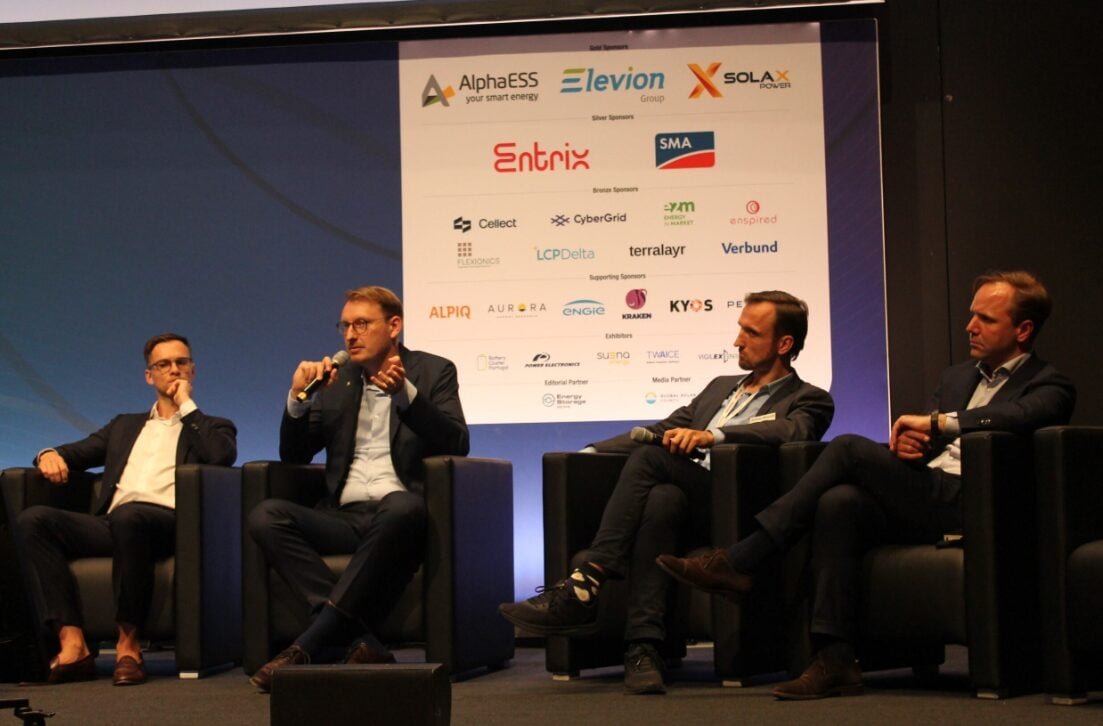
Capacity Markets (CM) have been launched in the UK, Italy, Belgium and Poland to name just a few in Europe, and battery energy storage system (BESS) technology has won increasingly large shares of the long-term revenue contracts they provide. In some places, like Poland, it provides the bedrock of the BESS business case. The Energy Storage Summit Germany is co-located with Informa’s The Battery Show Europe 2025, and the two events run side by side for three days, collectively covering both the European battery industry and the downstream battery energy storage system (BESS) deployment market in Germany. ‘Situation is much more critical this time’ Germany initially debated launching a CM some 12 years ago but decided that the investment signals from the energy market would suffice. The debate has resurfaced now, but the situation is much more critical as the new capacity investments that are needed have not happened, explained transmission system operator (TSO) TransnetBW’s senior specialist for national and European capacity mechanisms, Sebastian Schleich. The most recent coalition has said that it wants to launch a CM, with 2028 touted as a potential date, but also separately said that it wants 20GW of new gas-fired power plant capacity. Numerous sources during the event have said that the former is being used as a way for it to achieve a latter, meaning it won’t truly be technology-agnostic. ‘CM is a terrible idea for Germany’ Some panellists pulled no punches discussing it. Developer Kyon Energy‘s founder and MD Philipp Merk said it was a terrible idea for two reasons. “We need to keep the price signals in tact. One great example of what happens when the state meddles too much with a market is the (notoriously unreliable) German train system,” he said. “Point two. We recently ran a study along with other companies that are concerned about a ‘lock-in’ effect and a capacity market that’s tailored completely around gas. It’s definitely not technology-agnostic. “We are proposing an update of the current market design where balancing managers need to take into account the reliability of forecasted load to cover their demand and do more to hedge those risks. This would keep price signals intact. I think this would be a way where we don’t end up paying billions for gas-fired power plants that we would not need in the end and that are not the most economic way of going about it.” His comments followed those from Fluence’s growth manager Tobias Nitsch earlier in the day, on a different panel, who made a similar point about the CM not being technology-agnostic. “If it is designed in a proper way such that BESS can contribute, the revenues will be like a toll and banks and insurers really like that. But, if for example the de-rating factor is too high then it’s little more than an incentive for gas. We implore the regulators to keep it technology-agnostic,” Nitsch said. Harmony Energy’s Stefan Tait similarly said: “Technology moves much faster than regulation. There is a danger you frame a market to be too focused on a certain technology.” Germany should follow other examples Kilian Leykam, head of energy storage for developer-operator Aquila Clean Energy, had a very different view. “We think it’s a good idea to implement a capacity market, not because it’s needed for the battery business case in Germany but because it helps to structure the overall political discussion that we are having,” he said. “The capacity markets seen elsewhere structure the discussion of what capacity in a country is needed. Because in Germany, we currently see a very unstructured discussion. Finding an optimal size for each specific technology is very difficult if you do it separately. Having a market which makes basically different assets comparable to how they contribute to system security, we think is really beneficial for structuring the discussion.” “This is something where Germany does not need to go a new way. There are numerous examples across Europe which look fairly similar. There is an EU-approved concept which can be implemented relatively quickly. We need to just stick to the simple mechanism that has been proven in other European countries.” Investor Copenhagen Infrastructure Partners’ (CIP) VP energy origination Andreas Metschke was more on the fence but agreed slightly more with Leykam, also stressing the need to stick to what has worked. “If we are going for this, let’s not have the complexity explosion that sometimes happens in the German context. Let’s keep it simple and get it done with if we need to have it. I agree it’s probably going that way. So get it done already and keep it simple,” he said. TransnetBW’s Schleich also, perhaps unsurprisingly, agreed it was needed: “We, as a system operator, think that the implementation of a capacity market, is is necessary to ensure security of supply. And I agree with not making it too complex. We’d vote for a centralised CM with a local component.” “And it must be designed in a technology-neutral way. I do not agree that it would be designed around gas-fired power plants. And we see that BESS play a really important role in the CM in other countries.” He added that he was sceptical that an implementation of the CM in Germany by 2028 was possible. Separate auctions to procure the stated gas capacity may come before then. How will it impact the BESS business case? The next, big question was about how the CM would impact the business case for BESS. Kyon’s Merk said the optimistic view was that it was well-designed, with a fair de-rating factor, and provided a baseline of revenues which helped financing projects. “The more pessimistic view, which I tend to take, is it is designed with gas plants in mind and then we’ll need to deal with it. We will put up a viable business case. Remember all this BESS being built right now is doing so with zero taxpayer money, and suddenly we’ll be competing with something that’s to a
BASF begins production of black mass in Germany
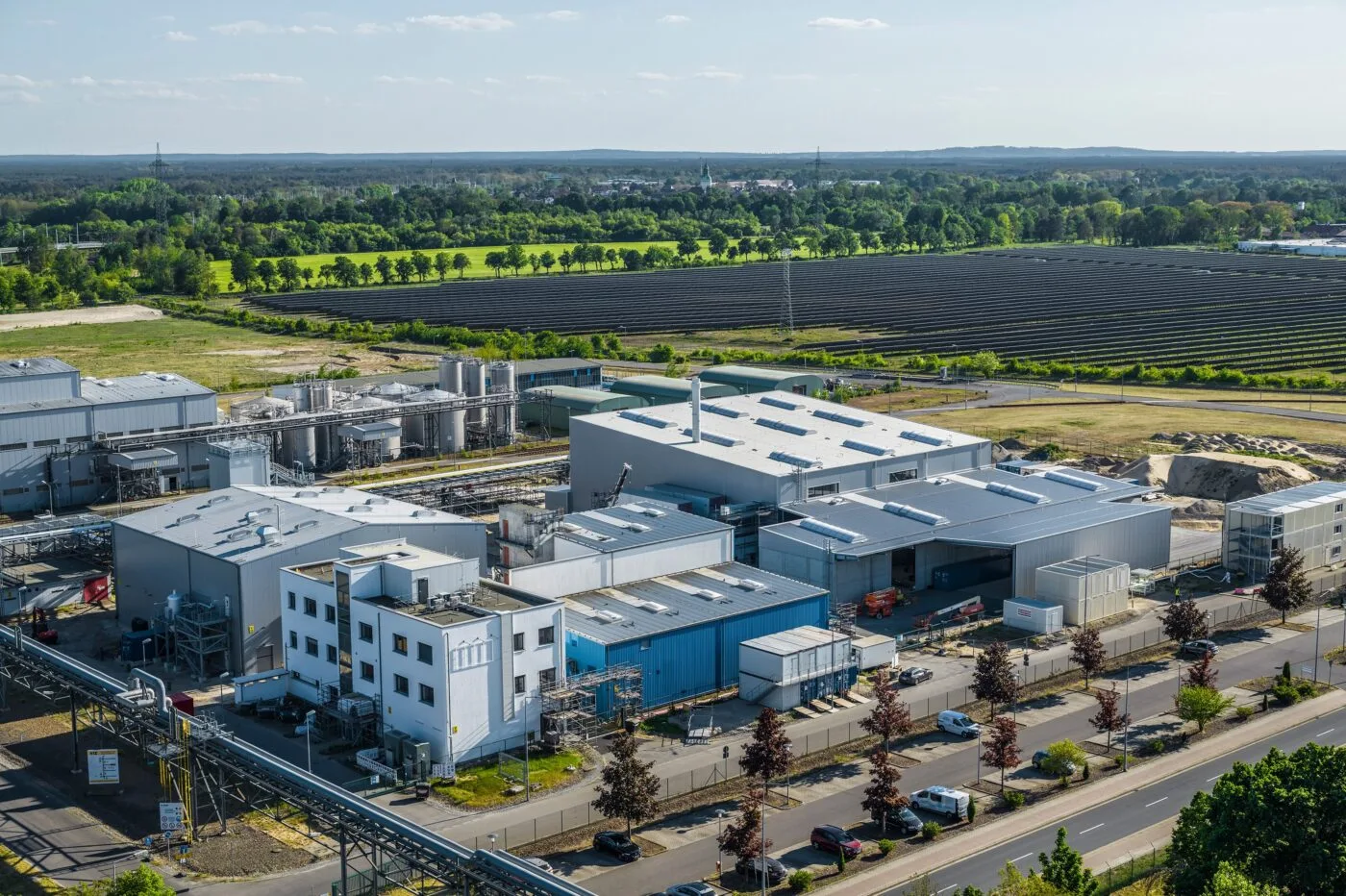
BASF has successfully commissioned its black mass production plant in Schwarzheide, Brandenburg. The German plant is one of the largest commercial black mass plants in Europe, with an annual processing capacity of up to 15,000 tons of spent lithium-ion batteries and production scrap. This corresponds to around 40,000 electric car batteries per year. BASF first presented the plans for the Schwarzheide battery recycling plant in June 2022. Commissioning was originally planned for the beginning of 2024, but it has now taken considerably longer. The new battery recycling plant can now complement BASF’s fully automated large-scale production plant for cathode materials and a prototype metal refinery for battery recycling at the site, as planned. The so-called ‘black mass’ is produced in the first phase of battery recycling. After the mechanical treatment of the battery (i.e. dismantling and crushing), components such as plastics and aluminium can already be filtered out. What remains is the black mass, which contains large quantities of the battery’s active materials – such as lithium, nickel, cobalt and manganese. To separate this mass back into the individual materials (which are then used to produce new cathodes), water and chemicals are used in a hydrometallurgical process. “Our new Black Mass plant is another proof for our commitment to the battery materials and recycling industry, which remains to be one of the most significant growth opportunities in the chemical industry and for BASF Battery Materials. It will become a cornerstone of our offerings to our customers to increase raw materials self-sufficiency and comply with the EU Battery Regulation,” said Dr. Daniel Schönfelder, President of BASF’s Battery Materials division. “With the new Black Mass plant, we strengthen our position as the preferred battery recycling partner for customers along the entire battery recycling value chain in Europe.” Local cooperation partners in Europe include Stena, with a cooperation agreement from early 2024, focused on developing improved processes to achieve high recovery rates for metals such as lithium, nickel and cobalt. Under the agreement, Stena Recycling in Halmstad, Sweden, collects, assesses, and pre-treats end-of-life lithium-ion batteries and scrap from battery production to produce black mass. BASF is further processing and refining the latter in its prototype metal refinery in Schwarzheide, Germany. Stena Recycling and BASF said in 2024, they intended to transfer their model to BASF’s planned commercial-scale metal refinery for battery recycling at a later stage. The annual processing capacity now possible at Schwarzheide is 15,000 tonnes, as planned. In 2021, BASF and CATL announced a strategic partnership in the field of battery materials solutions. The cooperation focuses on active cathode materials and battery recycling while supporting CATL’s localisation strategy in Europe and BASF’s globalisation efforts. For CATL, this is a plant near Erfurt, Germany. CATL opened its first battery factory in Europe in 2023. The company is currently working on further scaling up production in Arnstadt, Germany. The partners aim to develop a sustainable battery value chain using both their facilities in Europe. BASF’s says its offering in Europe now covers all steps along the battery recycling value chain, from collecting end-of-life batteries and production scrap, discharging and dismantling, as well as Black Mass production and refining – “leveraging a strong and reliable partner network in addition to BASF’s own black mass production facility.” basf.com
DHL & Mercedes Benz use Hylane’s ‘pay-to-use’ model for electric trucks
Logistics provider DHL Group, commercial vehicle manufacturer Daimler Truck and commercial emission-free vehicle rental company Hylane signed a cooperation agreement in the field of fully electric trucks at the Transport Logistic trade fair in Munich. The partnership provides for DHL to operate 30 Mercedes-Benz eActros 600 electric trucks via Hylane’s “transport as a service model”. The freshly signed agreement between Hylane, Daimler Truck and DHL means that DHL will not buy the vehicles, but Hylane will invoice DHL on the basis of actual kilometres driven. For Hylane, the addition of 30 eActros 600s to the fleet marks a targeted expansion of the existing portfolio, previously focused exclusively on fuel cell electric trucks. Sara Schiffer, Managing Director of Hylane explained that the new agreement is an important milestone in the expansion of Hylane, “through which we are supporting our customers even more comprehensively in the decarbonization of their transports.” Schiffer underlined that Hylane, which was founded in Cologne, Germany, in 2021, is going to be a provider open to all technologies that enable the emission-free operation of commercial vehicles. “We are consciously focusing on battery and hydrogen-powered trucks in order to offer the best solution depending on the intended use. The Mercedes-Benz eActros 600 from Daimler Truck, which recently won the International Truck of the Year award, has been available for logistics operations since December 2024, boasting 600 kWh battery capacity and a range of around 500 kilometres. The German automotive giant says that intermediate charging during statutory breaks even makes over 1,000 kilometres per day possible. The deal now begun with Hylane brings the German commercial vehicle rental company together with international heavyweights DHL and Mercedes-Benz Trucks. With a presence in over 220 countries and territories worldwide and 600,000 employees, DHL Group claims to be “the world’s leading logistics company.” Alone so far this year, DHL has announced it will open the UK’s largest EV battery service centre, that it is opening more electric vehicle centres in Asia, that it made electric vehicle deals with Kia, Daimler Truck brand Fuso, and with CATL for storage solutions for its logistics parks. Schiffer acknowledges, “The fact that we are taking this step together with Daimler Truck as the leading vehicle manufacturer and DHL as the first user of the trucks is particularly valuable for us and a great start to the new business segment.” The 30 heavy-duty long-haul electric trucks are to be delivered by the end of the second quarter of 2026 and will be used in the Post & Parcel Germany division between its parcel centres. daimlertruck.com
IEA report: Dimensions and trends of the global battery market
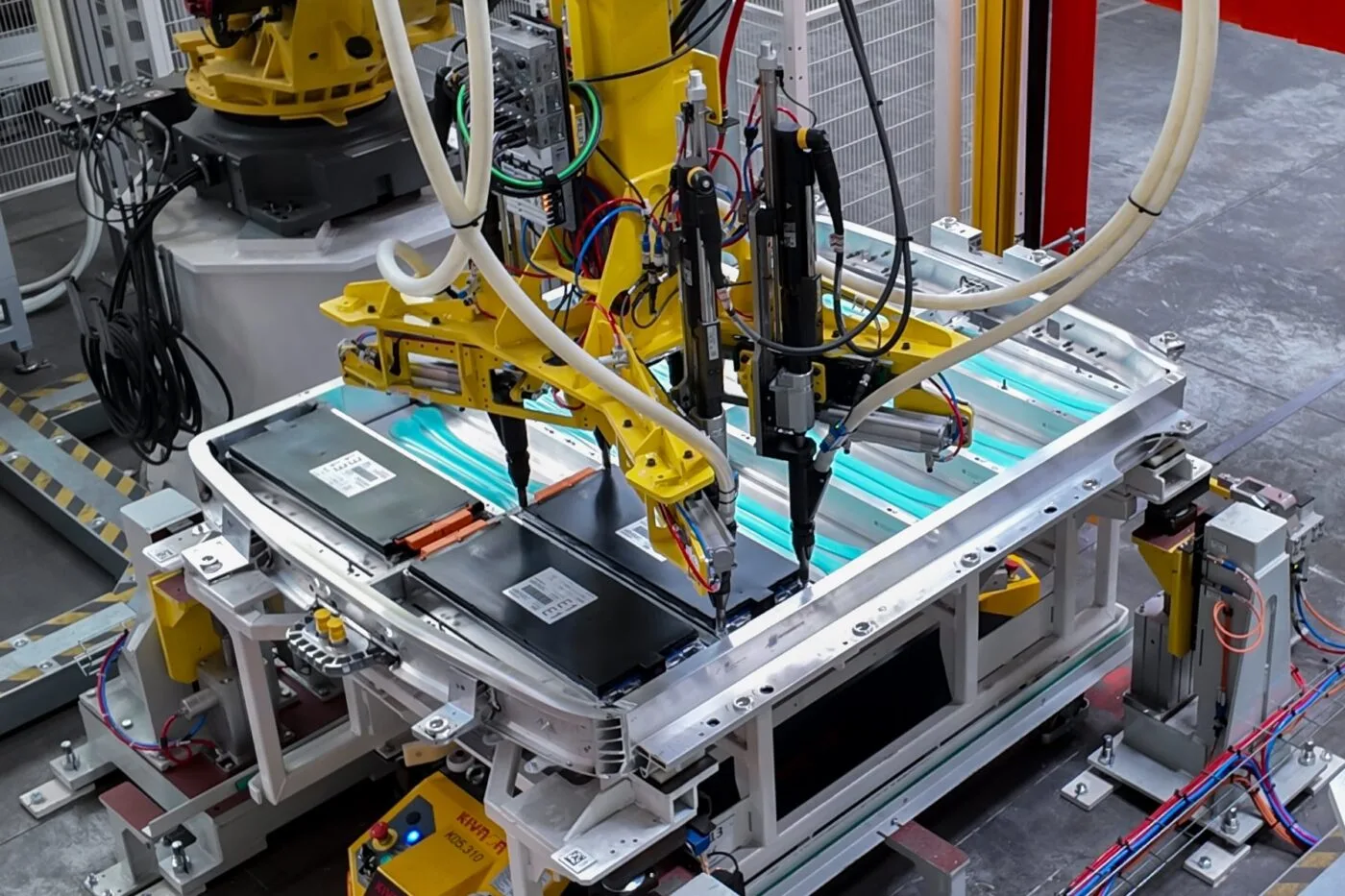
China dominates the market and supply chains, the increasingly popular LFP battery makes energy storage more affordable and the demand for electric trucks is becoming a factor in the battery market – these are some of the key messages to emerge from a new assessment by the International Energy Agency. We have the details. The International Energy Agency (IEA) traces the development of the global electric vehicle battery market in 2024 and reveals details on geographical market distribution, chemistry and price trends. It was already known from a previous IEA publication that battery demand in 2024 exceeded the one terawatt-hour mark for the first time. The International Energy Agency counts batteries of all types together. However, as the batteries installed in electric vehicles accounted for 85 per cent of the global battery market last year, it sees the rise above the TWh mark primarily as a result of the growing electric vehicle battery market. In 2024, this market alone is expected to account for a good 950 GWh, which is 25 per cent more than in 2023. “Demand for one average week alone in 2024 exceeded the total demand for an entire year just a decade earlier,” the study authors point out. They estimate that electric cars will remain the main driver of demand for electric vehicle batteries, with a share of over 85 per cent. Electric trucks are catching up: they accounted for almost 3 per cent of global EV battery demand, a growth of 75 per cent compared to 2023. “Electric truck battery demand was driven by growth in China,” the IEA specified. However, demand has also risen in Europe (+25% YoY). China is the largest and most dynamic market If the cake of all EV batteries from 2024 is broken down by region, China accounts for 59 per cent and the EU and the USA each account for 13 per cent. The IEA explains the fact that the latter two are on a par, even though fewer e-cars are sold in the USA, by the fact that around 25 per cent larger batteries per electric vehicle are installed in the USA. The share of emerging and developing countries in global battery demand was just under 5 per cent in 2024, which corresponds to a doubling compared to 2023 (supported by continued growth in Southeast Asia, India and Brazil). The market grew fastest in China (+30% YoY), followed by the USA (+20% YoY), whereas demand in the EU stagnated last year. In its forecasts, however, the IEA assumes that this dynamic will change: For emerging and developing countries, the agency assumes a 10 per cent share of demand by 2030. It also predicts an increasing share for the EU, the UK, Canada, Japan and South Korea, while the authors estimate that the USA will fall to 10 per cent and China to 50 per cent by 2030. Of course, the cake is getting bigger: the IEA expects demand for electric vehicle batteries to exceed 3 TWh by the end of the decade. Battery packs were 20 per cent cheaper in 2024 But back to the present – and the price trend for EV batteries: according to the report, prices for lithium-ion battery packs fell by 20 per cent in 2024, marking the sharpest decline since 2017. This was due to “low critical mineral prices and battery margins being squeezed through competition, predominantly in China,” according to the study authors. Lithium prices in particular fell by almost 20 per cent in 2024, reaching prices similar to those at the end of 2015 (“although lithium demand in 2024 is around six times greater than in 2015”). This is primarily due to a supply surplus. Geographically, prices for battery packs fell in all markets. But the extent of the decline varied significantly, according to the IEA, with the sharpest drop in China (-30% YoY), compared to 10 to 15 per cent in Europe and the United States. “This widened the gap between battery prices in China and the rest of the world, increasing the competitive advantage of Chinese EV and battery producers,” the report states. The faster pace of battery cost reduction and innovation in China has been made possible by fierce competition, which has squeezed profit margins for most manufacturers (“though not all”). LFP chemistry on the rise Battery chemistry also plays an important role in the price trend: lithium iron phosphate (LFP) batteries – the most commonly used battery chemistry in China – are almost 30 per cent cheaper per kilowatt-hour than NMC batteries, which are still the most commonly used in the United States and Europe. The higher energy density of NMC batteries remains an advantage for applications that require longer ranges or operation in cold climates, where LFP technology is typically less effective. “However, LFP batteries have now reached a performance level sufficient for most EV applications, making their lower cost a key advantage for automakers aiming to mass markets,” the IEA experts analyse. In 2024, LFP batteries already accounted for almost half of the global market for electric vehicles. The leader here is China, whose demand for LFP batteries covered almost three-quarters of domestic battery demand in 2024. In the United States, however, the share of LFP batteries used in electric vehicles remains below 10 per cent (“which may be a result of tariffs on Chinese batteries”), while in the EU their share rose by around 90 per cent for the second year in a row, reaching more than 10 per cent of the electric vehicle market. It is worth noting that almost all LFP batteries for electric cars sold in Europe or the United States were manufactured in China. The market penetration of LFP batteries is progressing even faster in other markets: In Southeast Asia, Brazil and India, the share of electric car batteries with LFP will reach more than 50 per cent this year, according to the IEA report. “In Southeast Asia and Brazil, LFP uptake is led by imports from China, mostly
Western Australia expands home BESS rebate scheme
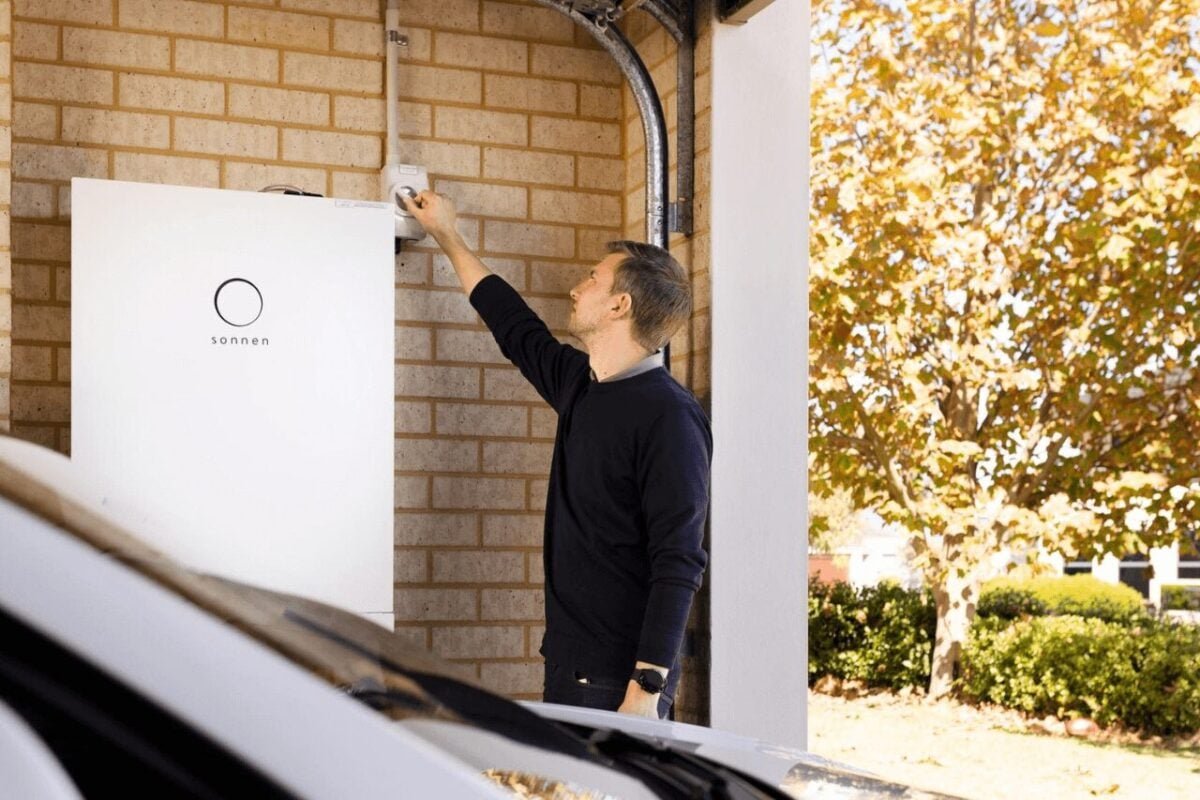
This scheme will have a budget of AU$337 million. The government also confirmed that no-interest loans of up to AU$10,000 will be available for households with an income of less than AU$210,000 per annum. This has been developed in collaboration with the Australian government. It has been confirmed that the loan repayment periods will be up to 10 years. The loan can be used for a home BESS and new or upgraded equipment, such as inverters and solar PV modules, as long as they are installed with the BESS. The home BESS rebate scheme will be available from 1 July 2025, the same date the federal government’s own AU$2.3 billion Cheaper Home Batteries Program comes into effect. Australia’s Cheaper Home Batteries Program was a central pledge made by Anthony Albanese, the Labor Party, in the buildup to the federal election, which Labor won in early May 2025. After this landslide victory, the government quickly confirmed that the programme would be introduced and would help cut the upfront cost of a home BESS by 30%. The two programmes will complement each other and help support the uptake of home BESS to optimise Australia’s vast rooftop solar PV resources, which surpassed 25GW this year. Households that sign up for the Western Australia home BESS Scheme will be required to participate in a virtual power plant (VPP) trial. Western Australia’s premier, Roger Cook, said introducing the new home BESS rebate scheme will deliver on the state government’s election pledge, having won the election earlier this year. “I’m thrilled to see the Albanese Labor government work with my government to expand the Western Australia Household Battery Rebate so it can now benefit around 100,000 households – ensuring it potentially reaches five times as many families than under the State-only scheme,” Cook said. The premier added that the scheme could have a side effect on the Western Australian economy, bolstering local battery manufacturing, which he claims is “crucial” to his vision for the state. Home BESS installed before the commencement of the state government’s scheme will not be eligible for the rebate or loan funding. A list of approved equipment, suppliers and installers for the scheme will also be announced in due course. Plenti Pty, an Australian consumer lender, will administer the scheme. You can find out more details about the scheme on the official website. Battery attachment could soon surpass 100% The home BESS rebate scheme, alongside the federal government’s wider Cheaper Home Batteries Program, aims to increase the percentage of battery attachment, which refers to a home BESS being installed alongside a new solar PV system. According to recent research by consultancy group SunWiz, the battery attachment rate in Australia is expected to soon exceed 100%, which the company has called a “tipping point moment”. SunWiz said that the battery attachment rate in 2024 stood at 22.6%. However, the introduction of the federal home BESS subsidy and Western Australia’s new scheme could provide a significant boost to this figure. However, the consultancy did ease expectations by stating that “we’re not quite there yet”.
UK approves 6GWh of BESS in May
The 2,869MW/5,998MWh of grid-scale battery energy storage system (BESS) awarded planning consent by authorities in May brings the total approved capacity to 61,674MW/128,789MWh, up around 6% month-on-month. However, no new projects were commissioned last month, leaving the UK’s operational capacity unchanged at 6,424MW/9,160MWh. Major BESS projects that were approved in May include the: Those four alone total around half of the total monthly figure, while there were smaller, single-digit planning consent wins for BESS projects including Balance Power’s 29.9MW project in Coylton, East Ayrshire. Having planning consent will be one of the key criteria for projects in the current shake-up of the UK’s grid connection queue being undertaken by energy regulator Ofgem. The government expects the shake-up to unblock the grid connection queues by taking ‘zombie’ projects out of the queue, as reported by our sister site Current. Read the previous two monthly instalments in the ESN Premium series of UK updates from our colleagues at Solar Media Market Research: