Tesla firmware shows new Model Y seat configuration is coming

In what is becoming a more common occurrence, a few Tesla features were used to flunk a 16-year-old who took his driver’s license test in New Jersey. It is not the first time this has happened, as we have reported on several instances of this in the past, both in the U.S. and other countries in the world. It is evidence that some officials are not caught up in the technology and innovation occurring in the automotive market, some of which is not necessarily exclusive to Tesla, but is included in each of its models, unlike other companies. Lochlan Keefer, a New Jersey resident, showed up to his driver’s test with his dad, James, in their 2022 Tesla Model Y. However, the test did not go according to plan, according to the examiner who rode along for the test with Lochlan. They accused him of using parking and “stopping assistance” to go through the test. The examiner cited the following as the reason for failure: “Had the parking and stopping assistance on never stepped on the brake to stop his self let the vehicle stop it self.” James said to NJ.com that they do not subscribe to Tesla’s Full Self-Driving suite, which includes things like Autopark, Navigate on Autopilot, and Autosteer on City Streets. These are a few of the things that have been used as reasoning to fail drivers in tests. Lochlan’s was a case of regenerative braking, which is standard on all vehicles, and Autopark: “The examiner accused my son of using driver assistance features simply because he parallel parked smoothly on the first try. He was specifically accused of using paid parking-assist and driving features, which we do not subscribe to.” It sounds as if the examiner may have confused the braking mishap for Tesla’s regenerative braking, which slows the vehicle when the accelerator is not pressed. The energy is then stored back in the battery to help with range. The examiner failed Lochlan, and James asked if he could take the test again if they disabled the regenerative braking for the exam. The examiner said Lochlan would have to wait two weeks. A supervisor came out and backed the examiner, but James said the policy the DMV claimed the Keefer’s violated was nowhere to be found: “I asked them to show me the policy they claimed we were violating. They couldn’t find it and they couldn’t cite it. When I showed them the policy, they refused to read it.” The report states that drivers in California and Arizona have also been subjected to failures on their driving tests due to confusion over Teslas and their driver assistance features.
Stellantis trials new 5-minute battery swapping tech in Fiat 500e fleet
Stellantis has begun trials for battery swapping technology in the Fiat 500e all-electric hatchback, which could offer a fully-charged battery in 5 minutes. What Happened: The company, which owns various brands like Jeep, Chrysler, Fiat, Peugeot and more, is conducting test runs for the technology in the Spanish capital Madrid with a fleet of 40 vehicles, Autocar reported on Friday. The 500e fleet belongs to Fiat’s Free2Move fleet, while the battery swapping trial is being undertaken in collaboration with battery swapping company Ample, the report said. “We are dedicated to thoroughly testing and analysing this concept in real-world conditions and aiming to expand it to private customers soon,” Fiat CEO Olivier François said, hinting that it could be offered to owners if the trial goes well. Why It Matters: The news comes in as Stellantis has been making moves in the sector, with the company having recently shared that the Dodge Charger EV in 2026 will be powered by a solid-state battery. The U.S. auto industry is struggling with supply chain issues as well as curbs on rare earth minerals and magnets imposed by China. However, U.S. President Donald Trump had shared that a deal has been approved pending Xi Jinping’s decision. Amid the trade tensions, Trump had also highlighted that he may hike the tariffs on the automotive industry to boost domestic production. “I might go up with that tariff in the not too distant future. The higher you go, the more likely it is they build a plant here,” Trump said. benzinga.com
'Sand Battery' goes into commercial operation in Finland
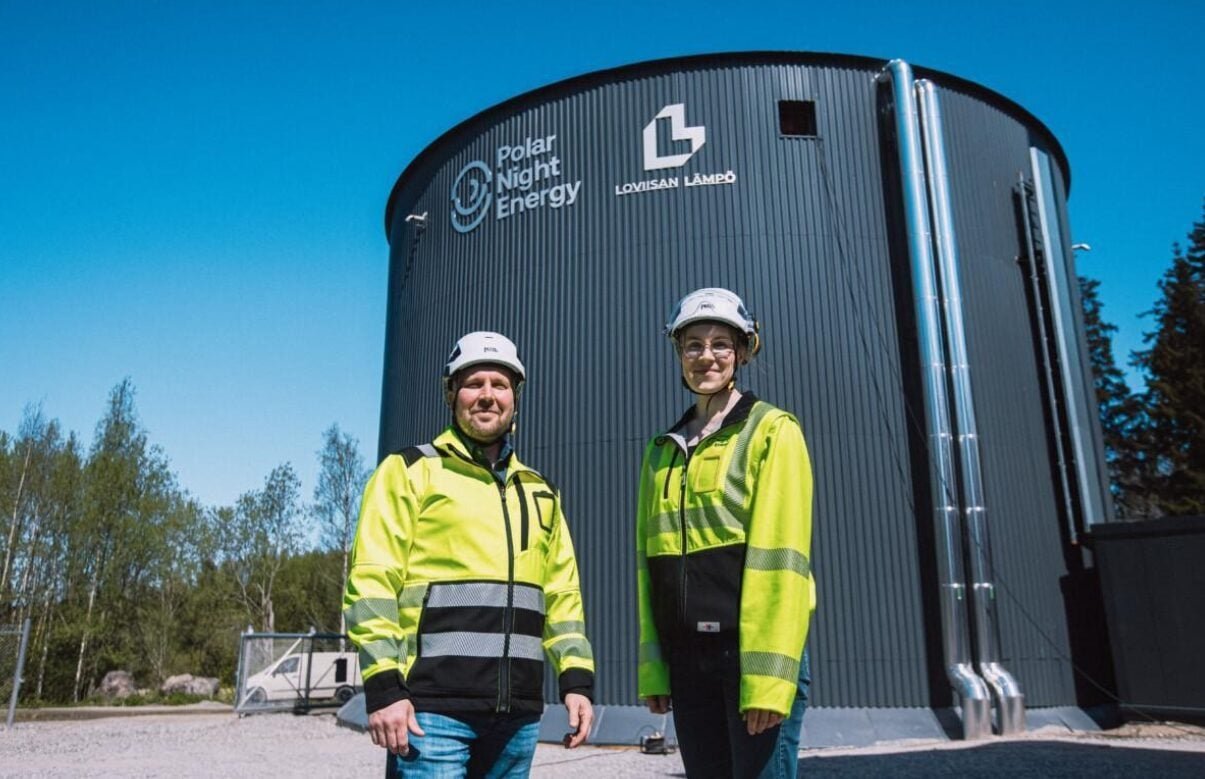
Technology firm Polar Night Energy built the project for Loviisan Lämpö, at a scale ten times bigger than its previous project. Its tech works by heating a storage medium using electricity, retaining that heat and then discharging that for industrial or heating use. “The Sand Battery means a lot to Loviisan Lämpö. It allows us to drastically reduce our emissions and improve the reliability of heat production,” said Mikko Paajanen, CEO of Loviisan Lämpö, which is owned by private equity firm CapMan Infra. It is expected to reduce the annual annual CO₂-equivalent emissions from the local heating network, reducing climate emissions in Pornainen’s district heating by nearly 70%. It will help the network phase out the use of oil and reduce the consumption of wood chips by 60%. An existing biomass boiler will continue to serve as backup. Heating for industry and buildings accounts for a huge portion of global emissions, but generally gets less attention than the electricity grid when it comes to decarbonisation, particularly around energy storage technology development. Polar Night Energy’s project started construction last year. The system, pictured above, is 12 metres tall and 15 metres wide and contains 2,000 tonnes of crushed soapstone as its thermal storage medium. The soapstone comes from the manufacturing processes of heat-retaining fireplace manufacturer Tulikivi. The project will also participate in the electricity reserve markets of Finland, with Finnish telecoms firm Elisa being enlisted to optimise this activity in January this year. Polar Night Energy is also investing €2.1 million (US$2.2 million), an amount matched by government agency Business Finland, to test power-to-heat-to-power applications for its tech. This would mean converting the stored heat back into electricity for use in the grid.
Sweden blocks Tesla FSD-style testing in Stockholm

In what is becoming a more common occurrence, a few Tesla features were used to flunk a 16-year-old who took his driver’s license test in New Jersey. It is not the first time this has happened, as we have reported on several instances of this in the past, both in the U.S. and other countries in the world. It is evidence that some officials are not caught up in the technology and innovation occurring in the automotive market, some of which is not necessarily exclusive to Tesla, but is included in each of its models, unlike other companies. Lochlan Keefer, a New Jersey resident, showed up to his driver’s test with his dad, James, in their 2022 Tesla Model Y. However, the test did not go according to plan, according to the examiner who rode along for the test with Lochlan. They accused him of using parking and “stopping assistance” to go through the test. The examiner cited the following as the reason for failure: “Had the parking and stopping assistance on never stepped on the brake to stop his self let the vehicle stop it self.” James said to NJ.com that they do not subscribe to Tesla’s Full Self-Driving suite, which includes things like Autopark, Navigate on Autopilot, and Autosteer on City Streets. These are a few of the things that have been used as reasoning to fail drivers in tests. Lochlan’s was a case of regenerative braking, which is standard on all vehicles, and Autopark: “The examiner accused my son of using driver assistance features simply because he parallel parked smoothly on the first try. He was specifically accused of using paid parking-assist and driving features, which we do not subscribe to.” It sounds as if the examiner may have confused the braking mishap for Tesla’s regenerative braking, which slows the vehicle when the accelerator is not pressed. The energy is then stored back in the battery to help with range. The examiner failed Lochlan, and James asked if he could take the test again if they disabled the regenerative braking for the exam. The examiner said Lochlan would have to wait two weeks. A supervisor came out and backed the examiner, but James said the policy the DMV claimed the Keefer’s violated was nowhere to be found: “I asked them to show me the policy they claimed we were violating. They couldn’t find it and they couldn’t cite it. When I showed them the policy, they refused to read it.” The report states that drivers in California and Arizona have also been subjected to failures on their driving tests due to confusion over Teslas and their driver assistance features.
California fast-tracks 4.6 GW battery project with 1.1 GW of solar
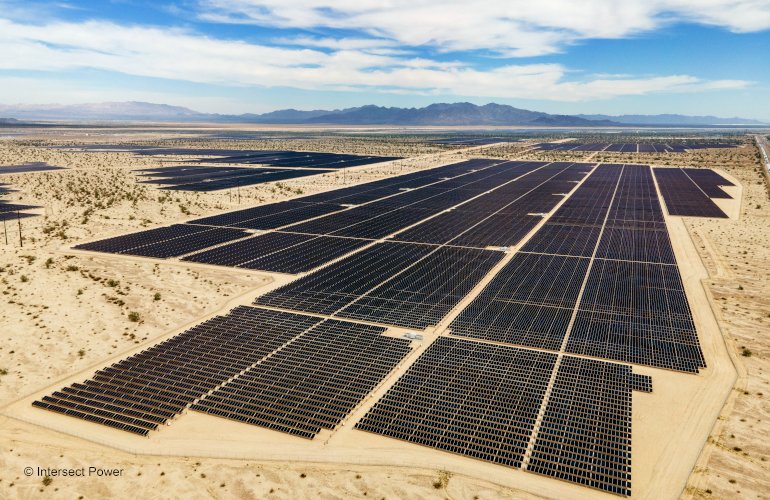
The California Energy Commission (CEC) has approved the Darden Clean Energy Project, the first development to receive fast-track approval under its Opt-In Certification program. The project includes 1.1 GW of solar capacity and a battery energy storage system (BESS), designed to power 850,000 homes for four hours. The California Energy Commission (CEC) approved the Darden Clean Energy Project, the first to be fast tracked under its Opt-In Certification program. The CES said that this battery storage project is destined to be the largest in world. An up to 4,600 MW battery energy storage system (BESS) will be paired with a solar installation of 300 million solar modules providing 1.1 GW of solar, it will generate enough electricity to power 850,000 homes for four hours. The Darden project, which is owned by IP Darden I, LLC, a subsidiary of Intersect Power, will connect to the PG&E grid and be located on 9,500 acres of land in western Fresno County that the CEC said is no longer able to support agricultural production. The CEC’s Opt-In Certification Program that was authorized by Assembly Bill 205, passed in 2022, requires the CEC to review applications 30 days of the submission and make a determination of completeness. The CEC then has 270 days to complete the environmental review. This program was developed with a goal of achieving California’s mandate that all retail electric sales come from renewable energy and zero-carbon resources by 2045. “The transition to 100 percent clean electricity by 2045 requires bold, utility-scale projects like Darden,” said CEC chair David Hochschild. “This project is significant not only for its size but its cutting-edge design and safety measures.” Projects seeking approval through the Opt-In Certification program must pay prevailing wages and provide community and economic benefits. The Darden project is expected to employ more than 2,000 people during the construction period, which will last from 1.5 to 3 years. In addition, owners of the project have committed to $2 million in community investments over the next decade starting with a $320,000 commitment to Centro La Familia Advocacy Services, a non-profit supporting crime victims, family wellness, and civic engagement in rural communities. “Today’s clean energy projects must do more than just deliver megawatts. They should create value in the communities where they’re built,” said CEC Commissioner Noemí Gallardo. “This project exemplifies a community-focused approach that advances the state’s energy goals while creating benefits for local workers and residents.” According to the CEC, California leads the nation in battery storage, with more than 200 utility-scale battery energy storage systems and more than 250,000 commercial and residential systems statewide. Battery storage helps stabilize the grid by storing excess energy produced during peak production periods and discharging it when demand is high or generation drops, such as in the evening or in the event of a power outage. However, battery fires are a concern, such as the one in January at the Vistra Energy lithium battery plant in Moss Landing. With battery safety in mind, Governor Newsom initiated an effort in 2024 to update the California Fire Code with specific fire safety requirements for stationary lithium-ion battery storage systems, and the California Public Utilities Commission’s approval of new safety. In addition, shortly after the fire, the Battery Energy Safety & Accountability Act (AB 303) was presented to the legislature. The bill proposes significant restrictions on BESS developments, including: Prohibiting BESS facilities of 200MWh or greater within 3,200 feet of sensitive receptors Restricting development on environmentally sensitive sites Repealing 2022 permitting reforms that had expedited state approvals for these facilities under California’s climate change initiatives While the Moss Landing fire was a wake-up call, the Wood Mackenzie Q1 2024 and 2023 Year in Review found that roughly 7.9 GW of grid-scale energy storage was installed in the United States in 2023. Reported to be a 98% increase over the total installed capacity in 2022, this indicates that, while the number of incidents roughly stayed constant, the number of installed units vastly increased, lowering the failure rate of these systems. “California is moving faster than ever before to build the clean energy we need – now with the world’s largest solar and battery project,” said Governor Gavin Newsom. “With a record amount of clean energy capacity added last year, we’re creating jobs and supporting local communities – all while building a cleaner, more reliable power grid.” San Francisco-based Intersect Power, a solar-plus-storage specialist, reports it currently a base portfolio of 2.2 GW of operating solar and 2.4 GWh of battery storage in operation or construction, representing ~$4B of capital investments. Intersect expects to break ground on an additional 4 GW of solar PV and 10 GWh of battery storage, representing ~$9B of assets in 2025. pv-magazine.com
The dynamics of BESS and cell supplier relationships
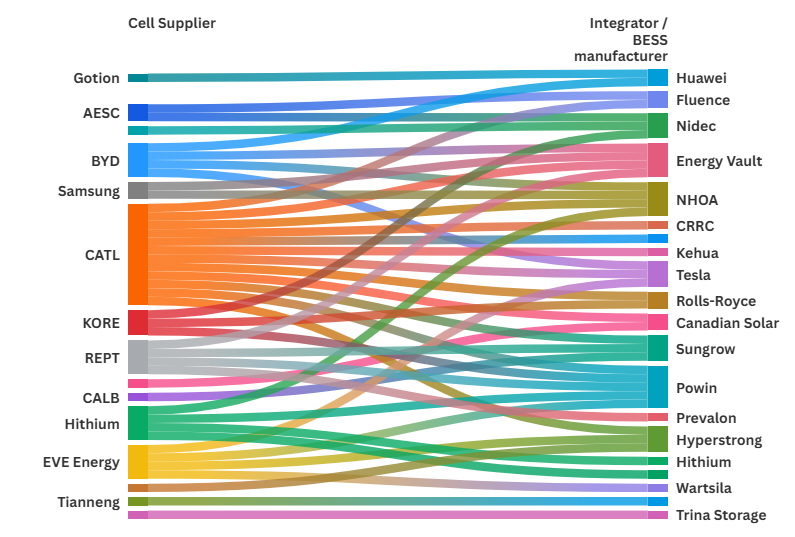
While this ensures a steady supply of cells, rising trade tensions and general market uncertainty have increased the urgency of having multiple cell suppliers. Some companies are reducing the third-party supply risk even further by starting cell manufacturing, such as Canadian Solar with production set to begin in 2025. Cell-to-system dynamics of BESS industry Very often system integrators and BESS manufacturers do not reveal which lithium-ion OEM supplied the cell in their product, even to potential customers during early-stage discussions. The infographic above is based only on publicly announced supply deals, so is by no means exhaustive (it only covers grid-scale BESS, so Panasonic and Tesla’s co-operation is not included). Sunwoda is a major lithium-ion OEM, for example, which likely works with many system integrators but has rarely if ever publicly announced a BESS supply deal. Part of this lack of transparency may be justified by a maturation of the industry meaning that the origin of the lithium-ion cells in the BESS is not particularly significant, with quality and safety parameters now far more developed and encoded than they were, say, five years ago. Integration, assembly, software and services are now the main areas where BESS providers differentiate themselves. As shown in the infographic, many lithium-ion OEMs have their own in-house BESS solutions using their cells while also supplying BESS manufacturers and integrators. This means an element of competing with their customers, who could either buy directly from, say CATL, or buy from a system integrator using CATL cells (or BESS). We’ve put this to numerous lithium-ion OEMs in the past, who in response have been relatively sanguine on this risk, saying the market is big enough that this competition isn’t a problem. Another trend that is increasingly affecting which cells BESS companies will buy is an increase in form factor. For the past few years, virtually all grid-scale BESS products used 280/314Ah cells, while the past year has seen cells twice or even over three times that size come to market. Hithium last week announced a 1,175Ah cell. China still dominant China still remains dominant in cell manufacturing, with nearly all system integrators included in the Battery StorageTech Bankability Ratings report acquiring cells from the region. CATL, the largest lithium-ion manufacturer in the world, has had publicly released supplier deals with over 10 different integrators included in the aforementioned report. Figure 1: From 18 top ESS integrators, the majority of cells in the systems come from Chinese companies. Even with Korean and American battery manufacturers, it is common for ESS cells to be manufactured in China as well given the lower cost of production; a business decision taken recently by Kore Power for example. However, the new tariffs have brought an emphasis on US manufacturing; while companies with established plans for US sites should be benefiting, instead, tariffs have led to market uncertainty and halted plans for both ESS projects and cell manufacturing facilities. Both Kore Power and Freyr (now T1 Energy) have cancelled gigafactory plans in the US earlier this year. Some companies are faring better with shifting more of their supply chain to the region, such as Fluence, which said systems with US-manufactured cells will be available this year from its supplier AESC and is rapidly expanding domestic manufacturing of other components. Gotion High-Tech is also committing to U.S. manufacturing with the company’s first ESS packs produced in California in 2024 and plans for a cell production site in Illinois in addition to a materials plant for a fully American supply chain. In general, there will be a gradual move out of China for cell manufacturing for both EV and ESS. Figure 2: Total capacity for cells (including for energy storage) is forecast to become more global from 2025 onwards. The cell production capacity is still heavily weighted towards that for electric vehicles and overseas expansion is aided by joint ventures with major automotive companies. However, it still shows suppliers pushing for overseas production capabilities and potentially trying to mitigate the effects of tariffs. Southeast Asia, which had previously been the prime spot for relocation of manufacturing for the solar industry, has been seeing increased interest with EVE Energy’s Malaysia factory already started production and Sunwoda planning a cell plant in Thailand. Energy storage is also seeing a similar trend, with CALB’s Portugal factory set to include the production of ESS batteries. LG Energy Solution is incorporating ESS battery production in its plants, notably in Poland and Michigan. With the strong investments in Korean manufacturers like LG Energy Solution and Samsung SDI into US factories and integrators seeking a more diverse supply chain, there’s strong potential for these companies to gain an edge over their Chinese competitors. Conclusion The supply chain for energy storage systems remains more complicated than just securing cells, and the dynamics between manufacturer and integrator equally so. With the cell manufacturing landscape remaining extremely concentrated within the top five and increased competition, integrators are looking to any further benefits the supplier could offer, whether that be through pricing or increased collaboration. American battery manufacturing is still a difficult landscape with the AD/CVD on anodes in addition to the reliance on imports and long timeframe to establish a manufacturing base. American-made batteries are likely to continue to be more expensive to produce and that extra cost falls on the customer, imports will still have a strong place in the market. To learn more about the Battery StorageTech Bankability Ratings Report, or to arrange a free demo, please contact our team at the link here.
Tesla confirms massive hardware change for autonomy improvement
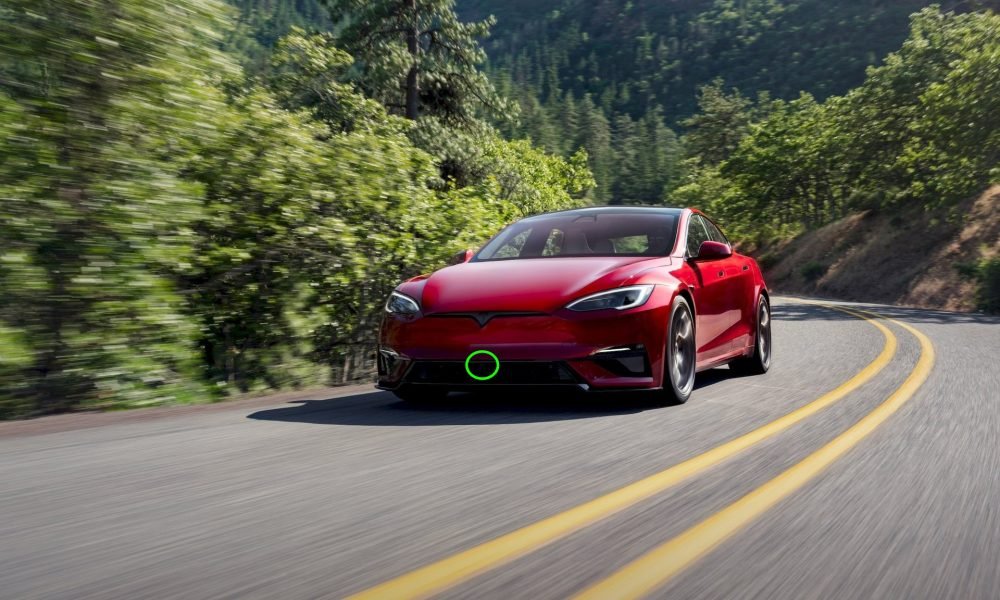
Tesla Robotaxi just got a big benefit from the U.S. Government, as the National Highway Traffic Safety Administration (NHTSA) is looking to ease some rules and streamline the application process that could hinder the development and licensing of autonomous vehicles. Tesla is set to launch its Robotaxi platform in the coming days or weeks, but regulation on autonomous vehicles is incredibly slim, so automakers are left in a strange limbo as permissions to operate are usually up to local jurisdictions. The NHTSA still has the ultimate say, but it is now adopting a new strategy that will see companies gain an exemption from federal safety standards and streamline the entire application process. The agency is authorized to grant exemptions to permit manufacturers to produce vehicles over a two or three-year period that might not comply with certain Federal Motor Vehicle Safety Standards (FMVSS). Robotaxi, for example, will eventually not have a steering wheel or pedals, through the Cybercab that Tesla unveiled last October. The exemption program the NHTSA announced today would be possible through Part 555 of the National Traffic and Motor Vehicle Safety Act: “NHTSA may grant a Part 555 exemption if at least one of four bases listed in the statute is met and NHTSA determines that the exemption is consistent with the public interest and the Safety Act. The statute also authorizes NHTSA to subject an exemption to terms the agency deems appropriate and requires that NHTSA publish notice of the application and provide an opportunity to comment.” The rapid and non-stop innovation that is being performed is tough to keep up with from a legal standpoint. The NHTSA recognizes this and says current legislation is appropriate for traditional vehicles, but not for the self-driving cars companies are producing now: “The current Part 555 process was designed for traditional vehicles. As currently applied, this process is not well suited for processing exemptions involving ADS-equipped vehicles in a timely manner or overseeing the unique complexities involving their operations. This has resulted in long processing times for applications for ADS-equipped vehicles. NHTSA must improve its Part 555 processing times substantially to keep pace with the rapid innovation of the ADS industry and to ensure that exemptions remain effective tools for nurturing groundbreaking safety technologies.” Now, the NHTSA will be “enhancing application instructions” to help manufacturers understand the requirements involved in the application process. This will streamline the entire process by “reducing the need for NHTSA to request additional information from the manufacturer,” the agency says. First Tesla driverless robotaxi spotted in the wild in Austin, TX Next, the NHTSA is going to have a more flexible approach to evaluating exemptions for ADS-equipped vehicles: “To build flexibility into the Part 555 process while also accounting for the unique aspects of those exemptions, NHTSA intends to develop terms that could be included in Part 555 exemption grants, when appropriate, to condition operations of exempted ADS-equipped vehicles on enhanced and continuing oversight from NHTSA. NHTSA would expect to administer this enhanced oversight through letters, which could be updated over time, mirroring real-world ADS development. This will enable NHTSA to focus its initial review during the application stage and align the Part 555 oversight approach more closely to exemptions administered under NHTSA’s Automated Vehicle Exemption Program (AVEP), which have proven effective for ADS.” This will benefit any company making autonomous vehicles, but it will especially benefit Tesla in the short-term as it is readying for the launch of Robotaxi. Tesla is trading up 1.89 percent at the time of publication. Part 555 Letter June 2025 by Joey Klender on Scribd
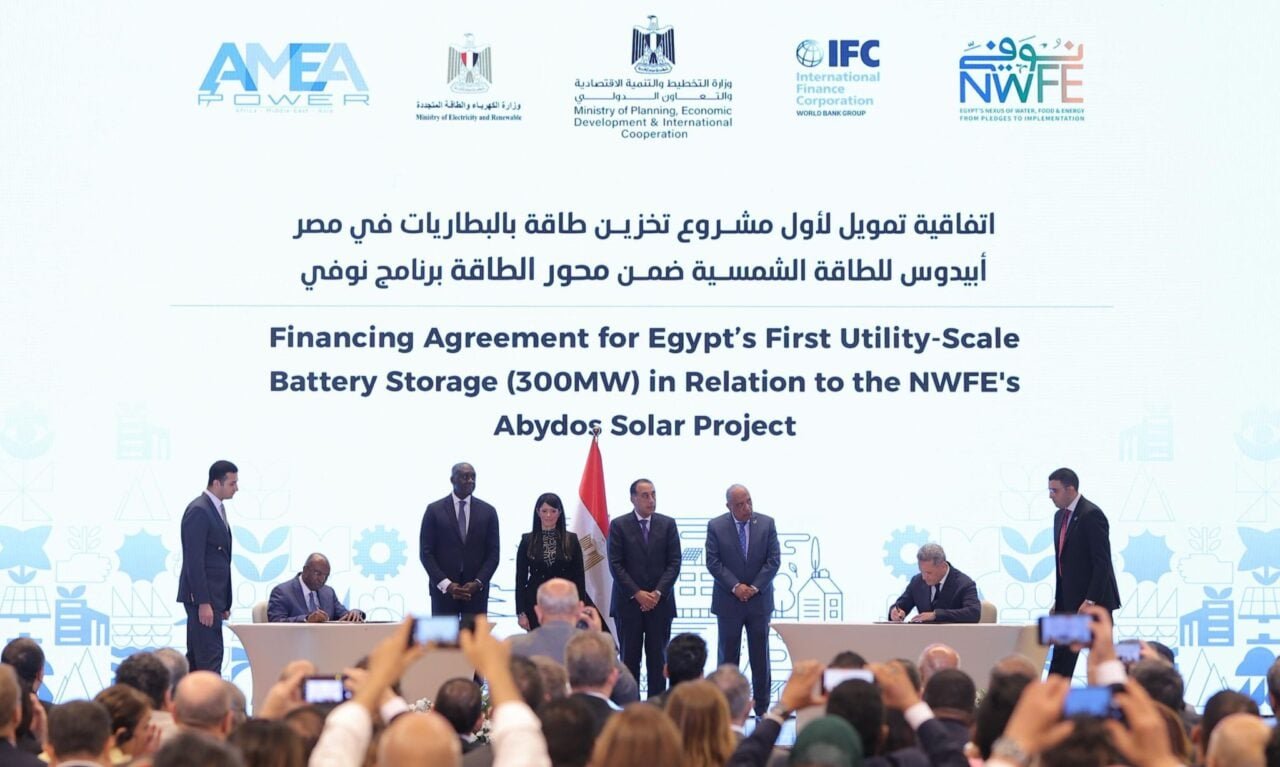
Egypt: Scatec, AMEA Power close financing on large-scale BESS
Egypt: Scatec, AMEA Power close financing on large-scale BESS - Energy-Storage.News Skip to content
Battery Power Online | Space Batteries: How SpaceX Designs Batteries for Satellites

By Kyle Proffitt June 16, 2025 | While EV, grid storage, and consumer electronics may be the most common battery applications in the news, there are some challenging and exciting edge cases. At the 2025 International Battery Seminar and Exhibit earlier this year, SpaceX principal engineer Ray Barsa spoke about the very unique conditions encountered in low earth orbit (LEO) affecting battery performance. Satellites from SpaceX SpaceX has developed the Starlink service, based on more than 7,000 satellites delivering internet to about 10 million people, and Barsa says the reach is truly global, including access—even in Antarctica—that enables things like FaceTime calls. The numerous satellites communicate with each other using lasers, creating a global mesh through which data can find routes to and from ground stations at any time. Because the speed of light is faster in a vacuum than through fiber, the latency can actually best terrestrial internet solutions, especially over long distances. Unlike geostationary satellites such as those associated with satellite TV, the LEO satellites circle the earth every 90 minutes. The tradeoffs are that an individual satellite serves a smaller area, requiring the mesh and complicated information transfer, but proximity to ground reduces latency and renders it a more viable internet solution. Space Batteries Barsa explained that their satellites need a good bit of power, both for running the lasers and for maneuvering. They use Hall effect argon thrusters to achieve and maintain orbit, avoid space junk, and de-orbit at end of life; these thrusters use electricity to ionize argon gas, and then a magnetic field accelerates the ions and releases them to create thrust. Barsa shared that each 500-kg satellite is powered by a battery pack with energy density over 230 Wh/kg, which is recharged using solar arrays during solar exposure. In total, they have over 80 MWh of orbiting batteries, a figure suggesting about 11 kWh/satellite. Barsa then talked their unique challenges and opportunities. On the one hand, they don’t have to worry about fast charging. He says the satellites run about 15 partial depth of discharge cycles per day, with no rest. He commented on Jeff Dahn discussing cell orientation as an important parameter affecting salt imbalance, but said that in microgravity, there isn’t necessarily a meaningful measure of cell orientation. The vacuum of space can also cause cell swelling and leakage. Additionally, “many plastics, foams, some common adhesives just don’t work in a vacuum… they disappear, they outgas,” Barsa said. Other strange things happen too. He showed what he suggested may be the only image of arcing occurring during thermal runaway. “What we’re seeing here is plasma generated from a secondary metal vapor arc… if that arc is able to liberate enough metal, that metal gets ionized and spreads through the pack as plasma, and you’re toast.” Satellites also face a unique challenge of micrometeorite and other space debris, “things like grains of sand traveling at Mach 25,” Barsa said, which can impact the batteries. In low earth orbit, you also deal with atomic oxygen—unpaired, highly reactive single atoms of O, which like to strip away materials—and UV exposure, which darkens materials. He gave the example of a white paint designed for radiative properties getting darker from UV, at the same time as fresh material becomes exposed by atomic oxygen stripping the surface layer. Charging and Discharging The satellites experience roughly 1 hour in the sun and 30 mins in the earth’s shadow for each orbit, translating to about C/2 charging. Longevity is critical, though. “We want to get the equivalent of 5,000 full cycles out of off-the-shelf cells from tier 1 OEMs,” Barsa explained. He went on to report that with cells from several years ago, cycling at a modest depth of discharge and C/2 rate, “we’re getting 90% retention up to 2,000 full cycles.” The batteries get no rest, but the cycling profile is very predictable. “You don’t have an aggressive driver of a satellite,” Barsa explained. He shared that their max depth of discharge is about 50%, but this number has increased as they’ve optimized various parameters. They also avoid higher voltages, at least until it’s time to de-orbit. Prior to this, he said they always keep some reserve energy to maneuver if something goes wrong. “One thing that SpaceX really holds important in the design here is that we don’t have ‘bricked’ satellites on orbit… what that means for the battery is SOC [state of charge] estimation is critical,” Barsa said. For this reason, LFP chemistry is challenging. He shared that they are using NMC chemistry 2170 cells. Temperature Considerations Barsa said that the temperature of battery packs is an important parameter for optimization. “We’ve emphasized a lot of thermal radiant improvements in the pack, and we’re able to hold less than 5 °C across all the cells in the pack,” he said. He explained that because they get passive cooling via radiation, “you’re able to tailor your surfaces to either absorb or project heat however you want, and if you know your C-rates and you know your heat generation, you can adjust emissivity using absorptivities to get really nice thermals in the pack.” This also translates to wins for low-resistance cells, as less ohmic heating occurs, and more insulation can be used. But What If They Burn? Barsa said that the critical runaway thresholds that work for EVs don’t hold up well in space, because the heat only dissipates by radiation and can thus accumulate more easily. SpaceX is also in a complicated position because they design their satellites to burn completely at end of life; they never get them back to run further analysis, and there is some conflict in designing an object to not burn—until the time is right and that’s exactly what you want it to do. Barsa said that SpaceX performs extensive testing, looking at the potential for sidewall rupture of cells and thermal runaway events in the pack. However, he said, they “have never even seen a single cell runaway in orbit.”
Change of officers at Hino Motors

Hino Motors, Ltd. announces the following personnel changes Hino Motors, Ltd. announces the following personnel changes. 1. Changes in CxO (as of July 1, 2025) Name New title Current title Kyotaro Hagiwara CDO (Digital) * Hino Computer System Co., Ltd. Managing Director Current CDO Hidenori Osano will become President and Representative Director of MOBILOTS Co., Ltd. on June 13, 2025, and DCDO (Digital) of the Company on July 1, 2025. 2. Composition of CxOs and Operating Officers (as of July 1, 2025) Function CxO / Operating Officer Title Name Internal Audit Operating Officer Norio Yoshida Compliance & Legal CCO (Compliance) Norio Yoshida DCCO (Compliance) Akio Sasaki DCCO (Compliance) * Technology Marek Tatur – CRO(Risk) Hiroki Yokohari CTrO (Transformation) Hiroki Yokohari Officer in Charge of Business Integration Tatsuya Nomura Quality CQO (Quality) Masahiro Ono Safety Health &Environment Operating Officer Motoshi Umeoka Business Management COO (Operating) ,Japan Business Naoki Sato COO (Operating) ,Overseas Business Junichi Kato Digital Strategy & Solution CDO (Digital) Kyotaro Hagiwara DCDO(Digital) Hidenori Osano TechnologyDevelopment CTO (Technology) Makoto Wakimura ProductionEngineering Operating Officer Masahiro Amano Purchasing Operating Officer Shigeki Sugiu Total Support (TS) CTSO (Total Support) Nozomu Harada Supply & Demand Operating Officer Yoshikazu Yamane – CLO (Logistics) Yoshikazu Yamane Monozukuri CMO (Monozukuri) Tokuichi Shiga Finance & Accounting CFO (Financial) Yasushi Nakano Human Resources CHRO (Human Resources) Satoshi Ogiso DCHRO(Human Resources) Hiroki Yokohari General & Government& Public Affairs Operating Officer Hiroshi Hashimoto SOURCE: Hino Join our LinkedIn Group Let us help you understand the future of mobility "*" indicates required fields
How companies can help save America's clean energy boom

The opinions expressed here by Trellis expert contributors are their own, not those of Trellis. It’s crunch time for federal clean energy policy — and the consequences for the American economy are enormous. Last month, the U.S. House of Representatives passed a budget reconciliation bill that would all but eliminate the federal clean energy tax credits that were extended and expanded by Congress in 2022. That legislation — and the long-term certainty it provided the private sector — powered an investment boom to the tune of hundreds of billions of dollars, as businesses quickly got to work building factories to produce clean technologies in the U.S. and new energy infrastructure to affordably and quickly meet the nation’s rising electricity demand. The goals of domestic manufacturing growth, affordable power and U.S. competitiveness are regularly touted by the Trump administration, yet the legislation passed by the House would undermine all three. By cutting off or overcomplicating most incentives, the bill would increase electricity rates by 10 percent or more, exacerbating inflation by making power more scarce at a time when we need more of it to support AI and other new technologies. It would kneecap U.S. growth and innovation in growing global industries such as electric vehicles, batteries and clean power infrastructure. And it would scrap major industrial projects at risk of hundreds of thousands of jobs. As Michael Tubman, the federal policy director at the electric vehicle manufacturer Lucid, said at a recent media briefing: “Anyone who has visited our [Arizona] factory can see the evidence plainly in front of them of the jobs — the high quality, high paying jobs that these incentives are supporting.” Dozens of companies head to Capitol Hill With the Senate working on its version of the legislation, companies still have time to make an impact. More than 30 companies are headed to Capitol Hill this week for a series of meetings with Senate Republicans, where they will emphasize the tax credits’ vast economic benefits. But companies don’t need to be in D.C. to take action. For sustainability professionals, the tax credits are crucial to meeting company goals, so now is the time for them to work with government affairs and executive teams to get in touch with the senators in states where they operate to make the case that gutting these incentives would be a self-inflicted wound to U.S. economic, energy and geopolitical interests. To prevent that outcome, businesses should press the Senate to fix four major flaws in the House bill: Tie eligibility to project construction, not completion The House bill changes the current rules so that projects must be fully completed and operational — rather than merely under construction — to qualify for the credits. But between permitting issues, supply chain disruptions, litigation and other unpredictable factors, the timing of a project is often well beyond a company’s control. The proposed change would therefore create uncertainty about whether even projects that are ready to break ground will qualify for tax credits, especially because the House legislation imposes a shorter timeline before the credits expire. The likely result: stalled investment, meaning less new energy and higher electricity prices. The Senate should stick with the existing “commence construction” requirement and set a more realistic expiration timeline than the House. Make foreign sourcing rules realistic, strategic and precise The House bill includes overly burdensome restrictions on the use of foreign components for projects claiming tax credits. A major goal of these tax credits is to support U.S. manufacturing and supply chains to reduce reliance on foreign adversaries for critical materials and infrastructure. But the proposed changes are so severe that they’re essentially unworkable. A $50 part, unknowingly sourced through a third-party supplier, could upend a billion-dollar project. That is a huge amount of risk for any company to take on. To comply, companies would need to immediately hire teams to closely inspect every link on their supply chains instead of hiring American workers to build and install cost-saving technologies. More likely, investment would just freeze up amid all the regulatory uncertainty as they await the final regulations for fear of noncompliance. The Senate can take a more clear, practical and simplified approach that applies to the taxpayer entity, company, or project, so that businesses can confidently and quickly invest in high-value domestic manufacturing, supply chains and energy production without ambiguity and red tape. Allow tax credits to remain fully transferable Clean energy tax credits are currently fully transferable — meaning developers that don’t have tax liability can sell them to businesses that do. It’s a win-win for buyers and sellers, creating an efficient and competitive market that ensures the incentives are put to work in the economy. The House bill would end that system, limiting transfers to a handful of large financial institutions that directly invest in the projects. This would weaken the financial viability of the projects, but it would also deprive companies across the economy of an opportunity to participate in project financing through tax credit transfers. The Senate should preserve transferability to keep the market functioning at its best. Keep consumer credits to drive American industry The House’s plan would also hurt consumers’ ability to afford modern and efficient technologies such as electric vehicles, rooftop solar panels and heat pumps by ending tax credits as soon as this year. While that would most immediately harm consumers and the companies selling those products, the consequences wouldn’t end there. Reduced consumer demand would ripple across the economy, slowing investment in key 21st-century capabilities such as advanced manufacturing, battery production and critical mineral supplies, as well as more foundational sectors such as steel, glass and aluminum. The Senate can recognize that consumer demand is another form of policy certainty that drives investment across the economy and that keeping these credits in place will help maintain our global economic leadership. The outcome in Congress will have major consequences for businesses across the economy — not just those making or buying clean technologies but all who depend
Akkodis named leader in aerospace and defense by ISG

Akkodis has been named a Leader by Information Services Group (ISG) in the inaugural ISG Provider Lens Aerospace & Defense Services and Solutions, 2025 reports. Akkodis named a leader in aerospace & defense services and solutions by ISG Copyright: Akkodis. Akkodis earned Leader status in three key quadrants across Europe and the U.S.: Engineering Design & Innovation – Overall Ecosystem MRO & Aftermarket – Overall Ecosystem (Europe) Technology Transformation & Consulting – Overall Ecosystem With over 40 years of experience, Akkodis delivers end-to-end engineering services across the Aerospace & Defense lifecycle—from concept and design through production and aftermarket support. In the Engineering Design & Innovation category, ISG highlighted Akkodis’ ability in the use of AI, digital twins, simulation, and automation to accelerate innovation, manage complexity, and enhance productivity. Its strong partnerships with leading OEMs were cited as key enablers of scalable solutions. In MRO & Aftermarket (Europe), Akkodis was recognized for its integrated offerings, including Logistics Support (ILS), spare parts management, and Continuing Airworthiness Management Organization (CAMO) services—enabled by its Design Organization Approval (DOA) certification since 2022. Leveraging advanced analytics, virtual asset modeling, and intelligent monitoring technologies, Akkodis enables proactive maintenance strategies that help reduce downtime, boost fleet availability and meet compliance requirements. In the U.S., Akkodis was rated a Product Challenger, with a strong digital foundation and clear potential for market growth. In Technology Transformation & Consulting, Akkodis was highlighted as a trusted partner in guiding complex digital journeys—from architecture and compliance to in-service support. ISG noted its ability to apply AI, robotics, IoT, and digital twins to enable value chain transformation. Proprietary AI platforms, strong industry partnerships, and a focus on sustainability enhance decision-making, efficiency, and client progress toward net-zero goals. Cybersecurity and regulatory expertise— including standards from the National Institute of Standards and Technology (NIST), which advances measurement science and technology, and DO-326A, which provides guidance on aviation cybersecurity—reinforce Akkodis’ value in mission-critical environments. Akkodis was also named a Product Challenger in Europe for Supply Chain Operations and Logistics Management – Overall Ecosystem, reflecting strong service depth and market opportunity. For more information, visit akkodis.com.
Tesla on 'self-driving' gets stuck on train track and hit by train

A Tesla Model 3 got stuck on a train track and was hit, albeit slightly, by a train in Sinking Spring, PA. The driver claimed it was in “self-driving mode.” According to the fire alerts in Berks County, a Tesla Model 3 drove around a train track barrier near South Hull Street and Columbia Avenue and got stuck in the tracks. The driver was able to exit the vehicle, but a train hit the car, reportedly snapping off the side mirror. The fire commissioner ordered to stop all train traffic as the emergency services worked to get the Model 3 off the tracks using a crane. Advertisement - scroll for more content Spitlers Garage & Towing, performed the recovery and shared a few pictures on Facebook: The Tesla driver reportedly claimed that the vehicle was in “self-driving mode” leading up to getting stuck on the train tracks. Tesla claims that all its vehicles built since 2016 will be capable of unsupervised self-driving with software updates; however, this has yet to occur. Instead, Tesla has been selling a “Full Self-Driving” (FSD) package for up to $15,000 that requires the driver to constantly supervise the vehicle, with the driver remaining responsible for the car at all times. Electrek’s Take There have been instances of Tesla drivers engaging in reckless behavior and then attributing it to the Full Self-Driving (FSD) features. I’m not saying it’s the case here, but it’s a possibility. On the other side, I’ve seen FSD try to navigate around construction barriers. It’s possible that it tried to do that in this case, here and then got caught on the tracks. We would need more data. FTC: We use income earning auto affiliate links. More.
Evergrow tax-credit transfer on 1.5-MW project keeps iconic PA carpet factory in operation

Evergrow has successfully completed a tax-credit transfer for a rooftop solar project at a carpet factory in Pennsylvania — a much needed energy source for the factory that would not have been possible without incentives from the Inflation Reduction Act (IRA). Bloomsburg Carpet Industries in Bloomsburg, Pennsylvania, is a third-generation, family-owned manufacturer of carpets for iconic institutions, including the House and Senate Chambers of the U.S. Capitol, the U.S. Supreme Court, Radio City Music Hall and Carnegie Hall. With the installation of a 1.49-MW solar power system on the roof of the factory, Bloomsburg dramatically reduced its operating overhead and energy costs. With more than 30 looms operating daily, Bloomsburg’s energy demands are significant. CFO Adam Bowman saw that inaction would expose the company to the higher energy costs that energy industry analysts warn will result from a historic rise in electricity demand unfolding across the United States. Industry experts project electricity demand to rise 25% by 2030, leading to higher electricity prices for consumers. For manufacturers like Bloomsburg, the annual cost increases could be staggering. Bowman led the effort to bring clean energy to the company’s rooftop to avoid these ballooning energy costs. A combination of incentives had started to make going solar more attractive. But it was ultimately the successful sale and transfer of the tax credits generated by the solar installation that got the financing over the finish line. At just under $2.2 million in qualifying costs, Bloomsburg’s rooftop solar system earned approximately $660,000 in investment tax credits (ITC). Under the IRA, the ITC was made transferable, meaning taxpayers like Bloomsburg can sell their credits to investors after the project is placed into service. This allows small businesses like Bloomsburg to rely less on debt financing to get their projects off the ground. Bowman initially tried to find a buyer for the credits himself. But as an independent, family-owned business, he encountered difficulties: Buyers worried about the potential risk of tax-credit recapture. Under the law, if a business is forced to sell the asset that generated the tax credits within five years, some or all of the credits can be “recaptured” by the IRS. For this reason, buyers tend to prefer sellers with a track record of long-term project ownership and sufficient assets to cover an indemnity. Bowman found that even though Bloomsburg Carpet had enjoyed decades of good financial standing, buyers still balked. That’s when he turned to Evergrow for help finding a buyer and navigating the required tax-credit diligence process. Evergrow uses technology to partially automate the diligence process, making it easier for non-experts like Bowman to provide documentation and complete the process. The company also supplies buyers with a diligence guarantee — meaning buyers are reimbursed for any recapture-related losses. Designed to overcome exactly the kinds of barriers Bowman had faced when trying to go it alone, the Evergrow Guarantee provides full assurance to tax-credit buyers that they’ll be reimbursed in the unlikely event of an IRS recapture. “Evergrow was on our side the whole time,” said Bowman. “The Evergrow Guarantee was really essential — I don’t think the deal would’ve gotten done without it.” The project’s impact is already being felt. Bloomsburg is now saving approximately $200,000 per year on electricity costs, plus an additional $50,000 annually from Pennsylvania’s Solar Renewable Energy Certificate (SREC) program. These savings, along with an improved Environmental Product Declaration (EPD) score, strengthen Bloomsburg’s environmental leadership in the textile industry. More details on the transaction are available in this case study published on Evergrow’s website. “We’re proud to support family-owned manufacturers like Bloomsburg Carpet in their transition to clean energy,” said James Richards, CEO of Evergrow. “This project is a model for how commercial and industrial businesses of any size can take full advantage of clean energy incentives like the ITC — with the right financial partner.” News item from Evergrow
Charged EVs | Ampcera launches nano-sulfide solid electrolytes, starts shipments to solid-state battery makers

US-based solid-state battery materials developer Ampcera has launched its new nano-sulfide solid electrolyte powders for all-solid-state batteries and has started global shipments to customers. Ampcera’s nano-sulfide powders feature high ionic conductivity and super-fine particle sizes in the hundreds of nanometers, addressing a bottleneck in solid-state battery development and manufacturing. The powders enable higher energy density cathodes and anodes, and processing of ultra-thin (10 microns or less) solid electrolyte separator layers. This enables high performance and commercial viability for solid-state batteries in EVs, as well as consumer electronics, aerospace, and defense applications. Initial shipments are underway to leading battery developers and automotive OEMs in the US, Europe and Asia. “Global customers are already validating this new product and placing orders. We’re turning innovation into revenue,” said Dr. Sumin Zhu, Ampcera’s CEO and co-founder. Source: Ampcera
The 2026 Rivian R1S And R1T Will Be Slightly More Expensive

The 2026 Rivian R1S and R1T will be more expensive than the outgoing models. Later this summer, the two EVs will cost between $90 and $1,090 more. We don't know what standard equipment the updated models will include, though. The 2026 Rivian R1S SUV and R1T pickup are coming later this summer, and while we don’t know exactly what the new model year will bring in terms of features, we do know that the two electric adventure vehicles will be more expensive. Rivian sent us a list with the updated pricing, and by and large, all the versions will cost roughly $1,000 more. We expect the 2026 R1S and R1T to come with a Tesla-designed NACS charging port. Let’s start with the R1S. The entry-level version with dual motors and the Standard battery pack starts from $76,990, up from the outgoing model’s $75,900 MSRP. The 2026 R1S Dual Large will retail for $83,900, $90 more than before, while the R1S Dual Max will have a starting price of $90,990, which is $1,090 more than it costs now. Lastly, the 2026 Rivian R1S Tri Max starts from $106,990, a $1,090 bump from the 2025 model. It’s more of the same for the R1T pickup. Later this summer, the entry-level R1T Dual Standard will start from $70,990 (up $1,090). The R1T Dual Large will go from $77,990 ($90 more), the R1T Dual Max will retail from $84,990 ($1,090 more), and the R1T Tri Max will sell for $100,990 ($1,090 more). The dual motor versions (except for the entry trim) of the R1S and R1T will continue to be eligible for a $5,000 Performance Upgrade, which is just a software update applied to the standard vehicle. The upgrade, which ups the power figure and makes the EV faster, can also be bought after taking delivery of the vehicle. It’s worth mentioning that none of these prices include the mandatory $1,895 delivery fee, which has gone up from $1,800. Rivian is yet to offer details on the features and options available on the 2026 models. The pricing of the soon-to-be-released Quad Motor version is also not out yet. That said, we expect the 2026 Rivian R1S and R1T to come with a Tesla-style NACS charging port from the factory, as revealed earlier this week in a now-deleted video. This would make charging adapters irrelevant when using Tesla Superchargers, which offer NACS cables, but it would introduce the need for an adapter when using CCS-equipped stalls, such as those offered by Electrify America, EVgo and others. Currently, the R1S can deliver between 270 and 410 miles of range, depending on the battery pack, and can accelerate from zero to 60 miles per hour in as fast as 2.9 seconds, thanks to a maximum output of 850 horsepower on the tri-motor version. Meanwhile, the R1T has a maximum range of 420 miles and is just as powerful and fast as the top R1S trim. With the addition of the quad-motor version, the two EVs are bound to deliver even more power, not that they needed it, and with an even higher price tag. But there's still hope for those who can't afford an $80,000+ car: the smaller R2 SUV is coming in the first half of next year with an estimated starting price of $45,000.
Enhance Your Boating Experience with Bluetooth-Enabled Marine Batteries

In today’s fast-evolving marine technology landscape, staying connected is no longer just about navigation or entertainment—it's about powering your entire boating experience with smart solutions. That’s where Bluetooth-enabled marine batteries come into play. What Is a Bluetooth Marine Battery? A Bluetooth marine battery is a smart lithium battery—often LiFePO₄ (Lithium Iron Phosphate)—equipped with an internal Bluetooth module. It allows you to monitor the battery's performance in real time via a mobile app, offering a new level of convenience, safety, and control for boat owners. Key Benefits of Bluetooth-Enabled Marine Batteries 🔋 Real-Time Monitoring Check essential data such as: State of charge (SOC) Voltage and current Temperature Cycle count Health status With just a smartphone and a free app (usually iOS/Android compatible), you can remotely monitor your boat battery, whether you're on the water or docked. ⚙️ Simplified Maintenance Bluetooth batteries help prevent overcharging, deep discharging, and overheating. Alerts and diagnostics sent via the app allow boaters to act before issues arise, increasing safety and prolonging battery lifespan. 🚤 Optimized for Marine Environments These batteries are typically housed in water-resistant, rugged enclosures, ideal for harsh saltwater environments. Paired with built-in BMS (Battery Management System) and Bluetooth tracking, they offer a smart and durable energy solution for: Fishing boats Yachts Sailboats Electric propulsion systems Off-grid marine applications 🔧 Easy Installation and Integration Bluetooth marine batteries are drop-in replacements for lead-acid or AGM batteries. They come in standard sizes (12V, 24V, 48V) and can be installed in parallel or series for higher voltage and capacity. Applications for Bluetooth Marine Batteries House battery systems: Power onboard electronics, lighting, and appliances. Trolling motors: Get precise power usage data for long fishing trips. Solar-powered boats: Monitor energy storage remotely. Electric outboard motors: Combine clean energy with intelligent monitoring. Final Thoughts A Bluetooth-enabled marine battery is more than just a power source—it's a smart upgrade for any modern boat. Whether you're managing multiple systems or heading out for long voyages, real-time data and intelligent diagnostics give you peace of mind on every trip. Interested in upgrading your boat’s power system?We offer OEM & wholesale Bluetooth LiFePO₄ marine batteries with smart BMS, mobile app control, and high-cycle durability. Contact us today for bulk pricing and technical support.
Chery to use LG Energy Solution's next-gen 46-series cylindrical batteries

LG Energy Solution will supply Chery with a total of 8 GWh of next-generation 46-series cylindrical batteries over the next six years, enough to power about 120,000 EVs. The battery supply is scheduled to begin early next year and will be installed in Chery's flagship EV models. (A Luxeed S7 sedan, jointly developed by Huawei and Chery, was showcased at the Shanghai auto show in April 2025. Image credit: CnEVPost) South Korean battery giant LG Energy Solution has signed a battery supply agreement with Chery, marking the first time a South Korean battery maker has signed a cylindrical battery supply contract with a Chinese automaker. LG Energy Solution announced today that it has reached an agreement with Chery to supply cylindrical electric vehicle (EV) batteries, according to a report by Yonhap News Agency. The South Korean battery maker will supply Chery with a total of 8 GWh of next-generation 46-series cylindrical batteries over the next six years, enough to power about 120,000 EVs. The battery supply is scheduled to begin early next year and will be installed in Chery's flagship EV models, according to the report. The two companies plan to expand their collaboration to include more EV models under Chery's umbrella, the report noted. The contract amount has not been disclosed, but industry observers estimate it could exceed 1 trillion won ($734 million), Yonhap News Agency said. The 46-series cylindrical batteries have more than five times the capacity and power of existing cylindrical batteries and offer high production efficiency, the report noted. This deal marks a pivotal step in scaling up global adoption of our new 46-series batteries and securing a dominant market leadership," said Kim Dong-myung, CEO of LG Energy Solution. Chery is one of China's largest automakers and one of the top exporters. The company exported 100,737 vehicles in May, marking the second month this year with exports exceeding 100,000 units, according to data compiled by CnEVPost. It is set to reach a cumulative total of 5 million vehicle exports later this month, becoming the first Chinese automaker to achieve this milestone, Chery announced last week. LG Energy Solution is one of the world's largest EV battery manufacturers, with a installation volume of 31.4 GWh in January-April, up 16.3 percent year-on-year, according to data from South Korean market research firm SNE Research. The South Korean company maintained its position as the world's third-largest player with a 10.2 percent share in January-April, trailing CATL's 38.1 percent and BYD's 17.3 percent. ($1 = KRW 1,361.47) This comes 18 months after the launch of Luxeed's first model, the Luxeed S7 sedan.