
Tesla CEO Elon Musk hits back at drug use claims, calls publications 'hypocrites'

Tesla shares have been blacklisted by the Swedish pension fund AP7, who said earlier today that it has “verified violations of labor rights in the United States” by the automaker. The fund ended up selling its entire stake, which was worth around $1.36 billion when it liquidated its holdings in late May. Reuters first reported on AP7’s move. Other pension and retirement funds have relinquished some of their Tesla holdings due to CEO Elon Musk’s involvement in politics, among other reasons, and although the company’s stock has been a great contributor to growth for many funds over the past decade, these managers are not willing to see past the CEO’s right to free speech. However, AP7 says the move is related not to Musk’s involvement in government nor his political stances. Instead, the fund said it verified several labor rights violations in the U.S.: “AP7 has decided to blacklist Tesla due to verified violations of labor rights in the United States. Despite several years of dialogue with Tesla, including shareholder proposals in collaboration with other investors, the company has not taken sufficient measures to address the issues.” Tesla made up about 1 percent of the AP7 Equity Fund, according to a spokesperson. This equated to roughly 13 billion crowns, but the fund’s total assets were about 1,181 billion crowns at the end of May when the Tesla stake was sold off. Tesla has had its share of labor lawsuits over the past few years, just as any large company deals with at some point or another. There have been claims of restrictions against labor union supporters, including one that Tesla was favored by judges, as they did not want pro-union clothing in the factory. Tesla argued that loose-fitting clothing presented a safety hazard, and the courts agreed. (Photo: Tesla) There have also been claims of racism at the Fremont Factory by a former elevator contractor named Owen Diaz. He was awarded a substantial sum of $137m. However, U.S. District Judge William Orrick ruled the $137 million award was excessive, reducing it to $15 million. Diaz rejected this sum. Another jury awarded Diaz $3.2 million. Diaz’s legal team said this payout was inadequate. He and Tesla ultimately settled for an undisclosed amount. AP7 did not list any of the current labor violations that it cited as its reason for
MAN begins mass production of electric trucks
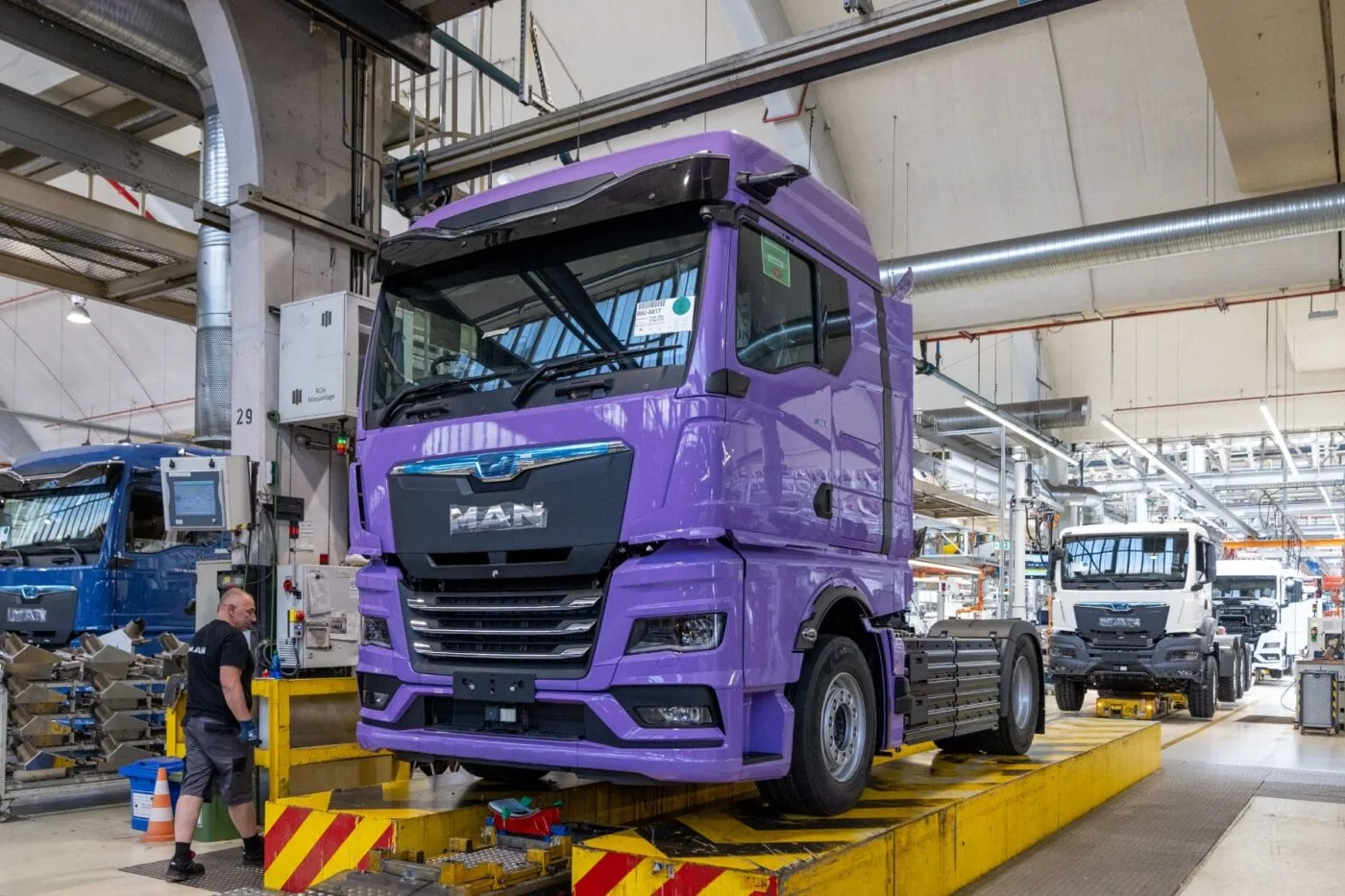
MAN has given the green light to series production of its eTruck electric HGVs. As of today, the Hauptwerk Munich plant has begun producing both electric and diesel trucks in a fully integrated mixed production line. MAN plans to deliver the first 1000 electric trucks by the end of the year. Calling it a ‘historic moment’ for MAN Truck & Bus, MAN CEO Alexander Vlaskamp said the shift marks a ‘turning point’ in the company’s history: “We have invested almost €400 million euros in research and development to be able to offer our conventional truck product portfolio with battery-electric drive as well… We aim to deliver the first 1000 electric trucks by the end of the year.” At a ceremony in the Munich plant, it was Vlaskamp along with MAN Production Director Michael Kobriger and EPP Chairman Manfred Weber MEP who hit the start button on production. This follows the first delivery of an eTGX to customers in October 2024. In order to kickstart series production of the eTruck, MAN has opted for a fully integrated mixed production of both electric and diesel trucks on the same assembly line – just like its competitors at Daimler Truck in Wörth. Michael Kobriger, board member for production and logistics has said this gives them a high degree of flexibility and responsiveness. “The production of electric or diesel trucks on a single line can be flexibly adapted to market developments, and the vehicles can be built exactly in the order in which they are ordered by customers. This innovative concept is accompanied by extensive changes along the assembly line as well as in the supply chain and logistics.” For instance, while the diesel trucks initially receive axles, tanks and exhaust fixtures, the E-models instead receive two battery blocks under the cab together with the HV distributor, climate compressor and other electrical components – all installed compactly inside the E-Powerpack. This is prepared at a separate pre-assembly line. MAN states that its maximum manufacturing capacity at the Munich plant is currently at approx. 100 trucks per day (diesel and electric), and that it takes around eight hours for each truck to be manufactured. The firm has said the major advantage of the eTruck is that all drive-relevant technology is arranged in the lower area of the frame: “The upper section thus remains completely free for the technical requirements of the body manufacturer and the customer has even more flexibility in the vehicle design.” Towards the end of the production line, all trucks undergo the ‘wedding’; an internal term used to describe the positioning of the cab on the fully assemble frame. Then, there’s the assembly of the tyres and the end-of-line ‘parameterisation’ and testing procedure. To prepare for series production, MAN has trained over 5000 employees in the ‘high-voltage technology’ underpinning the power pack. Kobringer states that around €1bn euros will also be invested in the conversion of the company’s other European plants to electrification by 2030. With much of these plants being based in Germany, he argues it will boost the industrial economy of Bavaria – particularly Nuremburg and Munich. The battery packs for both MAN’s electric trucks and buses are currently installed in Nuremburg. Regarding the eTruck, it will be launched in the models eTGX, eTGS and eTGL, all of which correspond to MAN’s existing diesel models. For example, the eTGX will share the wider cab of the diesel TGX. Each electric model, however, is based on the same modular platform. They each have a continuous output of 245 kW, 330 kW or 400 kW. Plus, with up to six NMC batteries, the trucks can provide a gross capacity of up to 534 kWh (480kWh usable). MAN states that this translates to up to 500 km of range without intermediate charging. Additionally, MAN has promised a seventh battery for even longer ranges of up to 740km – although the firm has not shared further details at this point. At the opening ceremony, MAN claimed that day tours of up to 850km (with intermediate charging) and very low consumption of an average 97 kWh per 100km will be possible with the eTrucks. Incidentally, MAN considers its new electric truck to be particularly attractive for use in automotive logistics because it is already available as a so-called ultra-lowliner tractor unit. What’s clear is that MAN is betting big on the eTruck, since electric trucks have so far played a minimal role at the company compared to electric buses. There is one exception to this, namely its first electric truck called the eTGM which entered production in 2018. With the company aiming to be carbon-neutral by 2050, as well as meet the current CO2 requirements of the EU, it plans to hand over more than 1000 eTrucks to customers this year alone. Alexander Vlaskamp stated that it’s now up to politicians to help maintain momentum of electrified logistics in Europe. He said: “Politicians must now set the right course with regard to infrastructure expansion and CO2 pricing so that the ramp-up in e-mobility continues to gain momentum.” mantruckandbus.com
Haven Energy & Clean Energy Alliance Launch Free Battery Storage Program For Eligible California Homeowners

In a move aimed at making energy resilience more accessible, Haven Energy and the Clean Energy Alliance (CEA) have teamed up to offer no-cost home battery systems to qualifying homeowners in San Diego County. The new initiative, called Battery Bonus Connect, provides fully installed battery storage without any out-of-pocket costs for residents who meet income eligibility criteria. The program is funded through California’s Self-Generation Incentive Program (SGIP), specifically the Residential Solar and Storage Equity (RSSE) fund. This incentive is designed to help income-qualified households reduce electricity bills and gain backup power protection during grid outages or peak demand periods. Who Qualifies? To be eligible, homeowners must: Live within the CEA service area (which includes Carlsbad, Del Mar, Solana Beach, and other communities) Own their home Participate in the CEA’s PeakSmart Savers program (a virtual power plant initiative) Meet income limits (typically 80% or less of the area median income, or enrollment in programs like CARE, FERA, or ESA) No credit checks or financing are required, and homeowners won’t be tied to any monthly fees, liens, or long-term contracts. What’s Included? Each installation includes: A home battery storage system tailored to the home’s energy profile Professional installation Ten years of maintenance and support from Haven Energy After ten years, homeowners can choose to keep the system at no cost or buy it earlier at fair market value. Virtual Power Plant Benefits These batteries won’t just sit idle. With customer permission, they’ll be part of a virtual power plant (VPP) managed by Haven. During times of peak grid demand, small amounts of stored energy from each home will be used to reduce pressure on the grid, while reserving at least 20% of the battery’s capacity for the homeowner’s personal use. This setup helps keep the lights on during outages and helps California reduce its reliance on polluting “peaker” power plants. Why This Matters California’s energy costs and climate-driven outages continue to rise. For many lower-income homeowners, the up-front cost of battery systems — often upwards of $10,000 — has kept them out of reach. Battery Bonus Connect removes those financial barriers. “The Battery Bonus Connect program is a meaningful step toward making clean energy solutions more accessible and available to all of CEA’s customers. By partnering with Haven Energy, we’re helping income-qualified customers with existing solar systems to gain the added benefits of battery storage – improving energy reliability, lowering electricity costs, and supporting a cleaner, more resilient grid. This program reflects CEA’s commitment to an equitable and affordable clean energy future.” — Greg Wade, CEO of Clean Energy Alliance Jeff Chapin, co-founder of Haven Energy, emphasized the program’s practical value: “By installing and aggregating the customer-sited battery systems into a VPP, we will also reduce grid congestion, lower our reliance on fossil fuels, and accelerate California’s optimization of renewables. Rather than sending surplus solar electricity to the grid in the middle of the day, we will store that electricity in the battery systems and discharge it during evening peak demand, reducing the need for natural gas generation.” CEA expects the program to cover around 300 installations, with demand expected to exceed supply. Interested homeowners are encouraged to check eligibility and apply soon. Sign up for CleanTechnica's Weekly Substack for Zach and Scott's in-depth analyses and high level summaries, sign up for our daily newsletter, and follow us on Google News! Whether you have solar power or not, please complete our latest solar power survey. Have a tip for CleanTechnica? Want to advertise? Want to suggest a guest for our CleanTech Talk podcast? Contact us here. Sign up for our daily newsletter for 15 new cleantech stories a day. Or sign up for our weekly one on top stories of the week if daily is too frequent. Advertisement CleanTechnica uses affiliate links. See our policy here. CleanTechnica's Comment Policy
Anza Q2 pricing report shows impact of tariffs on US storage
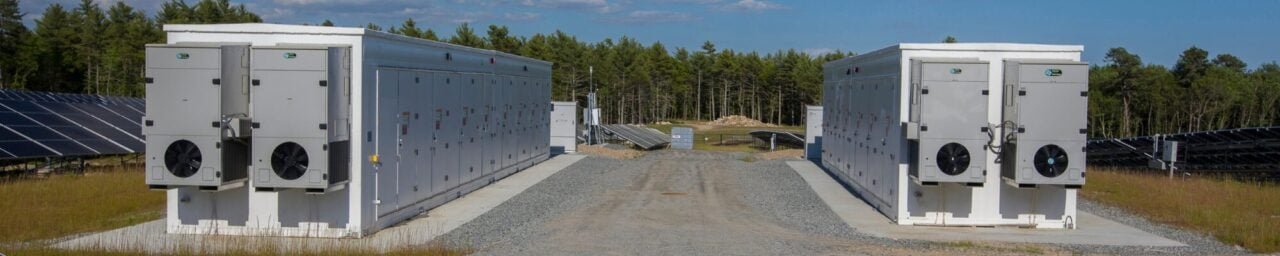
Tariff impacts Anza’s Q1 report noted that tariffs would likely significantly impact energy storage pricing. The company’s latest report reflects the true impact tariffs have had. In the Q1 report, pricing decreased marginally from August 2024 to 31 January 2025, and suppliers adjusted quotes and deal structures to prepare for tariffs. Since that time, a total tariff rate of 145% under the International Emergency Economic Powers Act (IEEPA) for China, along with Section 301, caused all manufacturers tracked by Anza to halt quoting in early April. Most of those same manufacturers returned to the market with reduced validity periods. The May reprieve lowers the IEEPA China rate to 30% for 90 days starting May 14 (Section 301 is still applicable), but suppliers are still safeguarding their margins using contract contingency clauses. Container production in Asia and the US surged significantly due to a tighter vessel supply due to tariffs. On 20 May, the International Trade Commission (ITC) announced a preliminary countervailing duty decision concerning Chinese active anode material. The initial duty is set at 6.55%, which might have little effect on the direct-current (DC) block level, but is still not fully known. Speaking with Energy-Storage.news, Senior Director of Strategic Sourcing at Anza Renewables, Ravi Manghani, notes: “Suppliers took most of April to navigate their way through the on-again-off-again tariff environment, but by mid-May, the prices finally settled down.” Manghani continues, “On the FOB basis (excluding tariffs and freight), we actually saw prices decline, which was expected as input costs have come down, and suppliers stepped up to absorb part of the ‘Liberation Day’ tariff. The tax bill now seems to have taken the front seat, as buyers evaluate their options on multidimensional risk factors.” Q2 system comparison Anza’s report analyses two standard project sizes, a 40MW distributed-generation project and a 200MW utility-scale project, both configured for four hours of duration. Both projects were analysed for weekly and monthly trends, observing significant and minor shifts in the industry. The cost for a four-hour, 40MW alternating-current (AC) BESS increased by 49% from early to late April, before dropping by 21% following the tariff pause on 12 May. DC systems experienced even more volatility, rising 84% from early to late April before dropping 33% in May. Anza notes that smaller, distribution-connected systems, like the 40MW system, faced a greater impact from tariffs compared to bulk-connected systems. Since January, prices for distribution-connected systems have surged by 68% for AC and DC, while AC bulk-connected systems saw a 56% rise and DC bulk-connected systems experienced a 69% increase. Q3 and beyond Anza says that prices are expected to remain volatile until policy clarity returns. Additionally, Anza says the 90-day tariff pause that began on 14 May is anticipated to raise shipping costs in Q3 2025, as various industries aim to import goods into the US to benefit from the reduced tariffs. Presently, a significant concern for the US energy storage sector is the US tax reconciliation bill, which, if enacted, might eliminate tax credits and bring other critical issues forward. Another key concern of the bill is the 60-day construction commencement requirement, mandating projects seeking tax credits to start construction within 60 days of the bill’s passage. Furthermore, these projects must be operational by the end of 2028. Manghani says of the bill, “First and foremost, if the 60-day commence construction requirement stays, we could see a rush to lock in supply for 2026-2028 deliveries. This could likely see prices rise by the end of this year and the first half of 2026.” The Senate appears to be softening this approach, however, during its part of the law-making process. See our coverage of its draft bill, from today, here. Manghani continued: “All this assuming the tariff situation doesn’t get any worse. Irrespective, we expect non-China products to hold a premium due to lower tariff concerns. The domestic options are also at the mercy of Foreign Entity of Concern (FEOC) language in the bill.” The FEOC restrictions would sever key supply chains for BESS technology before the US can establish a robust domestic supply chain. With so many unknowns, it is difficult to say right now what policy clarity will ultimately look like. Manghani adds, “The market needs clarity on two fronts – tax bill and tariffs. While the tax bill reconciliation is on track for a late July or early August resolution, tariffs will continue to keep everyone on their toes.” He continues, “In addition to the Liberation Day and Fentanyl IEEPA tariffs, the active anode materials AD/CVD case determinations are expected by fall, and the Department of Commerce has also started its investigation on processed critical minerals under Section 232.”
10 tips for early-stage sustainability professionals

As companies pull back on climate commitments (at least publicly) and trim their workforces, it’s a challenging time for sustainability professionals at every career level — but particularly those just starting out. The employment rate for recent college graduates aged 22-27 was almost 6 percent as of March, compared with 4.2 percent for the general population. ESG and sustainability teams are not immune to layoffs, and many professionals are reassessing their skill sets to land and keep a job. To mark the 10th anniversary of Trellis 30 Under 30 list — featuring rising stars in the climate sector — we reached out to the 270 people featured on earlier editions of the list and asked them this question: What one tip do you have for an early-stage sustainability professional? Here are responses from 10 past honorees. ‘Be agile’ Devin Carsdale (2017) Then: Sustainability compliance auditor for consumer goods purveyor Inter IKEA Group Now: Associate director of sustainability at pharmaceutical company Bristol Myers Squibb, specializing in sustainable procurement and Scope 3 emissions Advice: “Be amenable to taking on any number of tasks. As you grow in this space it is critical to be agile and a jack of all trades. This means project management, data analytics, change management, reporting and more!” ‘Take care of yourself’ Christina Copeland (2016) Then: Manager of disclosure services at sustainability reporting service CDP Now: Assistant vice president for sustainable finance reporting and strategy at insurer Great-West Lifeco Advice: “Take care of yourself. Working in sustainability can bring a lot of psychological baggage — the anxiety from knowing how bad it can be, feeling like you need to do more and are complicit just because you’re a human living in society. Find your community, your creative release, get professional support if you think it will be helpful. “ ‘Ask what makes you come alive’ Lisa Curtis (2016) Then: Founder and CEO of Kuli Kuli Foods, which makes organic, superfood snacks from drought-tolerant moringa trees planted to combat deforestation Now: Curtis still leads the company, which counts Walmart among its retail partners Advice: “I strongly believe in the Howard Thurman quote of ‘Don’t ask what the world needs, ask what makes you come alive because what the world needs is more people who have come alive.’ Start by understanding the type of work that gives you energy — the work that you could do even if no one paid you to do it — and then figure out how to get paid for it.” ‘Don’t wait for permission’ Phil De Luna (2019) Then: Program director for the Energy Materials Challenge Program with National Research Council Canada Now: Chief science and commercial officer for Deep Sky Alpha, a Canadian direct air capture innovation and testing center that has raised more than $90 million Advice: “As someone who has navigated the intersection of science, entrepreneurship and policy, my advice is: Don’t wait for permission — start building now. Sustainability challenges are multifaceted, and addressing them requires proactive engagement. Build your network, seek mentorship and don’t hesitate to pursue innovative ideas. Remember: Impactful change doesn’t come from waiting for the perfect moment; it comes from taking the first step and learning along the way.” ‘Stay curious and adaptable’ Franck Gbaguidi (2023) Then: Director of sustainability at Eurasia Group, a political risk research and advisory group. Now: Practice head for global sustainability, biodiversity and water at Eurasia Advice: “Stay curious and adaptable. Sustainability is constantly evolving — from the early CSR days to the ESG boom to today’s anti-ESG wave. Those who thrive are lifelong learners who anticipate shifts and shape the agenda, not just follow it. That mindset will position you to lead through whatever phase comes next.” ‘Don’t chase trends’ Pedro Alexandre Martins (2024) Then: Senior sustainability source manager at meal kit company HelloFresh Now: Senior engagement manager at Capitals Coalition, which helps companies consider natural capital, social capital and human capital alongside financial metrics as part of decision-making Advice: “Figure out where you thrive on the transformation spectrum. Change happens in startups, corporations, civil society and advocacy spaces — but the paths and pace differ. Don’t chase trends. Test what energizes you most! Systems change needs diverse builders; find where your purpose and skillset align best.” ‘Ask questions’ Hardik Miyani (2022) Then: Senior energy and commissioning engineer at building sustainability and efficiency firm Baumann Consulting Now: Miyani, named Young Energy Professional of the Year in 2024 by the Association of Energy Engineers, is the energy and decarbonization manager at Baumann Advice: “Build a strong foundation by mastering the basics of energy systems and data analysis, but always stay curious — ask questions, seek mentors, and connect your work to real-world impact. Sustainability is a marathon, not a sprint. Focus on measurable progress, not perfection.” ‘Learn from the past’ Kaity Robbins (2024) Then: Senior program manager of waste diversion at Whole Foods Market Now: Same Advice: “Approach every situation with curiosity first. It’s essential to acknowledge and learn from our past. Understanding why things are done certain ways provides the knowledge needed to chart better paths forward.” ‘Engage with seasoned professionals’ José Miguel Salazar Hernández (2020) Then: Senior specialist for corporate sustainability at CSRone, an ESG consulting firm in Taiwan Now: Manager for ESG, sustainability and climate change services with PwC Spain Advice: “Sustainability careers cycle along regulations and investor views, which are currently facing a scale back. This phase is temporary, as fundamentals shall endure. Climate, nature and human rights will remain key financial risks and opportunities. Newcomers should engage with seasoned professionals to get sufficient context and perspective of where to focus priorities.” ‘Be brave and be loud’ Emily Sambuco (2023) Then: Lead catastrophe analyst and atmospheric scientist with the corporate enterprise risk management team at Liberty Mutual Insurance Now: Same Advice: “Be brave and be loud. Leverage your expertise — whether in climate, sustainability, environmental science, whatever — and advocate for scientific and data-driven decision-making within your organization. Communicate, educate and build relationships. Your experience is
Comau and Roboze collaborate to expand into new market sectors

The two Italian companies are collaborating to combine additive manufacturing and automation to reach new markets. Comau and Roboze have announced a collaboration to address demand for cost-effective automation in on-demand manufacturing. The partnership will focus on sectors including automotive, aerospace, energy, and racing. The joint effort accelerates the availability of automation for advanced manufacturing everywhere, enabling true just-in-time production whenever and wherever it is needed. This directly supports reshoring strategies and sustainable manufacturing models, allowing companies to optimize resources, minimize waste, and align with growing market expectations for low-impact, environmentally responsible production. This collaboration highlights the role of automated processes in supporting broader adoption of advanced manufacturing based on specific needs. It also allows for the production of complex geometries not easily achievable with traditional methods, helping companies manufacture customized parts more efficiently. For more information, visit comau.com.
Tesla gears up to start selling Tesla Semi electric truck in Europe

Tesla is gearing up to start selling its upcoming Tesla Semi electric truck in Europe with a new hire to develop the market. Tesla Semi is finally about to go into volume production in the US after being unveiled almost a decade ago. The vehicle was unveiled in 2017 and was initially scheduled to enter production in 2019; however, the automaker delayed the program on several occasions. Tesla unveiled a “production version” in 2022, but it was only produced in small batches. The Class 8 electric truck remains a rare sight in the US, with only a few dozen units in the hands of a handful of customers and a few more in Tesla’s internal fleet. Advertisement - scroll for more content Photo: PepsiCo In January 2023, Tesla announced an expansion of Gigafactory Nevada to build the Tesla Semi in volume. However, that plan was also changed and delayed. Tesla ultimately built a separate factory adjacent to Gigafactory Nevada, and production was delayed until 2025. Earlier this year, Tesla completed the building and started working on the production lines. The automaker said that Tesla Semi production was expected to begin in late 2025 and ramp up to a capacity of 50,000 trucks per year. Now, we learn that Tesla is starting to build an organization to sell the Tesla Semi in Europe. Electrek found that Tesla hired a new leader to head business development for Tesla Semi in Europe. Usuf Schermo announced on his LinkedIn last week that he joined Tesla as “Head of Business Development EMEA for Tesla Semi.” Schermo, who holds a master in economic engineering, energy and ressources management from TU Berlin, has some experience with commercial electric vehicles. He was the head of sales in Germany for Volta Trucks from 2022 to 2024. The company made the Volta One, a 16-tonne electric truck aimed at city deliveries. Volta went bankrupted in 2023, but it got back in business with a restructuring in 2024, which didn’t last long as they were insolvent as of last month. For the last year, Schermo has been leading sales for EVUM aCar, a German startup building a small commercial vehicle. Now, he will develop the market for Tesla’s class 8 electric truck. The European electric commercial truck market is much developed in the US with already some significant competition from Volvo with the Volvo FH Electric, Mercedes-Benz with the eActros 600, MAN with the eTGX, and several others. The market is still young, but Volvo is already emerging as a leader with an estimated more than 3,000 electric trucks in operations in Europe. With production only starting in the US toward the end of the year, Tesla is not likely to have an homologated version of the Tesla Semi in Europe until later in 2026. Tesla has already announced plans to build the Tesla Semi in Europe at Gigafactory Berlin. The automaker currently only produces the Model Y at the German factory and its sales are crashing across Europe. Electrek’s Take I keep saying to Tesla fans that hate me: I track both Tesla hires and departures. I try to report on both, but the former are much more scarce than the latter these days. This is one of the few significant hires of the last years at Tesla and say “significant” because it shows Tesla is preparing to sell the Tesla Semi in Europe because this is clearly not an executive level role. Over the last year and since the great purge of talent in April 2024, Tesla has almost been exclusive promoting from within at higher director and VP levels rather than hire from outside. As for the Tesla Semi in Europe, it could work. Like I said, there’s already a lot of competition, but Tesla Semi is expected to have a longer range than everything else, which should attract buyers. However, as we recently reported, it is expected to be much more expensive than what Tesla previously announced. It could particularly useful for Gigafactory Berlin, which is at a real risk right now with Tesla’s sales crashing in Europe. Producing a new vehicle program there, and a commercial one that rely less on consumer perception, could help increase factory utilization. FTC: We use income earning auto affiliate links. More.
Gov. Gianforte vetoes Montana community solar legislation

Gov. Gianforte vetoes Montana community solar legislation Notifications
Charged EVs | Inmotion launches new DC-DC converter and inverter for commercial EVs

Inmotion Technologies, a subsidiary of Italy’s ZAPI GROUP and a supplier of electric motors, motor control units and auxiliary electronic equipment for industrial and commercial vehicles, has released a new DCC3 converter and ACH3 inverter. The DCC3 is a rugged, compact DC-DC converter engineered for flexibility to support a range of construction applications. It converts input voltages from 250 V to 900 V into a stable, adjustable 12 V or 24 V output, delivering up to 10 kW of power for auxiliary systems in electric or hybrid industrial, commercial and utility vehicles. The new converter design is available for prototyping now and will go into serial production at the end of 2025. The new third-generation, high-voltage ACH3 inverters come with customizable control software that integrates functional safety and cybersecurity. “Historically, inverter power output and efficiency have limited vehicle electrification. The ACH3 addresses these issues. It has a 99% peak efficiency, current ratings from 30 to more than 600 amperes and up to 900-volt bus voltage with full power,” said Martin Wennerblom, Product and Marketing Director at Inmotion Technologies. The inverter has a minimal environmental impact throughout its production, operational life and end-of-life disposal, according to the company. It has an expected lifespan of 72,000 working hours. The components are sourced from Europe and all units are assembled in Sweden. Inmotion also offers high-power onboard and off-board battery chargers, electric motors, electric power takeoff (ePTO) and fleet management solutions for the construction and industrial vehicle sectors. Source: Inmotion Technologies
The Ford Super Mustang Mach-E Was Built To Win Pikes Peak

Ford is gunning for another win at Pikes Peak this year. The car for the job is called the Super Mustang Mach-E. It has over 1,400 horsepower and can produce a ridiculous amount of downforce. Ford is returning to the legendary Pikes Peak hill climb competition this year with yet another wild electric one-off. Called the Super Mustang Mach-E, the outrageous EV one-ups last year’s winning SuperTruck with even more downforce and fewer pounds. Built on a bespoke chassis, the Ford Super Mustang Mach-E has three electric motors making no fewer than 1,421 horsepower. That’s up from last year’s 1,400 hp of the victorious F-150 Lightning lookalike, and as if that wasn’t enough, weight has also been slashed by 250 pounds (113 kilograms). Photo by: Ford 2026 BMW iX3 First Drive - BMW's Best EV Yet? Watch More The Super Mustang Mach-E has a 50-kilowatt-hour battery, which wouldn’t be anything to write home about on a road-going car, but for the 12.42-mile Pikes Peak, it’s more than enough. It feeds 700 volts of electricity to the UHP six-phase motors and can take in as much as 710 kW from regenerative braking–up from last year’s 600 kW. When it comes to downforce, the Super Mustang Mach-E is, again, quite the beast. Ford says the racing EV’s carbon fiber aero package can put down a whopping 6,900 pounds (3,130 kilograms) of downforce at 150 mph (241 kph). On a long enough straight where the speedo shows 200 mph (322 kph), that figure can climb even higher–up to 12,000 lbs (5,443 kg). By comparison, last year’s SuperVan had 6,000 lbs (2,721 kg) of downforce at 150 mph, while the SuperVan, which came second in 2023, had 4,400 lbs (1,996 kg). To keep the car glued onto the 156 turns of Pikes Peak, the Super Mustang Mach-E has forged magnesium wheels covered in Pirelli P-Zero tires, while carbon brakes ensure the zero-emissions racer can stop properly. Driving the electric beast will be Romain Dumas, Pikes Peak veteran and holder of the overall record here. Back in 2018, he set a new record behind the wheel of the Volkswagen ID.R concept, clocking in a 7:57.148 lap. Last year, Dumas won Pikes Peak with Ford’s SuperTruck EV, finishing the run in 8:53.553. 131 Source: Ford This year, the French racing driver will drive up the hill for the tenth time and will give it everything to secure another win for Ford. “This Mach-E is a different beast,” said Dumas. “We’re pushing the limits again, and that’s what the mountain is all about.” The car will run the number 310, as a nod to Ford’s third consecutive attempt at Pikes Peak and Dumas’ tenth drive in The Race To The Clouds. “We're continuing to push the boundaries of what's possible with electric vehicles,” said Mark Rushbrook, Global Director of Ford Performance. “This Super Mustang Mach-E demonstrator represents the next stage in our electrification journey—lighter, leaner, just as powerful, and more capable in high-altitude competition.” Can Ford pull it off for a second time this year? All signs point to a positive answer, but we’ll have to wait and see what the competition has in store. The 2025 Pikes Peak International Hill Climb (PPIHC) is happening this weekend, on June 22.
China EV insurance registrations for week ending Jun 15: Nio 3,060, Tesla 15,500, Xiaomi 5,600

Nio Inc, including the Nio, Onvo, and Firefly brands, saw 4,730 insurance registrations in China last week, a 9.24 percent increase from the previous week. Tesla's insurance registrations in China last week reached a 10-week high, up 79.40 percent from the previous week's 8,640 units. Nio Inc (NYSE: NIO) ended several weeks of consecutive sequential declines in insurance registrations in China last week, while Tesla saw a significant increase. During the week of June 9-15 -- week 24 of 2025 -- Nio brand vehicles had 3,060 insurance registrations in China, up 16.35 percent from the previous week's 2,630, ending three consecutive weeks of sequential declines, according to figures shared today on Weibo by several automotive industry observers. Nio's sub-brand Onvo recorded 1,230 insurance registrations last week, up 2.50 percent from the previous week's 1,200 units. Nio's other sub-brand Firefly saw 440 insurance registrations last week, down 12.00 percent from the previous week's 500 units. Nio Inc, including the Nio, Onvo, and Firefly brands, recorded 4,730 insurance registrations in China last week, up 9.24 percent from the previous week's 4,330, ending three consecutive weeks of sequential declines. Nio Inc delivered 23,231 vehicles in May, up 13.08 percent from 20,544 in the same period last year, but down 2.80 percent from 23,900 in April, according to data released on June 1. Nio's main brand delivered 13,270 vehicles in May, a year-on-year decrease of 35.41 percent and a decrease of 31.13 percent compared to April. Onvo delivered 6,281 vehicles in May, a 42.75 percent increase from April. Firefly delivered 3,680 vehicles in May. This marks the first full month of deliveries for the Nio sub-brand. Tesla (NASDAQ: TSLA) had 15,500 insurance registrations in China last week, marking a 79.40 percent increase from the previous week's 8,640 and the highest figure in the past 10 weeks. The US EV maker operates a factory in Shanghai producing the Model 3 sedan and Model Y crossover, which are delivered to domestic customers and also serve as an export hub. Tesla's retail sales in China in May totaled 38,588 units, down 30.11 percent year-on-year, though up 34.31 percent from April, according to data from the China Passenger Car Association (CPCA). Its Shanghai factory exported 23,074 vehicles in May, up 32.93 percent year-on-year, though down 22.38 percent from April. Earlier today, the delivery wait time for the Tesla Model 3 in China saw its first increase in the past nine months, suggesting that the Shanghai factory may be undergoing some new adjustments. Xpeng (NYSE: XPEV) had 6,400 insurance registrations last week, a 52.74 percent increase from the previous week's 4,190 vehicles. The company delivered 33,525 vehicles in May, marking seven consecutive months of deliveries exceeding 30,000 units. This represents a 230.43 percent increase from the 10,146 units delivered in the same period last year, though it is a 4.34 percent decrease from the 35,045 units delivered in April. Li Auto (NASDAQ: LI) had 7,900 insurance registrations last week, a decrease of 4.47 percent from the previous week's 8,270 units. It delivered 40,856 vehicles in May, a 16.66 percent increase from the 35,020 units in the same period last year, and a 20.38 percent increase from April's 33,939 units. BYD (HKG: 1211, OTCMKTS: BYDDY) brand vehicles saw insurance registrations of 70,300 units last week, up 28.17 percent from the previous week's 54,850 units. The company sold 382,476 vehicles in May, up 15.27 percent year-on-year and 0.63 percent from April. BYD announced significant discounts on models in its Dynasty and Ocean product lines at the end of last month, prompting several competitors to follow suit. Xiaomi (HKG: 1810, OTCMKTS: XIACY) had 5,600 insurance registrations last week, up 28.15 percent from the previous week's 4,370 units. Xiaomi's EV unit, Xiaomi EV, delivered over 28,000 units in May, it announced on June 1. Xiaomi unveiled the YU7 SUV (sport utility vehicle) on May 22. The company said yesterday that the YU7 will officially launch at the end of this month. The Zeekr (NYSE: ZK) brand recorded 3,200 insurance registrations last week, flat from the previous week. The Zeekr brand delivered 18,908 vehicles in May, up 1.57 percent year-on-year and up 37.74 percent month-on-month. Including Lynk & Co's deliveries, the Zeekr Group delivered 46,538 vehicles in May, up 12.64 percent from 41,316 in April, marking the third consecutive month of month-on-month growth. Leapmotor (HKG: 9863) had 8,800 insurance registrations last week, flat from the previous week. It delivered 45,067 vehicles in May, surpassing the previous record of 42,517 set in December 2024. This represents a 148.10 percent increase from the 18,165 units in the same period last year and a 9.82 percent increase from the 41,039 units in April. Aito -- the brand jointly developed by Huawei and Seres Group -- had 10,000 insurance registrations last week, up 13.77 percent from the 8,790 units in the previous week. Data table: China EV insurance registrations in Jun 9-15
Western Australia: GenusPlus contracted to build 400MWh BESS

Western Australia: GenusPlus contracted to build 400MWh BESS - Energy-Storage.News Skip to content
Huawei commissions Cambodia's first grid-forming BESS project

Huawei commissions Cambodia's first grid-forming BESS project - Energy-Storage.News Skip to content Huawei commissions Cambodia's first grid-forming BESS project - Energy-Storage.News Skip to content [/gpt3]
Leap and Xos partner to turn electric fleets into grid resources
Xos, a US manufacturer of electric trucks and vans, has partnered with virtual power plant operator Leap to turn fleet charging infrastructure into flexible energy resources. The integration enables fleet operators to earn revenue by supporting the grid during peak demand events. The collaboration integrates Leap’s software-only VPP platform with Xos Hub, a mobile, battery-integrated charging solution developed by Xos. It allows fleet operators using Xos charging technology to enrol in California’s Demand Side Grid Support (DSGS) programme. During emergency grid events, participating fleets will automatically shift charging from the grid to stored battery power via the Xos Hub, helping to reduce grid load and generate revenue for operators. “Leveraging our complementary technologies, Leap and Xos are tapping new value streams for commercial truck fleets, the transportation services that power our economy,” said Jason Michaels, CEO of Leap. “Together, we’re making these fleets cleaner, smarter, and more cost-effective, while contributing to a more resilient energy landscape.” The Xos Hub is designed to accelerate fleet electrification by providing mobile and semi-permanent charging without the delays and costs associated with traditional infrastructure. By integrating with Leap’s API suite, Xos can offer energy market participation without the need for additional hardware or significant operational changes. “Our VPP offering gives fleet customers advanced energy capabilities without compromising control or convenience,” said Dakota Semler, CEO of Xos. “It’s a powerful way to lower the cost of infrastructure ownership even further, maximise the value of our products, and support customers in meeting their electrification goals.” Leap’s platform currently manages over 200,000 distributed energy resources across U.S. energy markets. The addition of Xos’s electric fleet charging infrastructure is expected to expand the reach of the platform and enhance the impact of demand-side grid support in California. leap.energy
A Deeper Look at Hidden Damage: Nano-CT Imaging Maps Internal Battery Degradation

Last Updated on: 17th June 2025, 01:46 am The minerals that power lithium-ion batteries—including lithium, nickel, cobalt, manganese, and graphite—are both highly valuable and difficult to come by. As battery storage capacity across the United States continues to grow, constraints on the mining, refining, and processing of key minerals leaves our energy systems vulnerable to the fluctuations of foreign markets. China maintains significant control across the battery supply chain, including 60% to 90% of global mineral processing for lithium, nickel, and cobalt, according to a recent report from the U.S. Department of Energy. Direct recycling of battery cathodes within the United States offers an opportunity to strengthen domestic battery supply chains and extend the lifespan of critical materials. However, traditional battery recycling methods are expensive and energy intensive, breaking down materials to their basic elements and rebuilding batteries from scratch. National Renewable Energy Laboratory (NREL) researchers are exploring an alternative method in direct recycling, which aims to preserve and refurbish battery components for a more efficient and cost-effective process. Unfortunately, not all direct-recycled batteries are created equal. Microscopic and difficult-to-detect damage within cells builds up over time, weakening the performance of some batteries. High-quality recovered materials ensure that recycled batteries achieve the performance and lifetime expected by consumers. High-Resolution Insights To Improve Recovery NREL researchers look to X-ray nanoscale computed tomography (nano-CT) imaging of batteries at the end of their useful life to reveal hidden flaws that impact the quality of materials recovered for recycling. NREL’s state-of-the-art nano-CT scanner can achieve an impressive 50-nanometer spatial resolution—an ability typically reserved for high-energy synchrotron X-ray facilities. This advanced imaging tool allows researchers to analyze the internal structure and composition of energy materials in exceptional detail. Because nano-CT is nondestructive, scientists can observe these changes as they happen in real time, offering essential insights into how battery materials change during operation and cycling. “This in-house, high-resolution imaging allows us to inspect specific degradation types that exist in end-of-life battery materials,” said NREL’s Donal Finegan, a senior energy storage scientist. “Combined with other microscopy tools and advanced artificial intelligence, nano-CT helps pinpoint barriers facing direct recycling so we can develop techniques to recover and refurbish high-quality materials that maximize battery performance.” Tiny Cracks, Big Impacts “Early in this project, we found that the end-of-life material showed a similar energy capacity to pristine, unused battery cells, however, the charging rate was severely diminished,” said Melissa Popeil, an NREL energy storage doctoral researcher. “We were surprised to find that the primary damage type limiting battery performance was morphological changes, or particle cracking within the material microstructure.” What started as a basic electrochemical performance evaluation quickly expanded to include in-depth characterization of battery cell capacity, composition, morphology, microstructure, and more to determine the extent of degradation. To maintain real-world relevancy, the project looked at commercial battery cells that were cycled under realistic, long-term conditions as part of the U.S. Department of Energy’s Vehicle Technologies Office. Researchers used nano-CT scanning alongside NREL’s Microstructure Analysis Toolbox (MATBOX) to identify and quantify the types of damage within each cell, isolating different layers to maximize spatial variation. As researchers continue to develop new direct recycling processes, they will need to address these severe cracks in the cathode active materials. Fortunately, NREL researchers are up to the challenge. “Now that we’ve identified the extent of this cracking, we are evaluating new ways to process the end-of-life material to repair some of that damage,” Popeil said. “By targeting mechanical changes to the material, we can avoid extensive chemical processing in favor of simplified and more efficient recovery methods.” This research underscores the importance of advanced characterization techniques, such as nano-CT scanning, when determining a future for spent or discarded lithium-ion batteries. Researchers will next expand the project to include a wider range of battery materials entering the waste stream to optimize recycling processes for different battery chemistries, extending the lifetime and value of critical minerals within the U.S. supply chain. Learn more about NREL’s energy storage and transportation and mobility research. And sign up for NREL’s quarterly transportation and mobility research newsletter to stay current on the latest news. Article from NREL. By Rebecca Martineau. Sign up for CleanTechnica's Weekly Substack for Zach and Scott's in-depth analyses and high level summaries, sign up for our daily newsletter, and follow us on Google News! Whether you have solar power or not, please complete our latest solar power survey. Have a tip for CleanTechnica? Want to advertise? Want to suggest a guest for our CleanTech Talk podcast? Contact us here. Sign up for our daily newsletter for 15 new cleantech stories a day. Or sign up for our weekly one on top stories of the week if daily is too frequent. Advertisement CleanTechnica uses affiliate links. See our policy here. CleanTechnica's Comment Policy
Aslan Energy to build data centre with 120MWh BESS in Indonesia

Aslan Energy to build data centre with 120MWh BESS in Indonesia - Energy-Storage.News Skip to content
Tesla features used to flunk 16-year-old's driver license test
In what is becoming a more common occurrence, a few Tesla features were used to flunk a 16-year-old who took his driver’s license test in New Jersey. It is not the first time this has happened, as we have reported on several instances of this in the past, both in the U.S. and other countries in the world. It is evidence that some officials are not caught up in the technology and innovation occurring in the automotive market, some of which is not necessarily exclusive to Tesla, but is included in each of its models, unlike other companies. Lochlan Keefer, a New Jersey resident, showed up to his driver’s test with his dad, James, in their 2022 Tesla Model Y. However, the test did not go according to plan, according to the examiner who rode along for the test with Lochlan. They accused him of using parking and “stopping assistance” to go through the test. The examiner cited the following as the reason for failure: “Had the parking and stopping assistance on never stepped on the brake to stop his self let the vehicle stop it self.” James said to NJ.com that they do not subscribe to Tesla’s Full Self-Driving suite, which includes things like Autopark, Navigate on Autopilot, and Autosteer on City Streets. These are a few of the things that have been used as reasoning to fail drivers in tests. Lochlan’s was a case of regenerative braking, which is standard on all vehicles, and Autopark: “The examiner accused my son of using driver assistance features simply because he parallel parked smoothly on the first try. He was specifically accused of using paid parking-assist and driving features, which we do not subscribe to.” It sounds as if the examiner may have confused the braking mishap for Tesla’s regenerative braking, which slows the vehicle when the accelerator is not pressed. The energy is then stored back in the battery to help with range. The examiner failed Lochlan, and James asked if he could take the test again if they disabled the regenerative braking for the exam. The examiner said Lochlan would have to wait two weeks. A supervisor came out and backed the examiner, but James said the policy the DMV claimed the Keefer’s violated was nowhere to be found: “I asked them to show me the policy they claimed we were violating. They couldn’t find it and they couldn’t cite it. When I showed them the policy, they refused to read it.” The report states that drivers in California and Arizona have also been subjected to failures on their driving tests due to confusion over Teslas and their driver assistance features.
Large-Scale Fire Testing: Fluence, Hithium, Canadian Solar BESS
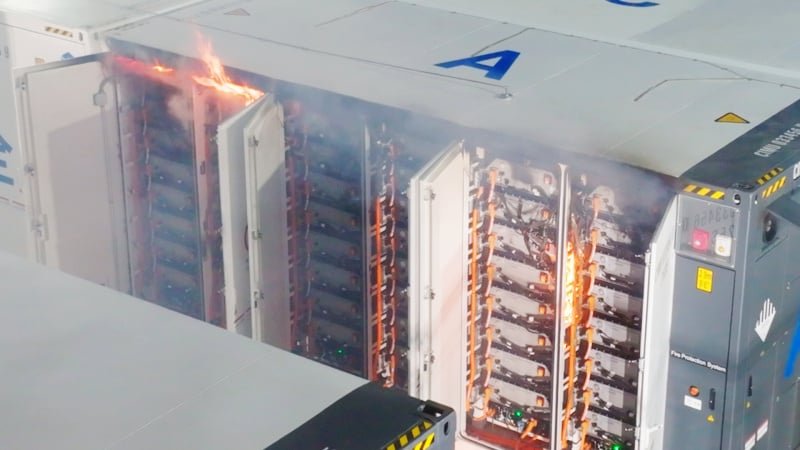
Large-Scale Fire Testing: Fluence, Hithium, Canadian Solar BESS - Energy-Storage.News Skip to content

