Develon electrifies excavator lineup
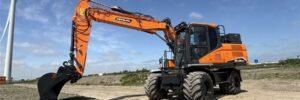
Construction equipment manufacturer Develon, previously known as Doosan Construction Equipment, has launched a new range of electric excavators. The first electric excavator—which carries the designation DX160WE-7—is a wheeled excavator. The DX160WE-7 and two crawler excavators based on the DX225LC-7 platform will be available with various battery configurations, including an extended range pack that should allow the excavator to operate for a full working day on a single charge. The new line is aimed at “supporting the transition to cleaner, quieter and more sustainable construction,” the company said. To develop electric drivetrains for this new line, the company partnered with ETEC Zero Emissions. The Waddinxveen, Netherlands-based company was founded as Elm in the 1930s. It had been a Doosan dealer for several decades and is continuing an even closer partnership with Develon post-name-change. ETEC was responsible for the integration of an electric drivetrain into several current Develon models to ensure the same performance as an ICE engine, albeit with zero emissions. While Develon was formerly known as Doosan Infracore, and Bobcat was part of the Doosan Group, the two companies are now separate entities under HD Hyundai. Source: Develon
Watch the first true Tesla Robotaxi intervention by safety monitor
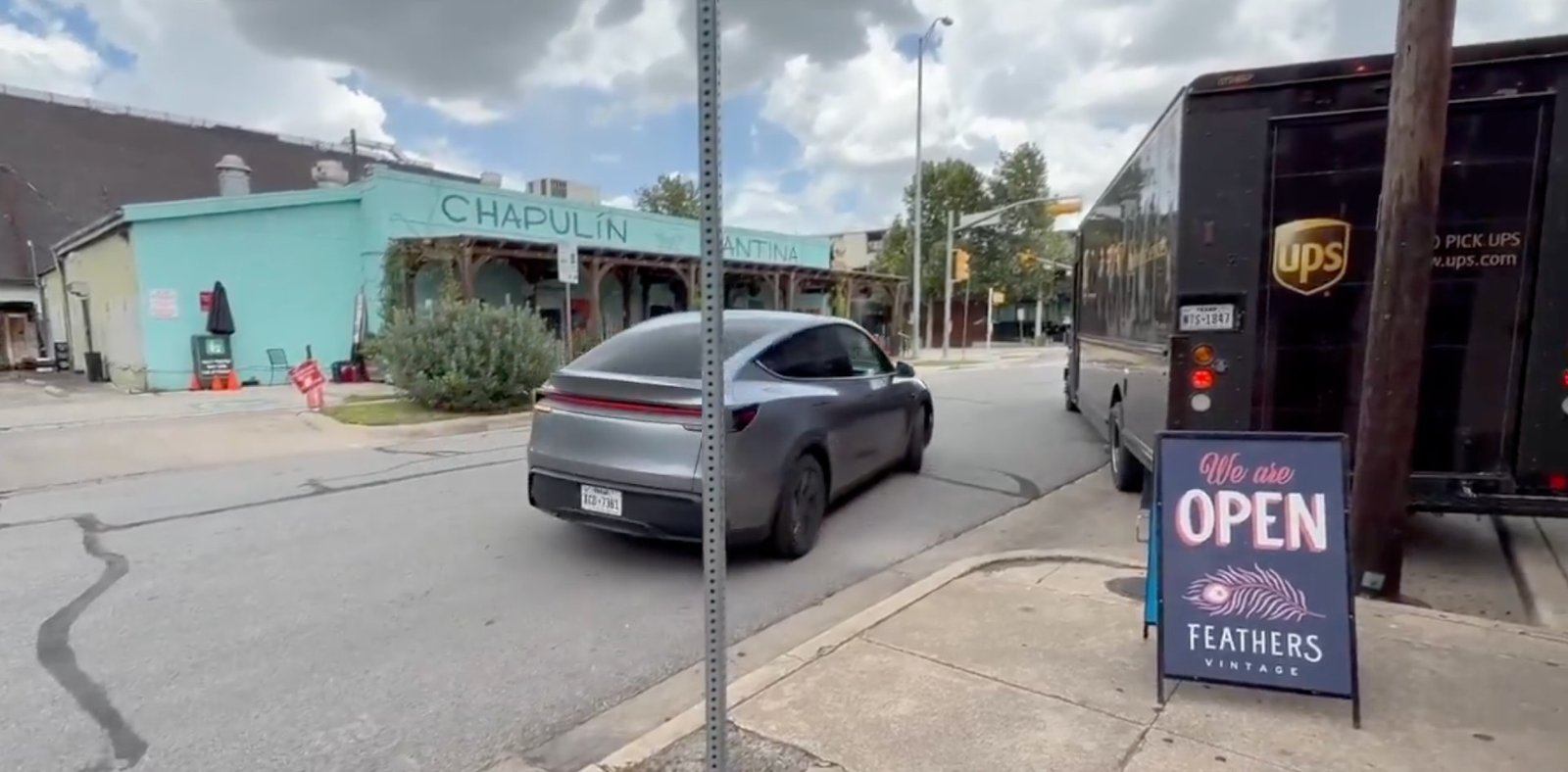
Nearly 60 hours into the launch of the Tesla Robotaxi platform, it appears we have our first true intervention that required the in-car safety monitor to intervene. We’ve seen and heard about a handful of minor issues with the Robotaxi fleet thus far, one of which included a risky, but very human-like behavior of navigating across yellow lines to a turn lane after missing a turn. While that is not necessarily a legal maneuver, it is something that you’d see commonly from human drivers, and although aggressive, it is sometimes reasonable to perform depending on traffic conditions. For what it’s worth, the car seemed very confused by the situation, and while the safety monitor did not get involved and the car handled the situation with no real issue, it is something as a rider you’d like to see less of. First Look at Tesla’s Robotaxi App: features, design, and more As previously stated, that specific example did not require any intervention by a safety monitor. On Tuesday, we saw a video of the first true intervention that required the safety monitor who sits in the passenger seat to intervene by pressing a button on the center touchscreen. During a ride that Tesla investor and YouTuber Dave Lee was taking in Austin in a Robotaxi, the vehicle seemed to get a little confused by a UPS truck that was parallel parking in front of it. The monitor pressed the “Stop in Lane” button on the touchscreen: This is the first intervention we’ve seen with Robotaxi (via @heydave7): pic.twitter.com/B9ji3iLa3a — TESLARATI (@Teslarati) June 24, 2025 This appears to be one of the first errors shared by Tesla Robotaxi Early Access Program users that required the monitor to actually intervene. We have not seen any of it yet. You could also see the UPS truck is also a bit at fault here, as the space it pulled into did not seem even remotely large enough to fit the entire vehicle. The car may not have anticipated that the truck would park there. You can see how the UPS truck was parked below, and it seems reasonable that the Tesla might not have thought it would attempt to fit there: Credit: Dave Lee The Model Y’s steering wheel was also turning sharply right into this spot, it appears. Dave ended his ride here, and stated that this was his dropoff spot. The UPS truck might have just cut off the Tesla, which led to the intervention. It is a testament to Tesla’s strategy with this Robotaxi rollout. The company is obviously confident enough in the Full Self-Driving suite that it does not feel a human needs to be in the driver’s seat. However, it is still requiring someone, as of now, to sit in the passenger’s seat for instances just like this one. Safety is the company’s priority with the launch of Robotaxi, and CEO Elon Musk has reiterated that. It is expected that we’d eventually see some kind of intervention that requires a monitor to step in. Everyone was safe. Obviously, these things happen with autonomous vehicles. We’ve seen Waymos get stuck at intersections in very strange scenarios at times: Waymo turned into oncoming traffic on the way to work. It sat there confused for 45 seconds with its hazards on. Then it proceeded to back up into oncoming traffic. And they’re about to let these guys on the freeway pic.twitter.com/ZLRKx2loo1 — Jake Glaser | LA Multifamily (@LAMultiBroker) January 31, 2025 It is proof that autonomous tech is still in a growth phase and engineers are still learning about its capabilities. Tesla and other companies will learn from these rare cases and become better companies, and offer safer technologies because of it. The post Watch the first true Tesla Robotaxi intervention by safety monitor appeared first on TESLARATI.
Technological complexity needs systems engineers to lead the way into the future

Purdue University has sponsored this post. Image: Purdue. Technology has been advancing rapidly for the last few decades, and especially over the last five to ten years. In particular, the integrated systems that are enabled by technology are evolving at warp-speed, with increasing material, project and integration complexity. In order to meet the needs of our society and its dependence on current and future products, technologies, and services, we need more engineers who are able to support the development and sustainment of these technologies and their systems. “Engineering as a discipline is growing, and has been growing,” says Patrick Brunese, assistant head of the Edwardson School of Industrial Engineering at Purdue University. “There were calls during the Obama administration for rapidly scaling up the number of engineering graduates in the U.S. and abroad. Purdue attempted to meet that goal head-on by rapidly growing our engineering programs at the bachelor’s, master’s and doctoral levels, over the last decade. And that trend is continuing.” When it comes to systems engineering in particular, the last several years have seen substantial growth, in the realm of 10%, which is expected to continue over the next decade. While 10% growth may not necessarily seem like a large number, the reality is that from 2022 to 2023 there were around 80,000 to 90,000 unique job postings for systems engineers. “That’s a lot of new opportunities, or opportunities created by promotion and turnover of existing engineers,” Brunese says. For engineers who want to take advantage of these opportunities, whether they are currently in a systems role looking to upskill, wanting to move into a systems role for the first time, or seeking promotion and higher salary, a master’s degree in systems engineering is essential. Purdue offers a unique educational opportunity through its new, fully-online master’s of science in systems engineering. Offering the program online, rather than only as a residential experience, is because many engineers seeking a master’s degree are already employed, often as some other type of engineer. When they have the opportunity to move into a more formal systems engineering role, or are in a systems engineering role for their organization and looking to upskill, a flexible online option is what they need. Building the master’s in systems engineering When asked how Purdue decided to create the new program, “the simplest answer is, demand,” Burnese says. “We regularly communicate with different employers, many of whom come to Purdue every year through job fairs, research engagements, to recruit our students and interface with our faculty. They would often note the need for more direct education in systems engineering.” “And speaking as someone who has taught classes, we saw the same thing from the student side, saying ‘it would be really nice if there was a systems engineering program online,’” he adds. The discipline isn’t a new one for Purdue, which has been educating talented systems engineers for decades through the programs that already existed in the College of Engineering, such as industrial engineering, aeronautics or astronautics, mechanical, electrical and computer engineering. But an integrated educational program with the systems engineering title didn’t exist, even though the discipline has become increasingly vital to the engineering industry “Purdue has the Systems Collaboratory, which is a university-wide initiative for systems engineering education,” Burnese says. “It’s administratively led out of the Edwardson School of Industrial Engineering, but engages faculty from all over the university, in engineering and systems, and also social systems, technological systems, and the interface between these two things.” To design the systems engineering program, Purdue examined the organizations that help guide the discipline of systems engineering, such as the International Council on Systems Engineering, and the Institute of Industrial and Systems Engineers, to determine the core competencies and skill sets that systems engineers need. The curriculum was designed to bring together the coursework that would meet those needs, highlighting key components of systems engineering such as systems analysis and design, economics and decision-making, project management, systems tools and methodologies, and more. The program contains coursework from industrial, mechanical, electrical and computer engineering, as well as core systems engineering courses. This enables students to craft a program that meets their particular needs within their systems context, and makes the best use of Purdue’s interdisciplinary approach to systems engineering education. “The interdisciplinary curriculum gives our students the ability to emphasize the elements that matter to them, while ensuring they still get the core knowledge that is necessary to say we’ve educated students in a particular area,” says Burnese. Courses are primarily taught by Purdue faculty, and there is no difference in coursework or course expectations between residential students and online students. “They’re getting the same educational experience, the same content, same assessments, same faculty teaching the class, and the same access to the faculty when you want to engage deeply with a topic,” Burnese says. Students graduate with a broad set of systems skills, not just the hard classical systems engineering like model-based systems engineering and other tools. Purdue ensures graduates develop a soft systems perspective and approach, along with other types of breadth through elective courses that focus on a student’s primary area of interest. The depth and breadth of Purdue’s courses ensure that every student graduates with a deep understanding of systems engineering, and the latest up-to-date skills that their career and their industry needs. Flexibility is key for working engineers Flexibility is the name of the game when it comes to online education, and one of the primary benefits for engineers looking to complete a master’s program while working. With lectures and assignments delivered asynchronously, students can complete their coursework on a schedule that works with their job and personal schedules. Lectures are delivered live for residential students in classrooms featuring recording and video streaming equipment, and remote students can attend if their schedule allows. The recorded lecture video is then available online to watch on demand. “If there were not programs like this in the online space, you’d have to be located — or
QuantumScape has integrated its ‘Cobra’ process, reducing solid-state production time tenfold
Solid-state battery developer QuantumScape shared another exciting milestone today: integrating its long-developed “Cobra” solid-state separator manufacturing process into its baseline production. This step technology significantly reduces the overall footprint and production time of QuantumScape’s proprietary solid-state cells, setting the stage for commercialized production. more…
Ford hopes to complete its Michigan LFP battery plant, even if Republicans nix tax break

Legacy automakers know that EVs are the future—but as public companies, the only future they can plan for is next quarter’s earnings report. As the current US administration slashes support for new technologies, automakers have been mostly silent, and some have quietly scaled back previously-announced electrification plans. So, it’s refreshing to hear that Ford still hopes to complete a new LFP battery plant it’s building in Michigan, even if Congress makes the project ineligible for tax incentives. The $3-billion plant, in Marshall, Michigan, uses technology that Ford licensed from Chinese battery maker CATL. Tax credits for US battery plants provided under the Inflation Reduction Act could offset about a quarter of the cost of the plant, Ford execs said. However, a bill making its way through Congress would ban federal support for battery plants that use technology from China. Ford says losing the credits would have a “very material” effect on the plant’s financial performance. “We don’t want to back off on this facility,” Lisa Drake, VP of Ford’s Technology Platform Programs and EV Systems, told reporters. “It would really be a shame to build these facilities and then all of a sudden have to scale back on the most important part, which is people.” Ford’s plant is scheduled to start production in 2026 and is expected to create 1,700 jobs. Several other US battery plants under construction use technology from suppliers based in South Korea or Japan, which are not targeted by the bill. Ms. Drake said Ford probably would have built the plant outside the US if not for the tax credits provided by the Biden administration’s IRA. She also noted that manufacturing machinery for the plant, now in transit from China, will be subject to higher tariffs than previously expected. A White House spokesman told the New York Times: “Our autoworker community strongly supports the president’s agenda and stands with him every step of the way.” Well, maybe not all of the autoworker community. David Green, Director of the United Auto Workers region covering Ohio and Indiana, recently wrote in The Ohio Capital Journal: “Repealing clean vehicle tax credits alone could reduce EV sales as much as 40 percent by 2030, and could result in the idling of existing assembly plants and the cancellation of many planned EV battery manufacturing facilities. The irony is stark and painful: thousands of battery workers have just voted to unionize, ensuring their jobs are high-quality and family-supporting. Now congressional Republicans are voting to kill those very same jobs.” Sources: New York Times, Washington Examiner, Ford
Tesla Robotaxi launch draws attention from regulators, mainstream media milks it

Tesla launched its Robotaxi platform in a limited capacity earlier this week in Austin, Texas, and after hundreds of rides have been taken, some instances have caught the attention of the National Highway Traffic Safety Administration (NHTSA). However, the information the NHTSA is requesting is routine and totally normal for the early stages of a rollout of this magnitude. But that did not stop mainstream media from milking it into something controversial, when it really is not. Tesla Robotaxi riders tout ‘smooth’ experience in first reviews of driverless service launch Various outlets reported on the NHTSA’s request to Tesla for additional information regarding things seen in videos online. The NHTSA said it is “aware of the referenced incidents and is in contact with the manufacturer to gather additional information.” Bloomberg initially reported on the NHTSA’s request for information. The thing is, the NHTSA has often reached out to companies right after it launches a driverless vehicle service. Both Waymo and GM’s Cruise, as well as Amazon’s Zoox, have had the NHTSA reach out to them regarding the launch of their driverless ride-hailing services. The headlines for Tesla are significantly different: “Tesla’s Robotaxis Have Already Caught this US Safety Agency’s Attention“ “Tesla’s Robotaxis have already caught the attention of federal safety regulators“ “US safety regulators contact Tesla over erratic robotaxis“ Reviews from riders in Austin have stated the Robotaxi platform is “smooth” and “comfortable,” with many ranting and raving about the advantages the new ride-hailing service has over others. Not only is it being monitored by a safety monitor in the passenger seat, but there are also other things that make it unique. One of the most notable is that your Robotaxi will automatically sync entertainment and streaming settings. The sensationalism that the media tends to use with Tesla is a big reason the company did not invite mainstream outlets to the event. Instead, reporters were seen waiting for Early Access invitees to exit their cars to ask them questions. Many denied the inquiries: “Can I talk to you, I’m with Reuters” > No @BeardedTesla @SawyerMerritt pic.twitter.com/jGUdakGzx1 — Robin (@xdNiBoR) June 22, 2025 Elon Musk responded to that video by saying “Lmao,” an acronym for “laughing my ass off.” The post Tesla Robotaxi launch draws attention from regulators, mainstream media milks it appeared first on TESLARATI.
CAD to OpenUSD export gets easier

Welcome to Engineering Paper. Here’s the latest design and simulation software news. Tech Soft 3D and Nvidia announced a new collaboration to further the mission of OpenUSD, the Pixar-created 3D file framework underpinning Nvidia’s Omniverse platform. For starters, Tech Soft 3D has officially joined the Alliance for OpenUSD (AOUSD). It will now work alongside founding members Adobe, Apple, Autodesk, Nvidia and Pixar, plus all the other general members, to develop and champion the 3D standard. But the real boost for Universal Scene Description, to use the framework’s formal name, is in Tech Soft 3D’s latest release of HOOPS Exchange. The software development toolkit for CAD data translation now supports export to OpenUSD, which Tech Soft 3D says will allow developers to bring engineering data from over 30 CAD file formats, including Catia, STEP, Solidworks, and more, into any 3D application that supports OpenUSD. “Tech Soft 3D’s investment in USD is great news for the entire industrial and CAD ecosystem,” said Aaron Luk, director of product management at Nvidia, in Tech Soft 3D’s press release. (OpenUSD used to be called USD, but the name was changed when the Alliance for OpenUSD launched in 2023.) Luk continued: “HOOPS offers an unparalleled opportunity for CAD users to seamlessly connect their data to USD, unleashing the immense power of its composition capabilities to aggregate diverse data sources and construct comprehensive digital twins for industrial and physical AI use cases.” This is the first I’m hearing about the AI use cases for OpenUSD, but I’d be more surprised if Nvidia didn’t find a way to bring it up somehow. Siemens and Altair are enjoying their honeymoon Three months later, how’s Siemens’ $10 billion acquisition of Altair going? I’m glad you asked, because I sat down with Sam Mahalingam, CTO of Altair, and Jean-Claude Ercolanelli, SVP of simulation and test solutions at Siemens Digital Industries Software, to get answers. One surprising revelation: Altair, the brand, is going away. Turns out Siemens is serious about that ONE Tech Company thing. For more inside details, including how the simulation developers are using AI, check out Siemens and Altair are on a mission to “transform engineering.” Design and Simulation Week 2025 If you’re not already counting down the days to Engineering.com’s annual Design and Simulation Week, here’s your 20-day warning. Running the week of July 14, 2025, this series of expert webinars will explore the top trends in engineering software from some of the leading voices in the industry (and me). You’ll learn about AI, automation, multiphysics and how to make the most of modern tools. Register for Design and Simulation Week now and start counting. Quick hits IMSI Design has released TurboCAD Mac 16, the latest version of its 2D and 3D CAD platform for macOS. It’s available as a perpetual license in four tiers: Platinum, Pro, Deluxe, and Designer, in descending order of price and functionality. Kubotek Kosmos has released KeyCreator 2025 Service Pack 2, which includes updated CAD file format translators and minor enhancements such as more text formatting options. Hexagon is preparing to spin off several of its divisions into a standalone company called Octave. It would include Hexagon’s existing Asset Lifecycle Intelligence and Safety, Infrastructure and Geospatial divisions, plus ETQ (currently operating under the Manufacturing Intelligence division), and Bricsys (currently operating under the Geosystems division and developer of the BricsCAD platform). The spinoff remains subject to shareholder, Board, and regulatory approvals. Siemens Digital Industries Software is showing off new AI tools for electronic design automation (EDA) at the 2025 Design Automation Conference this week in San Francisco. The company says it’s developed “a new EDA AI system specifically designed for semiconductor and PCB design environments” that “delivers secure, advanced generative and agentic AI capabilities, offering unparalleled customization capabilities and seamless integration across the entire EDA workflow.” One last link Michelle Froese of EV Engineering & Infrastructure explains Why EV architecture changes the rules for self-driving systems. Got news, tips, comments, or complaints? Send them my way: malba@wtwhmedia.com. The post CAD to OpenUSD export gets easier appeared first on Engineering.com.
ONYX launches new 65 MPH electric moped, boosting power even higher

ONYX Motors has just announced the second version of its storied RCR electric moped launched since the brand’s revival late last year. The new ONYX RCR 80V pushes the bike to its highest performance yet, breaking new power and speed records for the company while simultaneously raising questions about how to properly classify these fast electric motorbikes with pedals – and just who they’re for. more…
comemso introduces SmartCal for automated calibration of EV battery cell simulators

comemso has announced SmartCal, a fully automated calibration system for its Battery Cell Simulator (BCS), targeting developers and testers of battery management systems (BMS) in electric vehicle and high-voltage test environments. The SmartCal system enables on-site or in-lab calibration and adjustment of BCS units, designed to maintain long-term measurement accuracy in EV battery testing. SmartCal integrates an automated process and user interface with a 6.5-digit digital multimeter calibrated to ISO 17025 standards. For in-house use, calibration and measurement data are stored in a centralized comemso database. When used at the customer’s facility, the data is saved locally and automatically exported as a PDF calibration report. The system supports both verification and channel adjustment functions, allowing precise tuning of individual simulator channels. It can be rented or purchased and deployed flexibly across laboratory and production environments. comemso says the system helps ensure consistent measurement quality while eliminating downtime caused by device returns. “If you want to develop good BMS, you have to be able to test them precisely,” said Dr. Kiriakos Athanasas, CEO of comemso. “With SmartCal, we ensure that our customers can maintain the high measurement quality of their BCS over many years—simply, automatically and precisely.” SmartCal is designed for use in EV development, BMS end-of-line test systems, and energy storage applications. By enabling decentralized calibration, the system reduces logistical effort and minimizes testing interruptions. Source: comemso
IRA tax credit uncertainty kills $1.4 billion in clean energy projects in May
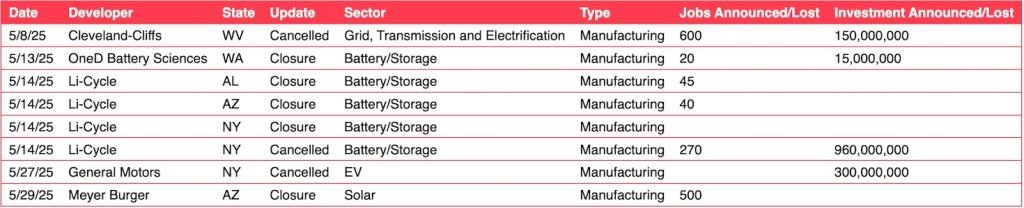
As the Senate continues to debate the fate of the clean energy tax credits established within the Inflation Reduction Act (IRA), the clean energy marketplace continues to take a financial hit. The latest report from E2 and the Clean Energy Buyers Alliance (CEBA) found that $1.4 billion of clean energy projects and factories were canceled in May. Impacting states including West Virginia, Alabama and Arizona, these numbers were actually an improvement over the loss off projects in April, which saw a $4.5 billion loss. “The consequences of continued policy uncertainty and the expectation of higher taxes on clean energy businesses are becoming painfully clear,” said Michael Timberlake, E2 communications director, “With renewable energy supplying more than 90 percent of new electricity in America last year, canceled projects will likely mean less available energy and higher electricity prices for consumers and business alike.” Since the Trump administration came into office, $15.5 billion in new factories and electricity projects have been cancelled, along with roughly 12,000 potential jobs. Eight clean technology projects were cancelled in May 2025. Graphic courtesy of E2. Despite these setbacks, the clean technology sector continues to grow, albeit at a much slower pace: $450 million of investments in solar, EV and grid and transmission factories and projects was announced in May. Rivian, for example, announced a $120 million investment to build a 1.2 million square foot supplier park in Illinois. The post IRA tax credit uncertainty kills $1.4 billion in clean energy projects in May appeared first on Trellis.
Bentley wins multiple 2025 Sustainability Delivery Awards
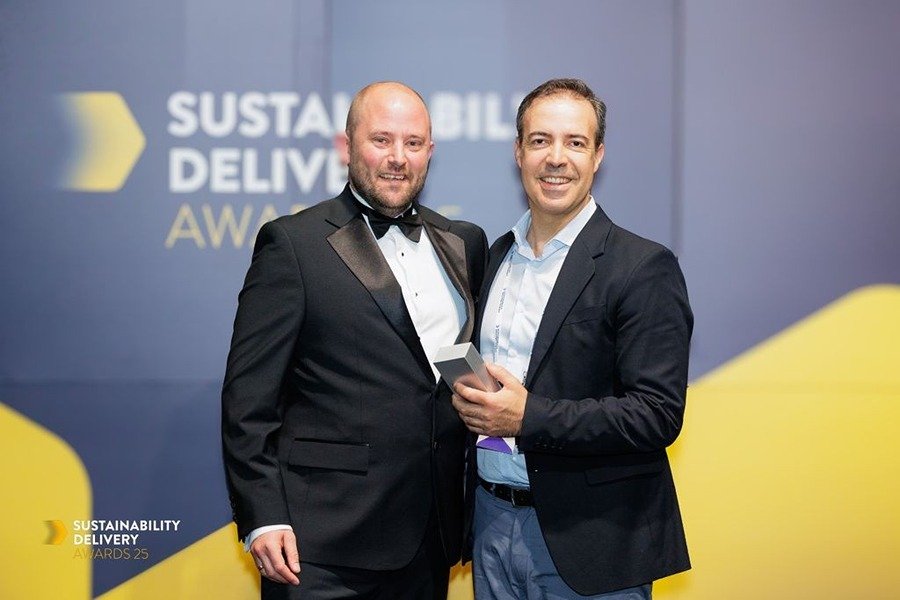
Bentley Systems, Incorporated was recognized across multiple categories at Environment Analyst’s 2025 Sustainability Delivery Awards, held earlier this month in Chicago. Bentley Systems’ Director of Sustainability, Rodrigo Fernandes (standing right), accepts a 2025 Sustainability Delivery Award from Ross Griffiths, Managing Director, Environment Analyst (standing left). Bentley received top honors in two award categories and was highly commended in a third, highlighting the company’s continued leadership in driving innovation and measurable progress toward meeting global infrastructure sustainability objectives: Digital Innovation Award (Winner): Bentley’s Carbon Analysis capabilities in iTwin Experience were recognized for their ability to enable infrastructure engineers to simplify and streamline data collection and carbon reporting, easily visualize and quantify embodied carbon, and rapidly explore alternatives for better designs, saving time and reducing risk on major infrastructure projects. Water Project of the Year (Winner): Together, Bentley and SABESP were recognized for the Integra 4.0 Cultural Transformation Through Digitalization project, which is a landmark initiative accelerating sustainable water infrastructure modernization in Brazil through digital twin technology. Energy Project of the Year (Highly Commended): Bentley, alongside Exo, were honored for the Evergy Power Transmission Structure Stabilization project, an effort that leveraged digital modeling and predictive analytics to enhance energy grid resilience. These recognitions underscore Bentley’s commitment and leadership position to advancing sustainability through digital engineering solutions that enable more resilient, efficient, and low-carbon infrastructure. The water and energy projects were previously honored at Bentley’s 2024 Year in Infrastructure conference: the SABESP Integra 4.0 program was recognized as a Going Digital Award winner in the Water and Wastewater category by a panel of independent jurors, while the Exo Evergy Power Transmission Structure Stabilization program received Bentley Founders Honors. The Sustainability Delivery Awards, hosted by Environment Analyst, celebrate innovation, leadership, and tangible progress across global infrastructure. Judged by an independent panel of industry experts, this year’s awards brought together leaders and changemakers committed to transforming the infrastructure sector for a more sustainable future. For more information, visit bentley.com. The post Bentley wins multiple 2025 Sustainability Delivery Awards appeared first on Engineering.com.
This new ultra-compact hub motor could change urban e-bikes forever
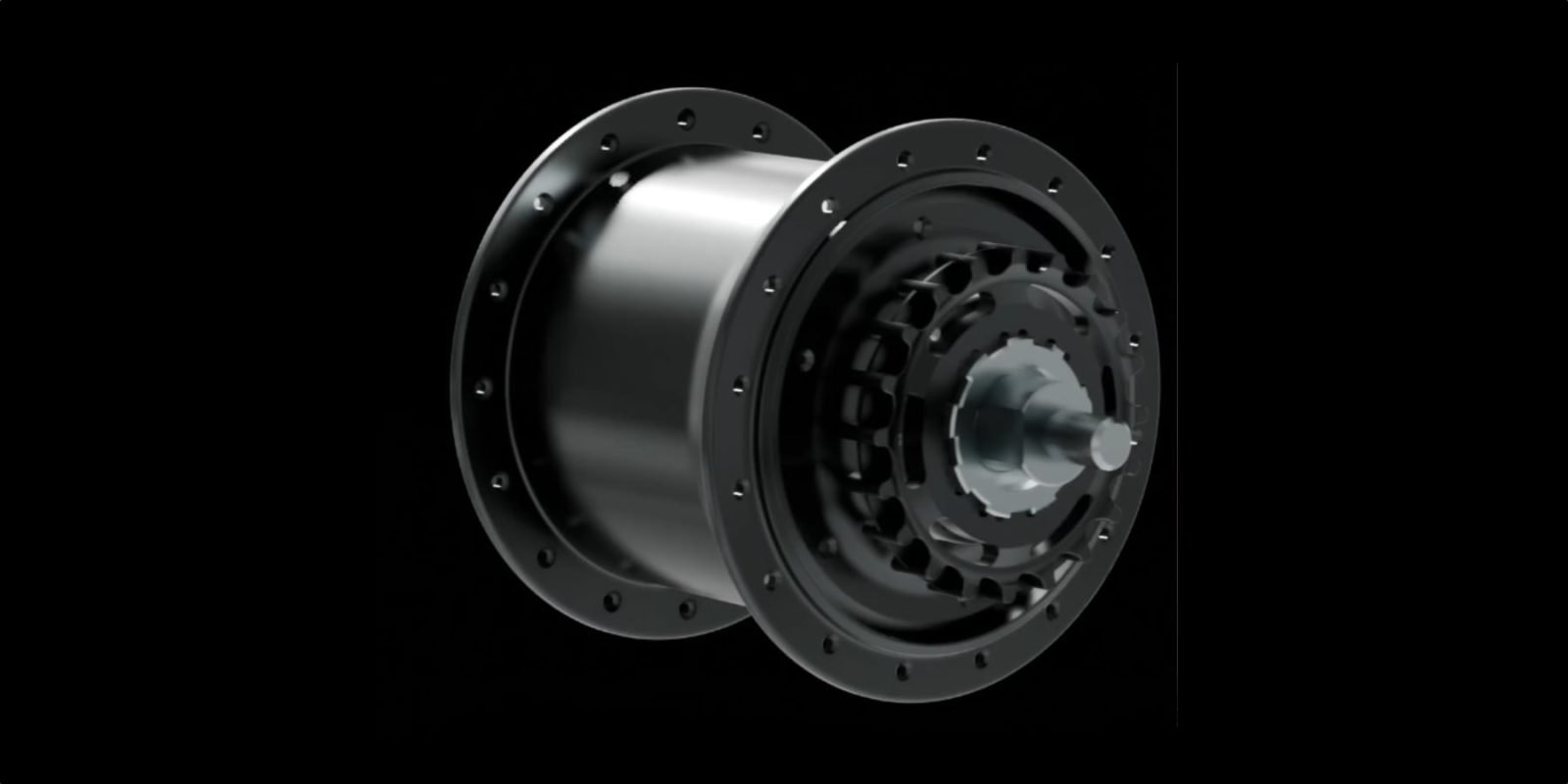
A new electric hub motor just dropped at Eurobike 2025, and it’s a big deal – mainly because it’s so small. Developed through a partnership between Moving Magnet Technologies (MMT), Swiss mechatronics firm Sonceboz, and French e-bike software company eBikeLabs, the new motor aims to set a new benchmark for premium urban e-bikes. And based on the specs alone, it just might. more…
Amprius forms partnership with a South Korea battery manufacturer

Amprius Technologies, which is developing a silicon battery anode platform, has signed a new contract manufacturing agreement with an unnamed battery manufacturer in South Korea. Amprius said that the strategic partnership expands its global production footprint and enhances its ability to deliver high-performance SiCore cells at scale to meet rising global demand. The South Korean partner brings extensive experience in manufacturing advanced lithium-ion batteries across a range of form factors and cell chemistries. Initial production will include a balanced SiCore cell engineered to deliver high-energy and high-power performance for an advanced drone. The facility will manufacture SiCore silicon anode cells to Amprius’s specifications, supporting current and next-generation battery platforms. These high-performance lithium-ion cells are optimized for high-demand applications in aerospace, defense and electric mobility. The addition of this manufacturing partner builds upon Amprius’s existing 1.8 GWh of contracted production capacity, enabling the company to deliver at volume. The expansion also allows Amprius to streamline logistics and accelerate delivery timelines to customers. “This partnership reflects the next step in Amprius’s capital-light production scaling strategy,” said Dr. Kang Sun, CEO of Amprius Technologies. “By expanding our manufacturing footprint into new regions, we are strengthening our supply chain and positioning ourselves to serve global customers with greater speed and efficiency.” Source: Amprius Technologies
Verosoft launches TAG Mobi EAM for Microsoft Business Central

Verosoft announced the launch of TAG Mobi EAM, a mobile-first EAM platform built to revolutionize how organizations in manufacturing, energy, and facility management modernize maintenance operations, strengthen workforce efficiency, and boost productivity. A maintenance professional uses The Asset Guardian (TAG) Mobi to optimize the assets in their plant. (CNW Group/Verosoft) As global enterprises work to navigate multi-site production, maneuver supply chain disruptions, meet sustainability goals, and mitigate a shortage of skilled labor, TAG Mobi EAM delivers a cost-effective, mobile-first, and AI-powered alternative to traditional EAM systems. Fully embedded in Microsoft Dynamics 365 Business Central, TAG Mobi EAM empowers enterprises with faster deployment and lower total cost of operations (TCOP), empowering enterprises to scale their asset operations without the complexity of legacy software. TAG Mobi: modernizing industries with simplicity and speed TAG Mobi EAM empowers teams to shift from reactive to preventive and predictive maintenance strategies, extending asset lifecycles and reducing downtime. By connecting TAG Mobi EAM and enterprise resource planning (ERP) environments, maintenance teams, finance, and operations can make smarter, faster decisions about equipment performance. TAG Mobi EAM’s flexible and user-based experience ensures that technicians, supervisors, managers, and operations each see only the tools and information relevant to their responsibilities, improving focus and efficiency on the job. With built-in AI-assistance tools, TAG Mobi EAM also accelerates user training and adoption by guiding individuals through real-time workflows, which is an essential advantage in industries where skilled labor is limited and productivity demands are high. Strengthening TAG Mobi’s position in the EAM market As businesses continue to invest in infrastructure modernization and sustainable operations, the need for reliable, flexible, and future-proof asset management is imperative in a data-driven economy. TAG Mobi EAM helps medium to enterprise businesses, from regional to global innovators, to navigate this ever-changing economic landscape. With the launch of TAG Mobi EAM, Verosoft further solidifies its position as an innovation leader in the enterprise asset management and maintenance sector. By delivering a mobile-first, AI-powered solution fully embedded in Microsoft Dynamics 365 Business Central, TAG Mobi EAM offers a scalable option to businesses looking for simplicity of use and integration within the Microsoft ecosystem. TAG Mobi reinforces Verosoft’s mission to empower businesses with innovative and intelligent software needed to manage assets effectively, reduce operational costs, and scale and protect their business. For more information, visit verosoftdesign.com. The post Verosoft launches TAG Mobi EAM for Microsoft Business Central appeared first on Engineering.com.
Smart new Raleigh ONE e-bike unveiled with GPS, anti-theft, & fast charging

Raleigh is rolling out a new chapter in its long legacy of bicycle design with the launch of the Raleigh ONE, a sleek, smart e-bike aimed squarely at the European urban mobility market. Officially unveiled today, the Raleigh ONE combines classic British cycling heritage with modern connected tech, delivering what the company calls “the only e-bike you’ll need in the city.” Taking a page out of Big Tech’s playbook, Raleigh is also offering a membership program to unlock extra features. But will riders pay up, or will they balk? more…
Scania to start deliveries of new electric buses to northern Sweden

An order that was placed in 2024 for Scania buses to be deployed in and around Åre, Sweden, a region where temperatures can vary some 60° C during the course of a year, is now to be fulfilled, and the buses put into operation. The buses are built on the Swedish manufacturer’s battery electric platform that was launched in October 2023 and recently added a three-axle variant. The company will start the deliveries this summer. The initial batch includes two-axle low-entry buses of the Scania Fencer f1 model, equipped with four battery packs. The second batch of three-axle low-entry Scania Irizar i3 buses with five battery packs will follow at the end of the year. Scania adds a three-axle low-entry model to its lineup of battery-electric buses The buses will be delivered through a collaboration with local Scania dealer Berners and operator Connect Bus and used in city and suburban operations. The 14 buses will be charged using local and sustainable hydropower. Electric Scania buses are already in operation nearby and have proven to run smoothly despite the region’s temperature variations, ranging from +30° C in summer to -30° C in winter. “We listened to the market and developed an electric bus platform that meets today’s transport needs. This order demonstrates that customers and authorities appreciate its benefits,” says Anna Ställberg, Head of Urban Solutions at Scania. “In addition to having zero tailpipe emissions, the buses are also equipped with the latest road safety technology, including new advanced driver assistance system functionalities.” Source: Scania
Centric Software receives FoodTech Innovation Tastech Award

Centric Software is thrilled to announce that it has won the Food 4 Future FoodTech Innovation Tastech by Sigma Award. Centric Software provides the most innovative enterprise solutions to design, develop, formulate, source, comply, buy, make, package, market and sell consumer goods products in food & beverage, grocery and multi-category retail to achieve strategic and operational digital transformation goals. Centric Software is Awarded the FoodTech Innovation Tastech Award for Centric Food & Beverage PLM. The Food 4 Future Expo is an annual event attended by over 8,000 professionals with exhibits of the latest solutions in food tech, food safety, robotics and automation, processing and packaging. The award was given to Centric Software in Bilbao, Spain on May 14 for the ‘most innovative digital solution for the food and beverage industry. At the ceremony were Spanish dignitaries from government agencies like the Ministry of Agriculture, Fisheries and Food as well as and the Ministry for Industry, Ecological Transition and Business Digitalization. Highly configurable and user-friendly, Centric PLM is a digital platform that streamlines product development by connecting teams, centralizing data and managing every aspect of the product go to market process. Brands, retailers and producers of any size can manage formulation, raw ingredient libraries, labeling, artwork and packaging, compliance documentation for traceability and bringing products faster to market in a safer manner. Centric PLM fosters project and portfolio oversight and strong supplier collaboration to increase accuracy to reduce the risk of non-compliance, lower cost of goods sold (COGS), speed time to market and ensure continued supply in fluctuating global conditions. Users enjoy seamless integration with other systems including ERP for synergy and efficient transfer of product data, as well as databases like Ciqual, GSDN and USDA FoodData Central, to stay current in a rapidly evolving market. Centric PLM integrates with Centric PXM and Centric Visual Boards. Centric Product Experience Management (PXM), combines AI-powered solutions including Product Information Management (PIM), Digital Asset Management (DAM), content syndication to e-comm sites, marketplaces, social media and Digital Shelf Analytics (DSA). It captures demand signals from digital sales channels and shows consumer behavior in real-time, creating a continuous feedback loop, so brands can quickly adjust products, pricing and inventory to personalize consumer experiences and increase sell-through in response to current market conditions. Centric Software has formed a strategic alliance with the leading food safety and regulatory service provider, FoodChain ID. From within the PLM environment, evaluate ingredients or formulations against 220+ country regulations, databases and libraries. Centric Visual Boards are an enabler for visual range planning and act as a visual pivot table with product data coming from multiple systems like ERP, CAD and more, tied directly to the images. It is a new, visual way of working to ensure robust, consumer-right and compliant product offers, dramatically decreasing assortment development cycle time and increasing profitability. For more information, visit centricsoftware.com. The post Centric Software receives FoodTech Innovation Tastech Award appeared first on Engineering.com.
These are the EVs that lose the least range in extreme heat
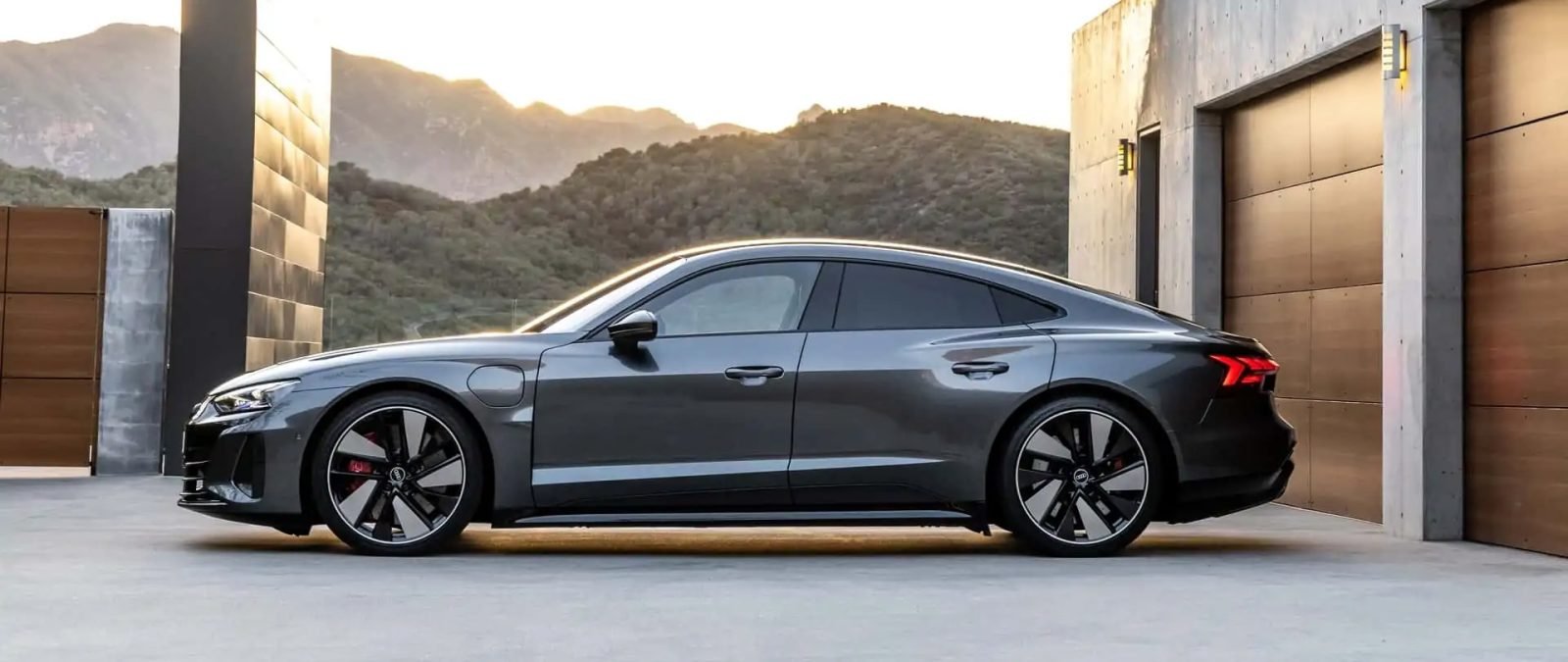
With much of the US sweltering under a record-breaking heat dome, many EV buyers and owners are left wondering how their favorite electric cars perform in extreme summer temperatures. A new study tracking over 29,700 electric cars in real-world conditions provides the answers, and we’re sharing them here: these are the EVs that handle the summer heat best. more…