EV Apocalypse | the EV tax credit is gone, but the deals stay STRONG!

It’s October 1st, which means the $7,500 Federal EV tax credit is dead and gone. That doesn’t mean it’s the end of the road for EVs, however – BMW, Ford, GM, and others are stepping up with big rebates, clever accounting tricks, and huge discounts to keep the deals rolling! All this and more on today’s stylin’, profilin’, limousine-riding, jet flying, kiss-stealing, wheelin’ n’ dealin’ episode of Quick Charge! WOOOOOOOOO!!! more…
EPRI’s GridFAST helps fleets and EV charging providers streamline communication with utilities

The Electric Power Research Institute (EPRI) has launched an online portal designed to help fleet operators and charging providers to interact with the United States’ 3,200 electric utilities. GridFAST encourages early notifications from customers with EV projects to allow utilities to plan for the new loads. EPRI developed GridFAST in collaboration with utilities, fleet operators and charging providers, to address the challenges related to grid interconnections. Many of these challenges result from utilities’ different processes, tools and regulatory requirements. Planning and integrating new electrical loads on the grid has historically been a multi-year process—considerably longer than the time required to procure new electric cars, buses or trucks. “For a hundred years, utilities have primarily integrated loads related to buildings, but these loads have long construction timelines, so the grid planning cycle matched those timelines,” said EPRI Senior Technical Executive Watson Collins. “EVs can be procured in a day or in a few months at most, so utility planning efforts need to start earlier than ever before. GridFAST enables customers with future projects to right-size their charging needs, while considering a utility’s existing grid capacity and any EV-related programs they offer.” “If you are a customer planning sites with EV charging loads, the simplest way to begin an early and secure conversation with the right utility and utility contact, is to use GridFAST as a central portal for collaboration,” said EPRI Director of Transportation Britta Gross. “Enter the earliest information you have about a site, update it over time as details become clearer, and ensure that your project is on the utility’s radar years in advance of your load needing grid interconnection.” Some of GridFAST’s key features: Customers can match any project location in the US to the relevant utility and the best point of contact at the utility. Customers can see EV-related program information across utilities in a standardized format. Customers can enter preliminary site information for projects many years down the road to inform utilities of future intentions. Customers need to understand only a single, common utility industry portal intake form to prepare information for a utility’s pre-service request process. Utilities can use customer site inputs to plan for the aggregate impact of customer loads, instead of addressing one customer load at a time. Several utilities and charging operators have already signed on to GridFAST’s Guiding Principles, including Ameren, CenterPoint Energy, Con Edison, Consumers Energy, DHL, Great River Energy, IONNA, National Grid, Omaha Public Power District, Pacific Gas & Electric, Pitt Ohio, Portland General Electric, Republic Services, Sacramento Municipal Utility District and Southern California Edison. “We need tools that will make it easier to interact with the dozen or so utilities that serve our sites, all of which have different processes and programs,” said Pitt Ohio VP of Vehicle Maintenance and Fleet Services Taki Darakos. “GridFAST’s standardization makes it easier to obtain information, identify the right contacts, and establish early connections with utilities. You enter some project information, even if you don’t yet know everything, and you get an estimate of the power needed and other information to begin a utility conversation.” Source: Electric Power Research Institute
Tesla reveals some crazy Supercharging (and Diner) stats from Q3

Tesla has revealed some pretty crazy Supercharging statistics from the third quarter, and there was also a very interesting tidbit regarding the Diner it opened in Los Angeles, as well. In an update posted by Tesla’s Charging account on X, it revealed several interesting tidbits about Supercharger growth, as well as usage and environmental offset, all occurring in the third quarter: 4,000 new Supercharger stalls opened, up 18% year-over-year 1.8 TWh of energy delivered to vehicles, up 29% year-over-year 842 million liters of gasoline saved, equivalent to 2 billion kilograms of CO2 offset 54 million quarterly charging sessions, up 31% year-over-year The most useful and impressive statistics here are the 4,000 new Supercharger stalls opened in the third quarter, and the environmental impact of gasoline saved. More chargers are crucial to keep up with the increase of EVs on the road, even non-Teslas, as many OEMs have access to the company’s network. Additionally, the environmental impact of using fewer gallons of gasoline for passenger transportation reduces our reliance on fossil fuels. This is still something that Tesla strives for to this day, as Elon Musk detailed in the Master Plan. On a lighter note, Tesla also detailed the number of Tesla Burgers it sold at its Supercharger Diner in Los Angeles in Q3. It’s a pretty impressive number: 50,000 Tesla Burgers sold, up 100% tastiness Tesla’s Supercharger Diner first opened in late July, so it has been in operation for a little over two months so far. Tesla Supercharger Diner officially opens: menu, prices, features, and more In the roughly 70 days the Diner has been in operation, Tesla has managed to sell about 715 burgers each day. This is incredibly impressive considering the company’s focus on localized, sustainably sourced ingredients and how it stacks up against a fast food franchise like McDonald’s. The average McDonald’s franchise sells approximately 14,000 burgers per month, Grok says. Tesla would have outpaced that by a considerable margin if its statistics are accurate. It’s pretty impressive. 4,000 new Supercharger Stalls opened in Q3, with 54 million charging sessions occuring, up 31% year-over-year Oh, and the Tesla Diner sold 50,000 hamburgers pic.twitter.com/1PfmEZ27Uy — TESLARATI (@Teslarati) October 1, 2025 Tesla’s Supercharger presence is felt in many countries across the world, with over 70,000 stalls available. While many EV owners charge at home, the expansion of the Supercharger Network is a necessary thing to have for commuters, road trips, and longer travel. Tesla has done a great job of being inclusive to other EV makers as well. The post Tesla reveals some crazy Supercharging (and Diner) stats from Q3 appeared first on TESLARATI.
Tesla Giga Texas production is off the charts, and so are deliveries as Q3 ends

It appears that Tesla Gigafactory Texas is determined to make sure that it ends the third quarter of 2025 on a very strong note. This was hinted at in videos of the massive electric vehicle complex on the final day of Q3 2025. Giga Texas’s push As per longtime Tesla watcher and drone operator Joe Tegtmeyer, who has been chronicling the progress of the Giga Texas complex since its earliest days, hundreds of vehicles were being handed to customers on the final day of Q3. “Hundred and hundreds of Tesla cars going to customers at Giga Texas today as part of a huge end of quarter event! Still a few hours left until midnight!” The drone operator observed. Tesla has been encouraging customers to pick up their vehicles at Giga Texas before the quarter ended. Just a few days ago, the official Tesla North America account on X posted an image of a fleet of new Model Y units that are ready for delivery at Giga Texas. In a follow-up post, the electric vehicle maker advised that, “For an expedited delivery, come pick up your car at its birthplace at Giga Texas – straight off the factory line.” Hundred and hundreds of @Tesla cars going to customers at Giga Texas today as part of a huge end of quarter event! Still a few hours left until midnight! pic.twitter.com/NVoBZEhDMV — Joe Tegtmeyer (@JoeTegtmeyer) September 30, 2025 Deliveries in full swing pic.twitter.com/Vgho5FIrA6 — Tesla North America (@tesla_na) September 27, 2025 Production & new vehicle inventory is off the charts at Giga Texas, with a full overflow lot on the E side in addition to a full & overflowing W outbound lot! This is the most new vehicles at Giga Texas at the same time than I have observed this year!Here are just a few… pic.twitter.com/6T5qu4Y018 — Joe Tegtmeyer (@JoeTegtmeyer) September 26, 2025 A very busy Giga Texas Giga Texas has been a hub of production activity as of late, with Tegtmeyer observing that the facility’s overflow lot and outbound lots were being filled with vehicles just days before the quarter ended. As per the longtime Tesla watcher, this was the most vehicles he has seen in Giga Texas this year. “Production & new vehicle inventory is off the charts at Giga Texas, with a full overflow lot on the E side in addition to a full & overflowing W outbound lot! This is the most new vehicles at Giga Texas at the same time than I have observed this year!” The drone operator noted in a post on X. The post Tesla Giga Texas production is off the charts, and so are deliveries as Q3 ends appeared first on TESLARATI.
Tesla Q3 deliveries expected to exceed 440k as Benchmark holds $475 target

Benchmark has reiterated its “Buy” rating and $475 price target on Tesla stock (NASDAQ: TSLA) as the company prepares to report its third-quarter vehicle deliveries in the coming days. Tesla stock ended the third quarter at $444.72 per share, giving the EV maker a market cap of $1.479 trillion at the end of Q3 2025. Benchmark’s estimates Benchmark analyst Mickey Legg noted that he expects Tesla’s deliveries to hit around 442,000 vehicles this Q3, which is under the 448,000-unit consensus but still well above the 384,000 vehicles that the company reported in Q2 2025. According to the analyst, some optimistic estimates for Tesla’s Q3 deliveries are as high as mid-460,000s. “Tesla is expected to report 3Q25 global production and deliveries on Thursday. We model 442,000 deliveries versus ~448,000 for FactSet consensus with some high-side calls in the mid-460,000s. A solid sequential uptick off 2Q25’s ~384,000, a measured setup into year-end given a choppy incentive/pricing backdrop,” the analyst wrote. Benchmark is not the only firm that holds an optimistic outlook on Tesla’s Q3 results. Deutsche Bank raised its own delivery forecast to 461,500, while Piper Sandler lifted its price target to $500 following a visit to China to assess market conditions. Cantor Fitzgerald also reiterated an “Overweight” rating and $355 price target for TSLA stock. Benchmark reiterated a Buy rating and $475 PT on Tesla! $TSLA pic.twitter.com/uJ3I5GTrXg — Tesla New York (@TeslaNY) September 29, 2025 Stock momentum meets competitive headwinds Tesla’s anticipated Q3 results are boosted in part by the impending expiration of the federal EV tax credit in the United States, which analysts believe has encouraged buyers to finalize vehicle purchases sooner, as noted in an Investing.com report. Tesla shares have surged nearly 30% in September, raising expectations for a strong delivery report. Benchmark warned, however, that some volatility may emerge in the coming quarter. “With the stock up sharply into the print (roughly ~28-32% in September), its positioning raises the bar for an upside surprise to translate into further near-term strength; we also see risk of volatility if regional mix or ASPs underwhelm. We continue to anticipate policy-driven choppiness after 3Q as certain EV incentives/credits tighten or roll off in select markets, potentially creating 4Q demand air pockets and order-book lumpiness,” the analyst wrote. The post Tesla Q3 deliveries expected to exceed 440k as Benchmark holds $475 target appeared first on TESLARATI.
Tesla China shows off Model Y L’s manufacturing process in new video

Tesla China has shared a video showing a glimpse at the impressive manufacturing process of the Model Y L. The video was shared by the electric vehicle maker on Chinese social media platform Weibo. Model Y L production The Model Y L may be just an extended wheelbase, six-seat version of the best-selling all-electric crossover, but manufacturing such a vehicle at scale while the standard Model Y is still being produced at high volumes in Giga Shanghai is no joke. As could be seen in Tesla China’s video, however, it appears that Gigafactory Shanghai’s Model Y L line is now dialed in. This is evident in the impressive automation on the Model Y L’s lines at Giga Shanghai. Throughout the video, robots can be seen producing and assembling parts of the Model Y L, from its third-row seats to its battery modules. Needless to say, it would appear that the Model Y L has become a product of “the machine that builds the machine.” $TSLA BREAKING: Tesla China shared the latest video inside the Shanghai Gigafactory. The video also shows the production line of the Model YL. Check it out! pic.twitter.com/bopAQLAUGS — Tsla Chan (@Tslachan) September 30, 2025 Model Y L momentum Vehicle registrations of the Model Y L have been picking up as of late, with industry watchers stating that Tesla China saw 4,000 registrations of the extended wheelbase, six-seat vehicle during the week of September 22-28, 2025. Considering that Tesla China saw a total of 19,300 insurance registrations during the week, the Model Y L effectively contributed almost 20% of the company’s overall figures. Demand for the Model Y L seems to be quite steady, with Tesla China’s official website stating that the earliest deliveries of the vehicle, if ordered today, would be around November 2025. Overall, the production ramp of the Model Y L, paired with its seemingly healthy demand in China, could provide some notable contributions to the company’s results this coming Q4 2025. The post Tesla China shows off Model Y L’s manufacturing process in new video appeared first on TESLARATI.
Tesla celebrates more than 50,000 vehicles sold in Turkey

Tesla has achieved a notable milestone in Turkey, just three years after the company started vehicle deliveries in the country. The feat was announced by the electric vehicle maker’s official account on social media platform X. More than 50,000 Tesla owners In a post, the official Tesla Europe and Middle East account noted that in just three years, there are now more than 50,000 owners in Turkey. Tesla posted a photo of its 50,000th vehicle delivery in its post, a black new Model Y unit. “There are now more than 50k Tesla owners in Türkiye, less than 3 years after we delivered our first car in the country,” Tesla Europe and Middle East stated in its X post. The milestone reflects Tesla’s surging momentum in Turkey, which was highlighted by the company’s impressive sales figures in August 2025. There are now more than 50k Tesla owners in Türkiye, less than 3 years after we delivered our first car in the country pic.twitter.com/Af24ePaHjV — Tesla Europe & Middle East (@teslaeurope) September 30, 2025 Tesla Turkey’s momentum Tesla sold 8,730 Model Y vehicles in Turkey during August, an 86% jump compared to July. That volume represented nearly half of all EVs sold in the country for the month, cementing Tesla’s leadership in the Turkish electric vehicle market. The sales surge placed Tesla ahead of almost every competitor, with only Renault managing higher volumes. Rival BYD was the second-best-selling EV brand in Turkey during the same period, with just 1,639 units sold. Tesla’s growth in Turkey is boosted by the country’s tax structure. Electric cars benefit from lower Special Consumption Tax rates, which range from 25% to 170% depending on power output. This is significantly less than the 70% to 220% levied on gas-powered vehicles. EV buyers also receive exemptions from the Motor Vehicle Tax for their first ten years of ownership, and credits can provide up to $30,000 in savings. The post Tesla celebrates more than 50,000 vehicles sold in Turkey appeared first on TESLARATI.
Tesla launches Model Y Performance in the U.S.

Tesla has officially launched the Model Y Performance in the United States, boasting better range, performance, and features than its previous build. The new Model Y Performance now sports a 0-60 MPH acceleration rate of 3.3 seconds, a good improvement from the 3.5 seconds the 2025 version offered. It also has a better range rating, up to 308 miles from 277 miles in the previous model year. Tesla Model Y Performance zips around Nurburgring with new features It is priced at $57,490, and will be eligible for the $7,500 EV tax credit for the remainder of today, September 30. If you’re reading this on or after October 1, you will be required to pay $57,490. BREAKING: Tesla has officially launched the new Model Y Performance for $57,490 If you order today, the $7,500 EV tax credit will apply and bring your price down to $49,990! pic.twitter.com/GodX0HvOYx — TESLARATI (@Teslarati) September 30, 2025 Tesla also announced several new additions, both aesthetically and performance-wise. We’ll discuss them below: Exterior Improvements New front/rear fascia Performance carbon spoiler for better aerodynamics – increased downforce and reduced drag New 21″ Arachnid wheels and tires with staggered fitment to improve grip and steering Adaptive damping adjusts handling and suspension for a smoother and more stable ride Performance Improvements New Drive Modes give you greater control for high-speed driving Increased charge capacity thanks to high-density battery cells Interior Improvements Quiet cabin with premium sound-damping materials & acoustic glass Heated/ventilated front sport seats & heated, perforated rear seats with power recline Added bolstering and side cushions for improved comfort and stabilty when cornering Cornered thigh cushion extenders, which were added to new Model Y L in China and Model Y Performance in Europe 16″ high-res touchscreen Credit: Tesla Credit: Tesla Credit: Tesla Tesla offered the Model Y Performance in other markets before the United States, with deliveries starting in Europe earlier this month. The launch of the Model Y Performance in the United States is expected to add a few thousand units to next quarter’s delivery figures. However, Tesla is doing customers a favor by launching it ahead of the tax credit’s expiration at midnight. The post Tesla launches Model Y Performance in the U.S. appeared first on TESLARATI.
Tesla eyes Los Angeles for Robotaxi operation, job posting suggests

Tesla is eyeing Los Angeles for its Robotaxi operation, a new job posting from the company suggests, as it aims to expand its service area in California. Tesla has been operating its Robotaxi platform in California for several months now, first launching it in July in the Bay Area, spanning from San Francisco to San Jose, giving those who have access to the ride-hailing suite a pretty substantial service area to travel within. However, the California operation is far from complete, as Tesla is aiming to expand to Los Angeles, a city that sits roughly seven hours south of San Francisco, but is among the most popular markets for its vehicles. LA is also an ideal location for Robotaxi expansion because of its reputation as a hotspot for ride-sharing services. Tesla is hiring a Vehicle Operator for its Robotaxi program in Marina Del Rey, a seaside community in Los Angeles County, located near Los Angeles International Airport (LAX), and several other hotspots. It is a frequent location of travel for tourists, making it ideal for Robotaxi: Tesla Robotaxi expanding to Los Angeles… pic.twitter.com/ULBDmgl8Yq — Jonathan Stokes (@jonathanwstokes) September 30, 2025 There is a substantial difference between how Tesla operates Robotaxi in California compared to Texas, the other state that currently allows passengers to hail a ride through the Tesla Robotaxi app. In Texas, the majority of rides are considered “driverless,” as there is nobody sitting in the driver’s seat. This applies to any ride that does not utilize any of the Texas freeways, as highways will require a driver in the seat, something Tesla did when its geofence in Austin expanded to include interstates. Tesla adjusts Robotaxi safety monitor strategy in Austin with new service area In California, things are a bit different. The “Safety Monitor” sits in the driver’s seat, regardless of destination or route. This has drawn some criticism, but Tesla has taken this step in an effort to keep passengers and traffic as safe as possible, recognizing that this is essential for these early rides. Eventually, and potentially as soon as the end of this year, Tesla could remove Safety Monitors from vehicles altogether, as CEO Elon Musk has hinted this is a possibility. The post Tesla eyes Los Angeles for Robotaxi operation, job posting suggests appeared first on TESLARATI.
Tesla Cybertruck not allowed in Germany over “significant passive safety concerns”
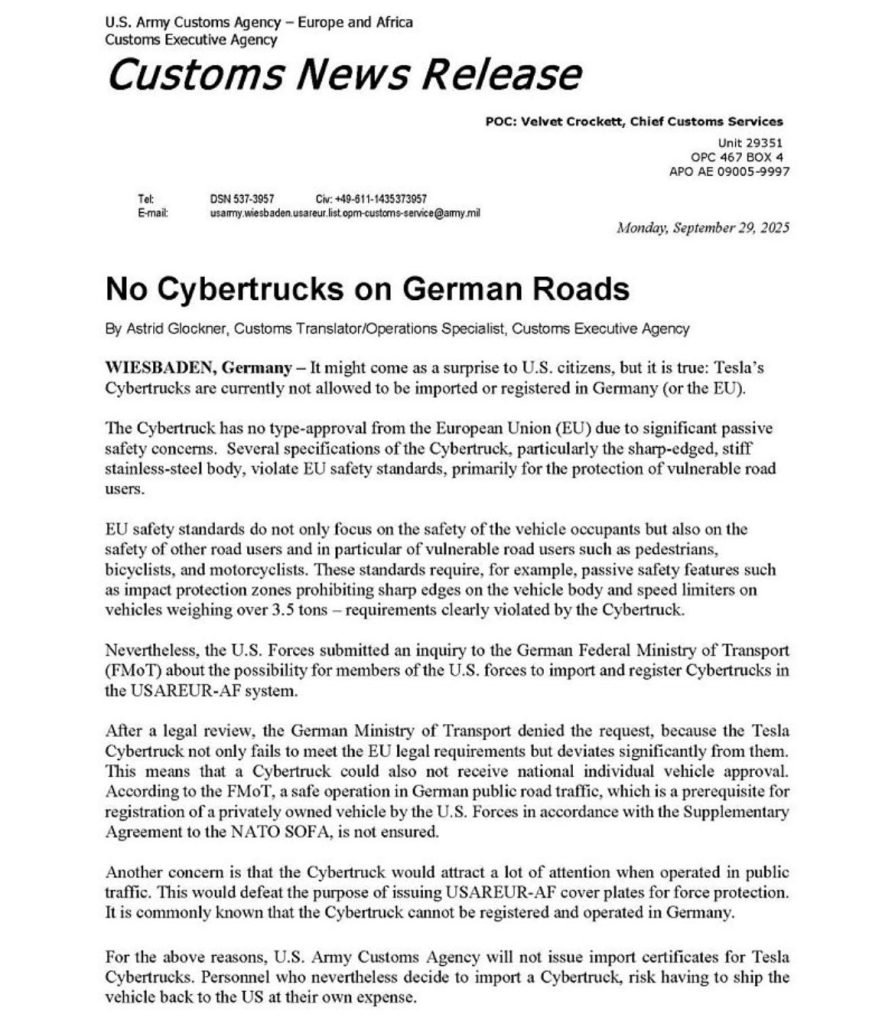
The U.S. Army Customs Agency news release has stated that the Tesla Cybertruck cannot be imported or registered in Germany or the wider European Union. This was because the vehicle had failed to obtain EU type-approval due to passive safety violations, with regulators citing risks tied to its stainless-steel body and design. The ruling effectively bars U.S. Forces personnel from legally operating the vehicle on German roads. As per the news release, U.S. Forces submitted an inquiry to the German Federal Ministry of Transport (FMoT) about the possibility for members to import and register the all-electric pickup truck in the USAREUR-AF system. Following a legal review, the “German Ministry of Transport denied the request, because the Tesla Cybertruck not only fails to meet the EU legal requirements but deviates significantly from them.” Officials argued that the vehicle falls far short of EU requirements, particularly those aimed at protecting pedestrians, cyclists, and other vulnerable road users. The Cybertruck’s sharp edges and weight classification also reportedly exceed thresholds that mandate impact protection zones and additional safety features. Credit: u/Serpenio_/Reddit “The Cybertruck has no type-approval from the European Union (EU) due to significant passive safety concerns. Several specifications of the Cybertruck, particularly the sharp-edged, stiff stainless-steel body, violate EU safety standards, primarily for the protection of vulnerable road users. “EU safety standards do not only focus on the safety of the vehicle occupants but also on the safety of other road users and in particular of vulnerable road users such as pedestrians, bicyclists, and motorcyclists. These standards require, for example, passive safety features such as impact protection zones prohibiting sharp edges on the vehicle body and speed limiters on vehicles weighing over 3.5 tons – requirements clearly violated by the Cybertruck,” the release read. Officials also shared concerns about the Cybertruck’s eye-catching design, which might reportedly put drivers in danger. “Another concern is that the Cybertruck would attract a lot of attention when operated in public traffic. This would defeat the purpose of issuing USAREUR-AF cover plates for force protection,” the release noted. With these decisions in mind, personnel who opt to import Cybertrucks into Germany could end up shipping their vehicles back to the United States at their own expense. The post Tesla Cybertruck not allowed in Germany over “significant passive safety concerns” appeared first on TESLARATI.
3 Climate Week NYC themes you should know
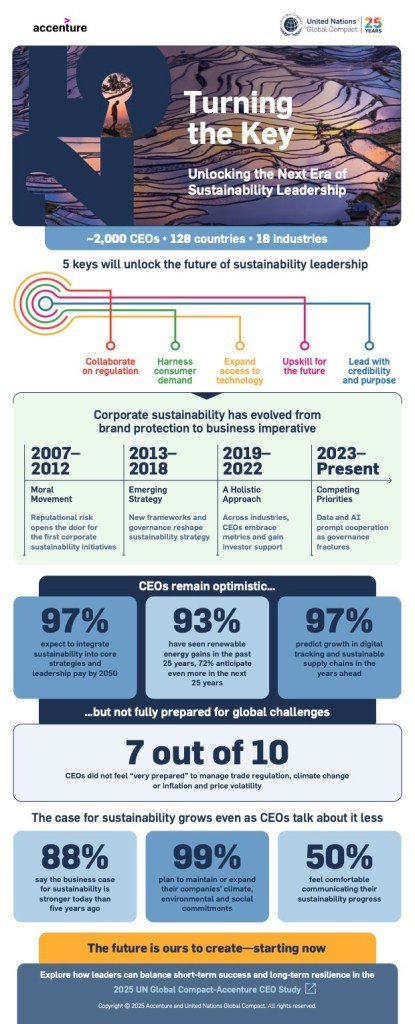
The corporate climate “actionists” who converged in New York last week for the 16th annual Climate Week NYC are resigned to the reality that federal policy won’t favor their agendas for at least another three-plus years. Even so, the majority of corporations with net-zero aspirations are not retreating from their top-level commitments. They’re just not talking about them as loudly. At least three research analyses published to coincide with Climate Week NYC suggest that companies committed to reducing emissions and conserving nature and biodiversity are actually doubling down on that agenda: The number of U.S. companies with net-zero commitments rose 9 percent in the past 12 months, according to the Net Zero Tracker’s 2025 stocktake, which did note that most of those pledges aren’t very robust. A focused study that included 75 top companies by market capitalization found that while roughly 13 percent retreated from programs between April 2024 and May 2025, nearly one-third increased their investments. Close to 90 percent of CEOs think the case for sustainability is stronger now than five years ago, according to research by Accenture and the United Nations Global Compact, which represents more than 20,000 member companies. Almost all of 2,000 surveyed executives expect to include these metrics in their core strategies and compensation structures by 2050. “That makes sense, because being a business leader is not about opinions from one day to another, it’s about building, it’s about investing, it’s about transformation,” said Ingka Group CEO Jesper Brodin, referencing the Global Compact data during a panel discussion at the Nest Climate Campus. Ingka, IKEA’s largest retailer with $47 billion in revenue in 2024, is on pace to meet its 2030 target to halve emissions. A cross-functional committee of business leaders that meets at least eight times annually manages this strategy. Only half of the CEOs responding to the UN Global Company survey, however, felt comfortable communicating this agenda — a refrain discernible in the other analyses. “I think the corporate sector has gotten pretty quiet on these issues, whether or not they are moving forward,” said Patagonia CEO Ryan Gellert during a panel discussion at the Nest Climate Campus. “I think there’s a real lack of leadership right now from the business sector, a real lack of leadership response to what we’re navigating.” Here are three themes of note from the weeklong industry gathering: Real work continues Some 100,000 people came to New York to attend more than 1,000 summits, panels, receptions, climate tech pitch sessions and countless face-to-face meetings. “This week for me, is about finding new people that I have not known before, hearing about new climate initiatives,” said Kate Heiny, vice president of sustainability for Booking Holdings, the company behind travel sites including Booking.com, Kayak and Open Table. “I often look to other industries and not the one that I’m in. I think that learning from other places has always been something that I would look to for growth. So it’s people, it’s ideas.” That need for connection, validation and fresh perspective was echoed in many of my interviews throughout the week. “I think it has just been great to see that the majority of companies are just plowing on like we are,” said another chief sustainability officer, speaking on background. “I see very serious people doing really extraordinary things, continuing at full force and momentum,” said Andrew Mayock, who headed the federal government’s sustainability strategy under President Joe Biden. Mayock was appointed the inaugural vice chancellor at the University of Colorado Boulder in March. He’s already shaping new master’s programs for integrating sustainability into business, engineering and policy. Mayock is also coordinating development of a new classification from the Carnegie Foundation for the Advancement that will recognize colleges and universities that include climate action as part of their mission. “I’m really buoyed by being here,” he said. AI debate gets more nuanced Plenty of companies in attendance were willing to talk about how artificial intelligence stands to accelerate both their company’s environmental agenda and revenue growth. Packaging company Ranpak, which counts Amazon and Walmart among its many big-name customers, is already deploying AI for applications such as rightsizing packages or detecting how much cushioning is needed to protect items in them. “What excites me, frankly, is the stuff that we haven’t figured out yet … the problems that haven’t even been identified yet that can be solved with all of this data,” said David Murgio, chief sustainability officer at the company. NVIDIA’s head of sustainability, Josh Parker, downplayed ominous predictions about AI load growth that could strain the U.S. grid, suggesting that the electrification of vehicles and industrial loads is a bigger load factor over time and AI plays an important role in easing bottlenecks. “AI is helping us modernize the grid, helping us integrate renewables and batteries,” he said during one panel. NVIDIA’s influence on the AI ecosystem cannot be understated. Its chips are at the center of data center buildouts by Amazon Web Services, Google and Microsoft, and the company Sept. 22 announced a deal to invest up to $100 billion in OpenAI’s infrastructure ramp-up. Natural gas isn’t going away The biggest tech companies are spending billions of dollars on the AI data center buildout. To tame the associated emissions they’re investing in creative contracts to keep nuclear power on the grid, support new nuclear technologies and add emerging generation options, such as geothermal. Here’s the thing few of them are talking about: 40 percent of the electricity powering U.S. data centers comes from natural gas, and it will be the biggest contributor of additional capacity between 2025 and 2030, according to the International Energy Agency. Meta’s big $10 billion project in Louisiana, as one example, will require three new gas turbines. Elsewhere, natural gas plants that weren’t running at full capacity are being commissioned for more load, said Julio Friedmann, chief scientist for carbon removal advisory firm Carbon Direct. “The thing that people don’t talk about, the hidden aspect of what’s actually happening, is that
Trützschler adopts CONTACT’s cloud PLM for digitalization
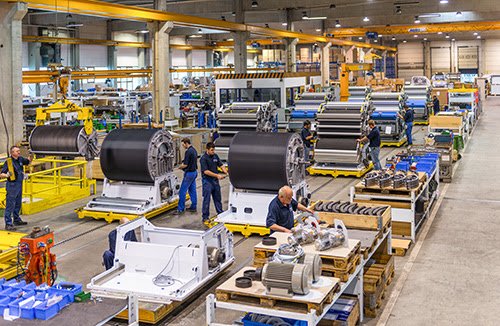
Trützschler, a textile machinery manufacturer, is adopting CONTACT Software’s CIM Database Cloud as part of its OneTrützschler digitalization initiative. Trützschler develops and manufactures its machines at nine locations around the globe. (© Trützschler) The company will use the “Innovate” edition of the cloud-based product lifecycle management system to create a central source of product data and improve collaboration in development. The SaaS solution provides scalability, data security and reduced IT requirements while staying up to date. Trützschler plans to use the new PLM system to centralize product-related information and support future digitalization projects. The system will integrate with third-party tools, including the SOLIDWORKS MCAD system and the ERP solutions PSI and Microsoft Dynamics AX, through open interfaces. In addition to central document and product data management, CIM Database Cloud offers extensive features for variant and project management as well as the cross-site coordination of tasks and processes. The 3D cockpit enables developers to intuitively collaborate on 3D models, while the xBOM Manager simplifies the synchronization of bills of materials. Founded in 1888, Trützschler Group SE from Mönchengladbach, Germany, has become one of the world’s leading manufacturers of machinery and equipment for processing natural and chemical fibers. The family-owned company operates in three business areas – Spinning, Nonwovens, and Card Clothing – and maintains nine development and production sites in Germany, China, India, the USA, and Brazil. Trützschler employs around 3,000 people globally. For more information, visit contact-software.com. The post Trützschler adopts CONTACT’s cloud PLM for digitalization appeared first on Engineering.com.
EcoFlow DELTA 3 Max and Ultra stations launch with up to $2,000 savings + FREE gear from $759, Bluetti Early Prime Day Sale, more

We’ve got an exciting launch kicking off this week’s Green Deals, with EcoFlow’s DELTA 3 series expanding to include the new DELTA 3 Max and DELTA 3 Ultra power stations with up to $2,000 in early-bird savings and FREE bundled gear starting from $759. Right behind those is Bluetti’s fresh Early Prime Day Sale with up to 63% discounts and some select exclusive savings, which is seeing the latest Apex 300 station dropping to a new $1,394 low, among many other offers. There’s also some savings to be had on an EGO chainsaw package, as well as 60V Greenworks snow blowers, and other ongoing Early Prime Day savings waiting for you below. And don’t forget about all the hangover deals from last week collected at the bottom of the page, rounded together within our latest edition of Electrified Weekly. Head below for other New Green Deals we’ve found today and, of course, Electrek’s best EV buying and leasing deals. Also, check out the new Electrek Tesla Shop for the best deals on Tesla accessories. more…
XCharge and Ascentium offer new EV infrastructure leasing program

EV charging provider XCharge North America has partnered with Ascentium Capital, a division of Regions Bank, to offer a new leasing program designed to make EV charging equipment more affordable and profitable for small-business owners. Under the new financing structure, which is modeled after existing programs used in the automotive industry, lessees can procure chargers and associated services for a fixed monthly rate. The financing bundles equipment, warranty and maintenance into one package. Unlike a Charging as a Service (CaaS) model, which typically pays site owners a percentage of revenue generated from EV charging, leasing allows businesses to receive the full revenue amount. “XCharge NA has always been focused on making EV charging more accessible for businesses of all sizes—from high-traffic airports to small-business owners. Our new financing model was designed to mitigate risk for individuals looking to get into EV charging without significant upfront CapEx,” said Aatish Patel, co-founder and President of XCharge NA. “We knew we needed an experienced financial provider to help bring our vision to life, and our collaboration with Ascentium gives us confidence that our new financing structure will unlock new revenue streams for small-business owners.” “This type of flexible capital option is exactly what the industry needs now, especially to empower small businesses and real estate owners that don’t have the ability to pay significant costs up front but are committed to participating in the EV transition,” said Stephen Interlicchio, Senior VP of Strategic Services for Ascentium Capital. Source: XCharge
Elon Musk gives update on Tesla Optimus progress

Elon Musk says Tesla is working hard to scale what will end up being its biggest product in his eyes: Optimus. Tesla Optimus is the company’s humanoid robot project, which was first announced several years ago but has gained more relevance and become a larger focus over the past year. Tesla truly had its big breakout with Optimus last year at its “We, Robot” event in October, where it was used to serve drinks, provide entertainment, and mingle with attendees. Tesla’s next-gen Optimus prototype with Grok revealed However, it has been a challenge for Tesla to truly scale Optimus and, although it has huge plans for production numbers, certain parts of the project have proven to be more difficult than others. One of the most notable things is that of its hands, as Tesla wants them to be nimble enough to thread a needle. This has proven to be very difficult. Scaling production and refining manufacturing are also likely challenges. Musk says Tesla is “working hard on scaling Optimus,” something that is a crucial issue to solve as the project is a major contributor to the company’s future. Musk said: Tesla has big plans for Optimus production It has plans for an annual production run-rate of 1 million by 2030 Earlier this year, the plan was to build 5,000 in 2025 Elon Musk has said Optimus should make up roughly 80% of Tesla’s value pic.twitter.com/NIGUKH248i — TESLARATI (@Teslarati) September 27, 2025 Musk has made some pretty tremendous predictions for Optimus and how important it could be to Tesla in the future. Earlier this month, he said Optimus will make up about 80 percent of the company’s value in the future. In January, he also noted during Tesla’s Q4 2024 Earnings Call that Optimus would be “overwhelmingly the value of the company.” Elon Musk details Tesla’s road to selling Optimus and Robotaxi affordably He has not only talked about Optimus’s importance in terms of money and revenue. He also said it would be “the biggest product of all-time by far,” because of its ability to revolutionize human life. He said it would be like “having your own personal C-3PO and R2-D2.” Summary Table of Estimations Aspect Musk’s Estimation Date/Context Implication for Tesla Valuation Share ~80% of total company value Sep 2025 X post; Jan 2025 earnings Shifts focus from EVs to robotics as primary growth engine Overall Valuation Up to $25 trillion (Optimus-driven) Mid-2024 interview ~34x current cap; exceeds U.S. GDP equivalent in profits Market Size >10 billion units globally Aug 2024 interview Universal adoption for labor/personal use Product Ranking Biggest product ever; > FSD value Mar 2025 statement; Apr 2022 Transforms Tesla into AI/robotics leader Unit Price ~$20,000 (high-volume target) Nov 2024 X post Enables affordability for billions of users The post Elon Musk gives update on Tesla Optimus progress appeared first on TESLARATI.
Samsung submits 300MWh solar-BESS to Australia’s EPBC Act
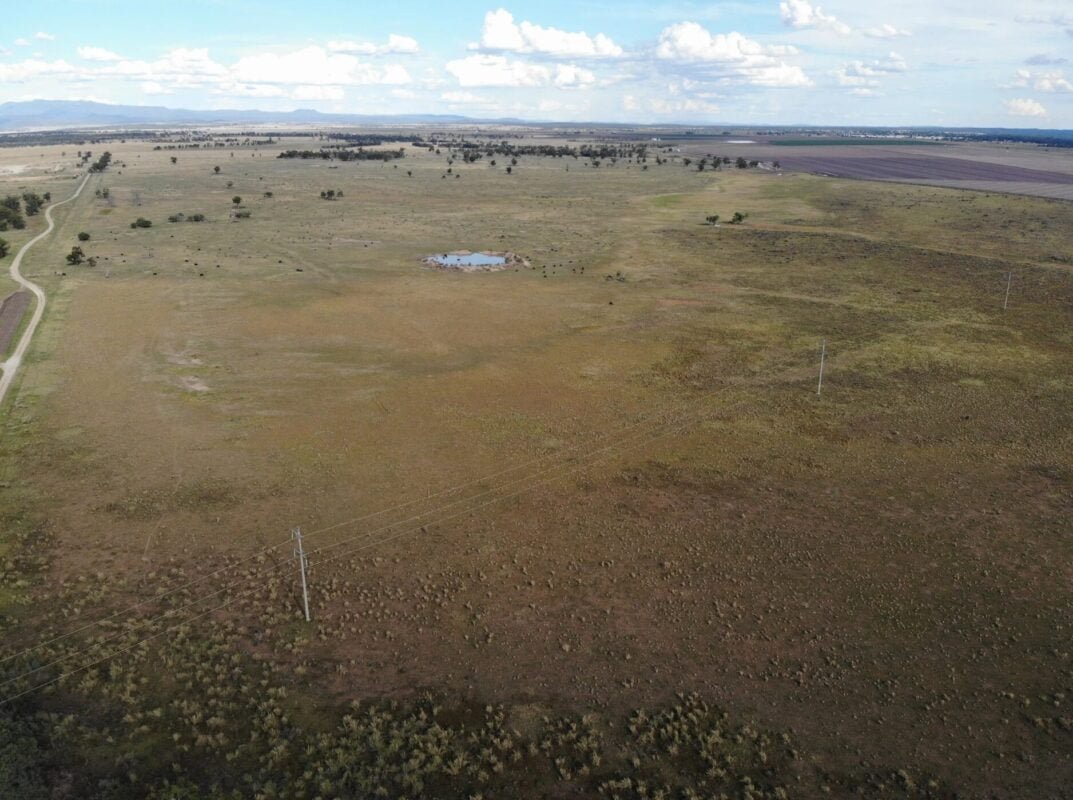
Samsung submits 300MWh solar-BESS to Australia’s EPBC Act - Energy-Storage.News Skip to content
500-mile test proves why Tesla Model Y still humiliates rivals in Europe
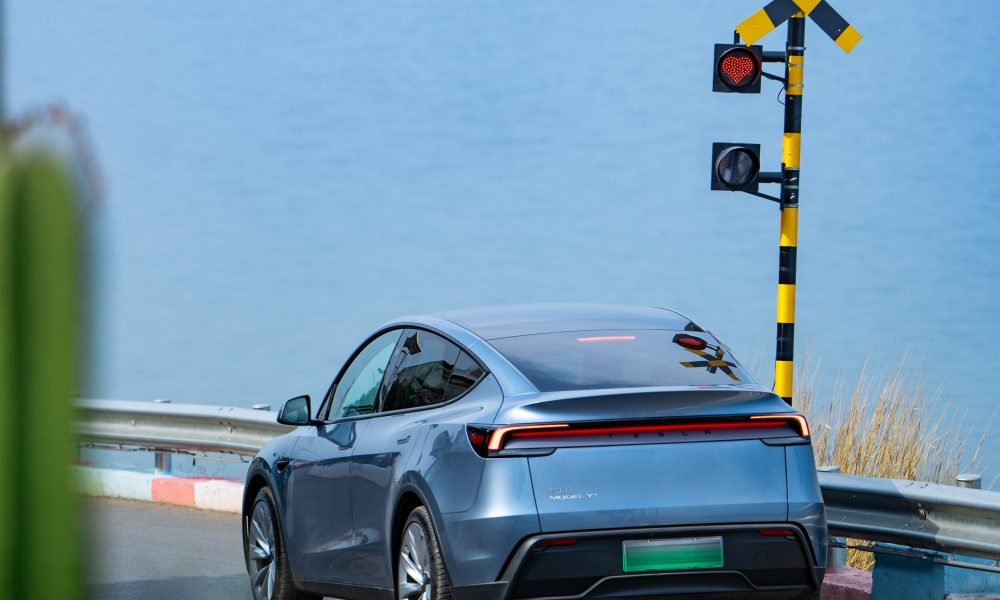
The Tesla Model S Plaid has been around for some time. Today, it is no longer the world’s quickest four-door electric sedan, nor is it the most powerful. As per a recent video from motoring YouTube channel Carwow, however, it seems like the Model S Plaid is still more than a match for some of its newer and more powerful rivals. The monster from China The Xiaomi SU7 Ultra is nothing short of a monster. Just like the Model S Plaid, it features three motors. It also has 1,548 hp and 1,770 Nm of torque. It’s All Wheel Drive and weighs a hefty 2,360 kg. The vehicle, which costs just about the equivalent of £55,000, has been recorded setting an insane 7:04.957 at the Nurburgring, surpassing the previous record held by the Porsche Taycan Turbo GT. For all intents and purposes, the Model S Plaid looked outgunned in Carwow’s test. The Model S Plaid is no slouch with its three motors that produce 1,020 hp and 1,420 Nm of torque. It’s also a bit lighter at 2,190 kg despite its larger size. However, as the Carwow host pointed out, the Model S Plaid holds a 7:25.231 record in the Nurburgring. Compared to the Xiaomi SU7 Ultra’s record, the Model S Plaid’s lap time is notably slower. Real-world tests As could be seen in Carwow’s drag races, however, Tesla’s tech wizardry with the Model S Plaid is still hard to beat. The two vehicles competed in nine races, and the older Model S Plaid actually beat its newer, more powerful counterpart from China several times. At one point in the race, the Xiaomi SU7 Ultra hit its power limit due to its battery’s temperature, but the Model S Plaid was still going strong. The Model S Plaid was unveiled five years ago, in September 2020. Since then, cars like the Lucid Air Sapphire and the Xiaomi SU7 Ultra have been released, surpassing its specs. But just like the Model Y ended up being the better all-rounder compared to the BYD Sealion 7 and the MG IM6, there is just something about Tesla’s tuning and refinement that makes raw specs seem not as game-changing. Check out Carwow’s Model S Plaid vs Xiaomi SU7 drag race video below.
Hithium signs deal for Eastern Europe BESS projects featuring 587Ah, 1175Ah cells
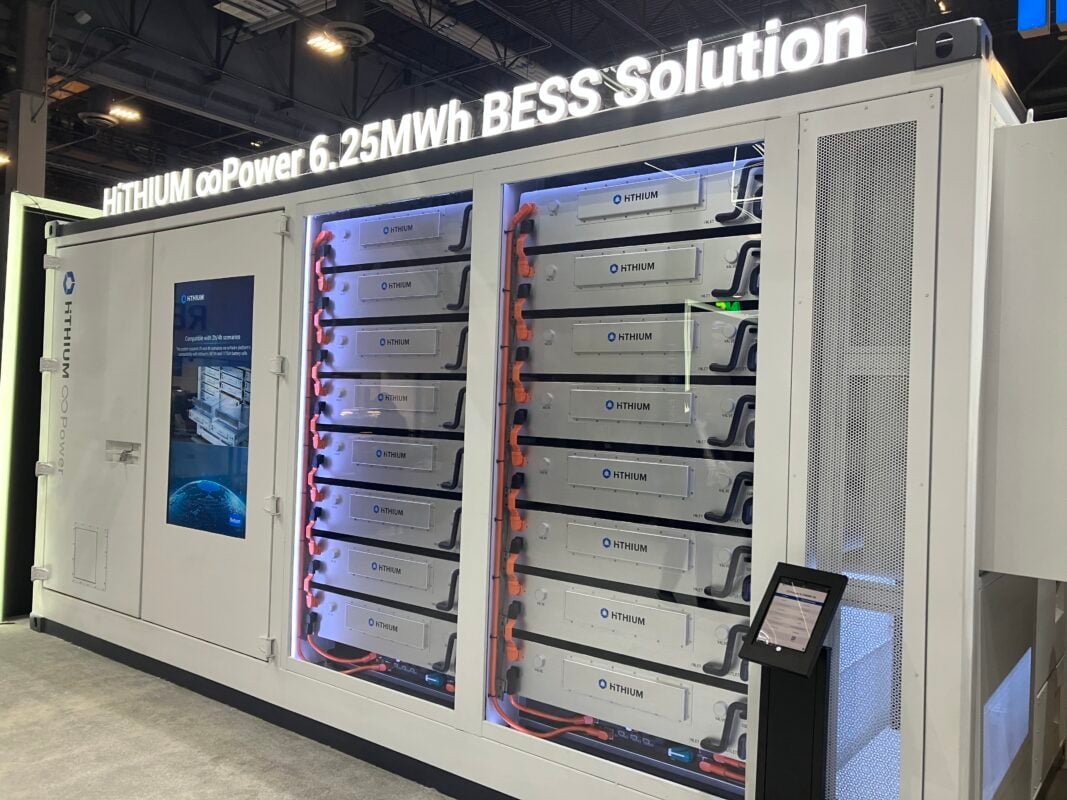
Hithium signs deal for Eastern Europe BESS projects featuring 587Ah, 1175Ah cells - Energy-Storage.News Skip to content