ESG reporting needs a refresh. Here’s how to fix it
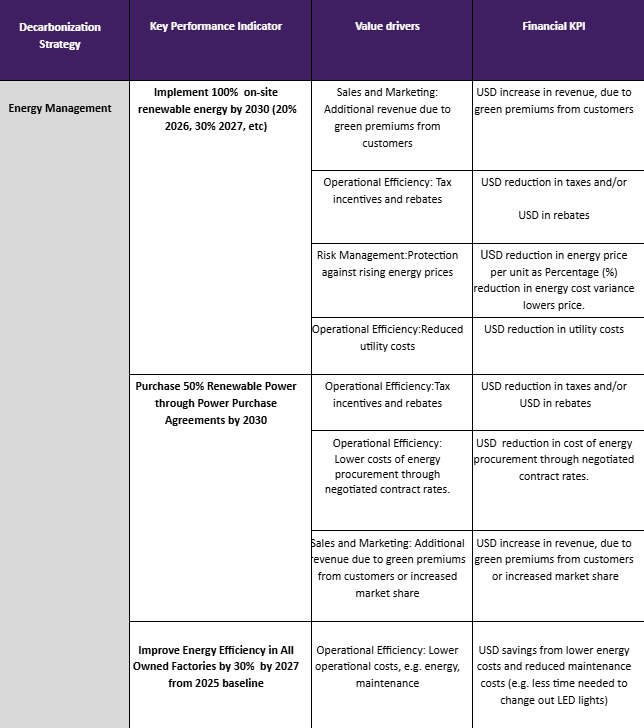
The opinions expressed here by Trellis expert contributors are their own, not those of Trellis. In North America and Europe, there’s a battle regarding sustainability reporting and compliance. Opponents say onerous regulations will reduce profitability, while proponents claim that, left to their own devices, companies will ignore important societal goals such as tackling global warming, water pollution or health and safety issues. According to our research, both sides are right and wrong. We’ve examined the Sustainability Accounting Standards Board (SASB) standards (part of the International Sustainability Standards Board) and the Corporate Sustainability Reporting Directive (CSRD) to understand whether these standards can drive better societal performance and drive better financial performance. In general, reporting and compliance regulations aim to ensure that everyone in the business ecosystem plays by the same set of rules and that there’s accountability for how those rules are followed. In the best of worlds, those standards help improve corporate performance on a wide range of issues, from providing credible data to investors to reducing harmful toxic emissions. Unfortunately, our research finds that most ESG reporting requirements focus on outputs rather than outcomes and eschew targets. Our SASB findings With SASB, our report identifies three main challenges as currently constructed: Most reporting metrics are activities/outputs rather than outcomes Most metrics are neutral or risk-focused rather than opportunity-focused ESG reporting metrics neither integrate financial performance nor provide guidance on how to understand and drive better financial performance Many companies and investors treat these metrics as the full scope of their sustainability efforts, but their design makes real progress unlikely. Our assessment shows that roughly 95 percent of SASB metrics focus on processes or outputs rather than measurable outcomes. Such activity-based measures reveal little about whether actions create societal or financial impact. For example, chemical companies must disclose how they engage with communities, yet this requires no specific actions or tracking of health outcomes. The coal industry, for example, is required to report its Scope 1 emissions and the percentage covered under emissions-limiting regulations. It’s also required to “discuss” a strategy to “manage” its emissions (note, it does not say reduce) as well as set targets and discuss performance (all of which comes under discussion, so targets and performance reporting is not required). The industry isn’t required to set a target for reducing emissions, nor is it required to provide a baseline or show a link between reduced GHG emissions and lower energy costs, lower carbon fees and other financial metrics. So what can companies and investors really learn from this reporting? Our CSRD findings The CSRD aims to better inform stakeholders by mandating double materiality and scenario planning. Both steps require strategic review of which ESG topics might drive better or worse financial performance as well as societal performance, which is a plus. However, our analysis finds different challenges with CSRD’s methodology: Its 1,000-plus required data points threaten to overwhelm users with immaterial information It lacks sector-specific standards (although there are plans to create them) Just five metrics explicitly measure positive financial outcomes rather than risk mitigation It doesn’t provide a methodology or definitions for impact/risk/opportunity It doesn’t require targets These shortcomings inadvertently foster a lack of performance-based KPIs which would then limit sustainability-linked impact and value creation for companies and undermine the intended objectives of CSRD and other European reporting standards. While the regulation aims to enhance transparency and accountability for a company’s material impacts, it doesn’t mandate that companies set outcome-oriented targets. Instead, it requires disclosure only for targets that companies have already established. For any targets set, the regulation imposes a set of minimum disclosure requirements, including the nature and scope of the target, baseline value, baseline year, milestones and interim targets. So if a transportation company sets a target of 15 percent emissions reduction in five years, they would need to specify where the reduction is expected to take place, disclose the baseline emission levels and set annual target reductions. This would be useful information, although still not tied to financials (an ongoing weakness). However, if no such emission reduction target is set, these additional disclosures aren’t required. Therefore, the standard may actually disincentivize target setting as companies aim to avoid additional disclosure that could expose them to risks. What practitioners can do As a result of these ESG reporting shortcomings, companies may collect data that’s not useful for making decisions. In fact, a common refrain at companies today is, “We need to spend our money on reporting, so we cannot spend money on sustainability execution.” In what world does this happen? In a world where metrics don’t require demonstration of performance or execution. Our dual reports on the two standards provide specific recommendations for improvement to both standard-setting bodies. At a high level, we recommend: Performance-based targets should be mandated for the most material impacts, risks and opportunities. These should include a baseline. Financial performance KPIs — both opportunities and risks — should be required and aligned with the most material targets. Even if reporting standards don’t improve, practitioners can still shift sustainability reporting from an onerous compliance checkbox to a strategic business exercise, by following the above recommendations and then mapping their sustainability KPIs to ESG reporting metrics. The following is an example which illustrates the proposed financial upside of decarbonization through improved energy management practices. In summary, to make ESG reporting meaningful, standards must require outcome-based targets and aligned financial KPIs that clearly link sustainability performance to business value. The post ESG reporting needs a refresh. Here’s how to fix it appeared first on Trellis.
GigaDevice launches GD25NX dual-voltage xSPI NOR Flash

GigaDevice announced the launch of its new generation of high-performance dual-voltage xSPI NOR Flash products – the GD25NX series. Featuring a 1.8 V core and 1.2 V I/O design, the GD25NX series connects directly to 1.2 V system on chips (SoCs) without an external booster circuit, significantly reducing system power consumption and BOM cost. Building on the success of the 1.2 V I/O GD25NF and GD25NE series, the new GD25NX further extends GigaDevice’s expertise in dual-voltage Flash design. With high-speed data transfer performance and outstanding reliability, the GD25NX series is ideal for demanding applications such as wearables, data centers, edge AI, and automotive electronics that require exceptional stability, responsiveness, and power efficiency. The GD25NX xSPI NOR Flash supports an octal SPI interface with a maximum clock frequency of 200 MHz in both single transfer rate (STR) and double transfer rate (DTR) modes, delivering data throughput of up to 400 MB/s. It achieves a typical page program time of 0.12 ms and a sector erase time of 27 ms, offering 30% faster programming speed and 10% shorter erase time compared with conventional 1.8 V octal Flash products. To safeguard data reliability, the GD25NX series integrates error correction code (ECC) algorithms and cyclic redundancy check (CRC) verification to enhance data integrity and extend product lifespan. In addition, the series supports a data strobe (DQS) functionality to ensure signal integrity in high-speed system designs, meeting the stringent data transfer stability requirements of SoCs use on data center and automotive applications. Built on an innovative 1.2 V I/O architecture, the GD25NX series delivers outstanding performance while maintaining exceptional power efficiency. At a frequency of 200 MHz, the device achieves read currents as low as 16 mA in Octal I/O STR mode and 24 mA in Octal I/O DTR mode. Compared with the conventional 1.8 V Octal I/O SPI NOR Flash devices, the 1.2 V I/O design reduces read power consumption by up to 50%, significantly improving system energy efficiency while sustaining high-speed operation—an ideal choice for power-sensitive applications. The GD25NX series is available in 64 Mb and 128 Mb densities, meeting diverse storage needs across various applications. These devices are supported on TFBGA24 8×6 mm (5×5 ball array) and WLCSP (4×6 ball array) packages. Samples of the 128 Mb GD25NX128J are now available for customer evaluation, while the 64 Mb GD25NX64J samples are currently being prepared. For detailed technical information or pricing inquiries, please contact your local authorized GigaDevice sales representative. For more information, visit gigadevice.com. The post GigaDevice launches GD25NX dual-voltage xSPI NOR Flash appeared first on Engineering.com.
Up to $13,289 exclusive savings on DELTA Pro Ultra X power station + 18 other offers, MOD e-bike Cyber Monday sale, Lectric, more
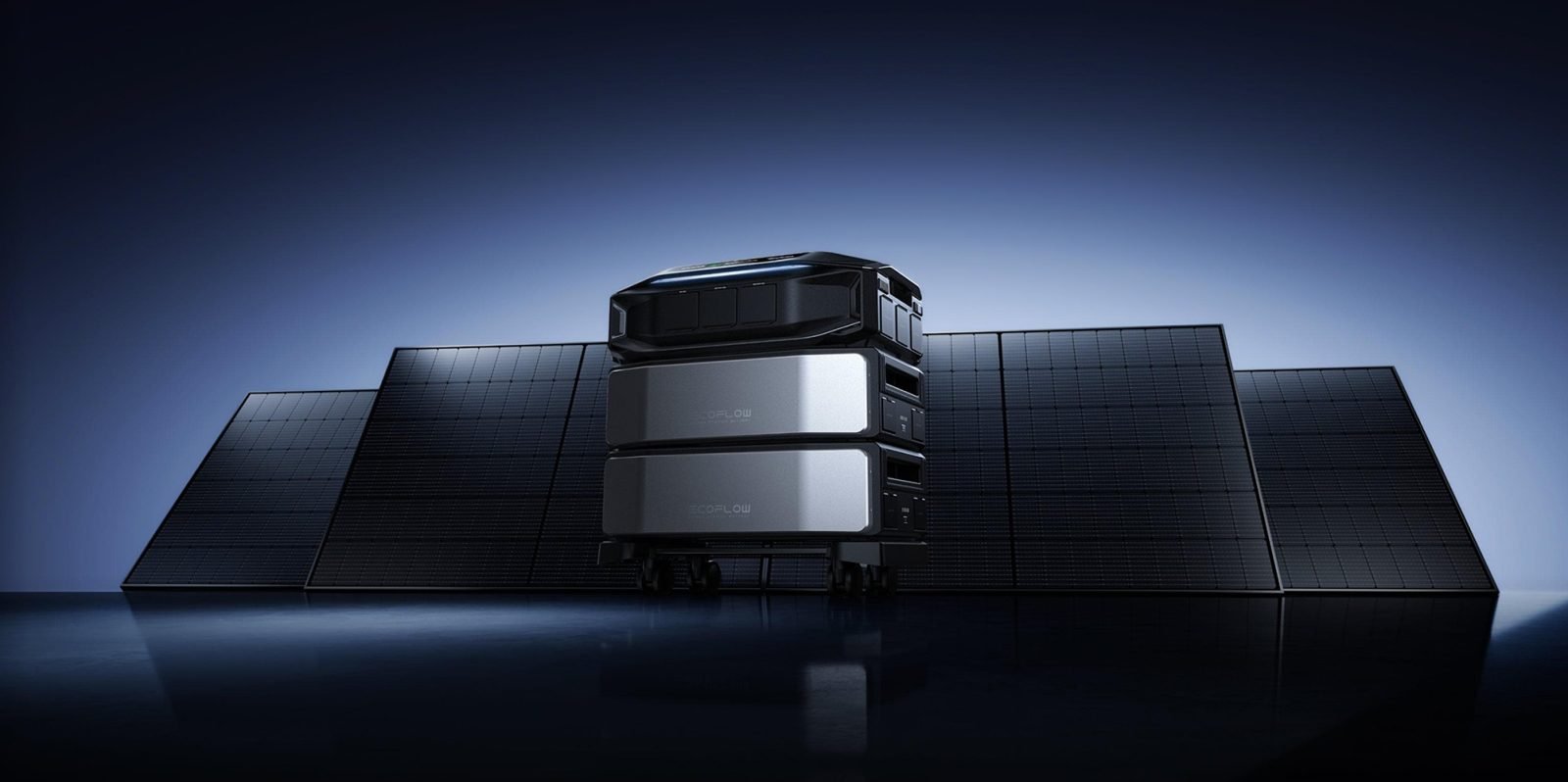
Thanksgiving may be over, but that just means we’re moving into Cyber Monday savings! Today’s Green Deals are jam-packed with power station and e-bike savings, in particular, led by EcoFlow’s latest DELTA Pro Ultra X Portable Whole-Home Backup Power Station (as well as 18 additional series offers) with up to $13,289 exclusive savings to new low prices starting from $174 – plus, EcoFlow’s DELTA Pro Ultra solar bundle and the brand’s latest flash sale. From there, we have a rare sale from MOD Bikes, with the Easy 3 Cruiser e-bike back at a $2,199 low, among others, as well as Lectric’s Cyber Monday Sale, and new low prices on units from Anker SOLIX, Jackery, an EGO Multi-Head combo, and much more waiting for you below. And don’t forget about the hangover deals from last week alongside the latest deals from this week that are collected together in our Black Friday/Cyber Monday Green Deals hub, which we will continue to update through the rest of the week. Head below for other New Green Deals we’ve found today and, of course, Electrek’s best EV buying and leasing deals. Also, check out the new Electrek Tesla Shop for the best deals on Tesla accessories. more…
Wireless EV charging pioneers Electreon and InductEV aim to combine forces
Wireless EV charging is about much more than convenience. The true benefits are seen in the commercial EV market. As InductEV’s then-president M. David Dealy explained to Charged in a 2024 interview, inductive charging can enable EV fleets to deliver the same service with smaller batteries, reduce vehicle costs, and extend battery life. Now two major players in the wireless charging field are planning to combine. Dynamic wireless electric vehicle charging provider Electreon has signed an MoU to purchase the assets of InductEV. The combined company will “bring together Electreon’s dynamic wireless charging and stationary high-power technology with InductEV’s ultra-fast static systems and charging platform, creating a full range of wireless charging solutions for every EV use case, from passenger vehicles to vans to buses, heavy-duty trucks and autonomous vehicles,” Electreon tells us. Both companies already work closely with various vehicle OEMs. Electreon boasts “deep operational experience and highly cost-efficient manufacturing capabilities,” which are expected to add significant value to InductEV’s technology. “Together with InductEV, we are working to [offer] wireless solutions for every charging scenario and for every type of customer and vehicle,” said Oren Ezer, CEO of Electreon. “InductEV is the US market leader in ultra-fast stationary wireless charging, and Electreon is the world leader in dynamic wireless charging. This transaction will generate powerful synergies across our technologies, manufacturing capabilities, strategic partners and customer bases.” “I’ve long believed that wireless charging will redefine how fleets operate,” said John F. Rizzo, CEO of InductEV. “Electreon shares that vision and brings the global reach and dynamic technology to make it a reality.” Source: Electreon Wireless
Tesla starts laying the groundwork for FSD tests in Austria

Tesla seems to be ramping its efforts to hire key personnel for FSD’s eventual expansion in Europe. This was hinted at in a new job listing for a vehicle operator role in Vienna, Austria. The job opening comes as the company pushes regulatory approvals and data collection in new European markets. Vienna’s vehicle operator role Tesla posted the job for “Fahrer (Vehicle Operator) (m/w/d)” in its Vienna office on its Careers website, seeking candidates to drive and monitor test vehicles as part of the Autopilot and AI team. The role involves collecting real-world driving data to refine Full Self-Driving systems for the country’s local roads. Responsibilities include operating vehicles in urban and highway environments, documenting system performance, among other tasks. Applicants need a valid Austrian driver’s license and at least two years of driving experience. Fluency in English is essential, along with a familiarity with driver assist systems. Tesla noted that the position offers a minimum annual gross salary of EUR 32,000, though relevant professional experience and qualifications will be taken into account. Similar to other Tesla roles, the position also offers TSLA stock as an incentive. $TSLA Servus, Austria Tesla is ramping up its FSD efforts in Europe, and the company is making sure that this magical tech will work in Austria too Info from Tesla's career page shows that the company is hiring a Vehicle Operator in Wien, Austria’s capital pic.twitter.com/aPWpJO4c2g — Ming (@tslaming) November 29, 2025 Tesla’s FSD Push in Europe Tesla’s FSD efforts in Europe have accelerated in recent months, with significant progress in Spain serving as a key milestone. In July 2025, Spain’s Directorate-General for Traffic launched the ES-AV framework to standardize automated vehicle testing, authorizing Tesla for nationwide FSD trials with 19 vehicles under Phase 3, which allows optional onboard safety operators and remote monitoring. The program, running through November 2027, aims to position Spain as a leader in the field, as DGT stated: “The program is designed to complement and enhance oversight, regulation, research, and transparency efforts, as well as to support innovation and advancements in automotive technology and industry.” Beyond Spain, Tesla has conducted FSD demonstrations in Germany, France and Italy for consumers, while pursuing national approval in the Netherlands for early 2026. The post Tesla starts laying the groundwork for FSD tests in Austria appeared first on TESLARATI.
Tesla continues growing its Cybercab production team with new job listings

Tesla continues to build out its workforce for the upcoming Cybercab, with two new job listings for quality inspectors for the autonomous two-seater being listed in the company’s official Careers website. Both positions are based in Gigafactory Texas, the site of the Cybercab’s initial production. New Cybercab listings Tesla recently added openings for “Quality Inspector, Cybercab” and “Quality Inspector, Cybercab – Incoming Quality” on its Careers website. The roles involve detailed inspections of Cybercab components using precision tools such as calipers, micrometers, and gauges, among others. Candidates must also identify non-conformances, document findings in Tesla’s quality management system and collaborate with production teams to resolve issues swiftly. Overall, these new Cybercab-related roles highlight Tesla’s emphasis on precision for the two-seater’s innovative features, such as its inductive charging setup, which is not available on any Tesla consumer vehicle today. If any, the Cybercab’s Quality Inspectors will likely be operating in uncharted territory as the vehicle is being produced using Tesla’s new Unboxed process. Elon Musk has also noted that the Cybercab’s production line will resemble a high-speed consumer electronics line instead of a conventional automotive line. Breaking: Tesla is hiring Quality Inspectors for its Cybercab manufacturin line in Austin to ensure components and assemblies built through the Unboxed Process meet strict quality standards. pic.twitter.com/cg5i4roOX5 — Tesla Yoda (@teslayoda) November 27, 2025 Recent Cybercab Design Evolutions Since its October 2024 unveiling, the Cybercab has undergone several refinements visible in recent prototypes, enhancing aerodynamics and manufacturability ahead of production. The tail design now rises slightly for better airflow, with a shortened rear body panel and repositioned red reflectors farther from the wheel arches. Front-end updates include segmented daytime running lights, actual turn signals and a sharper splitter, while side repeater cameras have shifted forward for improved visibility. Tesla has also enlarged door panels for easier ingress and egress, swapped to unpainted tires without extended covers and adjusted the B-pillar forward and lower, likely to foster a more open cabin feel. The post Tesla continues growing its Cybercab production team with new job listings appeared first on TESLARATI.
SpaceX’s Starship program is already bouncing back from Booster 18 fiasco

SpaceX is already bouncing back from the fiasco that it experienced during Starship Booster 18’s initial tests earlier this month. Just over a week since Booster 18 met its untimely end, SpaceX is now busy stacking Booster 19, and at a very rapid pace, too. Starship V3 Booster 19 is rising As per Starbase watchers on X, SpaceX rolled out the fourth aft section of Booster 19 to Starbase’s MegaBay this weekend, stacking it to reach 15 rings tall with just a few sections remaining. This marks the fastest booster assembly to date at four sections in five days. This is quite impressive, and it bodes well for SpaceX’s Starship V3 program, which is expected to be a notable step up from the V2 program, which was retired after a flawless Flight 11. Starship watcher TankWatchers noted the tempo on X, stating, “During the night the A4 section of Booster 19 rolled out to the MegaBay. With 4 sections in just 5 days, this is shaping up to be the fastest booster stack ever.” Fellow Starbase watcher TestFlight echoed the same sentiments. “Booster 19 is now 15 rings tall, with 3 aft sections remaining!” the space enthusiast wrote. BOOSTER 19 STACKING!During the night the A4 section of Booster 19 rolled out to the MegaBay. With 4 sections in just 5 days, this is shaping up to be the fastest booster stack ever.LabPadre pic.twitter.com/FSbc5CaAOy — TankWatchers (@WatchersTank) November 30, 2025 Booster 19's next aft section (A4:4) was rolled into MegaBay 1 earlier this evening!!!Booster 19 is now 15 rings tall, with 3 aft sections remaining!!! pic.twitter.com/qQvpEd2752 — Testflight (@_Testflight_) November 30, 2025 Aggressive targets despite Booster 18 fiasco SpaceX’s V3 program encountered a speed bump earlier this month when Booster 18, just one day after rolling out into the factory, experienced a major anomaly during gas system pressure testing at SpaceX’s Massey facility in Starbase, Texas. While no propellant was loaded, no engines were installed, and no one was injured in the incident, the unexpected end of Booster 18 sparked speculation that the Starship V3 program could face delays. Despite the Booster 18 fiasco, however, SpaceX announced that “Starship’s twelfth flight test remains targeted for the first quarter of 2026.” Elon Musk shared a similar timeline on X earlier this year, with the CEO stating that “ V3 is a massive upgrade from the current V2 and should be through production and testing by end of year, with heavy flight activity next year.” Considering that Booster 19 seems to be moving through its production phases quickly, perhaps SpaceX’s Q1 2026 target for Flight 12 might indeed be more than feasible. The post SpaceX’s Starship program is already bouncing back from Booster 18 fiasco appeared first on TESLARATI.
Tesla tinkering with Speed Profiles on FSD v14.2.1 has gone too far

Tesla recently released Full Self-Driving (FSD) v14.2.1, its latest version, but the tinkering with Speed Profiles has perhaps gone too far. We try to keep it as real as possible with Full Self-Driving operation, and we are well aware that with the new versions, some things get better, but others get worse. It is all part of the process with FSD, and refinements are usually available within a week or so. However, the latest v14.2.1 update has brought out some major complaints with Speed Profiles, at least on my end. It seems the adjustments have gone a tad too far, and there is a sizeable gap between Profiles that are next to one another. Tesla FSD v14.2.1 first impressions: Smooth, stress-free highway operation Speed Profiles are refined — Hurry seems to be limited to 10 MPH over on highways. Switching from Mad Max to Hurry results in an abrupt braking pattern. Nothing of concern but do feel as if Speed… — TESLARATI (@Teslarati) November 29, 2025 The gap is so large that changing between them presents a bit of an unwelcome and drastic reduction in speed, which is perhaps a tad too fast for my liking. Additionally, Speed Profiles seem to have a set Speed Limit offset, which makes it less functional in live traffic situations. Before I go any further, I’d like to remind everyone reading this that what I am about to write is purely my opinion; it is not right or wrong, or how everyone might feel. I am well aware that driving behaviors are widely subjective; what is acceptable to one might be unacceptable to another. Speed Profiles are ‘Set’ to a Speed From what I’ve experienced on v14.2.1, Tesla has chosen to go with somewhat of a preset max speed for each Speed Profile. With ‘Hurry,’ it appears to be 10 MPH over the speed limit, and it will not go even a single MPH faster than that. In a 55 MPH zone, it will only travel 65 MPH. Meanwhile, ‘Standard’ seems to be fixed at between 4-5 MPH over. This is sort of a tough thing to have fixed, in my opinion. The speed at which the car travels should not be fixed; it should be more dependent on how traffic around it is traveling. It almost seems as if the Speed Profile chosen should be more of a Behavior Profile. Standard should perform passes only to traffic that is slower than the traffic. If traffic is traveling at 75 MPH in a 65 MPH zone, the car should travel at 75 MPH. It should pass traffic that travels slower than this. Hurry should be more willing to overtake cars, travel more than 10 MPH over the limit, and act as if someone is in a hurry to get somewhere, hence the name. Setting strict limits on how fast it will travel seems to be a real damper on its capabilities. It did much better in previous versions. Some Speed Profiles are Too Distant from Others This is specifically about Hurry and Mad Max, which are neighbors in the Speed Profiles menu. Hurry will only go 10 MPH over the limit, but Mad Max will travel similarly to traffic around it. I’ve seen some people say Mad Max is too slow, but I have not had that opinion when using it. In a 55 MPH zone during Black Friday and Small Business Saturday, it is not unusual for traffic around me to travel in the low to mid-80s. Mad Max was very suitable for some traffic situations yesterday, especially as cars were traveling very fast. However, sometimes it required me to “gear down” into Hurry, especially as, at times, it would try to pass slower traffic in the right lane, a move I’m not super fond of. We had some readers also mention this to us: The abrupt speed reduction when switching to a slower speed profile is definitely an issue that should be improved upon. — David Klem (@daklem) November 29, 2025 After switching from Mad Max to Hurry, there is a very abrupt drop in speed. It is not violent by any means, but it does shift your body forward, and it seems as if it is a tad drastic and could be refined further. The post Tesla tinkering with Speed Profiles on FSD v14.2.1 has gone too far appeared first on TESLARATI.
Tesla Model Y is still China’s best-selling premium EV through October
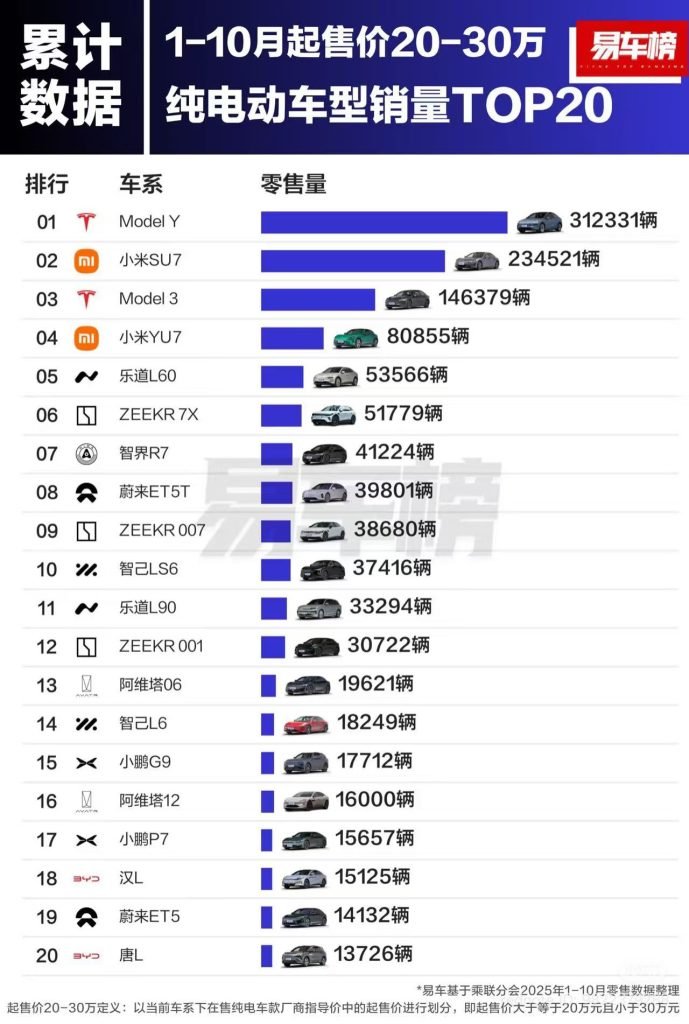
The Tesla Model Y led China’s top-selling pure electric vehicles in the 200,000–300,000 RMB segment through October 2025, as per Yiche data compiled from China Passenger Car Association (CPCA) figures. The premium-priced SUV outpaced rivals despite a competitive field, while the Model 3 also secured an impressive position. The Model Y is still unrivaled The Model Y’s dominance shines in Yiche’s October report, topping the chart for vehicles priced between 200,000 and 300,000 RMB. With 312,331 units retailed from January through October, the all-electric crossover was China’s best-selling EV in the 200,000–300,000 RMB segment. The Xiaomi SU7 is a strong challenger at No. 2 with 234,521 units, followed by the Tesla Model 3, which achieved 146,379 retail sales through October. The Model Y’s potentially biggest rival, the Xiaomi YU7, is currently at No. 4 with 80,855 retail units sold. Efficiency kings The Model 3 and Model Y recently claimed the top two spots in Autohome’s latest real-world energy-consumption test, outperforming a broad field of Chinese-market EVs under identical 120 km/h cruising conditions with 375 kg payload and fixed 24 °C cabin temperature. The Model 3 achieved 20.8 kWh/100 km while the Model Y recorded 21.8 kWh/100 km, reaffirming Tesla’s efficiency lead. The results drew immediate attention from Xiaomi CEO Lei Jun, who publicly recognized Tesla’s advantage while pledging continued refinement for his brand’s lineup. “The Xiaomi SU7’s energy consumption performance is also very good; you can take a closer look. The fact that its test results are weaker than Tesla’s is partly due to objective reasons: the Xiaomi SU7 is a C-segment car, larger and with higher specifications, making it heavier and naturally increasing energy consumption. Of course, we will continue to learn from Tesla and further optimize its energy consumption performance!” Lei Jun wrote in a post on Weibo. The post Tesla Model Y is still China’s best-selling premium EV through October appeared first on TESLARATI.
Tesla Model 3 and Model Y dominate China’s real-world efficiency tests

Tesla’s Model 3 and Model Y once again led the field in a new real-world energy-consumption test conducted by China’s Autohome, outperforming numerous rival electric vehicles in controlled conditions. The results, which placed both Teslas in the top two spots, prompted Xiaomi CEO Lei Jun to acknowledge Tesla’s efficiency advantage while noting that his company’s vehicles will continue refining its own models to close the gap. Tesla secures top efficiency results Autohome’s evaluation placed all vehicles under identical conditions, such as a full 375-kg load, cabin temperature fixed at 24°C on automatic climate control, and a steady cruising speed of 120 km/h. In this environment, the Tesla Model 3 posted 20.8 kWh/100 km while the Model Y followed closely at 21.8 kWh/100 km, as noted in a Sina News report. These figures positioned Tesla’s vehicles firmly at the top of the ranking and highlighted their continued leadership in long-range efficiency. The test also highlighted how drivetrain optimization, software management, and aerodynamic profiles remain key differentiators in high-speed, cold-weather scenarios where many electric cars struggle to maintain low consumption. Xiaomi’s Lei Jun pledges to continue learning from Tesla Following the results, Xiaomi CEO Lei Jun noted that the Xiaomi SU7 actually performed well overall but naturally consumed more energy due to its larger C-segment footprint and higher specification. He reiterated that factors such as size and weight contributed to the difference in real-world consumption compared to Tesla. Still, the executive noted that Xiaomi will continue to learn from the veteran EV maker. “The Xiaomi SU7’s energy consumption performance is also very good; you can take a closer look. The fact that its test results are weaker than Tesla’s is partly due to objective reasons: the Xiaomi SU7 is a C-segment car, larger and with higher specifications, making it heavier and naturally increasing energy consumption. Of course, we will continue to learn from Tesla and further optimize its energy consumption performance!” Lei Jun wrote in a post on Weibo. Lei Jun has repeatedly described Tesla as the global benchmark for EV efficiency, previously stating that Xiaomi may require three to five years to match its leadership. He has also been very supportive of FSD, even testing the system in the United States. The post Tesla Model 3 and Model Y dominate China’s real-world efficiency tests appeared first on TESLARATI.
ADLINK releases i.MX 95 edge modules with 15-year support
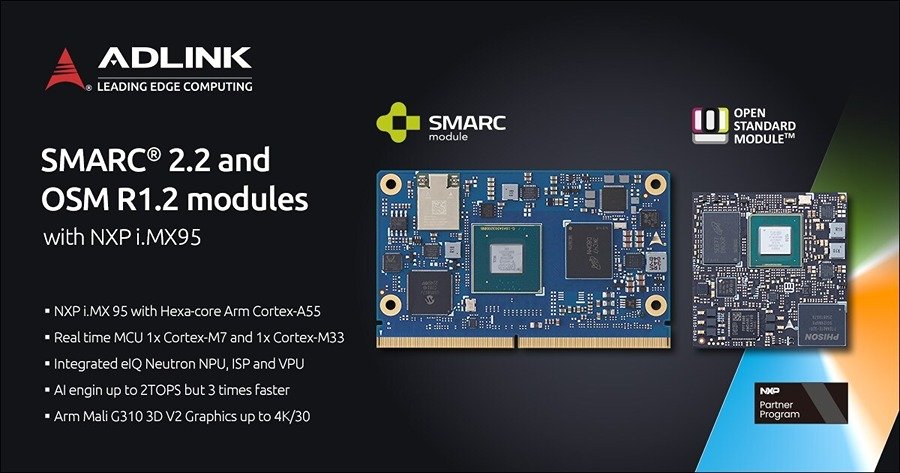
ADLINK Technology Inc. presents its latest NXP-based IMX95 modules powered by the cutting-edge NXP i.MX 95 applications processor family. Engineered to meet the demands of aerospace, automotive edge, commercial IoT, industrial, medical, and networking sectors, these modules deliver a powerful blend of performance, security, and efficiency—supported by a guaranteed 15-year product lifecycle to ensure long-term availability and stability. At the core of the IMX95 modules is the NXP i.MX95 processor, featuring up to six-core Arm Cortex-A55 alongside Cortex-M7 and Cortex-M33 cores, providing robust multicore processing and real-time control. The integrated Neutron Neural Processing Unit (NPU), supported by the eIQ framework, delivers up to 2 TOPS, enabling advanced AI inference, computer vision, and real-time data analytics directly at the edge—all within a low-power design optimized for sustained workloads. Complementing this AI capability, the NXP i.MX 95 modules feature an Image Signal Processor (ISP), Video Processing Unit (VPU), and Arm Mali graphics G310 GPU to support immersive 3D graphics and high-quality vision applications. With flexible memory configurations supporting up to 8GB LPDDR4L RAM and up to 256GB eMMC storage, plus multiple graphic output interfaces including DSI and LVDS, these modules offer extensive adaptability to varied application needs. They also include other standards found in all NXP products, ensuring broad compatibility and easy integration. Connectivity options include USB 2.0/3.0 ports and high-speed Ethernet interfaces with Precision Time Protocol (PTP), ensuring seamless integration into diverse industrial environments. OSM-IMX95: ultra-compact OSM solution for space-efficient edge systems The ADLINK OSM-IMX95, compliant with SGeT OSM 1.2 Size-L (45 mm x 45 mm), is a cost-effective module that delivers powerful processing and AI capabilities in a rugged, solderable form factor designed for extreme environments. Imagine a smart coffee machine that learns your preferences and brews the perfect cup every time, or portable medical analyzers providing rapid diagnostics at a patient’s bedside. Think of compact robotics navigating crowded factory floors or intelligent sensors embedded throughout smart city infrastructure, monitoring air quality and traffic flow in real time. ADLINK adopts a single-sided PCB design for its OSM modules, following best practices to simplify manufacturing assembly, lower production and carrier board costs, and enhance reliability by minimizing thermal and mechanical stress. Engineered for embedded edge deployments in space- and power-constrained devices, the OSM-IMX95 is available in ruggedized options that support industrial and commercial environments. It excels in smart city sensors, transportation systems, portable healthcare equipment, and compact robotics. Its soldered-down design reduces manual assembly requirements, making it ideal for high-volume production with lower labor costs. Coupled with low power consumption, integrated NPU, and industrial-grade reliability, it empowers developers to embed high-performance AI intelligence into applications where size, power efficiency, durability, and production scalability are critical. LEC-IMX95: SMARC module for scalable industrial IoT intelligence The ADLINK LEC-IMX95, compliant with SGeT SMARC 2.2 specifications and offered in the 82 mm x 50 mm form factor, delivers exceptional flexibility and performance for scalable edge and IoT applications. Imagine intelligent retail kiosks that recognize returning customers and personalize promotions in real time, or advanced audio systems in public venues that automatically balance clarity and volume for dynamic environments. Picture next-generation transportation systems optimizing traffic flow through AI-enabled control units, or industrial gateways managing complex sensor networks with precision and reliability. With its optional 10GbE interface alongside the standard 2x GbE, secure boot, and real-time control, the LEC-IMX95 delivers deterministic performance across smart infrastructure, retail automation, and intelligent transport systems. Designed for scalability and easy integration, the LEC-IMX95 pairs seamlessly with cost-effective carrier boards, making it an ideal choice for both standard and low-volume production. With its long lifecycle support and industrial-grade reliability, it enables rapid prototyping and deployment of high-performance, production-ready solutions for evolving industrial and commercial environments. Choose the right fit for your industry innovation — tailored-made ODM or ADLINK-ready solutions At ADLINK, we don’t just provide powerful modules — we also collaborate closely with you through advanced ODM design services to deliver tailored solutions for both OSM and SMARC platforms. Whether your project requires the modular scalability of the SMARC LEC-IMX95, enabling easy module swaps and upgrades as your needs evolve, or the ultra-compact, rugged, and cost-effective soldered-down efficiency of the OSM-IMX95, we offer the flexibility to meet your specific technical priorities. It’s not about the industry where you’re in — it’s about choosing the right form factor for your design goals: modular expandability for future-proof adaptability, or soldered resilience for space- and cost-constrained deployments. It’s your call. For more information, visit adlinktech.com. The post ADLINK releases i.MX 95 edge modules with 15-year support appeared first on Engineering.com.
Double your chances in Climate XChange’s 10th Annual EV Raffle!
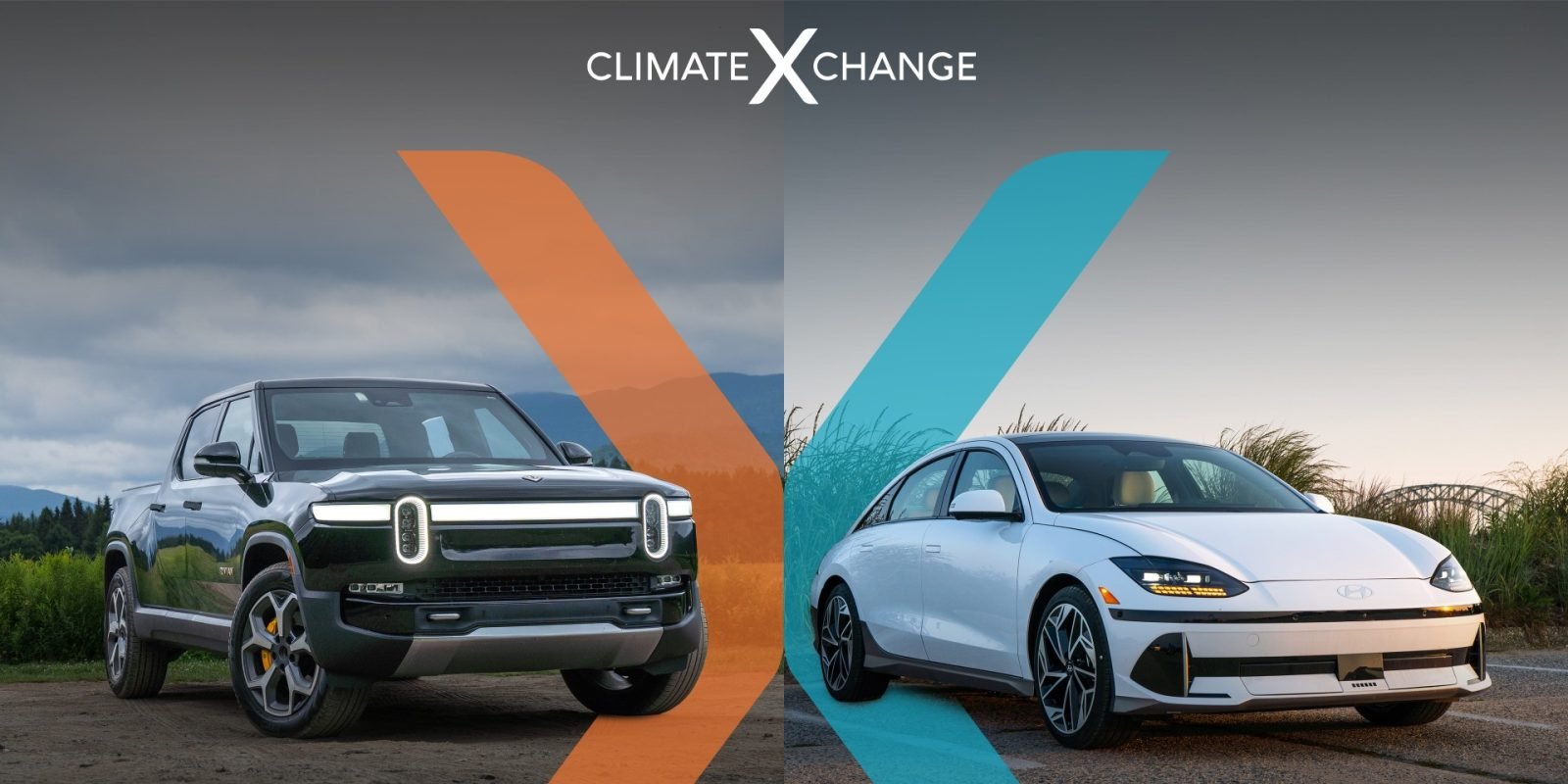
Climate XChange’s Annual EV Raffle is back for the 10th year running – and for the first time ever, Climate XChange has two raffle options on the table! The nonprofit has helped lucky winners custom-order their ideal EVs for the past decade. Now you have the chance to kick off your holiday season with a brand new EV for as little as $100. About half of the raffle tickets have been sold so far for each of the raffles – you can see the live ticket count on Climate XChange’s homepage – so your odds of winning are better than ever. But don’t wait – raffle ticket sales end on December 8! more…
Dabaja Brothers and ChargePoint aim to eliminate EV fast charging deserts in metro Detroit

Ubiquitous EV charging provider ChargePoint has announced plans to build a new public EV charging site in Canton, Michigan for the Dabaja Brothers Development Group, a metro Detroit real estate development company. Dabaja Brothers will own and operate the new charging site, and plans to open ChargePoint fast charging stations at several more Michigan locations, including Dearborn and Lavonia. The sites will offer a total of over 40 charging ports. Each site will feature ChargePoint Express Plus fast charging stations. Each Express Plus station can simultaneously charge two vehicles, and features a proprietary cooling architecture that’s designed to deliver peak charging speeds for sustained periods of time. All of the stations will be managed by the next-generation ChargePoint Platform. “We started this project because we saw a gap in our community—there was almost nowhere to charge an EV in Canton, and a similar lack of charging across metro Detroit,” said Yousef Dabaja, Owner/Operator at Dabaja Brothers Development Group. “This initiative will rapidly infill the fast charging deserts across the Detroit area, allowing drivers to quickly recharge their vehicles when and where they need to,” said Rick Wilmer, CEO at ChargePoint. Source: ChargePoint
Tesla Full Self-Driving (FSD) testing gains major ground in Spain

Tesla’s Full Self-Driving (Supervised) program is accelerating across Europe, with Spain emerging as a key testing hub under the country’s new ES-AV framework program. Based on information posted by the Dirección General de Tráfico (DGT), it appears that Tesla is already busy testing FSD in the country. Spain’s ES-AV framework Spain’s DGT launched the ES-AV Program in July 2025 to standardize testing for automated vehicles from prototypes to pre-homologation stages. The DGT described the purpose of the program on its official website. “The program is designed to complement and enhance oversight, regulation, research, and transparency efforts, as well as to support innovation and advancements in automotive technology and industry. This framework also aims to capitalize on the opportunity to position Spain as a pioneer and leader in automated vehicle technology, seeking to provide solutions that help overcome or alleviate certain shortcomings or negative externalities of the current transportation system,” the DGT wrote. The program identifies three testing phases based on technological maturity and the scope of a company’s operations. Each phase has a set of minimum eligibility requirements, and applicants must indicate which phase they wish to participate in, at least based on their specific technological development. BREAKING — The European FSD train is charging ahead fast Spain made a new legal framework and gives the green light for nationwide FSD testing! The regulatory document entered into force in July 2025Tesla has unlimited Spain wide testing approval for 19 vehicles and is… pic.twitter.com/2MNVCdMi9O — Kees Roelandschap (@KRoelandschap) November 28, 2025 Credit: DGT Como pez en el agua …FSD Supervised testing in Madrid, Spain Pending regulatory approval pic.twitter.com/txTgoWseuA — Tesla Europe & Middle East (@teslaeurope) July 3, 2025 Tesla FSD tests As noted by Tesla watcher Kees Roelandschap on X, the DGT’s new framework effectively gives the green flight for nationwide FSD testing. So far, Tesla Spain has a total of 19 vehicles authorized to test FSD on the country’s roads, though it would not be surprising if this fleet grows in the coming months. The start date for the program is listed at November 27, 2025 to November 26, 2027. The DGT also noted that unlimited FSD tests could be done across Spain on any national route. And since Tesla is already in Phase 3 of the ES-AV Program, onboard safety operators are optional. Remote monitoring would also be allowed. Tesla’s FSD tests in Spain could help the company gain a lot of real-world data on the country’s roads. Considering the scope of tests that are allowed for the electric vehicle maker, it seems like Spain would be one of the European countries that would be friendly to FSD’s operations. So far, Tesla’s FSD push in Europe is notable, with the company holding FSD demonstrations in Germany, France, and Italy. Tesla is also pushing for national approval in the Netherlands in early 2026. The post Tesla Full Self-Driving (FSD) testing gains major ground in Spain appeared first on TESLARATI.
ENCY 2.5 adds workflow tools and stability updates

ENCY 2.5 has been released. The update includes 130 changes aimed at improving workflow efficiency and stability across machining, simulation and core platform functions. Painting simulation: Faster visual feedback The part renders during painting simulation so painted and unpainted areas are visible without changing part visibility. The simulation shows painted areas by default without a paint-film thickness gradient. To review thickness, turn on “Verify compare” and set a color gradient against a reference. Automatic face selection: Two one-click helpers With a closed contour preselected, right-click a face on that contour to access: “Enclosed faces,” which selects all faces inside the closed contour, such as faces of a profile pocket. “Outer adjacent faces,” which selects faces adjacent to the closed contour edges, such as edge fillets around the contour. These options reduce multi-face selection to a single action and help limit selection errors on complex geometry. Swarf: Automatic axial-pass calculation Axial passes now allow toolpath calculation by either step size or pass count. Passes are distributed automatically with uniform spacing over the 3D model to support consistent surface finish while keeping user control over cycle time. Usability and workflow updates Hints refreshed for Pencil, Swarf, Non-planar Slicing and Threading (OD/ID) operations CLD adds “Number of starts” for the G92 threading cycle Downloads page now always includes links to offline installers Hole Machining updates the hole template dialog and parameter list API command set updated Selection improves Ctrl+Shift selection behavior 3D model import improves the parallel import pipeline Stability and fixes Reliability has been improved for project save/open, autosave recovery and PLM integration, including issues with network paths and reopening recent projects. Simulation reduces false collision reports in certain cases. Post-processing fixes improve the postprocessor generator and bundled postprocessors, and NC program generation no longer stalls. Platform and UI updates improve visuals and list scrolling, and include fixes for STEP export, spline geometry, spatial transformations, machining result-to-model comparison and targeted corrections in Swarf, Hole Machining, part-geometry selection in multi-part projects, ENCY Tuner 2 and the updater. Note: The 2.5 update is available to all users with an active software maintenance contract (SMC). For more information, visit encycam.com. The post ENCY 2.5 adds workflow tools and stability updates appeared first on Engineering.com.
Podcast: Tesla Robotaxi setback, Mercedes-Benz CLA EV, Bollinger is over, and more

In the Electrek Podcast, we discuss the most popular news in the world of sustainable transport and energy. In this week’s episode, we discuss a big Tesla Robotaxi setback, the new Mercedes-Benz CLA EV, Bollinger is over, and more. Today’s episode is brought to you by Climate XChange, a nonpartisan nonprofit working to help states pass effective, equitable climate policies. Sales end on Dec. 8th for its 10th annual EV raffle, where participants have multiple opportunities to win their dream model. Visit CarbonRaffle.org/Electrek to learn more. more…
Clarios acquires Maxwell Technologies to advance its supercapacitor portfolio

Clarios, a supplier of low-voltage energy storage solutions, has announced the acquisition of Maxwell Technologies, a manufacturer of supercapacitor cells and modules. Clarios says this acquisition will enhance its position in high-performance, short-duration energy storage. Specific terms of the transaction have not been disclosed. Maxwell Technologies’ supercapacitors are engineered to provide rapid charging and discharging, handling up to 1 million cycles and operating across a temperature range from minus 40 °C to 65 °C. Clarios says that these modules require no maintenance or additional fire-risk mitigation, addressing reliability and longevity challenges in energy storage designs. In 2019, Tesla acquired Maxwell Technologies, which many believed had less to do with its pioneering work with supercapacitors (aka ultracapacitors) than with its “dry electrode” technology—a far simpler way to make the anodes and cathodes that form a battery cell. In 2021, UCAP Power, a San Diego-based developer of ultracapacitor-based power solutions, purchased the Korean-based ultracapacitor business of Maxwell Technologies, along with other related assets, including the Maxwell brand. Clarios states that integrating supercapacitor technology supports its supply chain stability for both US and global original equipment customers, specifically within the EV and broader mobility sector. The acquisition also aligns with Clarios’ focus on battery circularity and low-voltage energy storage innovation. In addition to applications in automotive systems, Maxwell Technologies’ supercapacitors are also used in grid stabilization, power for data centers, energy generation, military, transportation and industrial automation. Maxwell has shipped over 85 million supercapacitor cells to date, according to Clarios. “Maxwell’s supercapacitors are designed to provide customers with high-power energy storage solutions that emphasize reliability, safety, and long life,” said Mark Wallace, CEO of Clarios. “This integration strengthens our ability to serve our automotive customers and creates a long-term opportunity to expand our presence in non-automotive sectors. Maxwell’s existing customer relationships in Data Centers, Grid, Military and Industrial applications will be maintained and actively developed under Clarios’ leadership.” Clarios will operate Maxwell Technologies as an independent, US-based business unit. Source: Clarios
Tesla FSD approved for testing in Nacka, Sweden, though municipality note reveals aggravating detail

Tesla has secured approval for FSD testing in an urban environment in Sweden. As per recent reports from the Tesla community, Nacka, Sweden, a municipality just a few miles from Stockholm, has given its approval for FSD tests. A look at the municipality’s note regarding FSD’s approval, however, reveals something quite aggravating. FSD testing approval secured As per Tesla watcher and longtime shareholder Alexander Kristensen, Nacka is governed by the Moderate Party. The shareholder also shared the municipality’s protocol notes regarding approval for FSD’s tests. “It is good that Nacka can be a place for test-driving self-driving cars. This is future technology that can both facilitate mobility and make transportation cheaper and more environmentally friendly,” the note read. The update was received positively by the Tesla community on social media, as it suggests that the electric vehicle maker is making some legitimate headway in releasing FSD into the region. Sweden has been particularly challenging as well, so securing approval in Nacka is a notable milestone for the company’s efforts. FSD in Sweden Tesla got their FIRST APPROVAL to test FSD in an urban environment!Today, Nacka Municipality, which is governed by the Moderate Party, approved Tesla's application to test FSD in the city.Stay tuned for more information. pic.twitter.com/I8LUsAa46S — Alexander Kristensen (@LinkN01) November 27, 2025 Tesla FSD has been approved for testing in Nacka, Sweden right outside Stockholm! In their comments, they made it clear that those who voted no did so because of the union shakedown. What utter corruption to block life saving tech as part of a union shakedown! https://t.co/wZG5AOaCMO — Whole Mars Catalog (@WholeMarsBlog) November 27, 2025 Aggravating details A look at the notes from Nacka shows that FSD’s proposed tests still met some opposition from some officials. But while some critics might typically point to safety issues as their reasons for rejecting FSD, those who opposed the system in Nacka openly cited Tesla’s conflict with trade union IF Metall in their arguments. Fortunately, Nacka officials ultimately decided in Tesla’s favor as the company’s issues with the country’s unions are a completely different matter. “The left-wing opposition (S, Nackalistan, MP and V) voted no to this, referring to the fact that the applicant company Tesla is involved in a labor market conflict and does not want to sign a collective agreement. We believe that this is not an acceptable reason for the municipality to use its authority to interfere in a labor law conflict. “Signing a collective agreement is not an obligation, and the company has not committed any crime. The municipality should contribute to technological development and progress, not work against the future,” the note read. The post Tesla FSD approved for testing in Nacka, Sweden, though municipality note reveals aggravating detail appeared first on TESLARATI.