Tesla announces major milestone at Gigafactory Shanghai

Tesla has announced a major milestone at its Chinese manufacturing facility, Gigafactory Shanghai, confirming on Monday that it had built its four millionth vehicle. Tesla Gigafactory Shanghai first started building cars back in October 2019 with Model 3 assembly, just ten months after the company broke ground on the plant’s 86-hectare piece of land. First deliveries started in December 2019, with the first units being given to employees. By the end of 2020, the plant was building cars at a run rate of around 150,000 vehicles annually. Production continued to ramp up, and by September 2023, less than three years after it started building Tesla’s EVs, it had built its two millionth vehicle. Fast forward to December 2025, and Tesla has confirmed that four million cars have rolled off of production lines at the plant, a major milestone in the six short years it has been active: Produced our 4 millionth vehicle at Gigafactory Shanghai Thanks to all our owners and supporters pic.twitter.com/DayVXUr220 — Tesla Asia (@Tesla_Asia) December 8, 2025 The capacity at Giga Shanghai is exceeding 950,000 vehicles per year, and this year, the company has delivered 675,000 cars through the first three quarters. It is also the only plant to manufacture the Model Y L, a longer wheel-based configuration of the all-electric crossover that is exclusive to the Chinese market. Gigafactory Shanghai’s four million cars have not all stayed within the domestic market, either. For a considerable period, the factory was exporting a significant portion of its monthly production to Europe, helping Gigafactory Berlin supplement some Model Y volume and all of its Model 3 deliveries. This is due to the Berlin plant’s exclusive production plans for the Model 3. The site is one of the most crucial in the company’s global plans, and Gigafactory Shanghai’s incredible pace, which has led to four million production units in just about six years. It’s fair to say that it won’t be long until we’re seeing Tesla celebrate the plant’s five millionth vehicle produced, which should happen sometime late next year or in early 2027, based on its current manufacturing pace. The company also builds the Megapack on the property in an adjacent Megafactory. The post Tesla announces major milestone at Gigafactory Shanghai appeared first on TESLARATI.
Tesla Optimus dramatically collapses after teleoperator mishap

Tesla Optimus dramatically collapsed after a teleoperator mishap at the company’s “Future of Autonomy Visualized” event in Miami this past weekend. It seemed blatantly obvious that whoever was controlling the Optimus robot from behind the scenes did not disconnect their ability to manipulate its movements, then left the controls, causing Optimus to collapse. A video captured at the event shows Optimus doing a movement similar to taking a headset off, likely what the teleoperator uses to hear guest requests and communicate with other staff: Tesla Optimus mishap at the Miami event To be fair, don’t we all want to do this around the Holidays? pic.twitter.com/EJ5QKenqQd — TESLARATI (@Teslarati) December 8, 2025 After the headset removal motion was completed, Optimus simply collapsed backward, making for an interesting bit of conversation. While it was a mishap, it was actually pretty funny to watch because of the drama displayed by the robot in the situation. This was obviously a mistake made by the teleoperator, and does not appear to be a spot where we can put any sort of blame on Optimus. It would have likely just stood there and waited for controls to resume if the teleoperator had disconnected from the robot correctly. However, details are pretty slim, and Tesla has not announced anything explaining the situation, likely because it seems to be a pretty face-value event. Tesla Optimus shows off its newest capability as progress accelerates The Tesla Optimus program has been among the most hyped projects that the company has been working on, as CEO Elon Musk has extremely high hopes for what it could do for people on Earth. He has said on several occasions that Optimus should be the most popular product of all time, considering its capabilities. Obviously, the project is still a work in progress, and growing pains are going to be part of the development of Optimus. In its development of Optimus Gen 3, Tesla has been working on refining the forearm, hand, and fingers of Optimus, something that Musk said is extremely difficult. However, it’s a necessary step, especially if its capabilities will not be limited by hardware. All in all, Optimus has still been a very successful project for Tesla, especially in the early stages. The company has done an excellent job of keeping Optimus busy, as it helps with serving customers at events and the Tesla Diner, and is also performing tasks across the company’s manufacturing plants. The post Tesla Optimus dramatically collapses after teleoperator mishap appeared first on TESLARATI.
Former Nike insider challenges activewear’s plastic playbook

Fears that activewear sheds plastics that penetrate the skin are giving people new reason to sweat over working out. Responsive entrepreneurs now advertise leggings, tanks and sports bras as “nontoxic,” “clean” and “safe.” They tout gym- and trail-ready garments made of merino wool, cotton, mulberry silk, bamboo and hemp. However, these materials alone can’t smooth curves or hug muscles through squats and sun salutations; only synthetics achieve that coveted stretch factor. So companies quietly blend natural fibers with elastane (also known as spandex), nylon or polyester. Activewear brands find themselves in a paradox: touting images of fresh-air lifestyles while they produce clothes from petrochemicals that feed the climate crisis and pollute the planet. Changing that requires formulating stretchy materials with proven performance, sustainable origins and lower end-of-life impacts. It’s a big challenge, said Marcian Lee, an analyst with Lux Research: “I don’t think we have a perfect solution that satisfies all three of these considerations,” he said. Enter Äktiiv One Nike veteran is determined to clean up athletic wear with his Äktiiv brand. Tim Gobet spends about $27 to make a pair of $100 leggings — not a high enough margin for larger brands, he said. The materials are certified nontoxic, mixing plant fibers and fewer oil-based inputs than standard fare. Portland-based Äktiiv is in a pre-profit growth phase. It has raised under a million dollars including early capital from former Nike co-worker Jeffrey Jordan — son of NBA legend Michael. Gobet manages suppliers, designs garments and juggles ads on Meta while his wife, Paulina, handles fulfillment. And their kids help move inventory through their Beaverton, Oregon, garage. In the past 90 days, customers spent an average of $152, and two-thirds returned to buy more. Gross revenues are at six figures each month. Äktiiv ads Äktiiv’s founder is finding traction with a direct-to-consumer approach and ads on Meta.Source: Aktiiv / Trellis How it started Gobet’s 15-year career at Nike included leading the Jordan Brand, which topped $3 billion in sales when he left in 2017. He helped the corporation launch its first recycled polyester-spandex base layers for pro athletes for the 2016 Rio Olympics. Yet Gobet was troubled by the industry’s hunger for virgin petroleum fabrics. “My materials developers started bringing alternatives: ‘Hey, this is made from recycled plastic.’ ‘Hey, this is made from corn input,’” he said. “My mind was like, ‘Why aren’t we using this anyway?’” He soon caught entrepreneurial fever. “I quickly realized, we need to zig while everyone else is zagging,” Gobet said. “My goal was to create truly high performance, buttery-soft fabric that feels and looks like what is toxic but is good for the planet and good for health.” First, he co-launched Zenkai Apparel with former NHL player Doug Lynch. Then Gobet moved on to start Äktiiv in 2020, hitting early snags with COVID-19 shutdowns and technical challenges. “For two years, not a single supplier could get it right,” Gobet said. Then a former Nike materials developer quickly figured out how to blend Äktiiv’s proprietary Proterra fabric from three types of yarn. Gobet found a partner in Sabrina Fashion Industrial. The Taipei company, which also serves major brands, knits and dyes Äktiiv’s material, then cuts and sews styles in Cambodia. A Kickstarter campaign in 2022 raised $27,026 for Äktiiv, which made its first sale in 2023. Other anti-plastic activewear Various other brands are taking a similar tack to Äctiiv by appealing to health-conscious consumers on Facebook, Instagram and elsewhere.Source: Aktiiv / Trellis What’s in the fabric Äktiiv’s Proterra fabric combines 42 percent petroleum-free nylon from castor beans or corn. Forty percent comes from a nylon 6,6 strain that biodegrades faster than traditional nylon. The final 18 percent is Roica V550 yarn, the only Cradle to Cradle Gold elastane. All of Äktiiv’s yarns are OEKO-TEX 100 certified for “baby-safe” toxicity limits. Äktiiv tests the finished fabric, a step that other brands skip, according to Gobet. The company advertises clothes free of bisphenol A, per- and polyfluoroalkyl “forever chemicals,” azo dyes, phthalates or formaldehyde. The tradeoffs Äktiiv’s solution isn’t perfect: One yarn is fossil-fuel-free but doesn’t biodegrade. The other two may degrade quickly in landfills or oceans but are petroleum-based. Gobet still dreams of finding a “holy grail” of biodegradable, plant-based activewear. “Both halves of the equation already exist,” he said. Meanwhile, he is thinking about how to help the industry complete that calculation, possibly by sharing learnings or launching an industry collaboration. Every alternative to regular elastane comes with trade-offs on performance, price, scalability and recyclability, according to Bonie Shupe, founder of Rewildist, a sustainable apparel consultancy in Colorado. “Transparency is essential as the industry transitions.” Äktiiv faces a circularity dilemma, too: As yet, mainstream technologies can’t recycle textile blends such as Proterra, even as startups compete to change that. Toxic matters Äktiiv is seizing on increasingly popular consumer suspicions, based on recent science, that tight, plastic-fiber clothes hurt their health. Studies show that skin can absorb certain plastics, but it’s unclear if that’s even harmful or if clothing is a culprit. Plastic in arteries is associated with a higher heart attack risk, but does plastic easily migrate into the bloodstream from the skin? For Gobet, Äktiiv’s chemical-safety certifications provide a competitive advantage and peace of mind. “I’m still not comfortable putting untested synthetic fabrics on people’s skin for hours a day, during workouts when pores are open and sweat glands are active,” he said. Gobet worries that mainstream brands selling synthetics will face new risks if future research confirms consumers’ fears. “If it turns out we were overly cautious? Great.” The post Former Nike insider challenges activewear’s plastic playbook appeared first on Trellis.
Simple Design for a Complex Issue

Siemens has sponsored this post. A patient tries on her newly fitted glasses from GoodVision. (Image: Antje Christ.) Seeing clearly is essential for education, employment and a general sense of wellbeing. In many parts of the world, getting eyeglasses that fit properly can be a luxury good. A simple pair of prescription glasses can cost weeks or even months worth of income. For children, that means learning becomes harder; for adults, work becomes less possible. A overlooked problem, left unsolved, becomes a generational barrier to success. GoodVision (EinDollarBrille), a nonprofit organization headquartered in Germany, is working to change that equation through engineering, local empowerment and thoughtful design. Their mission is as straightforward as it is ambitious: make vision care accessible to people who would otherwise never receive it. At the center of the initiative is a remarkably simple and durable pair of glasses. The frame is made from lightweight, flexible wire that is bent into shape using a portable mechanical forming machine. The lenses, which are generally the most expensive and technically precise component, are standardized in shape and “clicked” into the frames based on the user’s prescription. Sabine Adams, Design Engineer at GoodVision, explains, “We go out with vans and people that do the testing and have the glasses with them. And so, we can go anywhere and do the testing and provide the glasses in one step.” This simplicity is not an accident. It’s the result of iterative design rooted in a clear guiding principle: if the glasses are going to help the people who need them most, they must be buildable anywhere. Sabine Adam (L), design engineer at OneDollarGlasses, inspecting the fit of the glasses after bending together with René Freiherr von Künßberg, Head of Optics, Production and Materials Management at GoodVision. (Image: OneDollarGlasses.) Simplicity by Design The bending machine is the backbone of the GoodVision system. It requires no electricity, no specialized infrastructure and minimal training to operate. A single machine can travel in a small van to remote rural areas where medical resources and infrastructure are scarce. The team performs vision tests on-site, selects the correct lenses, bends the frame, and assembles the glasses — all in one visit. The organization utilizes a bending machine to maintain quality control and to stay within stringent medical device standards. (Image: GoodVision.) That “one visit” concept matters. In regions where travel is time-consuming and expensive, asking someone to return later for their glasses is often unrealistic. GoodVision eliminates that gap by creating custom-fitting glasses in real-time. The idea originated with a German schoolteacher, Martin Aufmuth, who noticed low-cost reading glasses in a dollar shop and wondered, “If a pair of glasses could cost so little here, why were they inaccessible to millions elsewhere?” With no background in industrial manufacturing, he began experimenting in his basement, shaping prototypes by hand, and seeking a way to make them repeatable and scalable. Pliers for wire bending and assembly. (Image: GoodVision.) Designing a low-cost frame was only the first step. It needed to be manufacturable under a wide range of conditions, consistent enough to meet medical quality standards and durable enough for real-world wear. That led to the creation of the bending machine and eventually to multiple generations of improved models. Simple Designs Still Need CAD To achieve this level of repeatability and reliability, GoodVision used Designcenter Solid Edge from Siemens to develop their frame-bending device as well as the glasses. Aufmuth had been part of a school that was partnered with Siemens, so the transition from using the software in education to using it for philanthropic ventures was obvious. Now the organization uses the Community Edition of Solid Edge, which is meant for non-commercial projects. GoodVision also receives support from their Siemens Solution Partner, Var Group, who assisted the organization with joining the Siemens’s start-up program, and continues to provide professional support for any user issues with Solid Edge. Leveraging Solid Edge has allowed volunteer engineers to build, refine and test designs digitally long before they reach the field. It also ensures that every component, from the frame hinge to the tiny locking fit of the lens interface, can be manufactured with the precise tolerances required for medical equipment, even in the field. “It’s a medical product, so we have to test the glasses,” Adams explains. “For example, the insert is set up in a special way so that they always fit and we have to have certificates for that. And in some countries, we are not allowed to sell the complete glasses without certification. To get the certifications needed, we had to provide all the designs, the drawings of everything with tolerances. You need to provide how you test your product afterwards, so we not only designed the machine, we also designed tools to test our product and tools for additional tasks.” The organization has now gone through five major generations of the bending machine. Each version focuses on refining ease of use, cost efficiency and manufacturability. Sometimes progress means tighter tolerances. Other times it means widening them to reduce costs without sacrificing function or certification. (Image: GoodVision.) Precision in the Field GoodVision has now supplied more than a million pairs of glasses worldwide in countries such as Burkina Faso, Nepal, Brazil and India, just to name a few. But scaling also requires quality control, especially when it comes to medical equipment. Lenses are sourced from overseas manufacturers, and each shipment must be inspected to ensure consistent fit with the frame system. To make this process volunteer-friendly, the organization designed physical go/no-go testing gauges that indicate whether the lenses meet required specifications without requiring calipers or specific technical training. Lens fit testing gauge (top) and milling device. (Image: GoodVision.) Turning precision engineering into repeatable, human-centered workflows is where GoodVision has really taken hold. The organization intentionally does not give glasses away for free to most adults. Charging the equivalent of one to three days’ wages ensures that the glasses carry value, supporting dignity rather than dependency. For schoolchildren, the
I tried the Strutt EV1 – the autonomous robot-chair that might redefine mobility

I recently attended Strutt’s Demo Day to check out the company’s new EV1 mobility device, and even if you’ve never paid attention to electric wheelchairs before, you’ll still probably find this interesting. The EV1 isn’t really a wheelchair in the traditional sense. It’s closer to an autonomous robot that just happens to take the form of a chair. Imagine a self-driving car fused with a humanoid robot, shrunk down to indoor-outdoor mobility scale. That’s the EV1. And after having spent some seat time in it, I can tell you that this technology is going to change lives. more…
Vulcan Energy secures €1 billion in financing for lithium production in Germany

The Export and Investment Fund of Denmark (EIFO) has granted an export loan of €100 million to Vulcan Energy for its Phase One Lionheart Project, bringing the total debt package for the project to approximately €1 billion. Located in the Upper Rhine Valley Brine Field (URVBF) in southwestern Germany, the Lionheart Project aims to establish Europe’s first domestic supply of sustainable lithium. China currently dominates global lithium refining. Vulcan’s Lionheart Project will manage every stage of the lithium value chain, from extraction to processing, reducing dependency on imports and strengthening European supply security. “Lionheart is a strategically important project which strengthens Europe’s supply chain and reduces its dependence on imports from China,” said EIFO Chief Commercial Officer Peter Boeskov. “Lithium is essential for Europe’s energy and mobility transition, and the Lionheart Project provides Europe with a new sustainable source.” “Lionheart is set to deliver Europe’s first fully domestic and sustainable lithium value chain, and with EIFO’s support, we now look forward to moving into the construction phase of the project,” said Vulcan Energy Managing Director and CEO Cris Moreno. Vulcan’s integrated geothermal and lithium production process extracts lithium chloride (LiCl) directly from naturally heated subterranean brine while simultaneously producing renewable geothermal energy for local communities and industry. Vulcan says its geothermal lithium extraction process significantly reduces the environmental impact of lithium production, as it uses recycled water and green energy. Lionheart will use both new and existing geothermal wells to maximize infrastructure efficiency. Vulcan will build a central processing plant at Industriepark Höchst near Frankfurt, where the extracted lithium will be converted into lithium hydroxide monohydrate (LHM) for direct use in battery production for the European automotive industry. Vulcan’s Phase One Lionheart aims to produce 24,000 tonnes of LHM per year—enough to supply batteries for about 500,000 electric vehicles—while also generating 275 GWh of renewable power and 560 GWh of heat for local consumers. Vulcan has already signed long-term supply agreements with customers including Stellantis, LG Energy Solution, Umicore and Glencore. Source: Vulcan Energy
Autonomous expands into AI edge computers and research robots

Autonomous Inc. said it has expanded its product portfolio beyond ergonomic and AI-driven office solutions. The company recently launched Autonomous Future Labs, a unit offering AI edge computers, AI gadgets and research-grade robotics for laboratories, developers and STEM education. Autonomous Inc. recently launched Autonomous Future Labs, a dedicated vertical offering AI edge computers, AI gadgets, and research-grade robots for developers, and STEM education. To anchor this expansion, Autonomous has secured strategic distribution partnerships with robotics manufacturers UBTech Robotics, LimX Dynamics and Elephant Robotics, effectively bridging the gap between high-end industrial hardware and the consumer-developer market. A gateway to embodied AI This expansion marks a pivot in the company’s mission to power the modern workspace. Recognizing that the future of work involves not just physical ergonomics but also automation and artificial intelligence, Autonomous Future Labs aims to democratize access to hardware to both well-funded research institutes and STEM training classes. The new lineup includes: Research & STEM Robotics: A curated selection of open-source-friendly platforms designed for accelerated discovery. The portfolio includes: Hacky (Open-Source TurtleBot) for STEM training, focusing on SLAM and Sim-to-Real policy implementation. Alfred (Delivery Robot) automates internal lab logistics for reliable material transport and sample retrieval with Autonomous’s order management software. The selection extends to robust Mobile AGVs for heavy payload logistics and warehouse automation simulation, and high-precision multi-axis robotic arms crucial for teaching kinematics and advanced manipulation tasks. AI Gadgets & Edge Computing: Bridging the gap between personal productivity and advanced research, Autonomous provides the complete Edge AI hardware solution. The collection includes cutting-edge AI smart gadgets for seamless workflow integration, alongside high-performance Edge AI computers tailored for processing sensor data and running local Large Language Models (LLMs). By processing data locally at the edge, these systems ensure maximum data privacy and deliver the high processing speed critical for real-time autonomous operation of robots on site. Autonomous introduces a diverse ecosystem of tools from its partners like UBTech Robotics, LimX Dynamics and Elephant Robotics as well as other brands to come. Strategic alliances and a vision for the future By forging strategic alliances with industry innovators like UBTech Robotics, LimX Dynamics and Elephant Robotics, Autonomous establishes itself as a premier channel for cutting-edge robotic hardware. This expansion introduces a diverse ecosystem of tools ranging from Hacky, Tron1 (LimX’s advanced multi-modal bipedal robots) designed for Embodied AI and dynamic locomotion research—to Elephant Robotics’ precise collaborative arms, which serve as critical platforms for teaching industrial automation. Availability The new collection of AI gadgets, edge computers, and robotic platforms is available in the US market through Autonomous’s website, with educational pricing tiers available for academic institutions and research labs. For more information, visit autonomous.ai. The post Autonomous expands into AI edge computers and research robots appeared first on Engineering.com.
Wheel-E Podcast: 1M Tern miles, kids on Sur Rons, LiveWire scooter, more

This week on Electrek’s Wheel-E podcast, we discuss the most popular news stories from the world of electric bikes and other nontraditional electric vehicles. This time, that includes Tern’s NYC e-bike delivery fleet surpasses 1 million miles, the CPSC has a stark warning about Rad’s e-bike batteries, what parents should know if their kid wants a Sur Ron e-moto, JackRabbit MG Doble review, Strutt’s EV1 electric mobility chair, and more. more…
Electric Miles surpasses 11,000 flexibility dispatches across UK DSOs

EVs are increasingly being used as dispatchable resources for electrical grids, and companies are springing up to address this business opportunity. One of these is the UK firm Electric Miles, which describes itself as “an EV smart charging and flexibility technology provider.” The company works with several of the UK’s electricity networks, including SP Energy Networks (SPEN), UK Power Networks (UKPN), National Grid Electricity Distribution (NGED), and Northern Powergrid, and says it has now delivered more than 11,000 flexibility dispatches through its SmartFlex platform. In the past month, Electric Miles says it successfully executed over 1,000 automated demand-side response events, supporting grid stability during peak winter demand across several regions. As winter demand increased, Electric Miles’ platform enabled fast and automated load reductions across domestic EV chargers, helping distribution system operators manage local constraints through flexibility instead of expensive infrastructure reinforcement. Electric Miles’ SmartFlex engine integrates real-time load management, day-ahead scheduling, and automated dispatch across mixed charger fleets. The company says the platform has demonstrated consistent accuracy and responsiveness at scale, giving DSOs access to predictable flexibility without manual intervention. The platform is hardware-agnostic, and integrates with 400+ charger models. “Flexibility is essential for operating a resilient and efficient distribution network, particularly during winter peaks,” said George Fournarakis, Flexibility Senior Specialist at SP Energy Networks. “Electric Miles [is] enabling EV drivers to take part in these services at scale.” “Electric vehicle charging provides a growing source of flexibility, providing real benefits to networks like ours and putting money back in consumers’ pockets,” said Alex Howard, Head of Flexibility Markets at UK Power Networks. “If we can make it easy for people to do the right thing for the grid, we can reduce the overall cost of the energy system.” “The growth of residential EV flexibility is an important part of preparing the electricity system for a decarbonised future,” said Doerte Schneemann, Flexibility and Markets Lead at National Grid. “Electric Miles’ approach, combining reliable automated response with strong customer engagement, shows how smart charging can support system needs at scale.” Source: Electric Miles
A wonky accounting device is becoming an essential part of climate strategies

This may have been the year when a somewhat wonky component of sustainability strategy — the environmental attribute certificate (EAC) — went mainstream. The past 12 months have seen certificates for low-emission products minted in multiple sectors, including cement, iron and carbon capture. In parallel, standard setters are close to giving companies greater leeway to use certificates in carbon accounting and target setting. “It definitely feels like this year something really clicked across the board — with buyers and suppliers, but also the standard setters seem to be getting it, the environmental NGOs, even governments,” said Kim Carnahan, CEO of the nonprofit Center for Green Market Activation (GMA). The approach is designed to unlock investment in climate solutions by separating the environmental benefit of a product from the product itself. Take sustainable aviation fuel, an area where EACs are well established. There are companies that are willing to pay a premium to have employees travel on flights that burn fuel derived from used cooking oil and other sustainable sources, but it’s impractical for an airline to respond to that demand by changing the fuel mix on specific flights. EACs solve the impasse by allowing airlines to deploy sustainable fuel wherever available and to sell certificates for the associated emissions savings. Companies that purchase the certificates deduct the savings from their greenhouse gas inventories, and retire the certificates so that they cannot be used again. The Sustainable Aviation Buyers Alliance, a project co-managed by GMA, Environmental Defense Fund and RMI that counts Amazon and Visa as members, has used the approach to aggregate $550 million in demand for sustainable aviation fuel certificates since 2021. Tech giants lead the way The approach is now proliferating, with the tech giants — which are trying to balance ambitious emissions goals with data center build out — leading the way. “A major driver behind EACs today is thinking about how we decarbonize data centers,” said Katherine Vaz Gomes, a decarbonization engineer at Carbon Direct, a consultancy. “There was a demand beforehand, but the hyperscalers have really accelerated the need to bring this to market.” This May, for instance, Microsoft used guidelines Gomes helped write when it purchased EACs covering more than 620,000 tons of emission reductions from Sublime, a startup that has developed low-carbon cement. Microsoft will use Sublime’s product in its construction projects when possible, but most cement is used within a few hundred miles of where it is produced, and Sublime is still building its first commercial facility. Purchasing the certificates allows Microsoft to support the startup — and claim the associated emissions savings — even when it cannot use Sublime’s product. Other data center projects will also involve EACs. In October, Meta said it would use ones purchased from Electra, a startup that is building a facility to produce low-carbon iron, to cover emissions associated with its infrastructure projects. The same month, Google announced plans to use EACs in a deal to fund technology to capture 90 percent of emissions from a new natural gas plant in Illinois. The electricity from the plant will be added to the grid that serves Google data centers in Illinois and Arkansas. Renewable energy certificates (RECs), another established form of EAC, have long been used to help pay for clean energy projects. But a new EAC was required in this case: Unlike solar and wind, which produce zero emissions after construction, the certificate needed to account for the fact that not all the emissions will be captured, said Iain Kaplan, a partner at NorthBridge Group, the consultancy that developed the methodology for the certificate. Broader coalitions Carnahan and colleagues are working to ensure these individual projects are followed by broader industry-wide efforts. In September, GMA teamed up with fellow nonprofit RMI to launch the Sustainable Concrete Buyers Alliance; founding members include Amazon, Prologis and Meta. The following month, Nevoya, an electric freight company, was announced as the winner of a request for proposals designed to kickstart work on EACs for road transport. The center is also consulting on plans to create a buyers alliance for low-carbon chemicals. This momentum will likely be accelerated if, as looks likely, two influential standard setters incorporate use of EACs into their guidelines. The Science Based Targets initiative is revising its net-zero framework and the latest draft allows companies to use EACs to hit targets — albeit only for specific types of Scope 3 emissions, a restriction that Carnahan would like to see loosened. Over at the Greenhouse Gas Protocol, a nonprofit that creates carbon accounting guidelines, a working group focused on market instruments is due to publish a white paper later this month that is expected to recommend integrating EACs into future rules. In addition to the flurry of new activity, 2025 also saw a subtler shift around EACs. The term is broadly used and encompasses two market instruments that are often criticized: RECs, which are faulted for doing little to add new renewables to the grid, and voluntary carbon credits, which, in the worst cases, have been issued to projects with no climate benefit. Other EAC projects have on occasion suffered from guilt by association, but the most recent crop has largely been evaluated on their own merits. This and other factors point to an increasingly important role for EACs in climate strategies. “We’ll see broader adoption beyond tech and data centers, with chemicals, steel and cement increasingly using EACs to support decarbonization,” said Greg Matlock at EY Americas, who tracks use of EACs in heavy industry. “In many instances, EACs will move from being an add-on to being a core part of how projects are structured.” The post A wonky accounting device is becoming an essential part of climate strategies appeared first on Trellis.
Trimble offers easy-install compaction control in India

Trimble said an easy-to-install configuration of its Earthworks grade control and Roadworks paving control platforms is now available in India for soil and asphalt compaction. Offered through a Trimble Works subscription, the setup combines required hardware with on-machine and cloud-based site management software in a single package. Trimble said the configuration uses fewer components than previous versions, which can shorten installation time for contractors working on highway projects. Trimble introduces easy-to-install grade control for compactors in India The Trimble compaction control system is offered in a 3D configuration intended to help operators improve asphalt and soil compaction speed and accuracy. The system is designed to be moved between compaction machines, which can support use on rented equipment or by subcontractors. Compaction data can be viewed, managed and compiled into reports for project stakeholders, including independent inspectors and government agencies. Infrastructure development in India According to the Government of India Press Information Bureau, India has the second largest road network in the world, and its national highways span a total length of 146,145 km (more than 90,000 miles), forming the primary arterial network of the country. The Government of India has undertaken several initiatives to enhance and strengthen the National Highways network.* Trimble WorksManager, WorksOS The new system configuration will be sold as a Trimble Works subscription plan, which includes Trimble WorksManager field-to-office software and Trimble WorksOS software, both of which enable reporting and quality control. Trimble WorksManager allows users to remotely send construction-ready models to machines and crews in the field. Trimble WorksOS is an advanced progress monitoring solution that allows contractors to provide real-time progress-to-plan reporting remotely, with information straight from the machine. This functionality enables contractors to provide detailed, real-time reporting to project owners to confirm the project is being completed to specification. Availability This new technology configuration is available to contractors in India now through SPRY Technocon or SITECH India Northeast. *Source: For more information about Trimble, visit trimble.com. The post Trimble offers easy-install compaction control in India appeared first on Engineering.com.
Cyber Monday Green Deals hub: e-bikes, EVs, power stations, tools, appliances, more [Updated]

The official Black Friday and Cyber Monday dates may have passed, but that doesn’t mean savings have slowed down any, with us now having shifted over into Cyber Week sales. Many of the previous Black Friday Green Deals we spotted up until today are continuing – some ending tonight with the holiday, while others are continuing on through the rest of the week. If you didn’t jump on these deals last week, you still have time to score the best prices of the year across e-bikes, EVs, power stations, tools, eco-friendly appliances, and much more. We’ve thrown all the best deals into this one-stop shopping hub for all your greener needs and will continue updating it throughout the week. Head below to browse all the best Cyber Monday Green Deals while they last. more…
Schaeffler showcases new compact EV range extender with integrated motor and power electronics

Schaeffler showcased a compact, highly integrated generator module for range extender electric vehicles (REEVs), new high-performance master control units designed for software-defined vehicles, and ongoing work on thermal management solutions using PFAS-free refrigerants at the CTI Symposium in Berlin. The new range extender module targets REEVs—vehicles gaining momentum in China and the US for applications that require extended driving range. Schaeffler says that the module combines an electric motor and power electronics, an integrated cooling system with oil pump, water connection and oil filter within a compact form factor. The Power Class 2 version delivers up to 300 kW of continuous charging power, directly providing energy to the battery and sufficient for towing pickup trucks with trailers. The range extender comes in 400 V and 800 V variants and operates when battery levels drop below a defined threshold. The smaller 80 kW module achieves an axial length under 200 mm, facilitating installation alongside an internal combustion engine and generator within EV powertrains. Schaeffler’s new High Performance Master Control Unit (HP MCU) for software-defined vehicles. The HP MCU, built on the Aurix T4x micro-controller family and optionally the S32 system-on-chip, follows a modular and scalable platform approach. Schaeffler says this unit as a central integration platform for all powertrain functions, intended to improve real-time control and enable more efficient orchestration of EV components. Schaeffler also showed its VoltShield-P insulation bearing for electric motors. This solution is designed to prevent bearing damage from high-frequency circulating currents. The company also highlights ongoing development of thermal management systems compatible with PFAS-free refrigerants, including propane and carbon dioxide, to address evolving environmental regulations and operational requirements. Schaeffler notes its product lineup is modular across mechanical, electronic and mechatronic components, and encompasses solutions for battery-electric vehicles, all hybrid configurations and REEV architectures. “Thanks to its product range and innovative strength, Schaeffler is carving out a defining role in the e-mobility segment, because we really do cover everything, from mechanical components, modules and complete systems to solutions for modern vehicle electrical architectures with centralized software for the software-defined vehicle,” said Thomas Stierle, CEO E-Mobility at Schaeffler. Source: Schaeffler Topics: Schaeffler, Electric Powertrains, Electric Motors, Power Electronics, EV Control Systems, Thermal Management
Tesla 2025 Holiday Update: Here’s what it includes, and what it’s missing

Tesla has finally announced the features for the 2025 Holiday Update, which includes a wide variety of new inclusions that are both functional and just for fun. The new features are plentiful, but there were a handful of things we were expecting to see based on what we know. We don’t want to sound ungrateful, because there are a lot of great new things on the way with this update. Here’s what was included: Grok with Navigation Commands (Beta) Grok will now have the ability to add and edit navigation destinations, which is a drastic improvement considering Tesla owners had to use their standard voice commands for this in the past. The utilization of Grok will likely improve the navigation experience by offering some insight into your destination, including reviews and other points of interest nearby. It will be enabled by using Grok’s “Assistant” personality. Tesla Photobooth “Turn your car into a photobooth! Take selfies from inside your Tesla & give yourself a makeover with fun filters, stickers, and emojis. Share with others right from the Tesla app.” This feature will be available within the Toybox. Dog Mode Live Activity When using Dog Mode to keep your four-legged friend comfortable in the car, you’ll now be able to check in on them as it will share periodic snapshots of the cabin, along with live updates on temperature, battery, and climate conditions. Dashcam Viewer Update Dashcam clips are awesome, but they’re void of a lot of information, which could be useful in some instances, especially if there is an accident. Now, there will be additional details included on each Dashcam clip, like speed, steering wheel angle, and Self-Driving state. Santa Mode New graphics, trees, and a lock chime are now available. Light Show Update A new Light Show, called Jingle Rush, will be available. Custom Wraps and License Plates in Colorizer Colorizer will now be known as “Paint Shop” in the Toybox. You will now be able to personalize your Tesla Avatar with window tints, custom wraps, and license plates. Preloaded designs will be available, but owners will be able to use their USB Flash Drives to create one that suits their style. Navigation Improvements Changing the order of your destinations will be easier through a new “Favorites” tab, and Home and Work can now be set by dropping a pin. There will also be “Suggested Destinations,” which will be determined through recent trips and habits while parked. Supercharger Site Map Perhaps the most significant feature of the Holiday Update, Tesla is adding a 3D view of select Tesla Superchargers by tapping “View Site Map.” When navigating to a location with this capability, the site layout, live occupancy, and nearby amenities will be available. Drivers will also be able to choose which stall to Supercharge. This is only available at a handful of locations currently, but it will expand to more Superchargers as it becomes more robust. Automatic Carpool Lane Routing Navigation will include an option to utilize carpool lanes. Your route will automatically choose the carpool lane when eligible. Phone Left Behind Chime If the in-car occupant detection system does not see anyone in the car and there is a phone key, or if a phone is left inside the cabin, your Tesla will chime a few seconds after the doors close. Charge Limit Per Location You can now save a charge limit for the current location while parked and it will be applied automatically the next time you charge there. ISS Docking Simulator In a SpaceX collaboration, Tesla has added this game to its in-car Arcade: “Become an astronaut and prove your skills by docking with the International Space Station. Control & guide the rocket in this 3D docking simulator game using a set of controls based on actual interfaces used by NASA astronauts.” Additional Improvements Enable or disable wireless phone charging pads in Controls > Charging (S3XY) or Controls > Outlets & Mods (Cybertruck) Add Spotify tracks to your queue right from the search screen & scroll through large Spotify playlists, albums, podcasts, audiobooks & your library seamlessly, without paging Take the vibes up another level with rainbow colors during Rave Cave. Accent lights color will change along with the beats of your music. App Launcher > Toybox > Light Sync Lock Sound now includes Light Cycle from Tron Mode. Toybox > Boombox > Lock Sound What’s Missing There are a handful of features we expected to see with the Holiday Update, but were not included. Banish Feature Tesla has been teasing the Banish functionality for quite a few years, but evidently, it is not quite there yet. Banish will allow owners to get out of their vehicle at the entrance of their destination, and the car will go find a spot and park itself. Some refer to it as “Reverse Summon.” Apple CarPlay With all of the rumors regarding Apple CarPlay and then the evidence that Tesla was working to bring CarPlay to vehicles, we really expected it to come with the Holiday Update. Tesla reportedly testing Apple CarPlay integration: report We’re not upset it’s not here, though. Tesla’s in-car UI is significantly better, at least in our opinion. Parking Spot Selection One of the biggest gripes about the new Arrival Features with Full Self-Driving v14 is that choosing a set parking spot is not available. This is especially frustrating for Tesla owners who rent or live in townhouse neighborhoods or apartment complexes with assigned parking. Tesla seems to be working on this based on the release notes for v14.2, where it said future capabilities would include Parking Spot Selection. The post Tesla 2025 Holiday Update: Here’s what it includes, and what it’s missing appeared first on TESLARATI.
2 top drivers of corporate sustainability, according to leaders
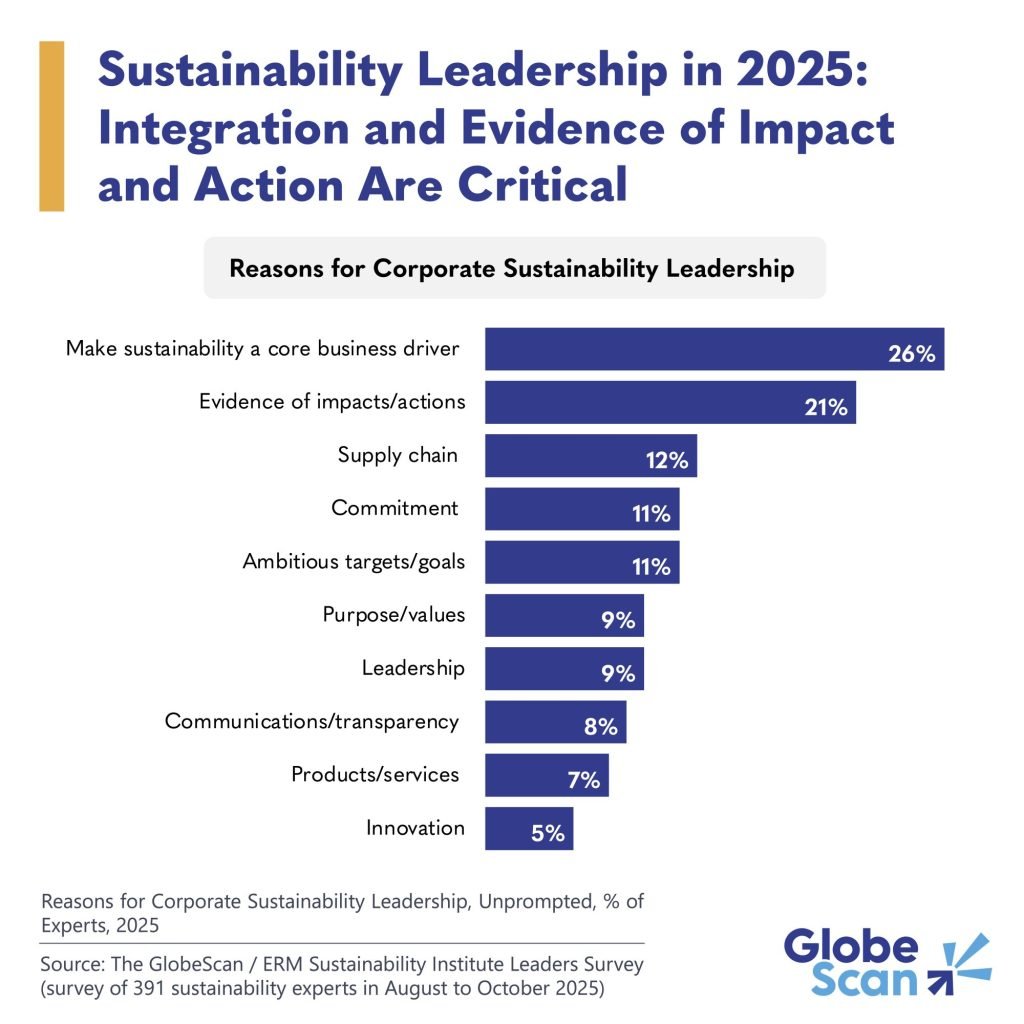
New research from nearly 400 global sustainability experts show the biggest driver of corporate sustainability is the ability to integrate sustainability the core business strategy and provide proof of sustainability action. To understand what drives stellar sustainability, Trellis data partner GlobeScan, along ERM, asked sustainability experts to name a company they consider a leader and to explain why. The most influential factor, cited by 26 percent of experts, was making sustainability a core business driver. Close behind, 21 percent emphasized demonstrating evidence of impacts and actions. Other key elements include: Driving sustainability across the supply chain (12 percent) Showing unwavering commitment (11 percent) Setting ambitious targets (11 percent) Aligning purpose and values (9 percent) What this means These results show that companies are expected to double down on integration and evidence, not just as best practices, but as levers to activate and demonstrate the business value of sustainability. In today’s era of backlash, greenhushing and regulatory uncertainty, making sustainability a core business driver signals resilience and relevance, while also providing measurable impacts and actions builds trust and counters skepticism. The post 2 top drivers of corporate sustainability, according to leaders appeared first on Trellis.
Digital Tails launches 3DT Automotive CPQ for RV builders

Digital Tails Group, a subsidiary of Bowmo Inc., has launched 3DT Automotive, a 3D configuration and CPQ platform for manufacturers of RVs, vans and custom campers. Digital Tails Group 3DT configurator and CPQ for camper and RV manufacturers 3DT Automotive provides a digital workflow that links real-time 3D visualization with production specifications. The company says the platform helps OEMs, custom builders and component suppliers support vehicle customization while shortening sales and engineering steps. The platform includes an interactive 3D configurator for interior and exterior layouts, modular upgrades, accessories, technical components, finishes, materials and region-specific packages. Its Smart CPQ engine applies compatibility rules, pricing logic, option dependencies and technical constraints to keep configurations manufacturable and reduce errors. 3DT Automotive is built on a modular architecture that can be deployed across product lines, regions, dealer networks and B2B channels. It can be used on websites, dealer portals, sales kiosks, mobile apps and OEM enterprise systems to provide a consistent configuration and quoting experience. A key feature of 3DT Automotive is the automatic generation of production-ready bills of materials, build sheets and technical specifications that work with ERP, PLM, CAD and MES systems. The company said this reduces manual engineering and data re-entry, which can shorten lead times, reduce production bottlenecks and lower the risk of order errors in custom vehicle manufacturing. Value for van and camper manufacturers Shortens quoting and engineering timelines Provides photorealistic visualization for reviewing configurations Uses option logic to flag incompatible configurations Supports updates for new trims, regional variations and custom layouts Connects sales, engineering and production in one workflow Industry impact Digital Tails Group said 3DT Automotive is intended to support the growing custom RV market, where vehicles often include many options and require more engineering input. The platform is designed to digitize and automate the configuration-to-production process so manufacturers can manage higher levels of personalization while keeping workflows consistent. Full platform overview: The post Digital Tails launches 3DT Automotive CPQ for RV builders appeared first on Engineering.com.
Segway Christmas Holiday Sale drops EV prices by hundreds to lows from $150, EcoFlow expansion battery flash sale, more

We’re ending this week’s Green Deals with a mix of new holiday events alongside ongoing Black Friday/Cyber Monday deals, headlined by Segway’s Christmas Holiday Sale that gives you hundreds in savings on popular EVs, like the ZT3 Pro All-Terrain Electric Scooter back at its $850 low, among many others. There’s also EcoFlow’s latest Cyber Week flash sale (ending tonight) that gives you up to 62% savings on an expanded DELTA 2 Max Power Station bundle and three battery bundles – at new lows starting from $329, as well as Ride1Up’s extended Cyber Monday Sale (lasting through the weekend) with up to $600 savings on an expanded lineup of e-bikes and extra batteries starting from $195, and much more waiting for you below. And don’t forget about the hangover deals from the holiday event and this week that are collected together in our Black Friday/Cyber Monday Green Deals hub, which we have updated over the week, like yesterday’s EcoFlow RAPID + 25W MagSafe Christmas promotional deals, the new low price on Anker’s SOLIX C300 DC 90,000mAh power station (ending tonight), and more. Head below for other New Green Deals we’ve found today and, of course, Electrek’s best EV buying and leasing deals. Also, check out the new Electrek Tesla Shop for the best deals on Tesla accessories. more…
onsemi launches advanced cooling package for power MOSFETs to boost efficiency in EVs

onsemi has released its EliteSiC metal-oxide semiconductor field-effect transistors (MOSFETs) in the industry-standard T2PAK top-cool package, targeting improved thermal performance and design flexibility for EVs, solar infrastructure and energy storage systems. The new offering combines onsemi’s silicon carbide technology with top-cool packaging. The initial lineup features 650-volt and 950-volt EliteSiC MOSFETs housed in T2PAK packaging. These devices prioritize thermal efficiency by channeling heat directly into the system’s heatsink, bypassing the printed circuit board’s thermal limitations. According to onsemi, this enables superior thermal performance, higher power density, compact system design, and reduced operating temperatures—all critical factors for engineers designing next-generation EV powertrains, on-board chargers and high-density inverters. The T2PAK top-cool package is designed to directly couple the MOSFET to the application’s heatsink, minimizing junction-to-heatsink thermal resistance. The initial range supports Rds(on) options from 12 milliohms to 60 milliohms, offering flexibility for power electronics design. The approach also helps maintain low stray inductance, supporting fast switching speeds and reduced energy loss. For EV applications, onsemi highlights benefits such as extended system lifetime due to lower component stress, simplified design for faster time to market, and improved performance for high-density systems. “Thermal management is one of the most critical challenges facing power systems designers in automotive and industrial markets today,” said Auggie Djekic, Vice President and Head of SiC Division at onsemi. “With our EliteSiC technology and the innovative T2PAK top-cool package, customers can unlock superior thermal performance and design flexibility, empowering them to create next-generation products that stand out in today’s competitive landscape.” Source: onsemi Topics: onsemi, Power Electronics