IonicRE to produce rare earths from magnet recycling with US Strategic Metals

Australia-based Ionic Rare Earths has signed an agreement with US Strategic Metals (USSM) to develop vertically-integrated rare earth production from recycling at USSM’s 1,800-acre (728.4-hectare) fully permitted site in Missouri. IonicRE will provide its subsidiary Ionic Technologies’ patented rare earth permanent magnet recycling technology to develop commercial recycling capacity for neodymium iron boron and samarium cobalt. The Missouri recycling facility is expected to produce neodymium and praseodymium as well as heavy rare earths including dysprosium, terbium, samarium, gadolinium and holmium. The companies will also evaluate other heavy rare earth recycling opportunities within the US. The initial agreement focuses on producing high-purity, separated magnet rare earth oxides (REOs) in the US, and the cooperation will potentially expand in the future to include a range of magnet and heavy rare earths from strategically sourced mixed rare earth carbonate (MREC), the companies said. The partnership supports the United States-Australia Framework for Securing of Supply in the Mining and Processing of Critical Minerals and Rare Earths the two countries signed in October 2025, which is aimed at delivering a US-Australia secured supply chain for critical minerals and rare earths. “Magnet recycling is the fastest and lowest-cost pathway to developing an ex-China rare earth supply chain in the United States. IonicRE is leading this charge in this area, and we now look to replicate the capability we have demonstrated in the UK now in the US to provide a key strategic supply of magnet and heavy rare earths into the US supply chain,” said Tim Harrison, IonicRE’s Managing Director. Source: Ionic Rare Earths
Tesla targets production increase at Giga Berlin in 2026

Tesla is looking positively toward 2026 with plans for further growth at its Grünheide factory in Germany, following steady quarterly increases throughout 2025. Plant manager André Thierig confirmed the facility’s stable outlook to the Deutsche Presse-Agentur (DPA), noting that Giga Berlin implemented no layoffs or shutdowns despite challenging market conditions. Giga Berlin’s steady progress Thierig stated that Giga Berlin’s production actually rose in every quarter of 2025 as planned, stating: “This gives us a positive outlook for the new year, and we expect further growth.” The factory currently supplies over 30 markets, with Canada recently being added due to cost advantages. Giga Berlin’s expansion is still underway, with the first partial approval for capacity growth being secured. Preparations for a second partial approval are underway, though the implementation of more production capacity would still depend on decisions from Tesla’s US leadership. Over the year, updates to Giga Berlin’s infrastructure were also initiated. These include the relocation of the Fangschleuse train station and the construction of a new road. Tesla is also planning to start battery cell production in Germany starting 2027, targeting up to 8 GWh annually. GOOD NEWS TESLA TARGETS PRODUCTION INCREASE AT GIGAFACTORY BERLIN IN 2026 According to the Plant Manager André Thierig, plans to expand the German factory are continuing The company has already received the first partial approval for expanding production capacities… pic.twitter.com/QpzIE6Slwc — Ming (@tslaming) December 31, 2025 Resilience amid market challenges Despite a 48% drop in German registrations, Tesla maintained Giga Berlin’s stability. Thierig highlighted this, stating that “We were able to secure jobs here and were never affected by production shutdowns or job cuts like other industrial sites in Germany.” Thierig also spoke positively towards the German government’s plans to support households, especially those with low and middle incomes, in the purchase and leasing of electric vehicles this 2026. “In our opinion, it is important that the announcement is implemented very quickly so that consumers really know exactly what is coming and when,” the Giga Berlin manager noted. Giga Berlin currently employs around 11,000 workers, and it produces about 5,000 Model Y vehicles per week, as noted in an Ecomento report. The facility produces the Model Y Premium variants, the Model Y Standard, and the Model Y Performance. The post Tesla targets production increase at Giga Berlin in 2026 appeared first on TESLARATI.
How companies can thrive amid sustainability packaging uncertainty

The opinions expressed here by Trellis expert contributors are their own, not those of Trellis. It’s no surprise that 2025 has been a year of fluctuation for corporate sustainability. The era of “by 2025” commitments is coming to an end, without clear consensus on what will come next. And for sustainable packaging, the shifting winds of state-by-state Extended Producer Responsibility (EPR) laws paired with a stalled global plastics treaty have left many wondering what exactly it will take to keep up, let alone get ahead. Uncertainty: A large roadblock for sustainable packaging The list of unknowns for the packaging industry is long. Looming largest on the horizon is the EU’s comprehensive and ambitious packaging law, the Packaging and Packaging Waste Regulation (PPWR). The PPWR will standardize EPR (policies that shift the cost of material recovery from consumers to producers) and its fees, recyclability, recycled content, material minimization (also known as source reduction) and conformity with design guidance. Although the first legally binding PPWR measures are set to go online in August 2026, many companies doubt this will happen without major compliance shifts or evolving targets for sustainable packaging, and a “wait-and-see” mindset is taking hold. In the U.S., the seven states with EPR laws for packaging are all in varying stages of rulemaking and early implementation. It remains unclear how significant the required fees will be, whether these laws will face legal challenges and whether states will succeed in harmonizing their targets and requirements. And regardless of geography, everyone is grappling with questions about the performance capabilities of materials such as bioplastics or paper options, the cost of recycled content, the stability of recycling end markets and which materials, ultimately, are “better.” Navigating future unknowns What are leading global companies doing in the face of all this uncertainty? At the Sustainable Packaging Summit in November, Europe’s largest sustainable packaging conference, they showed they’re taking clear positions — building robust, comprehensive strategies that move them closer to their circularity objectives. Take Mars, with its large portfolio of pet food in currently unrecyclable plastic packaging. Under the PPWR, state EPR laws and possible global plastics restrictions, the challenges with recyclability in their portfolio are a clear liability. That’s why the global giant has taken a leading role working towards better collection of plastic with initiatives such as the U.S. Flexible Film Initiative, the Sustainability Investment Fund, and the Flexible Plastic Fund, to advance the collection and circularity of packaging across the U.K. Through these efforts, the company is walking the walk — investing in a future where flexible plastic packaging and films are widely recycled. Avery Dennison, a global materials science and manufacturing company specializing in labels, RFID solutions and tapes, is also taking proactive steps to be an industry leader in sustainable packaging. Its sustainably optimized labels are key to improving the quality of recycled plastics. That’s because when labels such as Avery Dennison’s “cleanly” separate from packaging during normal recycling processes, they reduce contamination and ensure that recycled packaging materials make it to their next life. Additionally, the company’s other packaging technologies enable reusable packaging solutions by ensuring packaging and labels either separate cleanly or stay intact through dozens of washes. 3 things your organization can do What can other companies learn from these efforts? Both Mars and Avery Dennison are addressing the uncertainty head-on, driving the innovation and infrastructure solutions they’ll need to navigate the next decade of packaging sustainability. Here’s how others can start to do the same: Calculate the risk of the status quo: While analysis paralysis can trap organizations in their current position, doing nothing can actually be the riskiest choice of all. Consider the costs to your business if nothing changes. For example, what it would mean financially if your flexible film packaging continues to go uncollected and unrecycled and is ultimately prohibited from sale in several U.S. states or even across the entire EU? With the risks clearly outlined, failing to take major action becomes increasingly untenable. Make packaging a board-level discussion: With calculated risks in hand, it’s time to bring these costs to the highest level of relevant leadership within your organization. Packaging is no longer just an environmental issue and EPR laws are overhauling business as usual. A board of directors or C-suite leaders needs to understand the EPR fees they’ll pay for their packaging portfolios, see the size of opportunity to cut fees by moving towards different materials and talk through the short-term challenge of unstable recycling markets or higher recycled content costs. Set your own certainty: Perhaps the most powerful way to move through external uncertainty is to commit fully to a path forward that sets you up for success, no matter the variables. Start by assuming that all packaging regulations will remain as strict as, if not stricter than, they’re written today. Plan for a significant ratcheting-up of packaging fees, particularly for difficult-to-recycle packaging, as well as penalties for inaction or compliance. Assume a sizable investment in recycling infrastructure will be needed, and that your company will be part of the group paying for it. By setting your own certainty, you’ll be building a strategy that puts you in the driver’s seat. Uncertainty cast a shadow over the sustainable packaging landscape of 2025. Yet the smartest global companies are dropping the wait-and-see approach for an anticipate-and-act strategy, building new business models, material innovations and infrastructure solutions. The post How companies can thrive amid sustainability packaging uncertainty appeared first on Trellis.
Mitigating the Hidden Costs of Semiconductor Obsolescence
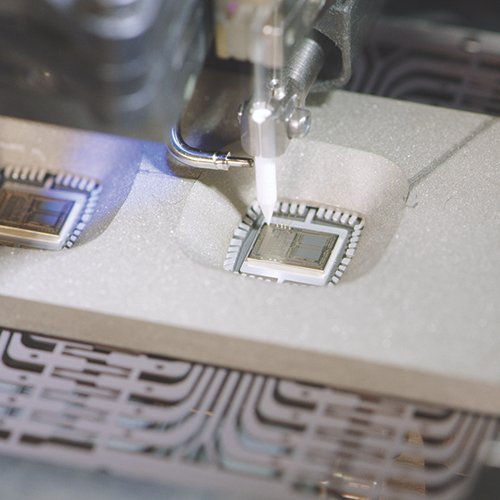
Navigating Manufacturing Challenges By Dan Deisz, Rochester Electronics’ Vice President, Design Technology There are many factors in any semiconductor product “puzzle” that can lead to obsolescence. These pieces range from business revenue to subcomponents of semiconductor products, including foundry process technologies, packages, substrates, lead frames, test platforms, and design resources. The puzzle pieces often include any given semiconductor company’s overall corporate or market focus. Market foci may change over time for a semiconductor company, even while a long-term system company, such as a customer, may not alter its product focus. Given the long-term availability risks inherent in any product selection, the part numbers offered by original component manufacturers extend well beyond the bill of materials (BOM) health reports provided by commercially available tools. How does the manufacturing supply chain impact long-term product availability? Most older semiconductor products are assembled in leadframe packages, such as DIP, PLCC, QFP, and PGA. However, the semiconductor market has shifted from leadframe packages as the primary volume driver to substrate-based assemblies. Why did the industry move away from lead frame assemblies? To fully understand why lead frame assemblies are disappearing, it is important to address the history of assembly locations, profit margins, and the move toward ever-increasing performance. Assembly offshoring started happening in earnest during the 1980s. This was before TSMC’s dominance in foundry technologies. Costs and environmental restrictions primarily drove offshore assembly, as 1980s assembly processes were less environmentally clean than those of today. The push for higher profit margins gradually eliminated numerous leadframe suppliers from the market, leaving only the largest suppliers profitable. Profit margins on lead frames were reduced to single digits, whereas most semiconductor companies’ margins trended toward 50%. Lead frame volumes peaked in the 1990s and early 2000s, concurrent with the push toward high-speed IO and the invention of BGA assembly. High-speed I/O protocols, such as PCI Express, multi-gigabit Ethernet, SATA, SAS, sRIO, and others, have demonstrated that wire bonds limit performance. The IO standards and other new standards coming online had performance roadmaps that wire bonds would never have met. As device speeds increased significantly, so did their power.A wire bond distributes power from the chip’s exterior to the core. For higher-performance products becoming available in the 1990s, supplying power to the device from outside the die was insufficient. Flip-chip and BGAs with substrates alleviated the power distribution challenge by delivering power directly to the core and eliminating bond wires, thereby improving signal integrity for high-speed SerDes standards. As leadframe assemblies declined in the early 2000s, QFN assemblies emerged for lower-pin-count packages. QFNs are substrate-based assemblies that primarily use wire bonds in high-volume production. Today, leadframe assemblies are produced in far lower volumes than substrate-based assemblies. The highest cost of installing lead frame assemblies is the trim-and-form tooling. As the volume of lead frames has diminished, the cost of replacing leadframe trim and form tooling, coupled with the single-digit profit margins of offshore suppliers, has put enormous pressure to move away from lead frame assemblies altogether. The industry moved away from lead frame assemblies because technology performance demanded zero wire bonds, and the costs of continuing to produce lower-volume lead frame assemblies were prohibitive. Once an assembly solution is in place, a test solution must also be viable. Consider the same trends in tester technology that enable the transition to substrate assembly testing, where disconnects may result in obsolescence. The newest handlers for production Test are primarily geared toward substrate-based assemblies. Efforts to reduce costs for volume production are currently based solely on substrate assemblies. Test for lower volume production at an OSAT location is less feasible as volumes diminish, especially if that product is lead frame-based. Assuming wafer availability, what if a company acquired an existing OSAT supply chain to continue providing the same semiconductor product? This is what Rochester Electronics believes is a short-term solution. Recall the manufacturing puzzle pieces we have examined, from lead frames and assembly to testing. If any link in the OSAT chain is deemed economically infeasible, an obsolescence event is expected. The risk of obsolescence increases because any company supporting the OSAT supply chain cannot drive product volume as the original semiconductor company would have. Therefore, that company cannot leverage the same level of product continuation. In the short term, OSAT chain management can keep a product in production, but it is not typically viable in the long term. Partnering with a licensed semiconductor manufacturer, such as Rochester Electronics, can mitigate the risks of component EOL. A licensed manufacturer can produce devices no longer supplied by the OCM. When a component is discontinued, the remaining wafer and die, the assembly processes, and the original test IP, are transferred to the licensed manufacturer by the OCM. This means that previously discontinued components remain available, are newly manufactured, and fully comply with the original specifications. No additional qualifications are required, nor are any software changes. Find out more: www.rocelec.com Learn more about Rochester’s manufacturing service solutions Watch to learn more about Rochester’s manufacturing capabilities Sponsored Content by Rochester Electronics The post Mitigating the Hidden Costs of Semiconductor Obsolescence appeared first on Engineering.com.
Dodge dealers don’t need a new Charger — they need a new Caravan
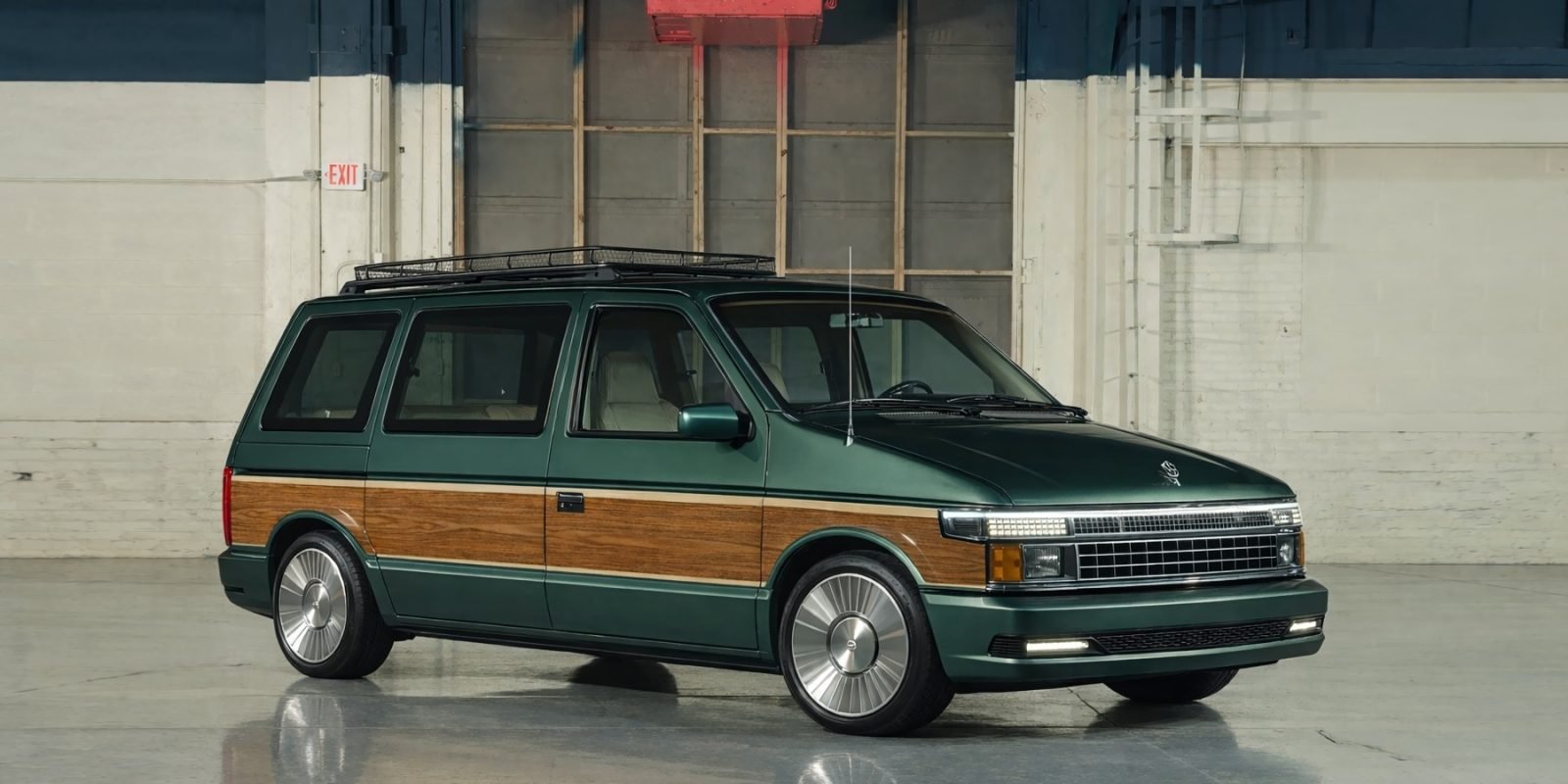
If the market failures of the Dodge Charger Daytona and VW ID.Buzz have proved anything at all, it’s that the Baby Boomer era is over, and their kids — GenX and Millenials alike — aren’t willing to pay a premium for a vehicle that looks like something their dad once thought was cool. As GenX becomes the largest and richest new car-buying demographic, manufacturers need to find out what they are nostalgic about. To that end, I propose the following nostalgia play: the “Goonies Never Say Die” edition 2027 Dodge Caravan BEV. more…
EVE Energy partners with Green Whale to accelerate marine battery adoption

Chinese battery supplier EVE Energy and Green Whale Technology (GWT) have signed a strategic partnership agreement to provide marine battery energy storage systems (BESS) and service to customers worldwide. The collaboration combines EVE Energy’s lithium marine battery system technology and GWT’s marine engineering, lifecycle service and commissioning expertise. The strategic agreement is structured as a back-to-back partnership to ensure EVE Energy provides comprehensive support, the companies said. EVE Energy and GWT are actively expanding their presence in the tanker, container, public transport, heavy lift, port, offshore, aquaculture, short sea shipping and yachting markets. They are currently developing a new battery product based on two new types of battery cells, which is expected to come into the market in 2026. The companies have already delivered a BV-class marine battery container in Asia. While the high C-rate maritime battery market has been dominated by nickel manganese cobalt (NMC) cell-based systems, EVE supplies LFP marine batteries, which can offer a longer lifetime than NMC-based systems in many application scenarios. EVE’s active balancing technology enables the systems to deliver a lifetime of up to 15 years, reducing total cost of ownership. To support customers globally, Green Whale Technology is establishing a Netherlands-based cloud service platform for local data compliance, digital security and mitigating geopolitical risks. Spare parts storage in Norway and the Netherlands will allow it to provide timely after-sales support in Europe. EVE Energy’s BESS factory has the capacity to produce over 10 MWh per day to ensure scalability and timely delivery. The marine battery system is priced below $300 per kWh. “By collaborating on all the key elements in BESS development, manufacturing, delivery and service, we aim to ensure that customers receive the best available battery technology, backed by global support throughout the product lifecycle of our systems. We are very proud that we can now extend the system’s lifetime to 15 years with an experienced local service provider, GWT, and look forward to seeing them deployed in the maritime markets,” Yong Cong Xiong, EVE Energy’s Head of Marine & Port. Source: Green Whale Technology
What Amazon, Disney and Netflix learned about ditching diesel generators
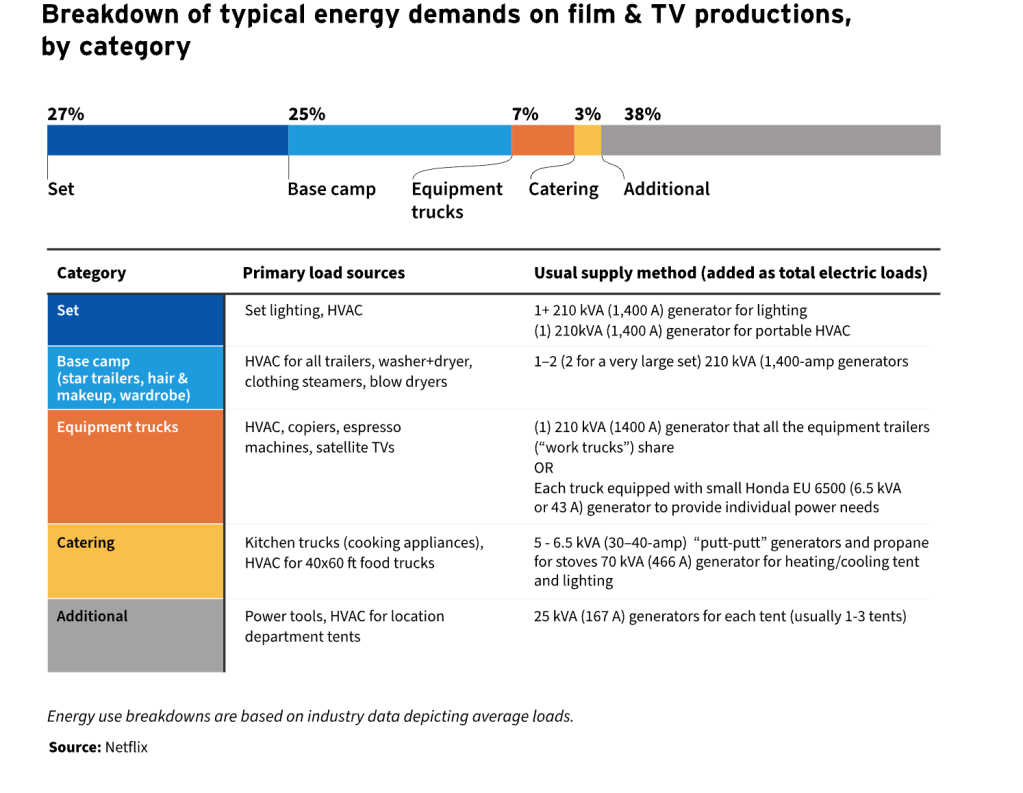
When Amazon’s MGM Studios filmed the second season of the Prime Video series “Fallout,” it substituted the diesel generators traditionally used to electrify movie and television productions with a network of solar-powered trailers. The technology, Solar Ring, from GreenLite Trailers, provided 4,952 kilowatt-hours of electricity to 14 trailers in the production’s central basecamp over a 20-week trial. Elsewhere in the U.K., Amazon uses hydrogen fuel technology to charge mobile batteries on sets, reducing the need for diesel generators in places where the Solar Ring wouldn’t make sense. “Film productions can’t plug all of their lights and equipment into house power if they are filming in the middle of a city, and we film in areas that have no power whatsoever, so we basically bring our own little power plants everywhere we go,” said Katherine Braver, global production sustainability project manager at Amazon, in a blog about the “Fallout” pilot. “Historically, these power plants are diesel-running generators.” The heavy weight of diesel Diesel generators are typically the heaviest emission source on studio production sets, contributing an estimated 15 percent of a production’s carbon footprint, according to estimates by major studios. These generators support a wide range of on-set equipment including cameras and lights, sound stages, catering and base camp operations. Amazon, Disney and Netflix are all piloting alternatives that produce less emissions and local air pollutants. Many of the technologies are also quieter, which means they can be placed closer to production sets and aren’t as disruptive in locations where many people live or do business. Amazon uses an internal research and development fund and plans future investments through its climate-tech financing arm, while Disney and Netflix co-sponsored a two-year-long accelerator program called the Clean Mobile Power Initiative that covered 10 startups that received investments from Third Derivative, which backs early-stage climate-tech entrepreneurs. Amazon didn’t disclose how much the Solar Ring system cut production emissions for “Fallout” through its recent trial. Netflix uses clean mobile power on all productions under its direct control — although not necessarily to power all operations; in 2024, the company cut its generator fuel by 20 percent on half of its productions. Disney doesn’t break its progress out as specifically, but says it has reduced emissions from its operations and energy use by 38 percent since 2019. While the applications that these companies are testing are specific to Hollywood, the technologies are all suitable for other industries that rely heavily on diesel generators: live events; construction and disaster relief; islanded microgrids; and commercial building backup power, particularly for data centers and hospitals, which often have reliability requirements to meet. “We’ve validated that this technology can be dropped pretty much everywhere,” said Caroline Winslow, manager of clean energy technology at Third Derivative. “It’s not a matter of will this work, it’s the use case for the technology.” Hone’s hydrogen technology was specifically developed for movie and television production.Source: Clean Mobile Power Initiative Big lesson: Solar alone doesn’t cut it The mission of the Clean Mobile Power Initiative was to test portable energy storage systems: small enough to fit into a 9-foot-by-18-foot parking space and capable of providing 140-220 kilowatts of three-phase power for up to 14 hours. Often these systems are powered by solar panels, but that’s not feasible in every location. In some places, for example, they’re hooked up to a centralized grid for recharging or even connected to diesel generators. “Our belief is that there is not a single solution,” Winslow said. The 10 participating companies sell a mix of lithium-ion battery energy storage and hydrogen-fueled equipment: Allye, Ampd Energy, Electric Fish, H2 Portable Power, Hone, Instagrid, Joule Case, Lex Products, RIC Electronics and Sesame Solar. Most of these companies aren’t specifically focused on Hollywood. Battery energy storage systems were the most cost-effective alternative to diesel generators studied by Disney and Netflix, according to an RMI analysis outlining the findings of their tests. On the other hand, hydrogen units allow for batteries to be recharged more quickly. For context, power and utility bills represent about 0.8 percent of a typical film or TV production’s total budget. The Clean Mobile Power Initiative estimates that if solar and batteries were used instead, it would boost that budget by 2.4 percent; if hydrogen systems are used, it would result in a 3.2 percent increase. Amazon, Disney and Netflix don’t typically own the power equipment on production sets: it’s generally provided by rental companies such as MBS Group, Sunbelt Rentals and Quixote by Sunset Studios, all of which participated in the Clean Mobile Power Initiative. If clean mobile power is to become a reality, studios must establish procurement policies and financial incentives that convince rental companies and equipment suppliers to invest in more clean power units, Winslow said. For example, if a studio would agree to rent a particular piece of equipment over several years rather than just for a single production — similar to the purchase agreements many corporations sign for renewable power — it would help lower the risk of a rental company’s investment. Special insurance policies are also needed to cover the equipment in case performance issues arise, the RMI analysis notes. “We are hearing more and more from the studios that we worked with, and adjacent ones, that there is a demand for more of this power,” Winslow said. “We need alignment on this message, not only across studios but also with the suppliers that are the asset owners.” The post What Amazon, Disney and Netflix learned about ditching diesel generators appeared first on Trellis.
Doosan to showcase AI-era energy and automation at CES 2026
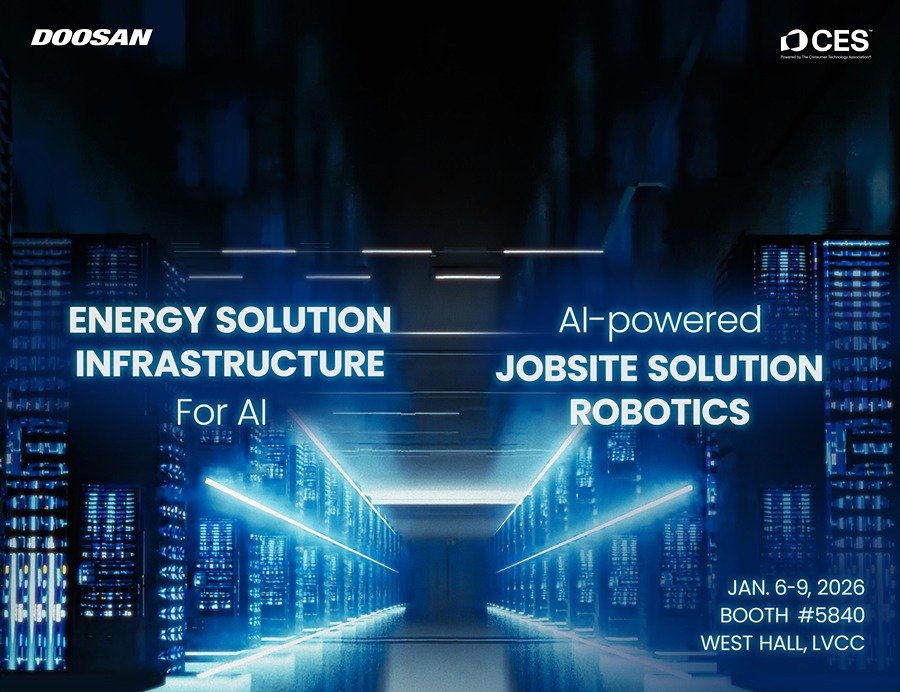
Doosan Group announced its participation in CES 2026 (West Hall, Booth 5840), where it will present a renewed portfolio of technologies advancing clean energy, jobsite automation and intelligent machine innovation designed to meet the demands of the AI era. This year’s exhibit will showcase forward-looking solutions from Doosan’s various business units, highlighting the Group’s commitment to supporting the rapid growth of AI-driven industries – from energy solutions and electro-materials for AI data centers to AI-powered innovations that enable safer and more efficient jobsites. CES 2026: Doosan to unveil energy solutions essential for AI infrastructure and AI-integrated autonomous worksite innovations. At CES 2026, visitors will experience how the Group’s technologies come together to deliver end-to-end energy solutions for data centers in the AI era, while interacting with innovations redefining the future of worksite operations. These technologies represent the company’s continued investment in delivering real-world applications that empower industries and infrastructure. Doosan exhibit highlights Doosan Enerbility: Doosan Enerbility, strengthening its presence in the global energy market after recently securing its first gas turbine contract in the United States, will showcase its latest breakthroughs in energy and power for cleaner, more scalable, and more efficient solutions engineered for the demands of the AI era. At the booth, Doosan Enerbility will present comprehensive solutions adaptable to any energy requirements. Visitors will also have a chance to learn about the company’s advancements in gas turbines and small modular reactors (SMRs) designed to meet the power needs of AI data centers. HyAxiom: HyAxiom, specializing in fuel cells, returns to CES to demonstrate its global leadership in advancing zero-emission technologies for future generations, as well as modular and scalable power solutions for AI data centers and microgrids. At the Doosan booth, HyAxiom will present its latest hydrogen and phosphoric acid fuel cell (PAFC) innovations, including the PureCell M400, HyAxiom PAFC 10MW Power Block, and HyAxiom Trailer-Mounted Application. The showcase will also highlight major company milestones, such as operating the world’s largest hydrogen-input fuel cell power plant and delivering the United States’ first multi-megawatt, multi-story fuel cell installation. Doosan Bobcat: Doosan Bobcat will showcase next-generation operator experiences and unveil groundbreaking technologies that bring AI out of the cloud and directly onto the jobsite. These innovations deliver real-time guidance, simplify complex tasks, and enhance precision, making operation easier for the next generation of workers while helping experienced operators boost productivity. Bobcat will reveal its newest concept machine and advanced technologies during its CES Media Days press conference on Jan. 5 at 2 p.m. PT in MandalayBay I. Doosan Robotics: Visitors will see firsthand how Doosan Robotics’ newest innovations are advancing automation across the aerospace, construction, and automotive sectors. The company will showcase its Scan & Go AI Robotics Solution, recently named a “Best of Innovation” winner in Artificial Intelligence and an honoree in Robotics. Developed in partnership with Maple Advanced Robotics Inc. (MARI), Scan & Go is the world’s first unmanned AI system designed for large-scale composite repairs, including aircraft fuselages, wind turbine blades, and architectural façades. Additional live demonstrations will feature AI-powered depalletizing solution with GPU-accelerated real-time obstacle avoidance and path planning. Doosan Corporation Electro-Materials BG: Doosan Corporation Electro-Materials BG will showcase its high-speed copper clad laminate (CCL) solutions for AI accelerators used in data centers. CCL is the core material that forms the multilayer PCB structure inside AI accelerators and plays a critical role in ensuring signal integrity and performance stability. With excellent dielectric performance and high reliability, Doosan’s CCL enables the stable transmission of ultra-high-speed signals required for next-generation computing. Doosan’s full CES 2026 showcase is January 6-9 during show hours, located in the West Hall – Booth 5840 where visitors can experience hands-on demonstrations, product previews, and expert-led presentations. For more information, visit doosan.com. The post Doosan to showcase AI-era energy and automation at CES 2026 appeared first on Engineering.com.
Elon Musk’s top 5 Tesla predictions for 2025 that didn’t happen

Another year has passed, and with it, another collection of Elon Musk’s ambitious timelines that didn’t quite align with reality. For those of us who have been following Tesla for years, this pattern is all too familiar. 2025 was billed as a year of massive expansion, widespread autonomy, and humanoid robots. Now that the year is pretty much in the rearview mirror, let’s take a look at Musk’s top 5 Tesla predictions that missed the mark. more…
Schaeffler to show multiple electric powertrain innovations at CES 2026

Schaeffler, The Motion Technology Company, will showcase a number of new technologies related to software-defined vehicles, automated driving, magnet-free systems that eliminate rare earth minerals, and modular powertrain solutions at CES 2026 in Las Vegas in January. Among the innovations Schaeffler will be presenting: A reimagined Master and Zone Controller architecture, including the High Performance Master Control Unit (HP MCU), which incorporates a microcontroller and microprocessor to support secure cross-system communication, and Zone Controllers, which are embedded within defined vehicle zones. Schaeffler’s HP Master Control Unit (MCU) Generation 4 and 5 DC/DC Converters, which transform high-voltage battery power to supply low-voltage networks. Generation 4 offers 3.6 kW of power, redundancy for two-phase operation, and compliance with EMC and AUTOSAR standards. Generation 5 provides scalable 3.7 kW DC/DC power with flexible 400- to 800-volt input and 12- to 48-volt output in a compact package that weighs less than 2 kg. Integrated modules for EV and hybrid platforms, including the SuperBox 4in1, a compact 800-volt power electronics solution that integrates the inverter, onboard charger, high-voltage DC boost and auxiliary modules (48 V/12 V). Battery packs that encompass not only mechanical structures and battery cells, but also control systems, thermal management systems and system integration. Innovations include lightweight battery housings, new cooling systems to maintain optimal operating temperatures, and sensor technologies for monitoring battery condition and safety. Steering and traction drive modules integrated for EV platforms—these combine motors, gear trains, active cooling and safety systems into a compact, unified solution. “Schaeffler’s presence at CES this year reflects how rapidly we are advancing the technologies required for the next generation of software-defined and electrified vehicles,” said Jeff Hemphill, Chief Technology Officer, Schaeffler Americas. “By combining our expanded software capabilities with integrated motion, energy and control systems, we are creating architectures that reduce system complexity, enable real-time control, and eliminate dependencies on rare earth materials.” Source: Schaeffler
Tesla shares epic 2025 recap video, confirms start of Cybercab production

Tesla has released an epic year-in-review video for 2025, recapping some of its major achievements from refreshed models to autonomy breakthroughs and production ramps. The cinematic montage, posted by the official Tesla account on X, celebrated the company’s progress in EVs, energy, and Robotaxi development while looking ahead to an even bigger 2026. Tesla’s 2025 highlights recap Tesla has had a busy 2025, as highlighted in the recap video. The video opened with Elon Musk explaining the company’s pursuit of sustainable abundance. A number of milestones were then highlighted, such as the rollout of FSD v14, Optimus’ numerous demos, the opening of the Tesla Diner in Hollywood, LA, the completion of the world’s first autonomous car delivery, and the launch of the Robotaxi network in Austin and the San Francisco Bay Area. Tesla also highlighted several of its accomplishments over the year. As per the company, the Model Y was the year’s best-selling vehicle globally again, and Teslas became more affordable than ever thanks to the Model 3 and Model Y Standard. Other key models were also rolled out, such as the refreshed Model S and X, as well as the new Model Y, the new Model Y Performance, and the six-seat, extended wheelbase Model Y L. The Megablock was also unveiled during the year, and the Supercharger Network grew by 18%. Over 1 million Powerwalls were also installed during the year, and the Cybertruck became the first EV truck to get both an IIHS Top Safety Pick+ award and an NHTSA 5-Star safety rating. Tesla 2025 recapSee y’all in 2026 – the best is yet to come pic.twitter.com/9j1IpMNfuV — Tesla (@Tesla) December 30, 2025 Cybercab production confirmed Interestingly enough, Tesla also confirmed in its 2025 recap video that the production of the Cybercab has started. This bodes well for the vehicle, as it could result in the vehicle really being mass-produced in the first half of 2026. Elon Musk confirmed during the 2025 Annual Shareholder Meeting that Cybercab production should earnestly start around April 2026. Musk has also noted that the Cybercab will be Tesla’s highest-volume vehicle yet, with the company aiming for an annual production rate of about 2 million units. “If you’ve seen the design of the Cybercab line, it doesn’t look like a normal car manufacturing line,” Musk said earlier this year. “It looks like a really high-speed consumer electronics line. In fact, the line will move so fast that actually people can’t even get close to it.” The post Tesla shares epic 2025 recap video, confirms start of Cybercab production appeared first on TESLARATI.
Tesla China delivery centers look packed as 2025 comes to a close

Tesla’s delivery centers in China seem to be absolutely packed as the final days of 2025 wind down, with photos on social media showing delivery locations being filled wall-to-wall with vehicles waiting for their new owners. Needless to say, it appears that Tesla China seems intent on ending 2025 on a strong note. Full delivery center hints at year-end demand surge A recent image from a Chinese delivery center posted by industry watcher @Tslachan on X revealed rows upon rows of freshly prepared Model Y and Model 3 units, some of which were adorned with red bows and teddy bears. Some customers also seem to be looking over their vehicles with Tesla delivery staff. The images hint at a strong year-end push to clear inventory and deliver as many vehicles as possible. Interestingly enough, several Model Y L vehicles could be seen in the photos, hinting at the demand for the extended wheelbase-six seat variant of the best-selling all-electric crossover. Tesla China's end-of-quarter delivery is still in the works! pic.twitter.com/B3YdtcqxNf — Tsla Chan (@Tslachan) December 29, 2025 $TSLA Among China's 200,000 to 300,000 yuan electric vehicles, Tesla's Model Y sold the most this year. (Jan~Nov) pic.twitter.com/eeLd5jh8Sp — Tsla Chan (@Tslachan) December 27, 2025 Strong demand in China Consumer demand for the Model Y and Model 3 in China seems to be quite notable. This could be inferred from the estimated delivery dates for the Model 3 and Model Y, which have been extended to February 2026 for several variants. Apart from this, the Model Y and Model 3 also continue to rank well in China’s premium EV segment. From January to November alone, the Model Y took China’s number one spot in the RMB 200,000-RMB 300,000 segment for electric vehicles, selling 359,463 units. The Model 3 sedan took third place, selling 172,392. This is quite impressive considering that both the Model Y and Model 3 are still priced at a premium compared to some of their rivals, such as the Xiaomi SU7 and YU7. With delivery centers in December being quite busy, it does seem like Tesla China will end the year on a strong note once more. The post Tesla China delivery centers look packed as 2025 comes to a close appeared first on TESLARATI.
Tesla celebrates 9 million vehicles produced globally

Tesla has achieved a new milestone, rolling out its nine millionth vehicle worldwide from Giga Shanghai. The achievement, announced by Tesla Asia on X, celebrated not just the Shanghai team’s output but the company’s cumulative production across all its factories worldwide. The milestone came as 2025 drew to a close, and it inspired praise from some of the company’s key executives. Tesla’s 9 million vehicle milestone The commemorative photo from Tesla Asia featured the Giga Shanghai team assembled on the factory floor, surrounding the milestone Model Y unit, which looked pristine in white. The image was captioned: “Our 9 millionth vehicle globally has just rolled off the production line at Giga Shanghai. Thanks to our owners and supporters around the world.” Senior Vice President of Automotive Tom Zhu praised Tesla’s factory teams for the remarkable milestone. He also shared his gratitude to Tesla owners for their support. “Congrats to all Tesla factories for this amazing milestone! Thanks to our owners for your continued support!” Zhu wrote in a post on X. Our 9 millionth vehicle globally has just rolled off the production line at Giga Shanghai Thanks to our owners and supporters around the world pic.twitter.com/D0nmZTqG62 — Tesla Asia (@Tesla_Asia) December 30, 2025 Congrats to all Tesla factories for this amazing milestone! Thanks to our owners for your continued support! https://t.co/5q5xUzktvV — LaoZhu (@tomzhu_nz) December 30, 2025 Giga Shanghai’s legacy Tesla’s nine million vehicle milestone is especially impressive considering that just 207 days ago, the company announced that it had built its eight millionth car globally. The eight millionth Tesla, a red Model Y, was built in Giga Berlin. The fact that Tesla was able to build a million cars in less than seven months is quite an accomplishment. Giga Shanghai, Tesla’s largest factory by volume, has been instrumental to the company’s overall operations, having reached four million cumulative vehicles earlier in 2025. The plant produces Model 3 and Model Y for both domestic Chinese and export markets, making it the company’s primary vehicle export hub. The post Tesla celebrates 9 million vehicles produced globally appeared first on TESLARATI.
Tesla officially publishes Q4 2025 vehicle delivery consensus
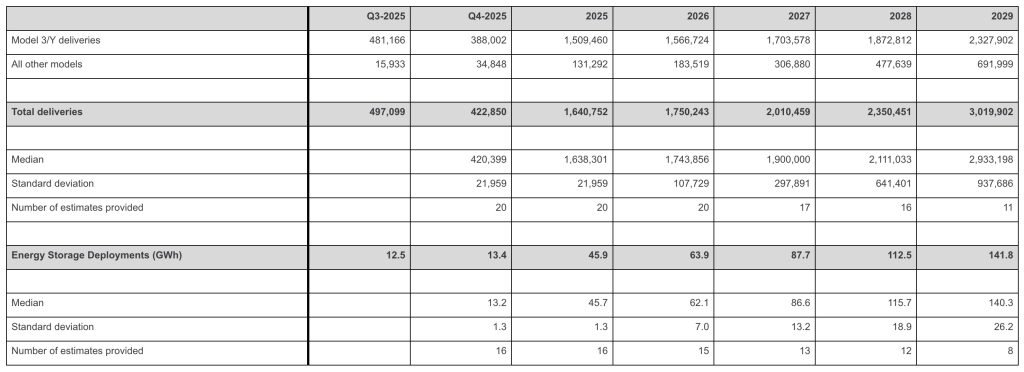
Tesla has taken the rather unusual step of officially publishing its company-compiled Q4 2025 delivery consensus on the Investor Relations site. As per analyst estimates, Tesla is expected to deliver 422,850 vehicles and deploy 13.4 GWh of battery storage systems this Q4 2025. By releasing these numbers directly, Tesla establishes a clear, transparent benchmark ahead of its actual results, making it harder for narratives to claim a “miss” based on outlier estimates. Official consensus sets the record straight Tesla’s IR press release detailed the consensus from 20 analysts for vehicle deliveries and 16 analysts for energy deployments. As per the release, full-year 2025 consensus delivery estimates come in at 1,640,752 vehicles, an 8.3% decline from 2025’s FY deliveries of 1,789,226 cars. Tesla noted that while it “does not endorse any information, recommendations or conclusions made by the analysts,” its press release does provide a notable reference point. Analysts contributing to the company compiled consensus include Daiwa, DB, Wedbush, Oppenheimer, Canaccord, Baird, Wolfe, Exane, Goldman Sachs, RBC, Evercore ISI, Barclays, Wells Fargo, Morgan Stanley, UBS, Jefferies, Needham, HSBC, Cantor Fitzgerald, and William Blair. Credit: Tesla Investor Relations Tesla’s busy Q4 2025 Tesla seems to be pushing hard to deliver as many vehicles as possible before the end of 2025, despite the company’s future seemingly being determined not by vehicle deliveries, but FSD and Optimus’ rollout and ramp. Still, reports from countries such as China are optimistic, with posts on social media hinting that Tesla’s delivery centers in the country are appearing packed as the final weeks of 2025 unfold. The Tesla Model Y and Model 3 are also still performing well in China’s premium EV segment. Based on data from January to November, the Model Y took China’s number one spot in the RMB 200,000-RMB 300,000 segment for electric vehicles, selling 359,463 units. The Model 3 sedan took third place, selling 172,392. This is quite impressive considering that both the Model Y and Model 3 command a premium compared to their domestic rivals. The post Tesla officially publishes Q4 2025 vehicle delivery consensus appeared first on TESLARATI.
From cow burps to data centers, it’s been a year

The opinions expressed here by Trellis expert contributors are their own, not those of Trellis. As managing partner of At One Ventures, I get a unique and broad perspective at how the climate venture landscape is evolving. In 2025, we made progress but didn’t move in a straight line: some long-standing technical and economic constraints finally gave way, while other parts of the system showed how easily momentum can be disrupted by market demand, price volatility and policy swings. Here are some of the lows and highs of this year in climate. For corporate sustainability professionals, these are signals of what’s to come. Lowlights Low lithium carbonate prices created headwinds for lithium battery recycling, meaning only the teams with the absolute best recycling economics can continue to compete. This drove some notable pivots and threatened to have us lose momentum in a capability we will ultimately need. Large, arbitrary tariffs were and are terrible for U.S. manufacturing. Efforts located in the U.S. were significantly harmed by chaotic trade policy. Elected officials showing almost no ability to push back to harmful policies. This is how you lose an economic race. As we approach near-perfect deepfakes, we’re entering a world where any narrative can be spoofed, adding jet fuel to an environment already rife with dangerous misinformation. Media consolidation into fewer hands that are acting progressively more carelessly to meet the 24-hour news cycle means we will be making stupid decisions faster. It was 36 degrees Fahrenheit hotter than historical highs in the arctic in February, and we had record heat wave 122 degrees Fahrenheit in South Asia in April, which put it on the verge of a major wet bulb fatality event. This event did lead to major productivity losses in the mango crop, an early example of how extreme temperatures disrupt stomata function — a mechanism that could drive major losses in the future. Bill Gates suggested that maybe climate change won’t be so bad, and we should focus on adaptation. While adaptation will absolutely be needed, this is no way to be a leader, and it will likely have some negative reverberations in the market. That said, the physics of planetary atmospheres marches on regardless of what people write or believe. It is not a field of study that is decided by passing comments from billionaires, a fact the media seems to keep forgetting based on where the coverage is focused. The lowlights of 2025 point less to failure than to fragility. The warning here is that many capabilities we will depend on, such as battery recycling, resilient supply chains, trustworthy information systems and heat-tolerant agricultural and labor practices, are being treated as optional when short-term economics or political noise turn unfavorable. Commodity price swings, trade volatility and media distortion can thwart short-term progress, but the real physical and operational needs don’t disappear when markets wobble. Letting critical sectors lapse because prices are temporarily low is not prudence; it is deferred risk. The task now is to design strategies that assume volatility rather than being derailed by it, and to invest in capabilities that remain necessary regardless of sentiment, cycles or headlines. Highlights In 2025, we were able to experimentally verify that by using asparagopsis seaweed as a feed additive, we can dramatically reduce the amount of methane a cow generates (90 to 95 percent), while substantially improving the feed conversion ratio. This means that the global reduction in enteric methane could be an actively profitable activity instead of one that needs to be regulated into practice. 2025 also saw geothermal nearing a new phase, with oil and gas majors building real expertise on how their subsurface operational skills can be used to unlock a new generation of geothermal baseload. This is in no small part due to startups that are helping to prospect and secure promising sites in less time and higher success probability. On the mobility front, BYD pulled ahead of Tesla as the largest global EV maker and is building an EV megafactory larger than the city of San Francisco. Waymo made big inroads into American cities, and real self-driving is about to transform much of mobility and transportation and supply chain infrastructure in the next decade. Data center build-outs created a mini climatetech ecosystem that supported investments in lower-power chips, decarbonized baseload, and storage for backup and generation intermittency. All the capital going into new generation and better power infrastructure should ultimately ramp U.S. ability to build, as well as lowering energy costs in the long run. Related to the data center construction boom, fission and fusion efforts received massive funding in 2025, with the reopening of a decommissioned part of Three Mile Island coming back online. While fusion efforts will challenge the classic 10-year venture fund life, substantial investment from U.S. private sector and Chinese public sector suggest that we will at least make significant advances in this cycle, regardless whether we crack the code on financeable facility-level gain. Total generation from renewables surpassed generation from coal for the first time in modern history in the first half of 2025 — a huge milestone, for which there is no reason to reverse (unless society collapses to the point where we can’t produce panels and wind turbines). Even in a year marked by slower capital flows, 2025 made clear that the underlying machinery of climate progress is still turning and there is amazing work being done. Methane abatement that pays for itself, baseload clean power that looks operationally familiar, autonomous mobility that is moving from novelty to infrastructure, and energy systems scaling to meet demand all point to where cost, reliability and emissions reduction are beginning to align. This is the moment to translate awareness into preparedness: reassessing supply chains; facilities; logistics; and workforce mobility with these shifts in mind. Every business moves people, goods or electrons. The companies that start planning now, before these technologies are fully mainstream, will have more options, lower transition risk and a clearer path through the next cycle.
HighPoint introduces Rocket 7634D PCIe Gen5 external CDFP adapter

HighPoint Technologies, Inc., a provider of PCIe storage and connectivity solutions, announced the Rocket 7634D, an independent PCIe Gen5 external CDFP adapter. Designed for external PCIe fabric deployments, the Rocket 7634D combines external CDFP CopprLink connectivity in a compact, low-profile form factor with PCIe Gen5 switching technology to support bandwidth, reliability, and interoperability needs for disaggregated computing, AI workloads, HPC, and professional media applications. Built to comply with the PCI-SIG CopprLink specification, the Rocket 7634D functions as a host interface card (HIC). It supports direct, non-blocking connections between servers or workstations and external GPUs, accelerator and I/O cards, or NVMe storage enclosures, without using tunneling or older interconnects. PCIe Gen5 performance The Rocket 7634D uses a Broadcom 89048 PCIe Gen5 switch IC to support external device expansion: 48-lane switching architecture: The Rocket 7634D manages lanes to support signal integrity and reduce contention for accelerators, NVMe storage, and data-intensive workloads. Up to 64 GB/s bi-directional throughput: The card provides up to a full x16 PCIe Gen5 link between the CopprLink device and the host platform so external devices can operate at native link speeds. CopprLink compliance and interoperability Compliance with the PCI-SIG CopprLink specification is intended to support reliability and interoperability, including: Compatibility with CopprLink-compliant devices and cables Gen5 signaling at up to 32 GT/s over the external cable connection A CDFP connector designed for compact external I/O and service access Host interface for industrial and enterprise use As a CopprLink-compliant HIC, the Rocket 7634D is positioned to connect servers to external PCIe resources such as: GPU and PCIe expansion enclosures: Dedicated Gen5 x16 connectivity for AI, simulation, and other compute workloads NVMe JBOF storage systems: Direct-attached Gen5 storage connectivity for high I/O workloads, including databases and analytics HighPoint also notes compatibility with its RocketStor 6600 Series NVMe storage enclosures and RocketStor 8000 Series GPU/compute expansion enclosures. Integration and management HighPoint describes the Rocket 7634D as designed for server deployment and OEM integration, including: A low-profile CEM form factor for space-constrained systems Firmware customization support for OEM and embedded use cases Compatibility with HighPoint RocketStor 8000 Series external GPU/compute enclosures and RocketStor 6000 Series NVMe JBOF enclosures HighPoint’s MPT (Management, Performance, and Troubleshooting) software is described as providing: Real-time health and link-status monitoring for the HIC and connected devices Troubleshooting tools for enterprise and industrial deployments For more information, visit highpoint-tech.com. The post HighPoint introduces Rocket 7634D PCIe Gen5 external CDFP adapter appeared first on Engineering.com.
Uninterruptible IPC solution for industrial automation
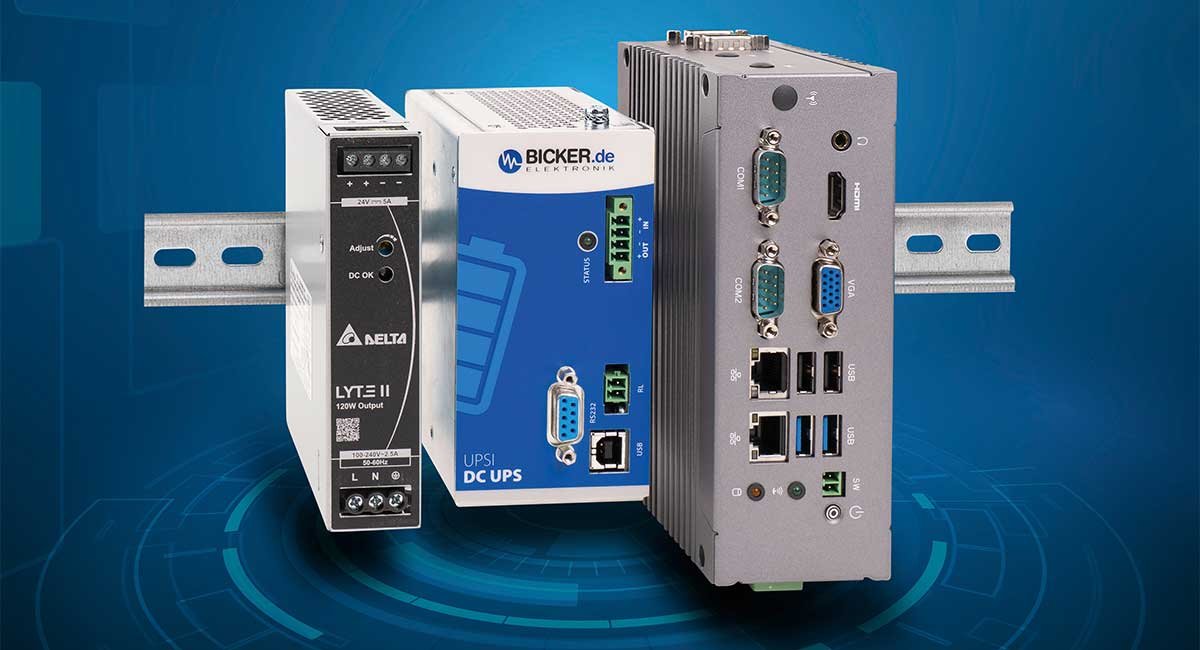
Bicker Elektronik presents a robust and fail-safe DIN rail bundle designed for control and automation tasks in industrial environments. The flexible DIN rail solution combines three perfectly matched components: the Delta DRL-24V120W1EN AC/DC power supply, the Bicker UPSI-2406DP1 DC UPS with integrated Li-ion battery pack, and the GIGAIPC QBiX-DR-EHLA6412H-A1 DIN rail industrial PC. Together, these components ensure a reliable and uninterrupted 24V DC power supply as well as high computing performance for continuous operation in harsh industrial conditions. Compact 24V power supply for control cabinets The space-saving DRL-24V120W1EN DIN rail power supply from Delta Electronics delivers 120W nominal output (24V/5A) with an efficiency of up to 91%. With a compact width of just 30mm, it saves valuable space on the DIN rail and simplifies integration into control cabinets. The wide input range of 90-264 VAC enables global use, while the operating temperature range of -40 to +70°C ensures high reliability. Comprehensive protection features against short circuit, overvoltage and overtemperature guarantee safe operation. The power supply is certified according to IEC/EN/UL 62368-1 and IEC/EN/UL 61010-1. Electromagnetic compatibility meets the industrial standards EN 61000-6-4 Class B (emission) and EN 61000-6-2 (immunity). Intelligent DC UPS with integrated Li-Ion battery pack The Bicker UPSI-2406DP1 protects critical systems against power failures, voltage dips and transients. Delivering 24V/4A (96W), the UPS automatically switches to battery operation in the event of a mains failure. Certified to IEC/UL/CSA 61010-1/-2-201, the compact DC UPS is designed for operation from 0 to +50°C. The intelligent power-sharing function dynamically distributes input power between load and battery charging, while the battery management system with Smart Battery Lock prevents unwanted discharge and enhances operational safety. With the freely available cross-platform UPS management software ‘UPScom’, all parameters can be configured, system status monitored, and controlled system shutdowns or automatic reboots of connected IPCs initiated during power outages. Compact DIN rail Industrial PC The GIGAIPC QBiX-DR-EHLA6412H-A1 is a powerful DIN rail industrial PC for 24/7 continuous operation in demanding industrial environments. Based on the Intel Celeron J6412 processor (4 cores, up to 2.6GHz, 10W TDP), it supports up to 32GB DDR4 RAM. The system provides 2× Intel® Gigabit LAN, 4× USB, 4× COM, HDMI 2.0 and VGA, GPIO (8 bit) and three M.2 slots as well as a SIM slot for 4G/5G. With fanless passive cooling, 9-36V DC wide-range input, DIN rail mounting and a rugged aluminium chassis, the IPC ensures reliable, maintenance-free operation from 0 to +50°C. The QBiX-DR-EHLA6412H-A1 is ideal for control, monitoring and edge-computing tasks in modern Industry 4.0 applications. Bicker Elektronik also offers matching DDR4 SO-DIMM modules and M.2 SSDs with extended temperature ranges. Integrated complete solution with system advantage The Bicker DIN rail IPC bundle combines power supply, UPS protection, and an industrial PC into a single integrated solution. It ensures safe AC/DC power supply, protects critical systems from power outages, and simultaneously provides high-performance computing capacity: Reliable 24V DC power supply with UPS buffering High reliability during voltage fluctuations and blackouts Powerful IPC computing performance for DIN-rail mounting Fanless and energy-efficient operation Compact designs for space-saving control cabinet layouts Minimised wiring and integration effort Compliance with industrial standards The bundle offers a practical, ready-to-use complete solution for modern production and process automation. For more information see below: AC/DC Power Supply 24V DC UPS DIN Rail IPC
check out these EVs before they're gone for good in 2026

A lot of mainstream auto media coverage right now is pushing the idea that some EVs are “dying.” What we’re really seeing is a wave of end-of-cycle, first-generation vehicles making way for their next-gen replacements — and, historically, that’s when buyers get the best deals. If that’s what you’re after, these are the EVs you should be looking at right now. The original inspiration for this article was the Chevy Brightdrop van that, despite being a solid last-mile delivery option with mountains of incentive cash on its stubby hood, failed to find enough of an audience to justify GM’s continued investment in the electric box van. But legacy brands like Chevrolet aren’t going any anytime soon, and neither are the customers they’ve spent millions of dollars acquiring over the past several decades. What that means is that Chevrolet will keep building parts and its dealers will keep offering service and maintenance on discontinued vehicles like the Brightdrop for at least a decade — and that’s just as true of almost all of the vehicles on this list. (*) Advertisement - scroll for more content Think of this, then, as less of an ending and more of a “last call” for some genuine deals on EVs that we may not see again (presented in alphabetical order, by make). Acura ZDX Acura ZDX; via Honda. Acura’s ZDX uses GM Ultium batteries and drive motors, but the styling, interior, and infotainment software are will be instantly familiar to Honda and Acura buyers. That means you get a solidly-built EV with GM levels of parts support and Honda levels of fit, finish, and quality control. All that plus Apple CarPlay and aggressive lease and financing offers on remaining ZDX models in inventory make the ZDX one of the best sporty crossover values in the business. Chevy Brightdrop 2025 Chevrolet BrightDrop 400; via GM. It’s hard to overstate how good the deals on Chevy’s Brightdrop got while GM was still trying to build up demand for its fleet-focused van, and now that the company has decided to stop production, the deals have gotten even better, with a newly announced $699 lease for 39 mo. with $2,999 down through January 2nd — and that’s before you factor in an additional $3,000 discount reserved for Costco Executive Members! Ford F-150 Lightning F-150 Lightning; via Ford. Ford confirmed production of the current F-150 Lightning had ended as part of its updated Ford+ plan earlier this month. That said, the F-150 Lightning pickups still sitting at dealer lots offer all the range, power, performance, and potentially life-saving ability to act as backup generators when the power goes out that earned the trucks headlines at launch – and Ford, much like Chevy, almost certainly isn’t going anywhere. Genesis Electrified G80 Genesis Electrified G80; via Hyundai. After selling less than 400 of its big electric G80 sedans in 2024 and fewer than 80 in the first half of 2025, Hyundai pulled the plug on the Genesis Electrified G80 back in August. That said, this one is luxurious, smooth, and comfortable – and one of the few EVs you can buy with “stuff” under the hood for you to show off at the local Cars and Coffee. Mercedes EQB EQB; via Mercedes-Benz. Mercedes-Benz is saying goodbye to its capable, seven-passenger EQB electric vehicle – but that doesn’t mean it’s over. If you’ve been eyeing a new, quasi-affordable SUV with nationwide dealer support and a luxury logo, the time is now. A quick search reveals that dealers are pushing hard to unload their existing stock of Mercedes EQBs. Mercedes-Benz of North Olmsted in Ohio (home of Benzs and Bowties’ Doug Horner), for example, recently advertised a new EQB with an MSRP of $59,300 with a $9,000 manufacturer incentive plus a $4,744 dealer discount. That’s more than 23% off the electric Benz’ original sticker price – and, at just $45,556, is well below the $50,080 average transaction price for new vehicles in September. Nissan Ariya Image by the author. I’ve already said that the Nissan Ariya didn’t get a fair shake. If you click that link, you’ll read about a car that offers decent driving dynamics, unique interior design details, and all the practicality that makes five-passenger crossovers the must-haves they’ve become for most families. With up to 289 miles of EPA-rated range, Tesla Supercharger access, and 0% interest deals from Nissan for up to 72 months, dealers should have no trouble finding homes for these. Also worth noting: Nissan isn’t discontinuing the Ariya globally – we’re just not getting the refreshed model you can still buy in other markets. Polestar 2 Polestar 2; via Polestar. This one’s interesting, because the Polestar 2 started life as a relatively conservative FWD effort that really probably should have just been the new Volvo S40 – but evolved into a genuinely capable RWD sport sedan that offered a traditionally German driving experience with Swedish sensibilities and Volvo’s traditionally high levels of safety. More than any other vehicle on this list, this one isn’t “dying,” it’s making way for the new generation of Polestar 3, 4, etc. models that are better – but the 2 is still fun. Now, it’s fun and more affordable. That said, it’s also the only vehicle on this list from a “startup” (*) rather than a legacy brand, so product support a decade out is – while not unlikely, feels like more of a question mark than the others. VW ID.Buzz Photo by Volkswagen. As much as I like the the Volkswagen ID.Buzz, its starting MSRP around $61,545 (incl. destination) puts its starting price some $20K higher than the incredibly good Toyota Sienna Hybrid or Honda Odyssey vans, making it a tough sale to families who are too young to get victimized by properly appreciate the Buzz’ nostalgic styling cues. Still, the ID.Buzz is capable enough, and with ~230 miles of range and 282 hp on offer from its battery/electric motor combo – plus Supercharger access – it’s still the only fully electric minivan you can get in the US. And, with $10,000 on the hood these days, the time might be right for you to score a great