Why MilliporeSigma’s sustainability lead sits in on sales pitches
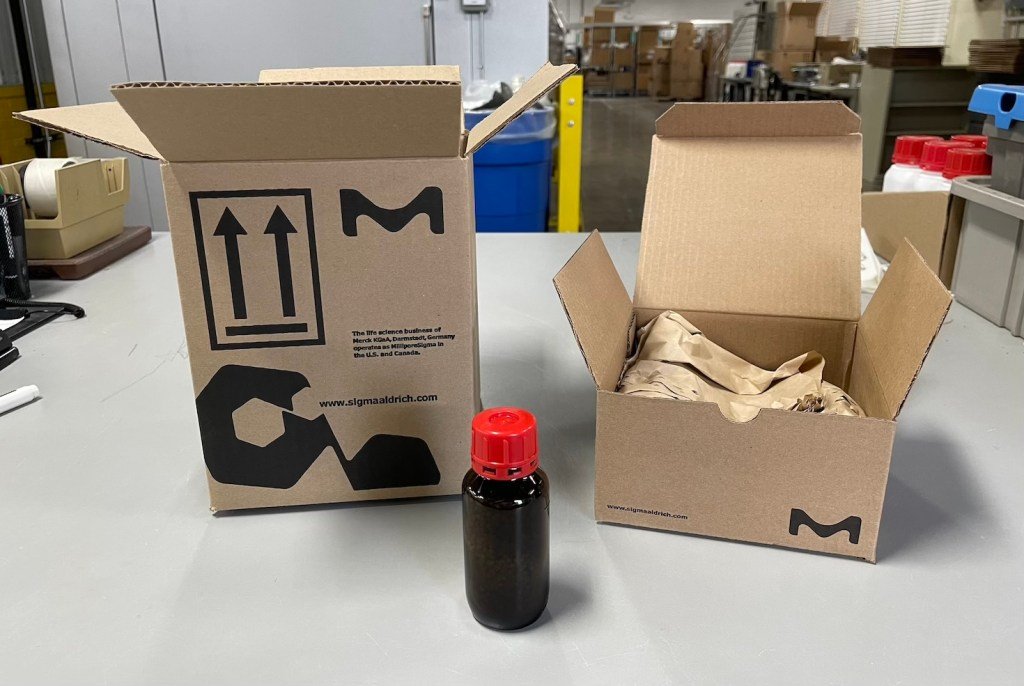
MilliporeSigma’s 40-person sustainability team reports to the chief strategy and transformation officer of parent company, Merck KGaA, Darmstadt, Germany. That means environmental considerations are automatically included in product design and packaging decisions, and the lead sustainability executive for the life sciences company often accompanies sales representatives to meetings with strategic accounts. “I see firsthand where it’s creating a more attractive environment for our customers to choose us more often because of what we’re doing related to sustainability,” said Jeffrey Whitford, vice president of sustainability and social business innovation at MilliporeSigma, the operating name for Merck KGaA’s U.S. and Canadian life science business. “We’re changing the narrative that it’s costs, costs, costs. We’re finding the connection points to make the financial picture much clearer and, I would say, much more attractive for the business.” Clear results Even when Whitford isn’t in the room, MilliporeSigma’s climate agenda is a component of how the company pitches new accounts and wins new business. It considers both potential savings and sales upsides during the product design process, something it has been doing since 2021 when sustainability started reporting to the strategy team. (Whitford started in environmental, health and safety 20 years ago with Sigma-Aldrich, which was acquired by Merck KGaA in 2015.) That reorganization has served the company well. Merck KGaA’s company-wide commitment, validated by the Science Based Targets initiative, calls for a 50 percent reduction in greenhouse gas emissions related to its operations and purchased electricity by 2030 (Scope 1 and 2, respectively) compared with 2020. It has cut Scope 1 by 53 percent and reduced Scope 2 by 30 percent. Merck KGaA has an emissions intensity goal that calls for it to cut emissions to 230 metric tons of carbon dioxide equivalent per 1 million euros of gross profit; the result for 2024 was 359 metric tons of CO2e. Sales for MilliporeSigma’s Greener Alternatives Portfolio — more than 2,500 products that contain bio-based solvents or chemicals, were repackaged with fewer plastics and more renewable materials or have some other preferable sustainability attribute — doubled in the past year. MilliporeSigma sells more than 300,000 products. The company doesn’t disclose what percentage of its annual sales for 2024 were attributable to Greener Alternatives. It added more than 880 products to the portfolio in 2024 including mPredict, an artificial intelligence tool that uses green chemistry concepts to help scientists eliminate thousands of physical screening experiments, and Cellvento, a feed solution that doesn’t need to be refrigerated, saving energy. A smaller box was developed and validated for shipping approximately 1,000 products from MilliporeSigma’s distribution center in Milwaukee, saving 60 metric tons of packaging annually.Source: MilliporeSigma Dedicated packaging plan One place where sustainability goals win over MilliporeSigma customers is packaging, which contributes 10 percent of the company’s emissions. Merck KGaA has committed to reducing packaging weight per unit sales by 10 percent by 2030, ensuring that all fiber materials are deforestation-free, and designing packages to be recovered, recycled or reused. The more than 100 projects the company has completed under its SMASH Packaging 2.0 initiative have cut emissions by more than 400 metric tons on an annual basis. Many products are distributed in glass, because it doesn’t react with certain chemicals, but the company is taking steps to reduce plastic-derived and fiber-based materials where possible. One example is the bulk packaging option MilliporeSigma adopted for several filter product lines, including Millstak (which removes particulates and clarified liquids during biopharmaceutical manufacturing) and Clarisolve (used with cell cultures). The approach reduces waste by 33-53 percent and also cuts the time it takes customers to unbox them in half. “So, they have a reduction in the CO2 footprint, they have a reduction in operator time, and they have a reduction in the amount of waste they have to deal with,” Whitford said. MilliporeSigma also stands out for its Green Cooler initiative, replacing the styrofoam typically used to transport refrigerated items such as blood products or antibodies with an insulated starch and paper-based option that can accommodate dry ice and disposed of in curbside recycling systems. Recycling instructions are printed directly on the cooler’s inside flap. MilliporeSigma handled 60,000 shipments using the Green Coolers in 2025 in Australia, Germany, Korea and the U.S. The new coolers will be introduced to all U.S. distribution centers in 2026, eliminating an estimated 60 metric tons of styrofoam annually — six jumbo jets’ worth of material. Two challenges in rolling out the new format was satisfying quality control teams and training distribution employees how to handle the coolers. For example, a distribution center in Phoenix, where summer temperatures can soar above 100 degrees Fahrenheit, must have confidence that a shipment arriving late on a Friday will stay cold over the weekend. “These are the things you uncover when you’re encouraging change, and you have to figure out how you have the resilience to navigate them and not get thrown off by the hurdles,” Whitford said. Hybrid funding approach Because sustainability considerations are part of MilliporeSigma’s commercial plan, the investments for supporting programs such as the Green Cooler initiative come from two main sources: product development budgets and strategic development funds that are meant for longer-range projects. The chief technology officer has also dedicated a portion of the corporate research and development budget to sustainability-related innovation, further demonstrating the company’s high-level commitment. “The biggest constraint is time, to be honest, because we are really fortunate to be in an organization where I have been given freedom to go and run,” Whitford said. The post Why MilliporeSigma’s sustainability lead sits in on sales pitches appeared first on Trellis.
poLight and IQL launch Raspberry Pi TLens Studio platform
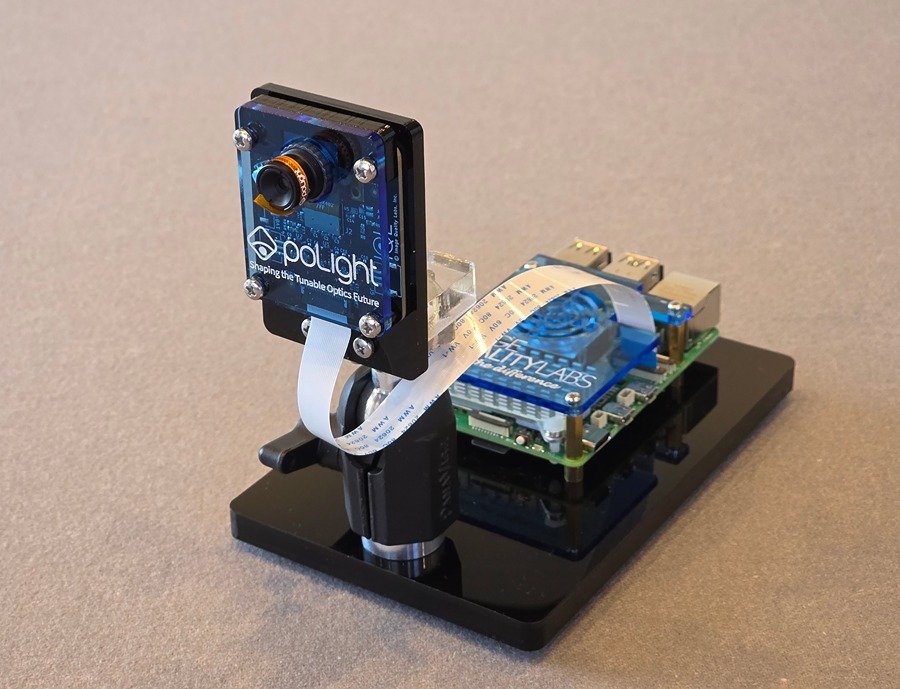
poLight ASA and Image Quality Labs announced the development of an M12-based Raspberry Pi TLens Studio evaluation and development platform, utilizing the new line of TLens off-the-shelf (OTS) focusing camera lens. This platform enables machine vision design engineers to quickly and easily evaluate high speed, constant field-of-view focusing functionality on their existing embedded computing platforms. Initially available in a 7.5mm focal length, the prototype will be available for private viewing in the poLight suite at CES (6-9 January) and in both the poLight (#6317) and Image Quality Labs (#6716) booths at SPIE (20-23 January). To schedule a CES viewing, contact info@polight.com. poLight ASA and Image Quality Labs announced the development of an M12-based Raspberry Pi TLens Studio evaluation and development platform, utilizing the new line of TLens off-the-shelf (OTS) focusing camera lens. This platform enables machine vision design engineers to quickly and easily evaluate high speed, constant field-of-view focusing functionality on their existing embedded computing platforms. Historically, industrial machine vision OEMs have been forced to rely on fixed focus cameras with a small aperture to achieve sufficient depth of focus, hindering advanced imaging for factory and warehouse automation, barcode scanners and embedded cameras. Delivering a small, cost-competitive OTS solution with constant field-of-view focusing which is based on a standard sensor platform enables industrial machine vision OEMs to quickly ramp their advanced technology. The M12-based Raspberry Pi TLens Studio platform leverages poLight’s ultra-fast (~1ms), ultra-low power-consuming (~1mW) TLens, enabling design engineers to rapidly set and change object/focal distances to accommodate different scenarios. The OTS lenses will be available at 6mm, 7.5mm, 13mm and 19mm focal lengths, in production volume by Q1 2026. The IQL TLens RPi 5 Evaluation Kit is a new development platform purpose-built to help engineers rapidly evaluate poLight’s TLens constant field-of-view focusing technology on modern embedded systems. Designed around the Raspberry Pi 5 and an M12 optical architecture, the kit will initially support IQL’s TLens-enabled camera modules built on the Sony IMX462 and Sony IMX900 image sensors, two industry-proven platforms for low-light, high-speed, and machine-vision applications. The evaluation kit provides a turnkey pathway for developers to test TLens performance, integrate with their existing software stacks, and accelerate camera-driven innovation in industrial automation, robotics, edge AI, and inspection systems. The IQL TLens RPi 5 Evaluation Kit, along with the first IMX462 and IMX900-based TLens camera modules, will be available in limited early-access quantities in Q1 2026. For more information, visit polight.com. The post poLight and IQL launch Raspberry Pi TLens Studio platform appeared first on Engineering.com.
Tesla Cybercabs spotted testing, unsurprisingly with steering wheels

A new sighting of Tesla Cybercab prototypes in Austin, Texas, is fueling the ongoing debate about the vehicle’s design. While the prototypes were spotted with steering wheels, which is standard for testing, it raises questions about whether Tesla can actually stick to its plan to launch the vehicle without them given the state of its self-driving effort. more…
The engineer’s guide to battery defects
Sponsored by Lumafield. EV-battery engineers wrestle with defects they can’t see until a pack fails. The Engineer’s Guide to Battery Defects lays out how industrial CT surfaces those threats in minutes. As the paper states, “Industrial CT scanning allows battery engineers to visualize and analyze specific issues related to anodes and cathodes that are otherwise challenging to detect”. Real-world scans show that “precise 3D imaging reveals the extent and distribution of the anode overhang, enabling…identification of potential areas of concern”, and they spotlight tab-weld voids that can trigger thermal runaway. With this guide, you’ll come away with practical workflows for R&D, supplier validation, and in-line QA; numeric benchmarks for anode-cathode overhang, porosity, and weld integrity; and a clear blueprint for ISO 26262 evidence packs. The paper explains why regulators insist on catching “delamination, misalignment, or contamination … before they lead to failures in the field” and shows how Voyager dashboards turn those CT measurements into trend data your team can act on.
Jackery unveils rugged portable power station, solar gazebo, autonomous solar robot
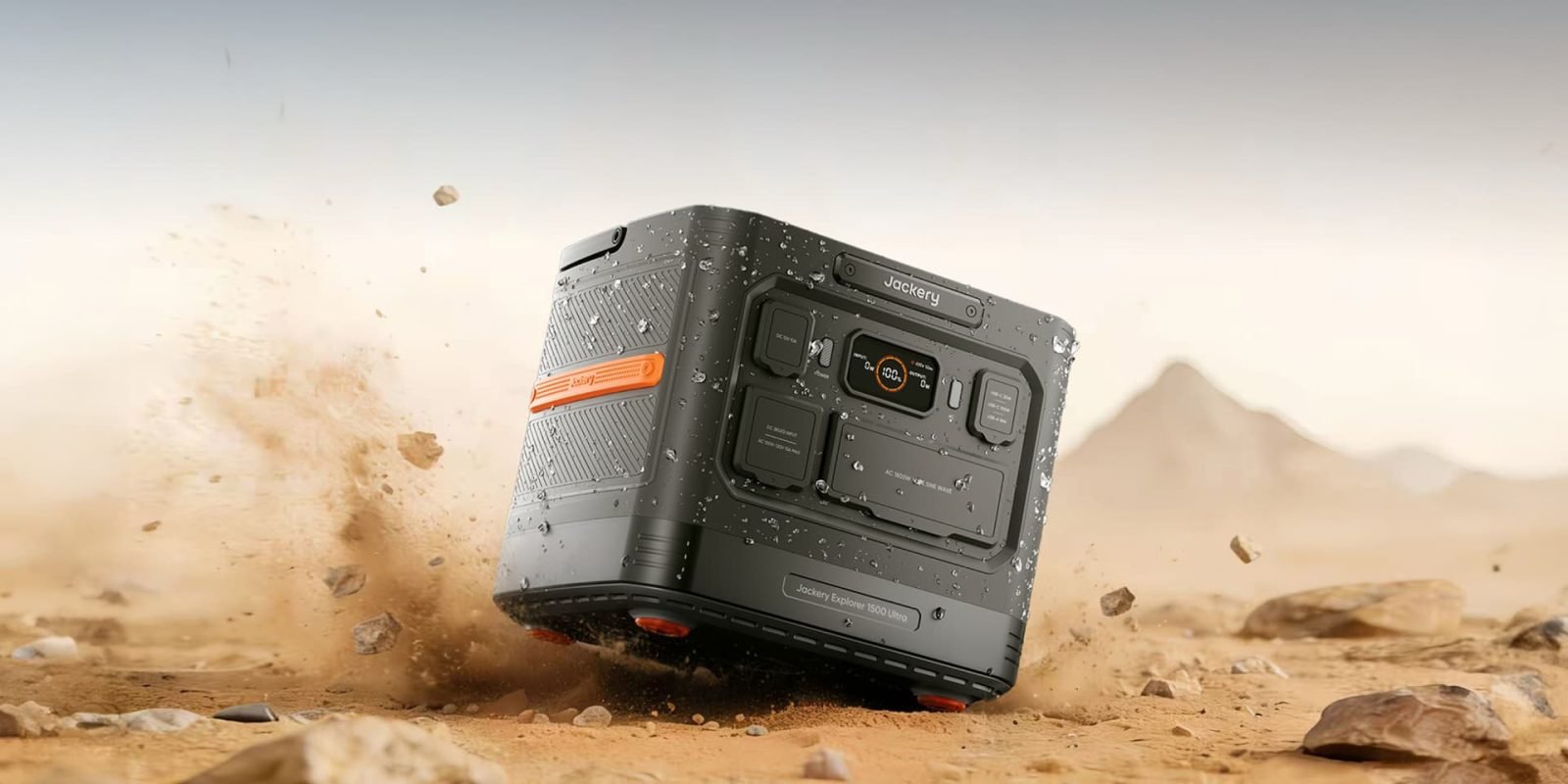
Jackery has just pulled the wraps off its newest portable power station, the Explorer 1500 Ultra, and it’s aiming squarely at people who actually use these things outside – not just those who keep them pristine in a garage for the occasional blackout. Unveiled this week at CES 2026, the new unit is designed to be tougher, lighter, and more weather-resistant than most power stations in its class, with specs showing how Jackery is leaning hard into real-world use cases. Beyond just portable power, the company is also showcasing innovative new products that target much bigger ambitions – literally. With a new solar gazebo and a self-following robot, the Jackery is dramatically expanding the scope of its solar and portable power initiatives. more…
Nexeon commissions silicon-carbon plant in South Korea

Silicon battery materials manufacturer Nexeon has brought its silicon-carbon facility in Gunsan, South Korea to production-ready status. Construction started last spring at the location in a key industrial hub in South Korea, which was chosen to ensure Nexeon has supply chain security. It has a reliable pipeline supply of monosilane gas, a key precursor material, through its close supplier partnerships. The strategic location in Gunsan also offers direct access and proximity to Asian battery cell producers, accelerating integration into their existing battery supply chains. The plant is designed so that Nexeon can install additional reactors to scale up production rapidly as demand for battery materials grows. The company is now progressing to the final customer production qualification processes under automotive quality standards. “The silicon-carbon materials produced at the Gunsan facility are designed to increase the energy density and charging speed of lithium-ion batteries significantly, addressing critical performance requirements for the EV and consumer electronics markets,” said Dr Scott Brown, CEO of Nexeon. Source: Nexeon
Seyond showcases full LiDAR portfolio and Hummingbird at CES 2026

Seyond is showcasing its complete end-to-end LiDAR portfolio at CES 2026, highlighting deployment-ready solutions spanning ultra-long-range, long-range, and fully solid-state sensing for automotive, robotics, and intelligent infrastructure applications. With a full-spectrum portfolio covering the entire perception stack, Seyond enables customers to source all LiDAR requirements from a single, trusted partner. Seyond’s portfolio includes flexible manufacturing and supply options, with select sensor configurations available from U.S.-based production lines and designed to meet BABA compliance requirements, supporting customers operating in regulated and security-sensitive environments. Mass-production–ready solid-state LiDAR within a complete end-to-end portfolio A key highlight of Seyond’s CES presence is the debut of its Hummingbird fully solid-state LiDAR series, including Hummingbird D1 for automotive OEMs and Hummingbird D1-R for robotics applications. Hummingbird D1 is Seyond’s first fully solid-state LiDAR and is mass-production ready, having already secured a world-first OEM design win, marking a major milestone toward large-scale deployment of solid-state LiDAR in passenger vehicles. Built on a fully electronic scanning architecture, Hummingbird eliminates mechanical components to deliver exceptional durability, reliability, and consistency in demanding real-world environments. Its compact form factor, ultra-wide 140° × 100° field of view, and minimal blind spot enable high-resolution, real-time 3D perception for intelligent navigation across automotive and advanced robotics platforms. Support for satellite architecture with raw data output and centralized processing further improves system efficiency and long-term scalability. Hummingbird complements Seyond’s comprehensive end-to-end LiDAR portfolio, which spans ultra-long-range sensing with Falcon K, long-range performance with Robin E1X, mid-range coverage with Robin W, and short-range, fully solid-state perception with Hummingbird. This full-spectrum approach enables customers to build complete perception systems using a single supplier, reducing integration complexity while accelerating development timelines. With unified validation standards, scalable manufacturing, and flexible supply options, Seyond supports customers from early prototyping through mass production and global deployment. Live LiDAR demos and real-world autonomous applications Seyond’s booth will also feature live demonstrations of Robin e1X, the newest evolution of the company’s long-range LiDAR family. Robin e1X delivers enhanced range, improved point cloud quality, and optimized performance for autonomous driving, smart cities, and industrial automation. In addition, Seyond will showcase a customer’s autonomous logistics delivery cehicle integrated with the company’s Robin W LiDAR. The vehicle demonstrates how Seyond’s sensing technology enables precise perception, safe navigation, and operational reliability in real-world autonomous logistics and last-mile delivery applications. Advancing scalable autonomy across industries With a LiDAR portfolio covering everything from ultra-long-range sensing to compact, fully solid-state perception, Seyond supports a wide range of autonomy use cases across automotive, robotics, intelligent transportation systems, and smart infrastructure. CES 2026 marks a key milestone as the company continues to deliver deployment-ready, production-scalable LiDAR platforms that allow customers to build complete perception solutions with a single, trusted technology partner. For more information, visit seyond.com. The post Seyond showcases full LiDAR portfolio and Hummingbird at CES 2026 appeared first on Engineering.com.
Anker SOLIX New Year Sale takes up to 65% off power stations, Navee XT5 Pro e-scooter at new $1,300 low, Autel, Greenworks, more
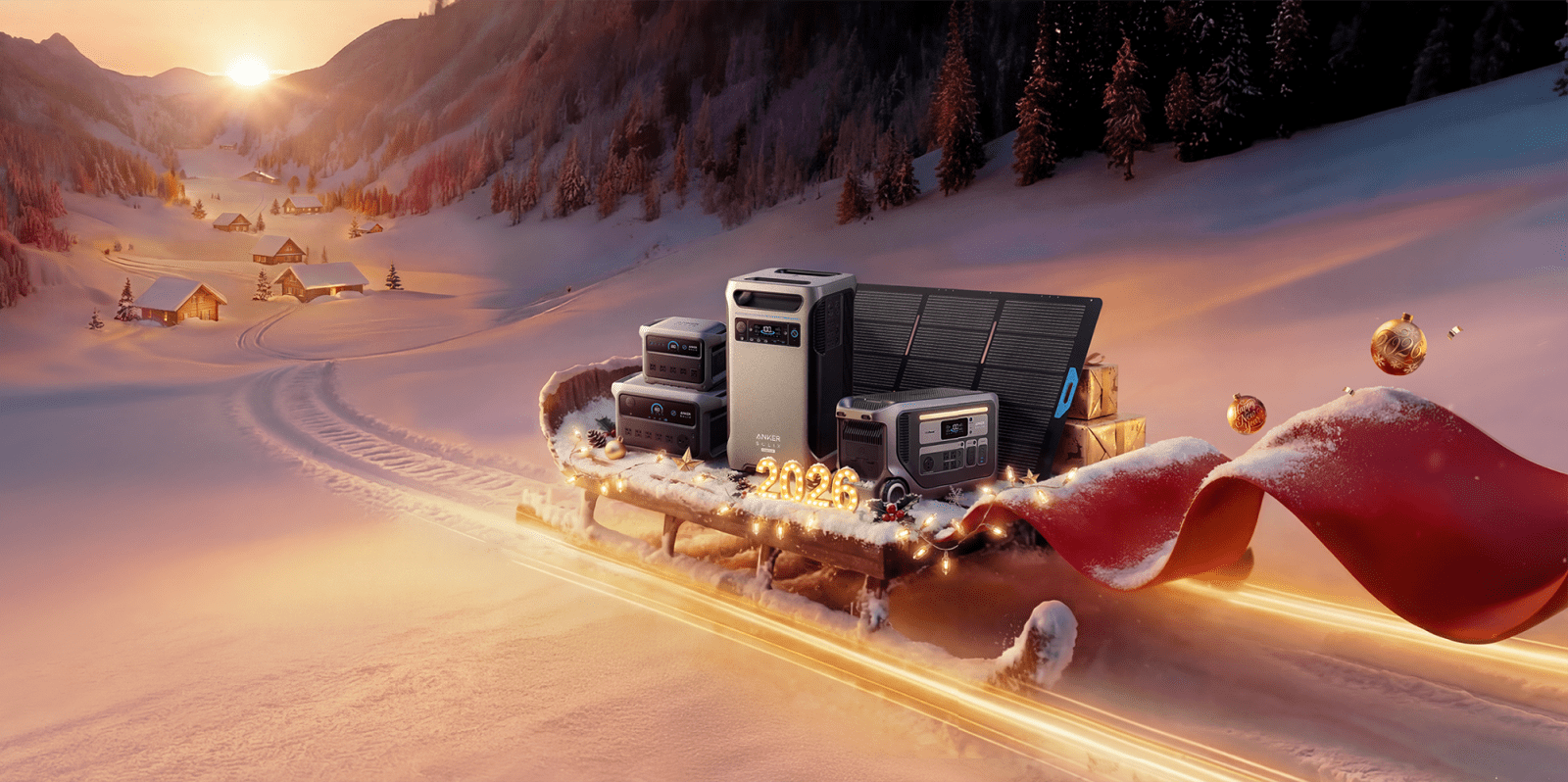
We’re ringing in the New Year with our final Green Deals edition of 2025 (as we will be dark tomorrow), led by Anker’s SOLIX New Year Sale with up to 65% power station discounts and plenty of continuing lows, like the F3000 Portable Power Station at $1,199, amongst others. We also spotted Navee’s latest XT5 Pro Long-Range Off-Road Electric Scooter hitting a new $1,300 low, as well as Autel’s MaxiCharger AC Pro 80A Level 2 EV charging station back at $909, a compact sawing solution from Greenworks, and much more waiting for you below. And don’t forget about the hangover deals at the bottom of the page, like yesterday’s EcoFlow December Holiday EcoCredits Madness Sale, the final days of Lectric’s Holiday e-bike deals, and more. Head below for other New Green Deals we’ve found today and, of course, Electrek’s best EV buying and leasing deals. Also, check out the new Electrek Tesla Shop for the best deals on Tesla accessories. more…
Kempower deploys MCS electric truck charging in Scandinavia and California

The Megawatt Charging System (MCS) is an emerging EV charging standard that (despite the name) allows commercial electric vehicles to charge at rates of up to 3.75 megawatts—fast enough for heavy-duty EVs to top up their batteries during mandated driver breaks or during loading and unloading. EVSE manufacturer Kempower has been at the forefront of MCS development, and now that truck OEMs such as Traton, Volvo and Daimler Truck are demonstrating progress toward commercially available, MCS-capable electric trucks, Kempower believes that 2026 will be “the year of MCS.” Kempower’s MCS deployments to date include: Alfredsson Transport, Sweden: Kempower claims to have performed the world’s first public megawatt charging session in August 2025, at Alfredsson’s truck charging site in Norrköpingin. Danske Fragtmænd, Denmark: a megawatt charging station for trucks opened in September in Odense, in collaboration with GodEnergi and Kempower. ASKO, Norway: a commercial MCS site is powered by Kempower’s distributed charging system. Circle K, Sweden: Kempower MCS chargers are up and running at Circle K charging stations in Järna and Vädermotet. EV Realty, California: Kempower will supply the MCS infrastructure for a grid-connected MCS site at EV Realty’s truck fleet hub in San Bernardino, California. Kempower expects the transition to MCS to take place gradually over the next few years, and is therefore pursuing a dual strategy, deploying chargers that can accommodate both CCS- and MCS-compatible vehicles. The Kempower Megawatt Charging System supports the Kempower Mega Satellites, which offer peak power of 1.2 MW, and a variety of different CCS satellites. Existing customers can also upgrade existing systems to MCS by combining two 600 kW Kempower Power Units. Source: Kempower
Tesla Cybertruck undergoes interior mod that many owners wanted
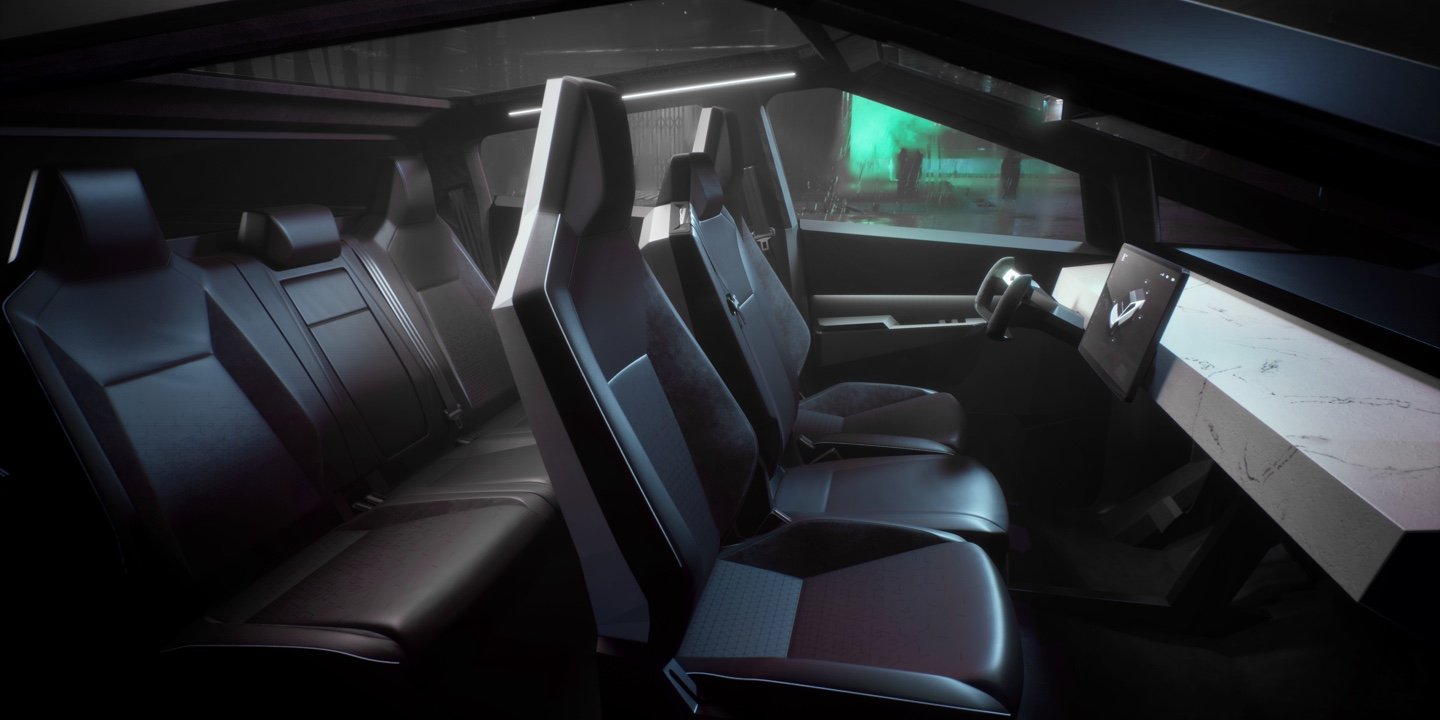
Tesla Cybertruck is significantly different from traditional pickups on the market in a lot of ways. However, one feature that was recently modified with its interior was a highly requested characteristic that is present in other trucks, but was void from Cybertruck. Tesla went with a five-seat configuration with Cybertruck: two in the front and three in the back. The spacious interior is matched with plenty of storage, especially up front, as a pass-through, center console, and other storage options, but some Tesla fans wanted something different: bench seating. Bench seating is popular in many full-size pickups and allows three passengers to sit up front. The middle seat is usually accompanied by a fold-down storage unit with cupholders. Tesla decided to opt for no bench seating up front, despite the fact that it equipped bench seating in the unveiling in 2019. Interior photos from the unveiling event from nearly six-and-a-half years ago show Tesla had originally planned to have a six-seat configuration. This was adjusted after the company refined the design: (Tesla Cybertruck interior configuration in 2019) Despite Tesla abandoning this design, it does not mean owners were willing to accept it. One owner decided to modify their Tesla Cybertruck interior to equip that third seat between the driver’s and passenger’s thrones. The fit is snug, and while it looks great, it is important to remember that this does not abide byregulations, as it would require an airbag to be technically legal. Please do not do this at home with your own Cybertruck: The Cybertruck is a popular vehicle in terms of publicity, but its sales have been underwhelming since first delivered to customers back in 2023. It’s hard to believe it’s been out for two-and-a-half years, but despite this, Tesla has not been able to come through on its extensive order sheet. This is mostly due to price, as Cybertruck was simply not as affordable as Tesla originally planned. Its three configurations were initially priced at $39,990, $49,990, and $69,990. At release, Cybertruck was priced above $100,000. This priced out many of those who had placed orders, which is the main reason Cybertruck has not lived up to its expectations in terms of sales. The adjustments to the specific features, like the removal of the bench seat, likely did not impact sales as much as pricing did. This modification shows some creativity by Tesla owners, but also shows that the Cybertruck could always be the subject of a potential refresh to include some of these features. Tesla routinely adjusts its vehicle designs every few years, so maybe the Cybertruck could get something like this if it chooses to refresh its all-electric pickup. The post Tesla Cybertruck undergoes interior mod that many owners wanted appeared first on TESLARATI.
After 25 years of covering corporate sustainability, it’s more complicated than ever
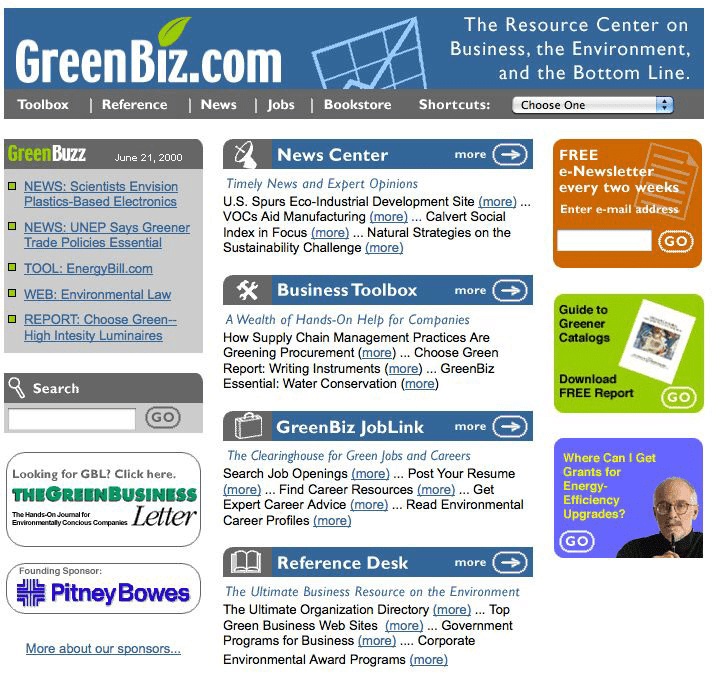
We’ve just concluded our 25th year since the website GreenBiz.com — now Trellis.net — debuted: “The Resource Center on Business, the Environment and the Bottom Line,” read its tagline at the time. We’ve now been covering sustainable business for a quarter century — not quite since the beginning of the era, but still from its earliest days. The journalists and analysts at Trellis — complemented handily by a sizable community of practitioners willing to share their ideas, perspectives and insights — have produced more than 25,000 articles during that time. And throughout, we’ve continually assessed the scope, veracity and impact of what we do and how we do it. In many ways, just like our readers. It hasn’t been easy. Sustainable business journalists have long struggled to get it right — the right mix of stories, of course, but also the right tone, balance and level of depth. There were no halcyon days when sustainable business journalism was easy, popular or uncontroversial. Nearly everything has been subject to punishing scrutiny, whether from activists, companies, investors, political point-scorers, watchdog groups, regulators or a corps of self-appointed sentinels. If you get it mostly right, you find yourself as we have: scrutinized and criticized but generally respected by all sides. Our homepage on launch day: June 21, 2000. At this 25-year juncture, I’ve been reviewing the trajectory of sustainable business reporting, including revisiting some of our earliest stories. It’s a bit like looking at an old picture of yourself and wondering what that “you” was really like back then. And how different things might be to have known then what you know now. Capturing eyeballs and clicks The evolution of sustainable business journalism roughly paralleled that of the internet, where “content” became cheap and ubiquitous, and where capturing “eyeballs” and clickthroughs required ever-spicier headlines and lede sentences. More recent years saw the emergence of social media where, um, content needed to be bite-sized and sometimes salacious. Then came the tsunami of narrative podcasts, live online interviews, carousel storytelling, video explainers, micro-series and “snackable reports” (trust me, they’re a thing), among other novel formats. Each added new opportunities and challenges for reporters and editors, requiring “journos” — shorthand for journalists in an era of bite-sized attention spans — and their publications to adjust their reporting and publishing strategies. Now, in the era of AI, many such strategies are being cast aside as algorithm-based technology radically transforms how information is created and consumed, and who creates it and their agendas, if any. It’s enough for an old-school journo like me to pine for the simpler world of blue pencils and bulldog editions. Meanwhile, the business of sustainability has evolved from a largely engineering-centric profession into one confronting an atmospheric river of trends and terms: triple bottom line, eco-efficiency, stakeholder engagement, corporate citizenship, corporate social responsibility, shared value, carbon neutrality, double materiality, ESG, decarbonization, nature-positive, carbon-negative, circular economy, just transition and many others. All in just the past 25 years. Three eras of coverage Amidst all this, how has media coverage changed? I view the past quarter century in three eras, which parallel the trajectory of sustainable business itself. 2000-2005: Shallow but earnest. Early reporting focused on mostly small, self-reported activities: a company phasing out polystyrene foam packaging “peanuts” from its shipping department, for instance. A name-brand company publishing its first-ever environmental report could become a headline-grabbing moment. There was relatively little effort by reporters to peel back the covers to understand what was behind these stories. Sustainable business (it wasn’t even called that yet) was sufficiently novel that nearly everything seemed worthy of covering, if not cheerleading. 2005-2015: Less shallow, more serious. Reporting grew deeper, with more-experienced journalists examining meaningful changes in companies’ products, processes and operations. We started to focus not just on the “what” but also the “how” and “why” of company initiatives. There was more effort taken to explain the nuts and bolts of what’s needed to nudge a company in a more sustainable direction: how increased transparency and disclosure, for example, could improve company operations; the challenges of accurately measuring and reporting a firm’s carbon footprint; the use of biotechnology and biomimicry to find less-problematic ingredients for everything from biofuels to blue jeans. How we looked in 2020. 2015-2025: Serious and deeper. Heightened scrutiny and politicalization, in tandem with more ambitious corporate initiatives, pushed reporters to ask more probing questions: Can companies truly offset their way to carbon neutrality? Is hydrogen a viable transportation fuel? Does ESG investing actually move companies and markets? Trellis’s Chasing Net Zero series represents a prime example of reporters digging deep to answer a seemingly simple question: What does it take for a company to dramatically reduce or eliminate its greenhouse gas emissions? The answer turns out to be far from simple. Trellis reporters use a detailed methodology to assess how specific companies across multiple sectors are faring. The complexity of these stories reflects the growing sophistication of sustainable business journalism overall. Four challenges ahead Today, we face both new and continuing challenges, among them: An evolving media landscape. Journalism now straddles two worlds: traditional balanced reportage and a digital, AI-enabled free-for-all, where a story dismissed as “fake news” might actually be accurate and where seemingly authoritative stories can turn out to be anything but. Publishing today requires balancing the consequential with the click-worthy, not to mention pairing context with clarity. Nuanced stories. As coverage goes deeper into company operations, the risk grows that complexity becomes oversimplified. For example, a story about a company restoring forests and protecting Amazonian biodiversity requires knowledge of land use; measurement, reporting and verification; and development finance, not to mention supply chains and Indigenous rights — but may be reduced by inexperienced writers and editors to merely “planting trees.” An uneven playing field. Some companies gush a steady stream of announcements and proactively court reporters and editors. As a result, such well-known brands as Amazon, Google, IKEA, Microsoft, Nike, Salesforce, Unilever and Walmart seem to appear disproportionately more frequently in
HighPoint launches RocketStor 8631D PCIe Gen5 accelerator enclosure
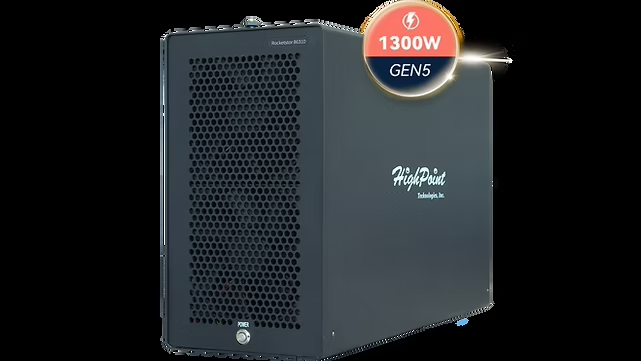
HighPoint Technologies, Inc. has announced the RocketStor 8631D, an external accelerator enclosure designed to provide PCIe Gen5 x16 bandwidth and sustained power for AI, HPC and professional media workflows. The RocketStor 8631D is intended for use cases where conventional expansion options, tunneling protocols such as Thunderbolt, or power-limited enclosures can constrain the performance of PCIe Gen5 GPUs and FPGAs. PCIe Gen5 x16 bandwidth The RocketStor 8631D is designed to deliver up to 64GB/s of PCIe Gen5 x16 bandwidth between the host server and the accelerator card. Signal retiming: Integrates Astera Labs PCIe Gen5 retimer technology to regenerate the PCIe signal over external cable runs. Standards-based connectivity: Uses the PCI-SIG CopprLink standard for interoperability and low-latency, non-tunneled communication. Power and chassis support The RocketStor 8631D includes a 1300W power supply to support high-TDP accelerators. 1300W PSU: Provides headroom for transient power spikes to help maintain stable operation under load. Chassis and cooling: Uses a triple-slot chassis and an internal cooling system intended to reduce thermal throttling. Cooling The enclosure includes a chassis layout and fan control designed to manage thermals during sustained workloads. Internal layout: Designed to reduce cable congestion and airflow obstructions. Dual-fan control: Uses two fans and integrated sensors to adjust airflow based on thermal conditions. This approach is intended to reduce thermal load on components and help maintain sustained performance by limiting thermal throttling. For more information, visit highpoint-tech.com. The post HighPoint launches RocketStor 8631D PCIe Gen5 accelerator enclosure appeared first on Engineering.com.
Aventon New Year Sale takes up to $500 off legacy + new e-bikes for lows from $999, Autel 50A smart EV chargers, Heybike sale, more

We’re kicking off 2026’s Green Deals led by the Aventon New Year Sale with up to $500 off e-bikes – many of which are continuing their previous 2025 holiday lows, like the Aventure 3 All-Terrain Smart e-bike at $1,799. Right behind it we have Heybike’s New Year e-bike sale with up to $800 savings starting from $999, as well as Autel’s Sierra Blue and Snow White MaxiCharger Home 50A Smart Level 2 EV Chargers at their $398 low, Jackery’s Explorer 600 v2 deals, Greenworks’ zero-turn riding mower, and much more waiting for you below. And don’t forget about the hangover deals at the bottom of the page, like the Anker SOLIX New Year power station sale that ends this weekend, the new low price on Navee’s latest XT5 Pro e-scooter, and more. Head below for other New Green Deals we’ve found today and, of course, Electrek’s best EV buying and leasing deals. Also, check out the new Electrek Tesla Shop for the best deals on Tesla accessories. more…
CATL and SAIC Commercial Vehicles collaborate on battery swapping

Chinese battery giant CATL and automaker SAIC Commercial Vehicle have formed a strategic partnership focused on joint technology research and development, commercial EV ecosystem building and global expansion. The collaboration will include jointly building an integrated smart battery swapping ecosystem and green transportation capacity system encompassing “vehicle, battery, station and cloud,” and accelerating the transition of logistics transportation and urban delivery to EVs, CATL said. CATL and SAIC Commercial Vehicles are jointly developing power battery technology, such as the CATL Tianxing Battery used in SAIC Maxus Dana series light commercial vehicles. The companies are also piloting the Chocolate Battery Swapping model launched by CATL Electric Service. The solution allows batteries to be replaced in three minutes, improving vehicle uptime and operational efficiency. CATL Electric Service plans to further expand its battery swapping network to reach 140 cities by 2026. The “vehicle, battery, station, and cloud” integrated model encompasses advanced technologies such as intelligent driving and intelligent refueling to create a smart energy service system. The companies intend to operate joint ventures internationally, leveraging resource integration and their complementary strengths to increase the competitiveness of Chinese commercial vehicles in the global market. Source: CATL
Tesla analyst breaks down delivery report: ‘A step in the right direction’

Tesla analyst Dan Ives of Wedbush released a new note on Friday morning just after the company released production and delivery figures for Q4 and the full year of 2025, stating that the numbers, while slightly underwhelming, are “better than feared” and as “a step in the right direction.” Tesla reported production of 434,358 and deliveries of 418,227 for the fourth quarter, while 1,654,667 vehicles were produced and 1,636,129 cars were delivered for the full year. Tesla releases Q4 and FY 2025 vehicle delivery and production report Interestingly, the company posted its own consensus figures that were compiled from various firms on its website a few days ago, where expectations were set at 1,640,752 cars for the year. Tesla fell about 4,000 units short of that. One of the areas where Tesla excelled was energy deployments, which totaled 46.7 GWh for the year. Wedbush’s Dan Ives has released a new note on Tesla $TSLA: “Tesla announced its FY4Q25 delivery numbers this morning coming in at 418.2k vehicles slightly below the company’s consensus delivery estimate of 422.9k but much better than the whisper numbers of ~410k as the… — TESLARATI (@Teslarati) January 2, 2026 In terms of vehicle deliveries, Ives writes that Tesla certainly has some things to work through if it wants to return to growth in that aspect, especially with the loss of the $7,500 tax credit in the U.S. and “continuous headwinds” for the company in Europe. However, Ives also believes that, given the delivery numbers, which were on par with expectations, Tesla is positioned well for a strong 2026, especially with its AI focus, Robotaxi and Cybercab development, and energy: “This will be viewed as better than feared deliveries and a step in the right direction for the Tesla story heading into 2026. We look forward to hearing more at the company’s 4Q25 call on January 28th. AI Valuation – The Focus Throughout 2026. We believe Tesla could reach a $2 trillion market cap over the coming year and, in a bull case scenario, $3 trillion by the end of 2026…as full-scale volume production begins with the autonomous and robotics roadmap…The company has started to test the all-important Cybercab in Austin over the past few weeks, which is an incremental step towards launching in 2026 with important volume production of Cybercabs starting in April/May, which remains the golden goose in unlocking TSLA’s AI valuation.” It’s no secret that for the past several years, Tesla’s vehicle delivery numbers have been the main focus of investors and analysts have looked at them as an indicator of company health to a certain extent. The problem with that narrative in 2025 and 2026 is that Tesla is now focusing more on the deployment of Full Self-Driving, its Optimus project, AI development, and Cybercab. While vehicle deliveries still hold importance, it is more crucial to note that Tesla’s overall environment as a business relies on much more than just how many cars are purchased. That metric, to a certain extent, is fading in importance in the grand scheme of things, but it will never totally disappear. Ives and Wedbush maintained their $600 price target and an ‘Outperform’ rating on the stock. The post Tesla analyst breaks down delivery report: ‘A step in the right direction’ appeared first on TESLARATI.
Grace under pressure: What will define sustainability in 2026

It’s a tough time for corporate sustainability. Budgets are tighter, teams are smaller and many companies are more reluctant to speak publicly about the work they’re doing. The focus has shifted from bold vision to practical results. A pattern has emerged in conversations that my colleagues and I at Trellis have had over the past year with sustainability leaders across industries, from manufacturing and tech to retail and infrastructure. The companies staying the course with sustainability efforts in 2026 are not necessarily the loudest or most aspirational. They are quietly executing. That pattern shows up in three ways that are reshaping the corporate sustainability landscape: steady leadership; integration with business systems; and data-driven narratives. These are also the through lines that will shape the program that Katie Ryan, Nico McCrossan and I are building out for GreenBiz 26, where we will convene thousands of sustainable business leaders Feb. 17-19, 2026, in Phoenix. Calm, steady leadership in a critical moment Sustainability leaders face more politicized and scrutinized environments than existed a few years ago. Many are being asked to do more with less: budget; authority; and certainty. The leaders who are still advancing their companies’ sustainability work in measurable ways share a common trait: steadiness. They focus on what they can control, advance work incrementally, build trust internally and stay aligned with core business priorities, even when sustainability is not the loudest voice in the room. CSO jobs continue to mature, with sustainability leaders playing central roles in finance, operations, product and risk conversations. Their influence increasingly comes from credibility, relationships and clear communication, rather than formal mandates alone. In 2026, leadership in sustainability will be less about bold declarations and more about steady competence. GreenBiz 26 sessions such as Executive Influence When You’re Not in the C-Suite will explore how leaders maintain steady influence and advance meaningful work amidst uncertainty and constraints. From sustainability strategies to business systems Sustainability is moving from separate initiatives to those that are integrated into business systems. Decarbonization efforts now link climate goals to real metrics, shared ownership and operational decision-making, rather than distant targets. Circularity is following a similar path, with extended producer responsibility, reuse and materials transitions moving from pilot programs into day-to-day operations. Digital infrastructure is drawing major scrutiny as data centers expand. Companies are considering energy use, carbon, embodied emissions, circular hardware, capacity planning and water strategy. These are core operational questions, not bolt-on initiatives. Transition planning also reflects this systems mindset. Effective sustainability leaders are ensuring that climate goals influence fundamental business decisions, from budgets and procurement to risk and board oversight. In the GreenBiz 26 session Tension Management: The ROI of Sustainability we’ll focus on how companies navigate difficult tradeoffs and ground sustainability decisions in operational and financial realities. What helps? Communications, data and technology As scrutiny has risen, sustainability leaders are communicating more precisely. Grand promises and gauzy visions are giving way to grounded narratives focused on outcomes and business value. Data and technology are essential enablers. Companies are investing in better supplier data, stronger lifecycle assessment frameworks and systems that make sustainability information useful across the organization. AI and digital tools help teams analyze complex data, automate reporting and make faster decisions, with governance and guardrails in place. What matters most is practicality: tools that cut manual work, reduce errors and help sustainability insights actually travel across the business. This often includes AI-assisted lifecycle assessment tools for faster impact modeling, customized AI agents and data platforms to standardize supplier emissions data and automated systems that pull and prepare sustainability data for reporting. Internal influence is equally critical. Aligning executives, guiding cross-functional teams and empowering people across the enterprise are core sustainability skills. Sessions such as The AI Tech Stack: What’s Actually Helping You Do Your Job? will explore which tools are genuinely reducing friction for sustainability teams. Sign up to attend GreenBiz 26 to experience these conversations firsthand. The post Grace under pressure: What will define sustainability in 2026 appeared first on Trellis.
Supermicro unveils liquid-cooled SuperBlade with Xeon 6900
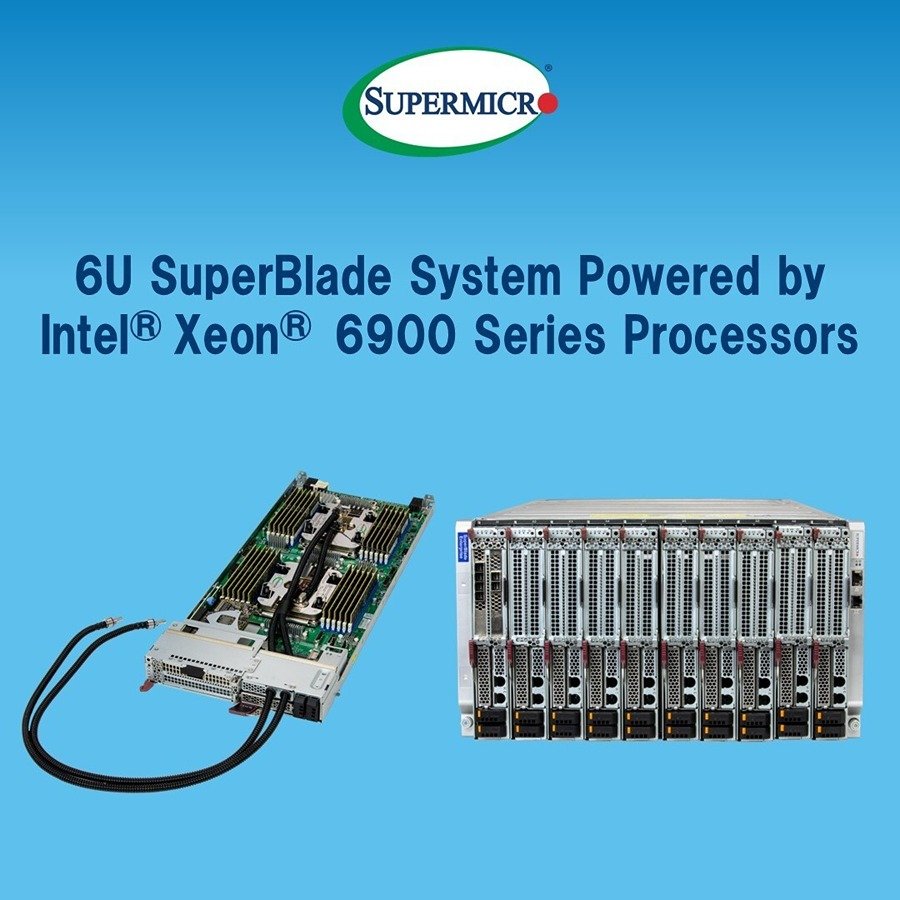
Supermicro Inc. is announcing the latest addition to its SuperBlade family with the SBI-622BA-1NE12-LCC, a high-density, direct liquid-cooled blade server powered by dual Intel Xeon 6900 series processors with up to 256 P-cores. This new SuperBlade solution delivers outstanding compute density, power efficiency, and performance. This new SuperBlade solution delivers outstanding compute density, power efficiency, and performance. Both air cooling and direct liquid cooling (CPU-only and CPU/DIMM/VRM cold plates) can be supported. Supermicro SuperBlade. SuperBlade delivers unparalleled compute density with the support for dual Intel Xeon 6900 series processors — each CPU equipped with up to 128 powerful P-cores and up to 500W TDP. A single 6U SuperBlade enclosure supports up to 10 SBI-622BA-1NE12-LCC blades, containing up to 25,600 high-performance cores per rack. By leveraging shared power supplies and fans along with integrated chassis management and networking, one enclosure can deliver the compute performance of an entire traditional server rack in a much smaller physical space. This approach lowers operating costs and power consumption without compromising performance. The SuperBlade chassis management module (CMM) provides total remote control of individual server blades, power supplies, cooling fans, and networking switches remotely. System administrators can control the maximum power consumption on a server through power capping and manage the power allocation in the SuperBlade CMM for each blade server. Remote power control capabilities to reboot and/or reset the server are available as well as remote access to the BIOS configuration and operating system console information vial SOL (Serial over LAN) or embedded KVM capabilities. Because the controller is a separate processor, all monitoring and control functions operate flawlessly regardless of CPU operation or system power-on status. The hot-swappable design also provides significant advantages for enterprises and data centers, reducing cabling by up to 93% and consuming up to 50% less space than traditional rackmount servers. These benefits not only minimize the total cost of ownership (TCO) but also facilitate efficient data center modernization. At the heart of this SuperBlade solution is unparalleled memory and storage flexibility. The system accommodates up to 24 DIMM slots per blade, supporting a maximum of 3TB of 6400MT/s DDR5 RDIMM or 1.5TB of 8800MT/s DDR5 MRDIMM — perfectly suited for memory-intensive applications. The robust storage options feature up to four PCIe 5.0 NVMe SSDs, two hot-swap E1.S SSDs, and two M.2 SSDs. The flexible PCIe expansion feature supports three PCIe 3.0 x16 cards – e.g., three 400G InfiniBand/Ethernet cards, or one 400G InfiniBand/Ethernet and two GPUs to provide acceleration for AI, HPC, and graphics-heavy workloads. Connectivity and acceleration further elevate SuperBlade capabilities, with two integrated 25G Ethernet switches with 100G uplinks in the back of the enclosure, ensuring reliable, high-speed networking while lowering the TCO through cable reduction. For more information, visit supermicro.com/superblade. The post Supermicro unveils liquid-cooled SuperBlade with Xeon 6900 appeared first on Engineering.com.
After 10,000 miles, here’s what happened to this electric bike

One of the biggest unanswered questions for many folks considering an e-bike isn’t how a bike rides on day one, but rather how it holds up after years of daily use. Reviews and first impressions are everywhere, but genuine long-term ownership stories are surprisingly rare. That’s why a recent shared case from a rider who just crossed 10,000 miles (16,000 km) on their e-bike caught my attention. more…